MG Windsor EV Review 2026: Is India’s Best-Selling Electric Car Actually Worth It?


Since its September 2024 launch, the MG Windsor EV has held position among the top spot in India’s monthly EV sales rankings with quiet, relentless consistency — crossing 3,000 units every single month. While it dominates the sales chart, it faces stiff competition from upcoming and premium mid-size electric SUVs. For a deep-dive breakdown of how it holds up against the competition, read our detailed comparison of the Mahindra BE 6 vs MG Windsor EV vs Hyundai Creta Electric. That kind of staying power does not come from a clever launch campaign alone. It demands a car that actually delivers in day-to-day ownership. After several months, thousands of kilometres of mixed-city and highway driving, AC and DC charging sessions, and real feedback from long-term users across India, here is the complete picture — the good, the frustrating, and everything in between.
What Makes the MG Windsor EV India’s Highest-Selling Electric Car Right Now?
The Windsor wins on a metric most car buyers in India privately rank highest: usable space per rupee spent. From a distance, the body styling — part MPV, part crossover, part tall hatchback — can look unusual. In person, it commands attention. But step inside and the form immediately makes sense. The 2,700mm wheelbase and high roofline combine to deliver a cabin that genuinely surprises. A 6-foot passenger pushing the front seat all the way back still leaves abundant rear legroom, and a completely flat floor makes three-abreast seating workable rather than punishing. One caveat worth flagging upfront: the Windsor’s 174mm ground clearance is adequate for most urban roads, but the long wheelbase means the underbelly battery pack is vulnerable on unscientific Indian speed breakers — the steep, unshaped ones built with no regard for ramp angle. Fully loaded runs require measured speeds over such obstacles to protect the battery floor. That practical note aside, real-world spaciousness is what quietly drives most Windsor purchase decisions.
How Much Does the MG Windsor EV Cost, and Is the BaaS Model Worth It?
What Is the True Cost of Buying the MG Windsor EV in India?
MG’s headline figure of ₹9.99 lakh is technically accurate — but only under the Battery-as-a-Service (BaaS) model, which separates the battery cost from the vehicle price. You pay for the car body and then rent the battery at ₹3.99 per kilometre. For full ownership, the Windsor sits between ₹13.50 lakh and ₹15.50 lakh (ex-showroom) for the 38kWh variants, with the 52.9kWh Windsor Pro extending beyond that. Factor in dealer handling charges and accessories — a practice real owners flagly call out as common at MG dealerships — and on-road costs typically land between ₹15 lakh and ₹19 lakh depending on variant and city.
Should You Actually Choose BaaS or Just Own the Battery Outright?
BaaS works on paper for light commuters who drive 50–60km daily and want to dramatically lower their entry cost. But for anyone covering higher distances, the per-kilometre charges accumulate quickly and tip the total cost of ownership higher than full purchase. The resale situation adds a more tangled layer of complexity — and it is not just market unfamiliarity. Under BaaS, the vehicle’s Registration Certificate (RC) explicitly reflects that the battery is leased. A third-party financing or leasing company holds a hypothecation or lien on the battery itself, which means the battery and the car body are legally owned by different entities. When the car enters the second-hand market, the bureaucratic transfer process requires resolving this encumbrance — either transferring the lease agreement to the new buyer or completing a battery buyout before the RC can be transferred cleanly. Most used-car dealers and RTO offices are not yet equipped to process this smoothly. MG does offer a buyback guarantee of up to 60% of the vehicle value after three years under the MG Shield programme, which provides some exit structure. For most buyers who can afford it, full battery ownership remains the cleaner, less ambiguous path.
What Is the MG Windsor EV’s Real-World Range Across City and Highway Driving?


How Far Does the 38kWh Windsor Actually Travel on a Full Charge?
MG claims 331km under ARAI certification for the base 38kWh battery. Real-world testing by independent outlets found 264km before the battery fully depleted in mixed city-and-highway conditions — roughly 80% of the claimed figure, which is actually a strong retention ratio by Indian EV standards. Long-term owner experience corroborates this: with two occupants, AC running, and sensible driving, city range lands in the 240–260km band. Push it onto the highway above 100kmph, drive aggressively through gaps in traffic, or sit in stop-go heat with the AC fighting a hot black interior, and that figure drops. Use regenerative braking actively and it nudges back up.
Worth noting technically: the Windsor uses Lithium Iron Phosphate (LFP) cells, which are inherently more thermally stable than NMC chemistry — but they still require careful Battery Management System (BMS) calibration in tropical conditions. The fact that long-term owners report zero unexpected range drops or sudden State-of-Charge (SoC) fluctuations even through harsh Indian summers is a genuine point in MG’s favour. It indicates the liquid-cooling thermal management is well-calibrated for high-ambient-temperature operation — something that cannot be assumed and should not be taken for granted in this segment.
Is the Windsor Pro’s 52.9kWh Battery Worth the Premium?
For anyone whose commute bleeds regularly into highway driving, the Windsor Pro’s 52.9kWh battery is a meaningful upgrade. Its 449km range claim is certified under the MIDC (Modified Indian Driving Cycle) framework — not the older ARAI cycle — which uses a more optimistic low-speed, urban-weighted test profile. This is an important distinction: MIDC numbers tend to show wider variation against real-world high-speed highway performance than ARAI figures do, which explains why the gap between the 449km claim and actual highway experience can feel larger than expected. In mixed real-world conditions with two occupants and the AC active, expect 350–380km — comfortably eliminating range anxiety on inter-city runs of up to 300km. The Pro also bundles a 7.4kW AC charger in the ex-showroom price, Level 2 ADAS, a powered tailgate, and new alloy wheel designs that the base Windsor misses. At this higher price point, the Windsor Pro begins to cross paths with vehicles built on dedicated born-EV architectures or established mid-size SUV legacy platforms. If you are trying to decide whether to stick with the Windsor or stretch your budget to the next segment, see how it benchmarks in our Mahindra BE 6 vs MG Windsor EV vs Hyundai Creta Electric comparison. If the budget permits, the Pro is the more complete car.
MG Windsor EV Variant Comparison: Standard 38kWh vs Windsor Pro 52.9kWh
| Feature | Windsor Standard (38kWh) | Windsor Pro (52.9kWh) |
| Battery Capacity | 38 kWh (LFP) | 52.9 kWh (LFP) |
| Certified Range | 331km (ARAI) | 449km (MIDC) |
| Real-World Highway Range | ~200–220km | ~350–380km |
| Bundled AC Charger | 3.3kW (home charger extra) | 7.4kW (included ex-showroom) |
| Level 2 ADAS | Not available | Standard |
| Powered Tailgate | Not available | Standard |
| Alloy Wheel Design | Standard | Revised design |
| Price (full ownership, approx.) | ₹13.50L–₹15.50L ex-showroom | ₹17.50L+ ex-showroom |
What Is Home Charging Like for the MG Windsor EV, and How Does It Work?
What Do You Need to Set Up Home Charging for the Windsor EV?
MG provides a detailed home charger installation programme for all Windsor buyers. The standard package covers the 3.3kW or 7.4kW charger unit, basic wall mounting, wiring up to the specified length, and testing. Your home needs adequate spare electrical load — 3.3kW minimum for the standard charger, 7.4kW for the fast unit. Critically, a proper earthing system is mandatory: neutral-to-earth voltage must stay below 2V for the charger to operate safely. If your building’s electrical setup doesn’t meet this threshold, additional civil and electrical work is on you. MG authorises installation partners to conduct a site survey first, at which point any additional costs for extended wiring are quoted. The entire installation window is valid for one year from delivery date — a deadline worth tracking.
What Is Living With the MG Windsor EV Day-to-Day Actually Like?
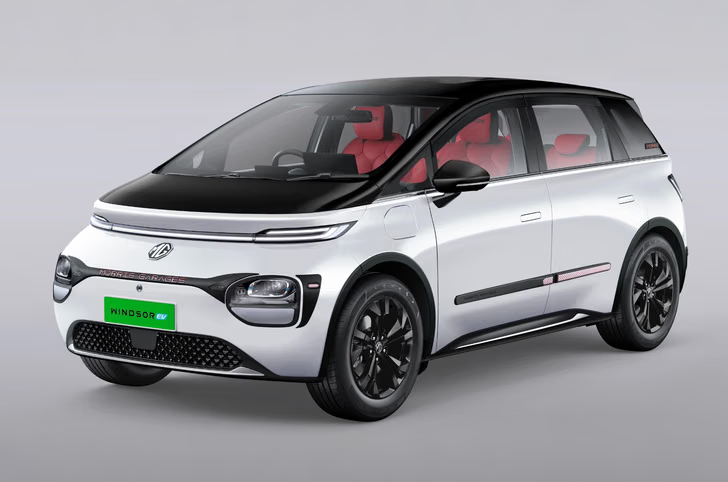
What Are the Interior and Technology Highlights Long-Term Owners Notice?
The 15.6-inch portrait touchscreen is the cabin’s centrepiece — and its most divisive element. MG has funnelled virtually every function through it, including ORVM adjustment, which long-term drivers find genuinely frustrating on the move. Over time, owners learn workarounds: a centre button cycles between mirror controls and AC settings. You adapt, but it never feels fully intuitive. The car also resets screen brightness to maximum on every restart — a persistent software bug that demands a manual dim each night drive.
The feature list for the price is genuinely strong: ventilated seats, automatic climate control, electric IRVM fold/unfold, a sharp 360-degree parking camera, one-touch windows all around, panoramic sunroof, and a keyless entry system that is seamless in practice. There is no start button — sit, press brake, engage drive, go. Within a week it feels normal. Within a month, you wonder why every car does not work this way.
How Reliable Has the MG Windsor Been Over Several Months of Ownership?
Reliability is one of the Windsor’s strongest cards. After several months and thousands of kilometres across mixed conditions, long-term reviewers report zero instances of the car failing to start, no high-voltage battery warnings, no unexpected range drops, no screen freezes, and no locking or gear-selector glitches. DC fast charging threw up occasional connection issues for some early owners — a fault the service network has since addressed, in many cases resolved by a terminal reset. Some users report a temporary screen brightness surge when a call comes in at night. But in the landscape of Indian EV reliability, the Windsor sits well above the noise, and that peace of mind has real daily value.
What Are the Honest Weaknesses of the MG Windsor EV That Buyers Should Know?
Does the MG Windsor’s Suspension and Ride Quality Hold Up Over Time?
Initially, the Windsor rides confidently. But owners who have covered 10,000km or more observe a gradual shift — the suspension begins to feel less composed over sharp potholes, with more crash and impact travelling into the cabin than it did when the car was fresh. The handling dynamics also expose their limitations: at higher speeds, the steering and wheel response feel slightly misaligned, creating a disconnect that never fully inspires confidence. The car’s weight — as with most EVs — compounds this, and sudden directional changes feel less composed than you would expect at this price point. The Windsor was never designed to be a driver’s car, but the dynamic degradation over time is worth factoring into ownership expectations.
Are the Rear Seats and Cabin Comfort Good Enough for Long Journeys?
The rear seats look plush and wide — and for shorter journeys, they deliver on that promise. But on longer runs or extended city traffic, the experience changes. The seat base is positioned slightly high, thigh support tapers off sooner than expected, and the overall cushion profile is tuned more for visual comfort than long-haul ergonomics. Combine that with significant heat ingress through the large glass roof and multiple glazed surfaces — especially under harsh Indian sun — and the AC has to work harder, which in turn eats into the battery range. There is also no rear wiper, which is a meaningful omission in monsoon conditions: rear glass visibility deteriorates rapidly in rain, and cleaning it manually with a cloth becomes a recurring inconvenience.
What Other Niggles Do Windsor EV Owners Commonly Report?
Beyond the suspension and seat comfort, long-term experience surfaces a cluster of smaller but persistent issues. The audio system has a noticeable left-right imbalance that persists regardless of equaliser settings — owners who switch regularly between the Windsor and another car find it increasingly difficult to unhear. Floor vibration near the accelerator and brake pedals is perceptible over rough roads, rumble strips, and even with bass-heavy music. Wind noise intrudes at highway speeds through the relatively thin glass. Installing an ISOFIX child seat is unusually cumbersome due to the soft, deep seat cushioning — a real frustration for families.
Safety Note — Electronic Door Latches: The Windsor uses an electronic latch system with no visible external mechanical lever. Pressing the interior release twice can unlock and open a door even while the car is in motion. This is not a theoretical edge case — it has been documented by long-term owners. If you are travelling with children, always engage the rear child locks before moving. Do not rely on the door appearing visually closed as confirmation that it is mechanically secured against accidental opening.
How Much Does MG Windsor EV Service Cost Over Time?
What Are the Ongoing Service Costs for the Windsor EV in India?
This is where the Windsor’s EV nature genuinely works in the owner’s favour. Each service visit involves a narrow set of items: brake fluid check or top-up, cabin air filter replacement, and periodic reduction gear oil service — MG recommends the latter at 40,000km intervals. Each service appointment, even at an authorised MG centre with some upsell built in, typically costs between ₹2,000 and ₹4,000. There are no engine oil changes, no spark plugs, no belts or clutches. Owners who have covered 30,000–40,000km on comparable MG EVs confirm that service expenses remain predictably low — one of the most compelling running-cost arguments for EV ownership in the Indian context.
Should You Buy the MG Windsor EV in 2026, or Wait for Something Better?
The Windsor is not a flawless car. The touchscreen-first design requires real adjustment. Suspension composure degrades subtly with mileage. Long journeys expose the rear seat’s ergonomic limits. The audio imbalance, thin glass, missing rear wiper, and fiddly ISOFIX fitting are all documented friction points that MG needs to fix.
But the full picture remains compelling. Cabin space is class-leading. Real-world city range of 240–260km covers most Indian daily patterns. Long-term reliability is solid — no battery errors, no screen glitches, no mysterious range drops across tens of thousands of kilometres. Service stays at ₹2,000–₹4,000 per visit. At ₹13.50–15.50 lakh for full ownership, the value equation is hard to beat. The Windsor Pro’s larger battery, ADAS, and 7.4kW charger make it the more complete package for buyers who can stretch.
Better EVs are coming. Some have already arrived. But the Windsor earns its number-one sales position the only way that truly matters — by delivering in real ownership, every single day.
Looking for more alternatives in this segment? Check out our comprehensive, head-to-head match-up evaluating range, space, and tech features: Mahindra BE 6 vs MG Windsor EV vs Hyundai Creta Electric: The Best EV Comparison Explained.
Specifications summary — Battery: 38kWh / 52.9kWh (Pro), LFP cells | Certified Range: 331km ARAI (standard) / 449km MIDC (Pro) | Motor: 100kW (134hp), front-wheel drive | AC Charging: 3.3kW (standard), 7.4kW (Pro, included) | Ground Clearance: 174mm | Boot: 604 litres | Wheelbase: 2,700mm | Price (full ownership): ₹13.50L–₹15.50L+ ex-showroom