
Hybrid vs Electric car in India 2026: Which is Better as Your Next Car?
A Complete Guide to Hybrid vs Electric Car Decision-Making in India | Technology · Running Costs · Policy · Real-World Usage · Verdict

Table of Contents
The Question That Is Dividing Every Indian Showroom in 2026
Walk into any car dealership in Bangalore, Jaipur, or Lucknow right now and you will overhear the same conversation. One customer is asking about a Maruti Grand Vitara strong hybrid. The next customer, five minutes later, wants the Tata Nexon EV. Both are trying to escape petrol prices that refuse to fall — but they are arriving at completely different answers.
The hybrid vs electric car debate in India has never been louder or more consequential. And it is a debate full of half-truths, misunderstood policy details, and genuine anxieties being exploited by both sides. Hybrid advocates claim EVs are impractical for India. EV supporters counter that hybrids are a petrol-burning compromise that delays the inevitable. Both camps have data. Neither tells the full story.
This guide will give you the complete picture on the hybrid vs EV in India question: technology explained simply, real-world running costs, the full India market comparison, policy mathematics, upcoming hybrid car in India, and the honest verdict most publications are afraid to give.
| 🔍 Hybrid vs EV India 2026: Which is Better? The choice depends on your specific ecosystem. Urban commuters with home charging benefit from EVs’ superior economics (₹1.0–1.2/km vs ₹3.5–4/km for hybrids). For highway-heavy users without charging access, strong hybrids offer a seamless, efficient alternative. The 2026 policy landscape—5% GST for EVs vs 40% for large hybrids and Delhi’s 100% road tax waiver—favors EVs below ₹30 lakh. While PM E-DRIVE excludes private cars, the lower tax floor and minimal maintenance make EVs the long-term fiscal winner for the high-mileage city driver. |
The Core Difference: Hybrid vs Electric Car Technology Explained
Before comparing hybrid vs EV cars in India, understanding what these technologies actually are is essential. Most buyer confusion begins here.
What Is a Strong Hybrid (Hybrid) Car?
A strong hybrid car — the dominant hybrid type in India’s 2026 market — uses both a petrol engine and an electric motor. Unlike a mild hybrid, a strong hybrid can run on pure electric power at low speeds (typically up to 25–40 km/h). The battery charges automatically through the engine and regenerative braking. You never plug it in. When more power is needed, the petrol engine takes over seamlessly. The result is dramatically better fuel efficiency in city stop-go traffic — precisely the driving condition that defines most Indian commutes.
In India, strong hybrid technology is led by Toyota’s THS II (Toyota Hybrid System) used in the Hyryder, Hycross, and Camry, and Maruti’s licensed version used in the Grand Vitara and Victoris. Honda’s e:HEV system (City Hybrid) works differently — the petrol engine primarily acts as a generator charging a battery that drives the electric motor, giving it even stronger city-driving efficiency figures.
| 📌 Key Benefits of Hybrid Car — Summary Infrastructure Independence: Zero charging required as the car self-charges while driving. Exceptional Efficiency: Delivers 27–30 kmpl in city traffic, doubling standard petrol mileage. Intercity Flexibility: The petrol backup provides unlimited highway range with zero range anxiety. Resale Confidence: Hybrids currently maintain a 70–75% value retention at three years in the used market. |
What is an Electric Vehicle (EV)?
An electric vehicle runs entirely on electricity stored in a battery. There is no petrol engine, no exhaust, no gear changes. An EV charges from an external power source — a home socket, wallbox charger, or public DC fast charger. Running costs are dramatically lower: ₹1–1.2 per km versus ₹5–7 per km for petrol at current prices. Maintenance is also substantially cheaper — no engine oil, no clutch, no spark plugs. And the driving experience, with its instant torque, is genuinely different from any petrol or hybrid vehicle.
In India in 2026, EVs are led by Tata Motors — Punch EV, Nexon EV, Tiago EV — alongside MG Windsor EV, Mahindra BE 6, Hyundai Creta Electric, and Maruti e-Vitara. India’s passenger EV sales grew 87.4% year-on-year in FY26 to over 2.33 lakh units, according to Jato Dynamics data reported by Business Standard in April 2026. The segment is no longer emerging — it is mainstream.
Hybrid vs EV Cars in India: A 2026 Market Comparison

Strong Hybrid Cars Available in India — Complete List
| Model | Hybrid Type | ARAI Mileage | Starting Price | Segment |
| Maruti Suzuki Victoris | Strong Hybrid (THS) | 28.65 kmpl | ₹16.38 lakh | Mid-size SUV |
| Maruti Suzuki Grand Vitara | Strong Hybrid (THS) | 27.97 kmpl | ₹16.63 lakh | Mid-size SUV |
| Toyota Urban Cruiser Hyryder | Strong Hybrid (THS II) | 27.97 kmpl | ₹16.77 lakh | Mid-size SUV |
| Honda City Hybrid eHEV | Strong Hybrid (e:HEV) | 26.50 kmpl | ₹20.00 lakh | Sedan |
| Toyota Innova Hycross | Strong Hybrid (THS II) | 21.10 kmpl | ₹26.76 lakh | MPV |
| Maruti Suzuki Invicto | Strong Hybrid (THS) | 23.24 kmpl | ₹28.98 lakh | MPV |
| Toyota Camry | Strong Hybrid (THS II) | 23.27 kmpl | ₹47.48 lakh | Premium Sedan |
Key EV Alternatives by Segment (May 2026)

| Model | Battery | ARAI Range | Real-World Range | Starting Price | Segment |
| Tata Tiago EV | 24 kWh | 315 km | ~220–250 km | ₹7.99 lakh | Hatchback |
| Tata Punch EV | 30/40 kWh | 365/468 km | ~275/355 km | ₹9.69 lakh | Micro-SUV |
| Tata Nexon EV | 40.5 kWh | 465 km | ~310–340 km | ₹12.49 lakh | Compact SUV |
| MG Windsor EV | 38 kWh | 331 km | ~240–280 km | ₹14.00 lakh | Compact SUV |
| Hyundai Creta Electric | 51.4 kWh | 473 km | ~330–360 km | ₹17.99 lakh | Mid-size SUV |
| Mahindra BE 6 | 59/79 kWh | 535/682 km | ~380–430 km | ₹18.90 lakh | Mid-size SUV |
| Maruti e-Vitara | 49/61 kWh | 497/550 km | ~350–390 km | ₹17.49 lakh | Mid-size SUV |
Hybrid vs Electric Car India: The Honest Head-to-Head on Every Key Factor
Key Benefits of EV or Hybrid Car in India – Ownership in the Indian Context
| Factor | Strong Hybrid | EV (Mid-SUV) | Who Wins (2026) |
| GST Rate Applied | 40% (GST 2.0) | 5% | EV (35% Gap) |
| Central Incentive | None | None (Private Cars) | Tie |
| State Road Tax (Delhi) | 50% Waiver | 100% Waiver | EV |
| Sec 80EEB Deduction | Not available | Expired (Mar 2023) | Tie |
| Effective Purchase Cost | High (Tax Heavy) | ₹5-6 Lakh Lower | EV (Clear Winner) |
| Factor | Strong Hybrid | EV (Mid-SUV) | Who Wins (2026) |
In the Indian automotive market, the debate between Hybrid and Electric isn’t settled on the highway—it’s settled at the billing counter. For a mid-sized SUV with an ex-showroom price of ₹16.5 lakh, the tax invoice tells a story of two very different worlds.
Popular strong hybrids like the Maruti Grand Vitara or Toyota Hyryder are trapped by their own dimensions; because they exceed the 4-meter mark and utilize 1.5L engines—blowing past the critical 1200cc threshold—they are hit with the maximum 40% GST under the 2026 tax slabs. Meanwhile, a comparable EV, such as the Tata Curvv.ev or MG ZS EV, enjoys a concessional 5% GST rate.
The financial fallout is staggering. On that same ₹16.5 lakh car, the hybrid buyer is effectively handing over ₹6.6 lakh to the taxman, while the EV buyer contributes just ₹82,500. Even with Delhi’s 2026 policy offering a 50% road tax olive branch to hybrids, it cannot bridge the gap. When you start your journey with a ₹5.7 lakh tax penalty just for choosing a 1200cc+ hybrid, the EV becomes the only logical choice for the value-conscious Indian driver.
Running Costs: The Economics of the Extra Mile
The running cost gap isn’t just a saving; it’s a structural shift. Whether you charge at home or use the growing public network determines your ROI.
| Usage Scenario | Strong Hybrid | EV (Home) | EV (Public DC) |
| City Driving (per km) | ₹3.5 – ₹4.0 | ₹1.0 – ₹1.2 | ₹2.0 – ₹2.5 |
| Highway (per km) | ₹2.8 – ₹3.5 | ₹1.5 – ₹2.0 | ₹2.5 – ₹3.0 |
| Annual (15k km City) | ₹52,500 – ₹60,000 | ₹15,000 – ₹18,000 | ₹30k – ₹37k |
| 5-Year Total Cost | ₹2.6 – ₹3.0 Lakh | ₹0.75 – ₹0.90 Lakh | ₹1.5 – ₹1.9 Lakh |
| Annual Maintenance | ₹12,000 – ₹20,000 | ₹3,000 – ₹6,000 | ₹3k – ₹6k |
The Narrative: In the stop-and-go chaos of an Indian metro, the EV is a financial “cheat code.” Charging at home at ₹8/unit keeps your costs at a negligible ₹1.2/km. Even with petrol at ₹100/L and a hybrid delivering a stellar 25 kmpl, you are still spending 3x more per kilometer than an EV owner.
Infrastructure & The “Apartment Friction”
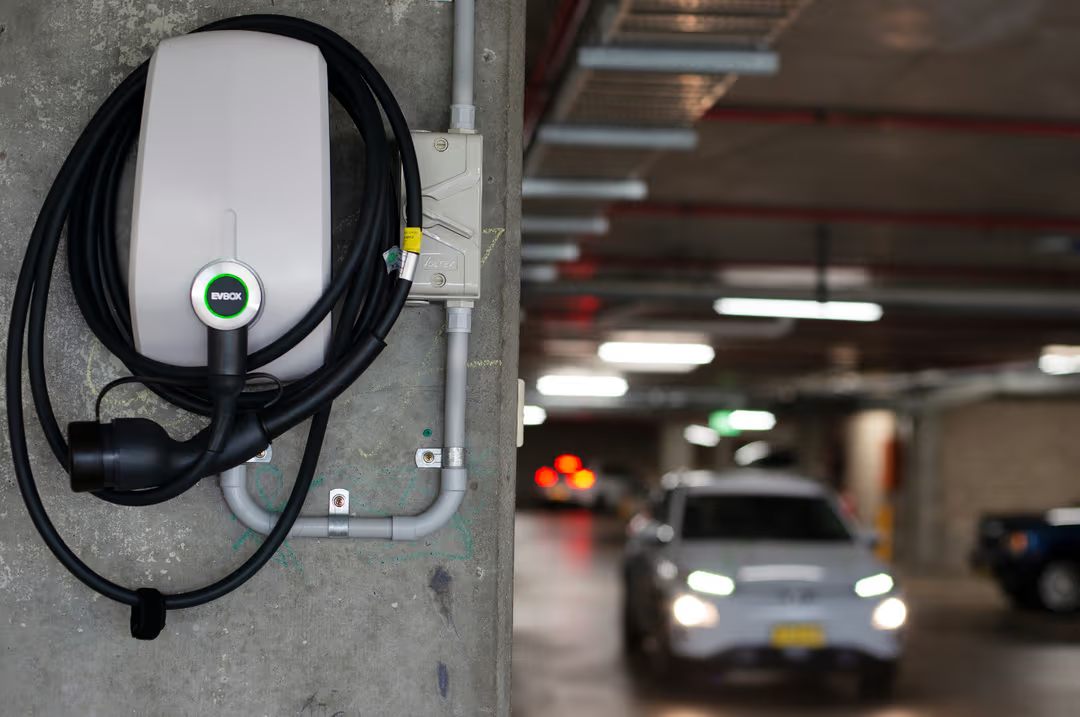
While the math favors the EV, the lifestyle reality remains nuanced.
- The Home Advantage: For those in independent houses, charging is a solved problem. A standard overnight plug-in ensures you never visit a “fuel station” again.
- The Apartment Reality: For apartment dwellers without dedicated charging access, the hybrid’s self-charging simplicity is a legitimate win. Relying solely on public DC fast chargers (at ₹18-22/unit) nearly doubles EV running costs and adds “logistical friction.”
⚠️ Real Charging Friction for Apartment Dwellers
Without home charging, public DC fast charger costs (₹15–18/unit) nearly double the EV’s per-km running cost advantage. For apartment dwellers without RWA approval for a wallbox, the strong hybrid’s self-charging simplicity is a legitimate advantage — not just a marketing claim. This is the most important variable in the hybrid vs EV India 2026 which is better question.
Key take-away: In 2026, the “Honest” choice comes down to your parking spot. If you can charge at home, the ₹6 lakh tax saving and 75% reduction in running costs make the EV the only logical investment. However, for the high-mileage highway traveler or the apartment resident without charging infrastructure, the hybrid remains a vital—albeit heavily taxed—bridge to the future.
City vs Highway Suitability: The Honest Split
| Driving Scenario | Strong Hybrid | EV (40+ kWh) | Verdict |
| City commute, home charging available | ~₹3.5/km | ~₹1.0–1.2/km | EV (running cost) |
| City commute, no home charging | ~₹3.5/km | ~₹2.0–2.5/km | Hybrid (convenience) |
| Highway 200–300 km trip | No charging stop needed | 1 DC fast charge (25–30 min) | Hybrid (convenience) |
| Highway 300+ km trip | No stop needed | 2 fast charges required | Hybrid (clearly) |
| Mixed city + occasional highway | ~₹3.5/km blended | ~₹1.2–1.8/km blended | EV (economics) |
| Tier 2/3 city usage | Fully practical | Depends on charging | Hybrid (currently) |
Visual Aid: Cost of Ownership Comparison — Description
Imagine a grouped bar chart showing cumulative 5-year total cost of ownership (purchase + running + maintenance, minus all incentives) for three vehicle types in the mid-SUV segment. The X-axis runs from Year 1 to Year 5. The Y-axis shows total cumulative cost in Indian rupees. The petrol SUV bar climbs steeply to approximately ₹34–36 lakh by Year 5. The strong hybrid bar is meaningfully lower — approximately ₹28–30 lakh. The EV bar, for a buyer with home charging, is the lowest — approximately ₹23–26 lakh. The EV and hybrid bars converge around Year 2 to 3, confirming the break-even point of EV’s total cost advantage at roughly 2 to 3 years of ownership. This chart is available on BijliWaliGaadi.com.
Upcoming Hybrid Car in India 2026–2027: What Is Coming and Why It Matters
The upcoming hybrid car in India pipeline for 2026 and 2027 is significant for anyone evaluating the hybrid vs EV in India question — because it dramatically expands buyer options. For years, if you wanted a strong hybrid in India, you essentially chose between the Maruti Grand Vitara, Toyota Hyryder, or Honda City Hybrid. That is changing rapidly.
| Upcoming Hybrid Car in India | Expected Launch | Hybrid System | Est. Price | Efficiency |
| Honda Elevate Hybrid | H2 2026 | 1.5L e:HEV Strong Hybrid | ₹17–20 lakh | ~26–27 kmpl |
| Renault Duster Hybrid E-Tech | Diwali 2026 | 1.8L + 1.4 kWh (160HP) | ₹18–22 lakh | ~28 kmpl |
| Hyundai Creta Hybrid | Early 2027 | 1.5L Self-Charging Strong Hybrid | ₹18–21 lakh | ~22–25 kmpl |
| Kia Seltos Hybrid | Late 2026–2027 | 1.5L Strong Hybrid | ₹19–23 lakh | ~23–25 kmpl |
| Mahindra XUV3XO Hybrid | 2026–2027 | Strong/Mild Hybrid | ₹14–18 lakh | ~22–24 kmpl |
| Maruti Fronx Hybrid | Early 2027 | 1.2L Z-Series HEV | ₹12–15 lakh | ~35 kmpl |
| Maruti Swift Hybrid | Late 2027 | 1.2L Z-Series HEV | ₹10–13 lakh | ~35–40 kmpl |
| Nissan Tekton Hybrid | Late 2026 | 1.8L Strong Hybrid (~160HP) | ₹20–25 lakh | ~27 kmpl |
The upcoming hybrid car in India wave of 2026 is moving down-market — the Maruti Fronx Hybrid and Swift Hybrid at ₹10–15 lakh would bring strong hybrid technology to a price point that directly competes with entry-level EVs for the first time. The Renault Duster Hybrid E-Tech is a particular standout: European-spec hybrid technology with up to 80% electric-only driving in city conditions, a fundamentally different capability from Toyota’s THS system.
A Strategic Caution on Upcoming Hybrid Car in India : Every upcoming hybrid car in India still burns petrol. Every government policy signal — 5% EV GST vs 28% hybrid GST, PM E-DRIVE, state EV incentives — points away from hybrids and toward pure EVs. The upcoming hybrid car in India boom of 2026–2027 may represent the peak of hybrid relevance before improving EV infrastructure and pricing make the transition irreversible. Buyers choosing an upcoming hybrid car should factor in the technology’s 5-year resale trajectory carefully.
Benefits of Hybrid Car in India 2026: The Five Arguments That Are Hard to Dismiss
A fair hybrid vs electric car analysis must give the benefits of hybrid car in India and their honest due — because there are genuine advantages that pure EV advocates too often dismiss.
Benefit 1 — Zero Charging Infrastructure Dependency: The most undeniable benefit of hybrid car ownership in India: you never need to find or plan for a charger. For buyers in Tier 2 and Tier 3 cities, for frequent highway users, and for apartment dwellers with no path to home charging, the benefits of hybrid car technology in this dimension are real and significant.
Benefit 2 — Dramatically Better Fuel Efficiency: At 27–30 kmpl in city conditions — roughly double a comparable petrol car’s 12–15 kmpl — the strong hybrid’s ₹3.3–3.5/km running cost is genuinely impressive. Not as good as an EV with home charging, but meaningfully better than any petrol or diesel alternative at comparable prices.
Benefit 3 — Familiar Ownership With No Behaviour Change: One underappreciated benefit of hybrid car in India ownership is psychological: no behaviour change required. Same refuelling routine. Same service network. Same insurance process. For families where multiple decision-makers are involved, the benefits of hybrid car in India technology include the comfort of full familiarity.
Benefit 4 — Currently Stronger Resale Value Confidence: In India’s used car market in 2026, hybrids hold resale value more reliably than EVs. Used-car buyers remain cautious about battery health on older EVs. A 2023 Grand Vitara Hybrid retains approximately 70–75% of its value at three years. Comparable EVs average 60–68% at the same age. (Source: CarWale review community data, BijliWaliGaadi.com forums)
Benefit 5 — Grid Carbon Consideration: India’s electricity grid remains approximately 60% coal-based as of 2025 (IBEF data). A strong hybrid achieving 28 kmpl produces fewer lifecycle carbon emissions than an EV charged entirely on a coal-heavy grid in some analyses. CSEP’s January 2026 study on EV fiscal support in India noted this as a nuanced point worth acknowledging, even while recommending continued EV policy support.
These are genuine benefits of hybrid car in India ownership — not marketing spin. Acknowledging them honestly is what makes a credible hybrid vs EV India 2026 which is better analysis, rather than an ideological one.
Hybrid vs EV India 2026: What Government Policy Actually Tells You
If any part of the hybrid vs. electric India debate has an unambiguous answer, it is the policy environment. The Government of India has moved beyond subtle hints; it has been explicit—and the picture is unmistakably pro-EV.
Hybrid vs EV in India 2026: Why the 35% GST Gap Decides Which is Better
Under the GST 2.0 Reform implemented in late 2025, the tax structure was simplified but intensified for hybrids. While the government reduced GST for small commuter cars, it doubled down on “demerit” taxes for larger engines.
Because most strong hybrids (like the Maruti Grand Vitara or Toyota Hyryder) exceed 4 meters in length and utilize 1.5L (1500cc) engines, they blow past the 1200cc “small car” threshold. This triggers a unified 40% GST rate. In stark contrast, pure electric vehicles remain locked at a concessional 5% GST. This 35% chasm is the single most visible policy choice in the Indian automotive sector today.
| Vehicle Type | Engine / Length | GST Rate (2026) | Policy Stance |
| Pure EV | Any | 5% | Strongly Promoted |
| Small Hybrid | < 1200cc & < 4m | 18% | Neutral |
| Strong Hybrid | > 1200cc or > 4m | 40% | Demerit/Discouraged |
| Petrol / Diesel | > 1200cc / 1500cc | 40% | Demerit/Discouraged |
PM E-DRIVE: The Infrastructure Engine
The PM Electric Drive Revolution in Innovative Vehicle Enhancement (PM E-DRIVE) scheme, which replaced FAME-II, serves as the backbone of India’s 2026 EV strategy. With a massive ₹10,900 crore outlay, the policy’s priorities are crystal clear:
- Public Transit & Commercial First: The scheme provides direct e-vouchers for two-wheelers and three-wheelers, but excludes private electric cars from direct cash subsidies.
- The Hybrid Exclusion: PM E-DRIVE completely ignores hybrid technology. Not a single rupee of the scheme’s budget is allocated toward hybrid purchase incentives.
- Infrastructure Overdrive: A dedicated ₹2,000 crore is currently funding the installation of 22,100 fast chargers specifically for electric four-wheelers. By mid-2026, this has turned major national highway corridors into “EV-ready” zones—a benefit hybrids simply don’t need and don’t receive.
State Incentives: The Delhi EV Policy 2.0 (2026-2030)
While the Central Government manages GST, the most dramatic savings for 2026 buyers are found at the State level. Delhi’s EV Policy 2.0, which went live (draft version) in April 2026, has introduced a more nuanced—but still heavily biased—framework.
For the first time, Delhi has acknowledged hybrids, but only as a “bridge.” Electric cars priced under ₹30 lakh receive a 100% waiver on road tax and registration fees. Strong hybrids under that same price cap now receive a 50% waiver. While this is a win for hybrid buyers compared to 2025, the “Registration Gap” remains roughly ₹80,000 to ₹1.2 lakh in favor of the EV.
Note: Outside of Delhi, states like Uttar Pradesh have allowed their aggressive 2023-2025 hybrid waivers to expire, returning to a “Pure EV” incentive model. For a mid-SUV buyer, the combined effect of GST savings and state waivers can create an on-road price difference of ₹6 lakh, even if the cars have the same factory cost.
Policy Verdict on Hybrid vs EV in India The policy environment for the hybrid vs electric car India debate is unambiguous. Under the GST 2.0 Reform (Sept 2025), EVs maintain a 5% rate while hybrids—typically exceeding the 1200cc threshold—are taxed at 40%. While Section 80EEB deductions have expired for new 2026 buyers, and PM E-DRIVE excludes private cars, state-level support fills the gap. In Delhi’s 2026 EV Policy, EVs get a 100% road tax waiver, while strong hybrids receive only 50%. For those comparing hybrid vs ev cars in india, these skewed tax brackets create a ₹5.5–6 lakh effective cost advantage for EVs over their lifecycle.
Hybrid vs EV India 2026 Which Is Better: Honest Guidance by Buyer Type
Choose an EV If You Are…
- A Cost-Conscious Urban Commuter: Fear: “Electricity bills will skyrocket.” / Fact: In Tier-1 metros, your running cost stays between ₹1.0–1.2/km. For a 50km daily commute, you save nearly ₹5,000/month compared to a hybrid, making home charging the ultimate “fuel hedge” against ₹100+ petrol.
- A Budget-First Explorer: Fear: “EVs are only for the rich.” / Fact: With the Tata Punch EV Facelift (2026) starting at ₹9.69 lakh, the entry barrier has collapsed. There is still no strong hybrid under ₹12 lakh that offers this level of tech, instant torque, and low maintenance.
- A Policy-Savvy Strategist: Fear: “I’m missing out on tax breaks.” / Fact: While the Section 80EEB deduction has expired for 2026 buyers, the GST 2.0 gap is your new best friend. You save 35% on GST immediately—a structural advantage of ₹5-6 lakh that hybrid buyers (taxed at 40%) can never recover.
- A High-Mileage Owner: Fear: “Battery replacement will eat my savings.” / Fact: If you cover over 12,000 km/year, the fuel savings and 60% lower maintenance costs mean the car pays for its own “price premium” within 3.5 years. By year 5, an EV is purely profitable compared to any hybrid.
- A Resident of Progressive States: Fear: “On-road prices are too high.” / Fact: In Delhi, Gujarat, and Maharashtra, the Delhi EV Policy 2.0 offers a 100% road tax waiver (up to ₹30 lakh). This often makes a mid-SUV EV cheaper to register than a significantly smaller petrol hatchback.
Choose a Strong Hybrid If You Are…
- A Highway Specialist: Fear: “I’ll be stranded at a broken charger.” / Fact: If your lifestyle involves 300km+ intercity runs twice a week, the unlimited range of a hybrid is a genuine mental health feature. No app-hopping or infrastructure planning—just refuel and go.
- An Apartment Dweller: Fear: “I can just use public chargers.” / Fact: Without home charging, your cost per km jumps from ₹1.2 to ₹2.5+ due to public DC tariffs. If your RWA won’t allow a socket, the hybrid’s self-charging tech is the only way to avoid “charging friction.”
- A Tier-2 or Tier-3 Pioneer: Fear: “India is ready for EVs everywhere.” / Fact: While corridors are improving, many smaller cities still face unreliable public charging uptime. A hybrid ensures you aren’t a “beta tester” for local infrastructure in 2026.
- A Resale-Focused Buyer: Fear: “EV tech will be obsolete in 3 years.” / Fact: For those who sell their cars every 3-4 years, the predictable resale value of a hybrid—backed by familiar petrol mechanics—offers a lower-risk exit than rapidly evolving battery tech.
- Waiting for the “Next Big Thing”: Fear: “Current EVs don’t fit my style.” / Fact: With the Renault Duster E-Tech (Diwali 2026) and the Maruti Fronx HEV (early 2027) on the horizon, waiting for a hybrid makes sense if you want specific SUV form factors that EVs haven’t perfected at the ₹12–15 lakh price point yet.
The hybrid vs EV India 2026 which is better future question may already be answered by where the investment is going. Every major OEM — including Toyota, Maruti, and Honda — is investing in EV platforms alongside their hybrid lineups. Hybrids are what they are selling today. EVs are what they are betting on tomorrow.
Hybrid vs EV India 2026: Which is Better Future Investment?
| The 2026 Reality Check | Hybrid vs EV India 2026: Which is better for the future? |
| For Urban Owners | EV wins definitively. With home charging, you bypass the 40% GST penalty on 1200cc+ hybrids and enjoy fuel costs of just ₹1.2/km. |
| For Highway Users | Strong Hybrid wins on flexibility. If you lack home charging or travel 300km+ intercity weekly, the hybrid’s self-charging tech is a quality-of-life essential. |
| For Budget Buyers | EV is the only game in town. Under ₹12 lakh, the Tata Punch.ev Facelift is your only choice; no strong hybrid currently exists in this price band. |
| 2028–2030 Outlook | EV takes the lead. As infrastructure matures and the 35% GST gap remains, the “bridge” technology of hybrids will likely face steeper depreciation. |
The hybrid vs. electric India debate doesn’t have a one-size-fits-all answer, but in 2026, it finally has a directional one for most. If you commute within a city, have access to a 15-amp socket at home, and plan to keep your vehicle for more than three years, the EV is the mathematically superior choice. The hybrid remains a specialized tool for specific constraints: high highway dependence, apartment friction, or the sparse infrastructure of Tier-3 corridors.
The Honesty Test: Resale and Relevance
Here is the part of the hybrid vs. EV India 2026 analysis that demands total transparency: every policy signal—from the September 2025 GST Reform to the PM E-DRIVE infrastructure blitz—is pointed toward a post-petrol future.
While the upcoming hybrid car in India wave of 2026–2027 (including the Renault Duster E-Tech and Maruti’s series hybrids) will offer fantastic efficiency, they remain technologies that burn fossil fuels. As a buyer in May 2026, you must ask: What will this car be worth in 2031?
The data suggests that as India’s energy transition accelerates, the ₹5.7 lakh tax penalty currently baked into the price of a 1.5L hybrid may eventually reflect in its resale value. Choosing between hybrid vs. EV cars in India is ultimately a choice of which technology you trust to stay relevant as the infrastructure gap closes and the policy tilt becomes a permanent shift.
The data, the 2026 tax code, and the national investment trajectory all give the same answer: The future is being built for the plug, not the pump.
FAQs
-
What is the core difference between a hybrid vs electric car?
Strong hybrids use a petrol engine to self-charge an internal battery—no plugging in required. They offer 23–27 kmpl. EVs run purely on external electricity, costing just ₹1.0–1.2/km with zero emissions. The choice depends entirely on your home charging access.
-
Is hybrid or EV better for Indian roads in 2026?
EVs win in cities with home charging due to massive tax savings and ultra-low fuel costs. Hybrids are superior for highway-heavy users or those in apartments without charging infrastructure, offering “infinite” range without the need for a charger.
-
What are the main benefits of a hybrid car in India 2026?
The biggest benefit of a hybrid car in India is independence. You get high efficiency without “infrastructure anxiety.” It’s a “plug-and-play” solution for Tier-2/3 cities and remains the preferred choice for buyers prioritizing familiar mechanics and reliable resale value.
-
How does GST differ for hybrid vs EV cars in India?
This is the 35% Divide. Under GST 2.0, EVs are taxed at 5%, while 1200cc+ hybrids are hit with 40% GST. On a ₹16.5 lakh car, the hybrid buyer pays a ₹5.7 lakh tax penalty compared to an EV, making the upfront cost much higher.
-
What hybrid vs EV cars are available under ₹20 lakh?
Options include the Maruti Grand Vitara/Victoris and Toyota Hyryder for hybrids. In the EV corner, the Tata Punch.ev, Nexon.ev, MG Windsor, and the newly launched Hyundai Creta EV offer more variety and significantly lower on-road prices due to tax breaks.
-
Which upcoming hybrid cars are arriving in 2026-27?
Keep an eye on the Renault Duster E-Tech (Diwali 2026), the Maruti Fronx HEV (early 2027), and the Mahindra XUV 3XO Hybrid. These models aim to bridge the gap in the sub-₹15 lakh segment where EVs currently dominate.
-
Does PM E-DRIVE help hybrid buyers?
No. The ₹10,900 crore PM E-DRIVE scheme is strictly for pure EVs and public infrastructure. Private hybrids receive zero central subsidies and are excluded from the government’s massive 22,100 highway charger rollout.
-
What is the 5-year running cost comparison?
For 15,000 km/year of city driving, a hybrid costs roughly ₹3.0 Lakh in fuel. An EV with home charging costs just ₹0.85 Lakh. Even with the expiration of the Section 80EEB tax break, the EV saves you over ₹2 Lakh by year five.
-
What is the “which is better” future outlook?
The policy trajectory is tilted. With Delhi’s EV Policy 2.0 pushing for zero-emission registrations, EVs are the mainstream default for 2026 and beyond. Hybrids remain a vital but highly-taxed “niche” for high-mileage travelers until highway charging becomes universal.


