
Mahindra BE 6 vs MG Windsor EV vs Hyundai Creta Electric: The Best EV Comparison Explained

Why This Comparison Matters More Than Any Other in India’s EV Market Right Now
The mid-size EV segment in India has reached a level of maturity where technical spec sheets alone are no longer sufficient to guide a purchase decision. For a buyer committing ₹20 lakh or more, the choice between the Mahindra BE 6, MG Windsor EV, and Hyundai Creta Electric is about selecting a specific engineering philosophy that fits their lifestyle.
The transition to the mainstream is evident in the numbers: in FY2026, India recorded 199,923 electric passenger vehicle sales, a substantial 83.63% jump over the previous year. This growth was driven by a few key players. The MG Windsor maintained its position as a market leader for much of the year, while the Mahindra BE 6’s performance—reaching 42,721 units—surpassed most industry projections. Since its arrival in early 2025, the Hyundai Creta Electric has also successfully leveraged its significant brand equity to bring electric mobility to a wider audience.
We’ve already covered the Tata trio in detail on this site, along with Delhi’s new EV Policy 2026–2030, Ather’s strategy, solid-state battery technology, EV buying guide and wireless EV charging. This is the piece that was missing — the one comparison that’s driving the most purchase decisions right now.
Complete Specification Comparison: Mahindra BE 6 vs MG Windsor EV vs Hyundai Creta Electric
Before the analysis, here’s the full data. Every number below is sourced and verified — no marketing claims, no unverified estimates.
| Spec / Metric | Mahindra BE 6 | MG Windsor EV (Pro) | Hyundai Creta Electric (LR) |
| Price Range (Ex-showroom) | ₹18.90L – ₹28.49L | ₹14.00L – ₹18.50L | ₹18.02L – ₹24.70L |
| Battery Options | 59 kWh / 79 kWh (Blade LFP) | 38 kWh / 52.9 kWh (LFP) | 42 kWh / 51.4 kWh |
| ARAI/MIDC Claimed Range | 557 km / 683 km | 332 km / 449 km | 420 km / 510 km |
| Real-World Range (tested) | ~450–470 km (79 kWh) | ~350–380 km (52.9 kWh) | 432 km (Average) |
| Efficiency (real-world) | 5.68 km/kWh | ~6.8 km/kWh | 8.4 km/kWh (Segment Best) |
| Motor Power & Torque | 227 bhp / 282 bhp; 380 Nm | 134 bhp / 200 Nm | 133 bhp / 169 bhp; 255 Nm |
| Drive Layout | RWD Only (Born-EV) | Front-Wheel Drive (FWD) | Front-Wheel Drive (FWD) |
| 0–100 km/h (tested) | 6.7 – 7.14 sec | 8.6 sec (Claimed) | ~7.9 – 8.5 sec |
| DC Fast Charging | 175 kW (20 min 20-80%) | 60 kW (55 min 0-80%) | 100 kW (39 min 10-80%)* |
| AC Charging (included) | 7.2 kW (11.2 kW optional) | 7.4 kW | 11 kW |
| Wheelbase | 2,775 mm | 2,750 mm | 2,610 mm |
| Boot Space / Frunk | 455 L + 45 L Frunk | 604 L (No Frunk) | 433 L + 22 L Frunk |
| Safety (Bharat NCAP) | 5-Star (Verified) | Not Officially Tested | Under Review |
| BaaS Option | Not Available | Yes (₹3.9/km or ₹4.5/km) | Not Available |
| FY2026 India Sales | 42,721 units | Market Leader (9/12 months) | ~7,663 units (partial year) |
*Note: Hyundai Creta Electric charging speed updated via 2026 OTA software rollout; previously limited to 50 kW.
What the Spec Sheet Misses: The Three Differences That Actually Decide This Comparison
Numbers are a starting point, not an answer. Here are the three things that matter most — and that most comparison articles gloss over.
1. The Platform Difference Is Not Marketing — It’s Engineering Reality
The Mahindra BE 6 is built on the INGLO platform, which Mahindra designed from a blank sheet of paper with one purpose: to carry a large battery pack as low and centrally as possible, route power to the rear wheels, and give the chassis the structural rigidity that EVs need without the compromises that come from adapting an ICE floorpan.
What this means in practice: the BE 6’s wheelbase is 2,775 mm — 165 mm longer than the Creta Electric’s 2,610 mm. That’s a significant number. It’s why the rear-seat experience in the BE 6 is genuinely spacious despite the car’s coupe-like roofline. The rear-wheel drive configuration also gives it a fundamentally different character behind the wheel — more balanced, more planted in corners, more willing. Every other mass-market EV in India in this price range is front-wheel drive. The BE 6 is the only exception.
The Hyundai Creta Electric, by contrast, is an ICE-to-EV conversion. The battery sits where the fuel tank and transmission tunnel used to be, the chassis is the Creta’s, and the drive is through the front wheels. This is not a criticism — it’s an explanation of why the Creta Electric feels so familiar and confidence-inspiring to anyone who has driven a modern compact SUV. There’s no learning curve. The driving position, the visibility, the ergonomics — all evolved over years of Creta refinement.
The MG Windsor EV sits on a platform derived from the Baojun Yunduo — a Chinese market MPV-crossover. The cabin-first design philosophy shows in the 604-litre boot and the 135-degree reclining rear seats, but the platform’s ICE origins are visible in the narrower width (1,682 mm vs BE 6’s 1,907 mm) and the less sophisticated suspension tuning.
“Unlike the Mahindra BE 6, which is a born-EV, the Hyundai Creta Electric is an ICE to EV conversion, and as such, it continues with the Creta’s front-wheel-drive format. The BE 6’s 79kWh battery is also a massive 27.6kWh larger than the Creta’s 51.4kWh unit.” — Autocar India — BE 6 vs Creta Electric Range Comparison Test, 2025
2. The Efficiency Paradox: Smaller Battery, Nearly Identical Real Range
This is the single most important finding from real-world testing, and it is the one that surprises buyers most. Let me lay it out plainly.
In Autocar India’s exhaustive, GPS-verified real-world range tests, the Hyundai Creta Electric’s 51.4 kWh battery delivered a combined average real-world range of 432 km — recording 486 km in city conditions and 378 km on the highway. With an efficiency of 8.4 km/kWh, it stands as the second most efficient mass-market EV ever tested in India, coming remarkably close to its 510 km ARAI figure.
In comparison, the Mahindra BE 6’s 79 kWh battery — carrying 27.6 kWh more energy — delivered 449 km combined in the same testing regime. Its efficiency was recorded at 5.68 km/kWh. While it offers more absolute range, it requires significantly more energy to move its larger footprint and higher-output motor.
To put that in financial terms: at ₹8 per kWh (a standard home charging rate), the Creta Electric costs roughly ₹0.95 per km in energy. The BE 6 costs approximately ₹1.41 per km. Over 60,000 km of ownership, that is a ₹27,600 difference in electricity bills alone — even before factoring in the higher upfront purchase price of the 79 kWh variant.
The MG Windsor Pro, with its 52.9 kWh battery, sits in the middle with a real-world efficiency of ~6.8 km/kWh. It delivers approximately 350–380 km in mixed conditions. While acceptable for city-heavy use, it does not match the Hyundai’s class-leading efficiency.
None of this suggests the BE 6 is a poor choice; a 79 kWh battery providing 449 km of real-world range is a powerhouse for long-distance touring. However, buyers who see the 683 km ARAI figure and expect to achieve it in daily use will be disappointed. The ARAI benchmark is conducted under laboratory conditions. Real Indian roads, consistent AC usage, and cruising speeds cut that number significantly.
3. DC Fast Charging Speed: The Detail That Changes Road Trip Planning
India’s public fast-charging infrastructure is growing but remains patchy outside the primary metro corridors. When you find a high-speed charger on a highway, the speed of that unit relative to your car’s acceptance rate determines exactly how long your road trip stop lasts.
The Mahindra BE 6 leads the segment here, accepting up to 175 kW DC. This allows a 20–80% charge in approximately 20 minutes at a compatible ultra-fast charger. The MG Windsor Pro accepts up to 60 kW, meaning a similar range top-up takes around 50–55 minutes.
The Hyundai Creta Electric has recently seen a significant improvement; while it launched with a 50 kW limit, a 2026 software update has officially unlocked 100 kW DC fast-charging capability. This has slashed the 10–80% charging time to just 39 minutes (down from nearly an hour), making it much more competitive for long-distance travel.
For buyers who primarily charge at home overnight and do occasional weekend trips, these differences are less critical. However, for those who regularly drive 350+ km routes and depend on mid-journey top-ups, the BE 6’s raw speed and the Creta’s updated 100 kW capability are genuine, practical advantages that fundamentally change the rhythm and stress levels of an Indian road trip.
Interior Experience, Ownership Quality, and the Things That Matter After the Test Drive
Mahindra BE 6: Impressive Technology, But Not Without Rough Edges


The BE 6’s interior is forward-looking in a way that few Indian cars are. The curved integrated display unit, wrap-around ambient lighting, and the panoramic sunroof (standard from the mid-spec onwards) signal a clear premium intent. Furthermore, the 45-litre frunk adds genuine practicality that its FWD rivals simply cannot match.
While early production units saw owners reporting software glitches in the infotainment system and sensitive ADAS over-braking in dense traffic, Mahindra has been aggressive with OTA updates. By mid-2026, these “version 1.0” quirks have largely been smoothed out. However, the BE 6 remains a sophisticated “Born-EV” platform; while it carries the peace of mind of a verified 5-star BNCAP safety rating, it still demands a slightly higher learning curve than a traditional ICE-to-EV conversion.
Finally, while Mahindra’s EV-specific service touchpoints are expanding rapidly, the network density—especially for specialized high-voltage components—still hasn’t reached the ubiquitous levels of Hyundai. For buyers in Tier-3 cities, verifying the proximity of a certified ‘XUV & BE’ service hub is a prudent final step before committing.
MG Windsor EV: The Cabin is the Car’s Strongest Argument


The cabin remains the Windsor’s strongest argument. Spend twenty minutes in the rear seat and it’s clear why it dominated the sales charts throughout 2025. The 135-degree reclining “Aero-Lounge” seats, massive glass roof, and 15.6-inch touchscreen create a lounge-like experience tailored for the chauffeur-driven owner.
The Battery-as-a-Service (BaaS) model has also matured. While it effectively lowers the entry barrier—with the car priced between ₹9.99L and ₹11.99L upfront—the pricing is now more nuanced. For 2026, the rental is tiered: ₹3.9/km for the 38 kWh battery and ₹4.5/km for the 52.9 kWh pack. This remains a structurally unique offering that appeals to urban dwellers who prioritize low initial outflow over total cost of ownership.
The primary trade-off remains range. The base 38 kWh model’s real-world range of 250–280 km is increasingly seen as a limitation in a market now accustomed to 400+ km benchmarks. The 52.9 kWh Pro variants address this with a practical 350–380 km range, but at ₹17.25L–₹18.39L, they compete directly with the Creta Electric, making the choice about luxury versus efficiency.
Hyundai Creta Electric: The Car That Works the First Day and the Fifth Year
If the BE 6 is for the enthusiast and the Windsor is for the value-seeker, the Creta Electric is for the buyer who wants an invisible transition to electric power. It leverages a nameplate with 15 years of trust and a service network that reaches into 1,400 cities.
The ownership experience is highly polished. The Level 2 ADAS is standard across the range and remains the gold standard for India-specific calibration, avoiding the jarring “phantom braking” seen in some rivals. Technical highlights include the 11 kW onboard AC charger—the fastest in this segment—which allows for significantly faster overnight charging compared to the standard 7.2 kW units.
The most critical update for 2026 is the charging speed. The 100 kW DC fast-charging capability has been officially unlocked via an OTA software update. This has slashed the 10–80% charging time to just 39 minutes. This single update has effectively removed the Creta’s biggest historical weakness, transforming it from a “city-only” SUV into a legitimate long-distance tourer that can hold its own against the Mahindra BE 6 on India’s growing highway charging network.
Delhi EV Policy 2026 — How it Changes the On-Road Price for All Three
Delhi EV Policy 2026 — How it Changes the On-Road Price for All Three
The Draft Delhi Electric Vehicle Policy 2026–2030, released April 11, 2026, introduces a massive shift for car buyers. It grants a 100% exemption on road tax and registration fees for all EVs priced under ₹30 lakh until March 2030. Additionally, a scrappage incentive of ₹1 lakh is available for those trading in a Delhi-registered BS-IV or older vehicle.
Here is the projected impact on the final on-road price in the capital:
| Variant (Ex-showroom) | Approx. Tax & Reg. Saving | With ₹1L Scrappage Benefit |
| Mahindra BE 6 (Pack One) — ₹18.90L | ₹1.90 – 2.10 lakh | ₹2.90 – 3.10 lakh total saving |
| MG Windsor EV (Pro) — ₹17.25L | ₹1.75 – 1.95 lakh | ₹2.75 – 2.95 lakh total saving |
| Creta Electric (Excellence LR) — ₹23.50L | ₹2.35 – 2.60 lakh | ₹3.35 – 3.60 lakh total saving |
| Creta Electric (Executive) — ₹18.02L | ₹1.80 – 2.05 lakh | ₹2.80 – 3.05 lakh total saving |
Analysis for Delhi-NCR Buyers:
Delhi EV Policy 2026–2030: A Complete Expert Analysis of the draft policy
(Read more: Electric Car Incentives: What Personal Buyers Need to Know)
This policy effectively narrows the price gap between these three competitors. When you factor in the scrappage benefit and the 100% tax waiver, the Hyundai Creta Electric (Executive) and Mahindra BE 6 become remarkably competitive against top-end ICE SUVs. For a Delhi buyer, the choice shouldn’t be made on ex-showroom prices; the real story is told by the on-road “cheque value,” which is now lower than it has been in years.
Who Should Buy Which One: The Honest Verdict
I dislike the “it depends on your needs” cop-out. After analyzing the spec sheets, the real-world efficiency tests, and the new 2026 policy landscape, here is my actual recommendation by buyer type.
Buy the Mahindra BE 6 if you are:


- The Highway Regular: You do 300–500 km routes frequently. The 175 kW DC charging isn’t a luxury for you; it’s a necessity that turns a 50-minute “wait” into a 20-minute “break.”
- The Performance Purist: You want the most dynamic EV under ₹30 lakh. With Rear-Wheel Drive, a 282 bhp motor, and a purposeful “Born-EV” chassis, this is the only car here that feels like a sports SUV rather than a converted commuter.
- The Safety-Conscious Early Adopter: You want the peace of mind of a verified 5-Star BNCAP rating from day one and are willing to navigate occasional software updates in exchange for the most advanced hardware platform in India.
Buy the MG Windsor EV if you are:
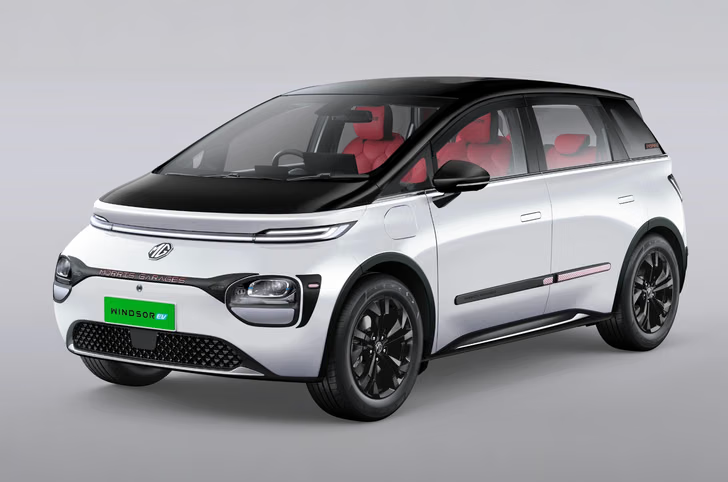
- The Urban Professional: Your daily driving is strictly city-based, and you have a second car for long interstate runs. The 38 kWh base model offers the best luxury-to-price ratio in India.
- The “Chauffeur-Driven” Family: You spend your time in the back seat. The 135-degree “Aero-Lounge” recline and massive glass roof make the Windsor feel two segments higher in terms of rear-seat comfort.
- The Subscription Skeptic turned Believer: You live in an apartment without easy home charging or want to keep your initial “cheque value” under ₹12 lakh. The BaaS model (starting at ₹3.9/km) is your ticket into the EV world with the lowest possible entry barrier.
Buy the Hyundai Creta Electric if you are:
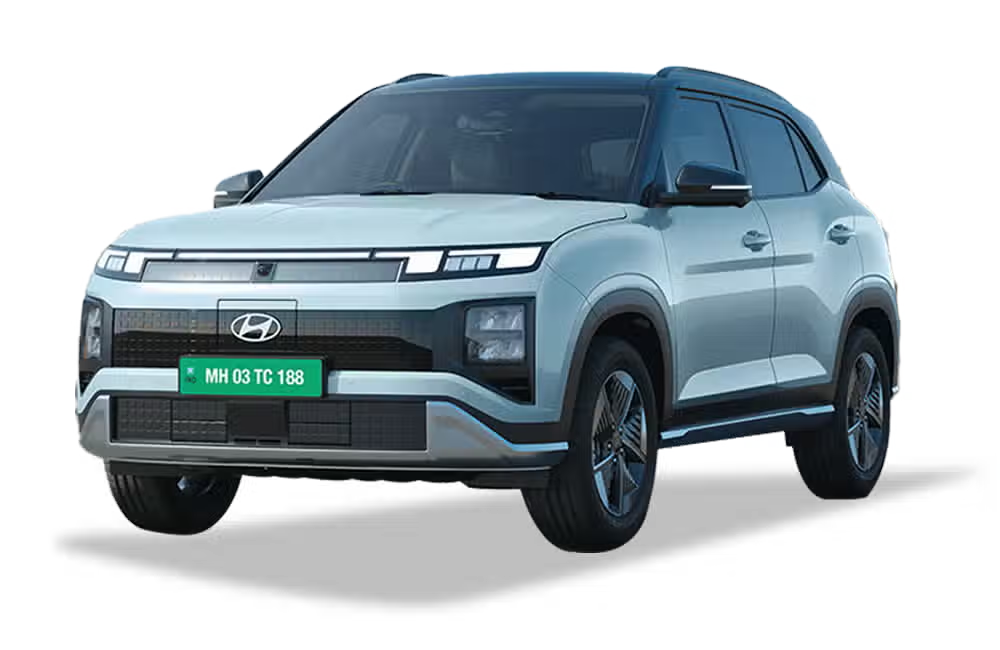
- The Efficiency Maverick: You track your monthly bills. You want the 8.4 km/kWh efficiency that ensures your running costs stay below ₹1/km, providing the best long-term return on your investment.
- The “Zero-Drama” Owner: You want an EV that feels exactly like a Creta. You value the 11 kW onboard AC charger for faster home top-ups and a Level 2 ADAS system that is actually tuned for the chaos of Indian traffic.
- The Long-Distance “Safe Bettor”: With the 100 kW fast-charging update now live, you can finally take this on the highway with confidence. You are buying into a 1,400-city service network that ensures help is available whether you’re in Delhi or Dhanushkodi.
| Category | Mahindra BE 6 | MG Windsor EV | Hyundai Creta EV |
| Driving Experience | Best in class (RWD) ★★★★★ | Adequate (Comfort-tuned) ★★★☆☆ | Very good (Refined) ★★★★☆ |
| Real-world Range | 449 km (79 kWh) ★★★★☆ | 350–380 km (Pro) ★★★☆☆ | 432 km (Average) ★★★★★ |
| Energy Efficiency | 5.68 km/kWh ★★★☆☆ | ~6.8 km/kWh ★★★★☆ | 8.4 km/kWh ★★★★★ |
| Fast Charging | 175 kW (Segment Leader) ★★★★★ | 60 kW (Average) ★★★☆☆ | 100 kW (Post-Update) ★★★★☆ |
| Interior Quality | Premium / Tech-forward ★★★★☆ | Lounge-first, Luxurious ★★★★★ | Refined, Familiar ★★★★☆ |
| Boot / Practicality | 455L + 45L Frunk ★★★★☆ | 604L Boot (Max Cargo) ★★★★★ | 433L + 22L Frunk ★★★☆☆ |
| Safety (BNCAP) | 5-Star (Verified) ★★★★★ | Not Officially Tested ★★☆☆☆ | Under Review ★★★☆☆ |
| Ownership Ease | Developing (New Platform) ★★★☆☆ | Good (Innovative BaaS) ★★★★☆ | Best in class (Network) ★★★★★ |
| Value (Entry) | ₹18.90L — Performance Value ★★★★☆ | ₹13.50L — Unbeatable ★★★★★ | ₹18.02L — Strong Resale ★★★★☆ |
Final Word
India’s EV market in 2026 is finally hitting its stride. We have moved past the “early adopter” phase where buyers had to make excuses for their cars. Today, the competition is so fierce that it’s forcing these three manufacturers to be better than they ever intended to be. Three years ago, the only reason to buy an EV under ₹25 lakh was to escape the petrol pump. Today, you’re buying a BE 6 for the RWD thrill, a Windsor for its lounge-like luxury, or a Creta for its bulletproof efficiency.
If you’re in the research phase, don’t settle for a spec-sheet victory. Go and feel the difference. You need to experience how the Mahindra BE 6 handles a corner under power and how the MG Windsor’s rear seats actually feel after a long day in the office.
For our readers in the capital: The clock is ticking. The Delhi EV Policy 2026–2030 has created a unique window where road tax and registration fee exemptions can save you up to ₹2.60 lakh on these specific models. History suggests these policy windows don’t stay open forever once the 100,000-unit cap is hit. If you’re sitting on the fence, now is the time to jump.
We are entering a new phase of long-term tracking. Now that Hyundai has successfully rolled out its 100 kW DC charging update, the playing field has leveled. Our next focus will be on real-world battery health data for the INGLO platform and the total cost of ownership under MG’s tiered BaaS model.
Stay plugged in. Subscribe to BijliWaliGaadi.com for the updates that actually move the needle on your purchase decision.
Editorial note: This article contains no paid promotion, sponsored content, or brand affiliation. All specifications are sourced from verified publications and manufacturer official data. Real-world range figures are from independent test programmes.,
FAQs- People Also Ask: Mahindra BE 6 vs MG Windsor EV vs Hyundai Creta Electric
-
Which has the best real-world range in 2026 — BE 6, Windsor EV, or Creta Electric?
The Mahindra BE 6 (79 kWh) wins on raw distance, covering 449 km on a charge. But the real star is the Creta Electric; it manages a massive 432 km from a much smaller battery. It’s the efficiency king, meaning you get nearly the same range for a lot less electricity. The Windsor Pro is best kept for the city, delivering about 350–380 km.
-
Is the MG Windsor EV BaaS option worth it in 2026?
It’s a great move if you want to keep your initial cheque under ₹10L or if you don’t have home charging. At ₹3.9–₹4.5/km, it’s perfect for moderate city use. However, if you’re a high-mileage driver doing over 1,200 km a month, you’re better off buying the battery outright to save money in the long run.
-
Which electric car battery is the most expensive to replace in India?
Mercedes-Benz EQS (107.8 kWh) leads at Rs. 28–38 lakh. Among popular passenger EVs, Hyundai Ioniq 5 LR and Kia EV6 cost Rs. 14–20 lakh. The Olectra 12m city bus battery tops all segments at Rs. 48–70 lakh.
-
Does the Mahindra BE 6 have a 5-star Bharat NCAP safety rating?
Yes, the BE 6 is officially 5-star verified and feels incredibly solid on the road. The Creta Electric is still “Under Review” for its electric-specific chassis, while the Windsor hasn’t been put through the BNCAP grinders yet.
-
Which electric SUV is the best all-round choice for Indian conditions in 2026?
It’s a massive saving. Since all three are under the ₹30L cap, you skip road tax and registration fees entirely—saving up to ₹2.6L. If you scrap an old BS4 car, you get another ₹1L off. It’s effectively the most affordable way to put a mid-size SUV in your garage right now.
-
Which EV has the fastest charging speed — BE 6, Windsor, or Creta Electric?
The BE 6 smokes the competition here with 175 kW charging—you’re back on the road in 20 minutes. The Creta has caught up significantly with its 100 kW update, taking about 39 minutes for a top-up. The Windsor remains the slowest, taking nearly an hour at a 60 kW station.


