
SUN Mobility: How India’s Battery Swapping Pioneer Is Rewriting the Rules of Electric Vehicle Adoption
SUN Mobility – AT A GLANCE:
- Founded: April 2017 Bengaluru, India
- Stations (July 2025): 900+ across 20+ cities
- Vehicles served: 50,000+ 2W, 3W, 4W, HCV
- Monthly swaps: 1.4 million+ Indofast network, December 2025
- Total funding raised: ~$135 million 4 rounds; Bosch, Vitol, IOCL, Helios Climate, PIDG
- Annual revenue (FY2025): $30.9 million Source: Tracxn / public filings

Table of Contents
Introduction: The Problem That Created SUN Mobility
Walk into any conversation about electric vehicle adoption in India and two barriers dominate the room within minutes — cost and charging. A lithium-ion battery pack accounts for anywhere between 35% and 50% of an EV’s total price. That single component is why a two-lakh-rupee electric scooter costs more than three lakh at the showroom. Add to that the fact that a two-wheeler EV can take four to eight hours to fully charge on a slow charger, and the proposition starts to crack for a delivery rider whose vehicle is also his income tool.
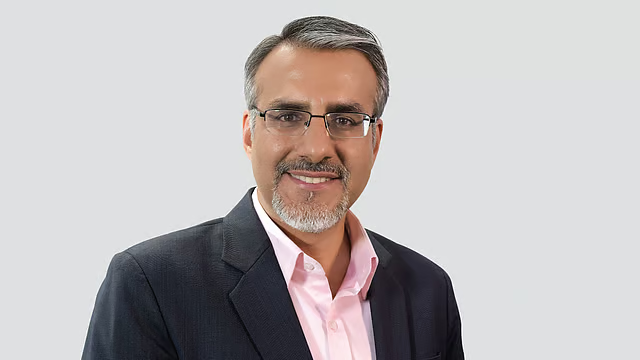
Chetan Maini — the engineer who built India’s first electric car, the Reva, back in 1994 — saw this problem not as a deterrent, but as a design brief. In April 2017, he partnered with Uday Khemka, Vice Chairman of the SUN Group and a 30-year veteran of clean energy investment, to found SUN Mobility. The idea was deceptively straightforward: stop selling batteries with vehicles. Sell energy as a service instead. Let the driver pull into a swap station, swap a depleted battery for a fully charged one in under two minutes, and drive away — paying only for the energy consumed.
Nearly eight years later, with 900 swap stations across India, over 50,000 vehicles in service, $135 million in total funding, and a landmark joint venture with Indian Oil Corporation, SUN Mobility has moved from concept to infrastructure. This is the comprehensive story of how it happened, why it matters for India’s green mobility mission, and where the company is heading next.
“Seven years ago, SUN Mobility was founded on the premise of making electric vehicles affordable, reducing range anxiety and time for charging electric vehicles. Since then, we have created the world’s leading open architecture platform for battery swapping that seamlessly supports various electric vehicle form factors across multiple OEMs and are deploying globally.”
— Chetan Maini, Co-Founder & Chairman, SUN Mobility — PRNewswire, June 2024
Who Founded SUN Mobility? The Founders, the Vision, and the Joint Venture Structure
Chetan Maini — The Engineer Who Built India’s First EV
Chetan Maini was born in Bengaluru in 1970 into the family that runs the Maini Group — a manufacturing conglomerate with deep roots in engineering and electric mobility. As an undergraduate at the University of Michigan, he was part of the solar car team that won a cross-country race across the United States and placed third at the World Solar Challenge in Australia. He then earned a Master’s degree in hybrid electric technology from Stanford University.
In 1994, he founded the Reva Electric Car Company, which became the world’s best-selling city electric car in its category, sold in 24 countries and acquired by Mahindra in 2010 as Mahindra Reva. By the time he left Mahindra Reva in 2015, Maini had accumulated over 35 global patents in battery and energy management systems. His observation was blunt: EVs were still too expensive, and it was the battery that was responsible. Separating the battery from the vehicle and turning energy into a subscribed service was the logical engineering response.
Uday Khemka — The Energy Investor Who Backed the Vision

Uday Khemka brings the finance and policy dimension to SUN Mobility’s founding team. As Vice Chairman of the SUN Group — a diversified global investor with interests in energy, mining, and new energy storage — Khemka was already running SUN New Energy Holdings with a specific mandate to back distributed renewable energy, energy storage, and electric mobility. A Baker Scholar from Harvard Business School and a member of the World Economic Forum’s Young Global Leaders community, Khemka had spent decades pushing for clean energy adoption across emerging markets. His alignment with Maini’s battery-swapping thesis made the partnership natural.
Ajay Goel — The Clean-Tech Operator

The third co-founder of SUN Mobility, Ajay Goel, brings operational heft. With 25 years of experience spanning high-tech, cleantech, strategy consulting, and executive leadership — including tenures as President Solar and New Business at ReNew Power and earlier at Tata Power Solar — Goel has been with SUN Mobility since inception as Co-Founder and Executive Director. Together, the trio combines EV engineering depth, energy investment vision, and clean-tech operating experience in a founding team that is difficult to replicate.
SUN Mobility is structurally a joint venture between the Maini Group and the SUN Group. It is headquartered in Bengaluru, Karnataka, with CIN U35100KA2016PTC124376, and operates a corporate office in Gurugram for its Indofast joint venture activities.
SUN Mobility’s Business Model: Battery-as-a-Service and Why It Changes the EV Economics

What Is Battery-as-a-Service (BaaS)?
SUN Mobility’s core business model rests on a principle borrowed from telecoms and software: separate the infrastructure from the device, and monetise usage rather than ownership. In the EV context, this means the vehicle is sold without the battery pack — reducing its upfront price significantly — and the battery itself is owned by SUN Mobility’s network. Customers pay for the energy they consume, either on a pay-per-use basis or via a subscription.
When a rider needs power, they pull into a Swap Point, physically exchange their depleted battery for a freshly charged one from the station’s rack, and leave in under two minutes. The network then charges the depleted battery, monitors its health via cloud connectivity, and makes it available for the next rider. The customer never waits. The driver never owns a depreciating battery. The network operator manages the full battery lifecycle.
The Three Pillars of SUN Mobility’s Revenue Architecture
- Battery-as-a-Service (BaaS): Customers pay per swap based on energy consumed. The company earns from the energy delivered through its network. Fleet operators, delivery platforms, and individual riders all access the same infrastructure at differentiated pricing.
- Mobility-as-a-Service (MaaS): SUN Mobility operates integrated EV mobility solutions where it manages both the vehicles and the energy infrastructure, enabling partners like Bounce Infinity, Bluwheelz, and Revfin to deploy large EV fleets with managed energy supply.
- Infrastructure Licensing and Technology Partnerships: SUN Mobility licenses its open-architecture platform to OEMs and fleet operators, enabling vehicle manufacturers to build compatible vehicles. Bosch’s 26% stake is partly a reflection of this — the German auto supplier gains access to interoperable battery technology for its OEM network.
The Open-Architecture Platform: Why Interoperability Is SUN Mobility’s Moat
The decision to build an open, interoperable architecture was a deliberate strategic choice — and it is what separates SUN Mobility from closed-loop battery swapping operators. A closed system, where only one OEM’s vehicle works at one OEM’s station, limits network density and adoption. SUN Mobility’s Smart Battery works across multiple vehicle makes and models, meaning a single Swap Point can serve a Bajaj e-rickshaw, a Bounce Infinity scooter, and a Hero Electric delivery vehicle all from the same rack of batteries.
This universality is what attracted Bosch — whose business model depends on supplying components across diverse OEM bases — and it is what makes the Indian Oil partnership viable. A fuel station serving multiple vehicle brands is only feasible if the energy delivery system is brand-agnostic.
| Model | How It Works | Target Segment | Revenue Driver |
| Battery-as-a-Service (BaaS) | Customer swaps depleted battery at station; pays per kWh consumed or per swap | 2W, 3W, small 4W fleet operators, gig delivery riders | Per-swap / per-kWh energy fee |
| Mobility-as-a-Service (MaaS) | SUN Mobility manages vehicles + energy under a single subscription or lease | Delivery platform fleets (Zomato, Swiggy), logistics operators | Fleet management + energy bundled fee |
| Infrastructure Licensing | OEMs build BaaS-compatible vehicles using SUN Mobility’s open battery standard | Vehicle manufacturers, city transport bodies | Licensing fees + integration revenue |
| Franchise / Full-Service Partner | Entrepreneurs set up swap stations; SUN Mobility/Indofast provides tech, ops support, revenue sharing | SMBs, fuel station dealers, retail chains | Revenue-sharing + franchise fee |
| Heavy Electric Vehicle (HEV) BaaS | Modular battery swapping for buses and trucks, swap under 3 minutes | Private bus operators, logistics trucks, state transport | Per-swap commercial fleet contracts + MoU revenue |
SUN Mobility’s Core Technology: Smart Battery, Quick Interchange Station, SwapX, and Smart Network
SUN Mobility’s technology stack has three components that work together as a system: the Smart Battery, the Quick Interchange Station (now available in the SwapX compact form as well), and the Smart Network that connects them all. Each layer is designed to be modular, scalable, and crucially — interoperable across vehicle platforms.
Smart Battery™


The Smart Battery is SUN Mobility’s proprietary, cloud-connected battery pack. It is built with embedded electronics that communicate the battery’s state of charge, health, temperature, and location to the Smart Network in real time. This cloud connectivity serves two purposes: it allows the network to optimise charging cycles and extend battery life, and it enables remote diagnostics that reduce maintenance costs across the network.
The latest generation, the S2.1 Smart Battery, was launched at Auto Expo 2023. Its specifications as verified from SUN Mobility’s official release and ANI News:
| Parameter | S2.1 Smart Battery Specification |
| Capacity | 2.1 kWh |
| Range improvement vs. previous generation | 45% more range |
| Safety certification | AIS156 Phase 1 certified (Government of India automotive safety standard) |
| Total safety and performance tests conducted | Over 450 tests — climatic, cyclic, drop, and vibration |
| Connectivity | Cloud-connected; real-time state-of-charge and health monitoring |
| Interoperability | Designed for multiple vehicle platforms across different OEMs |
| Development | Developed indigenously in-house by SUN Mobility in India |
SUN Mobility Quick Interchange Station (QIS)
The Quick Interchange Station is the full-format battery swapping unit deployed at SUN Mobility’s Swap Points. It houses a rack of charged Smart Batteries, manages charging cycles for depleted batteries, and facilitates the physical exchange. A battery swap at a QIS takes under two minutes — a time frame that is comparable to fuelling a petrol vehicle rather than the four to eight hours associated with slow EV charging.
The QIS is designed for high-throughput locations — fuel station forecourts, auto stands, logistics depot parking areas, and metro station peripheries. Multiple QIS units can be co-located at a single site to handle peak demand. It is connected to the Smart Network for real-time monitoring of battery inventory, station health, and energy consumption.
SUN Mobility SwapX — The Compact Franchise Station

Launched at Auto Expo 2023, SwapX is SUN Mobility’s plug-and-play compact swapping station, purpose-designed for the franchisee model. Where the full QIS requires dedicated infrastructure, SwapX can be set up at a pharmacy, a kiryana store, or a petrol pump kiosk — requiring nothing more than a standard 15-amp power socket and as little as six square feet of floor space.
SwapX’s verified technical features from the SUN Mobility 2023 launch release:
- Three onboard computers managing the full swap lifecycle
- Smart card reader for authenticated access
- Smoke detection sensor
- Surge and shock protection circuitry
- Advanced thermal management system
- Onboard SOS button for operator emergency signalling
- Modular stacking — multiple SwapX units can be stacked together to scale capacity at a single location
- Intuitive display screen showing battery availability, swap status, and connectivity
Smart Network — The Digital Backbone
The Smart Network is the software and connectivity layer that ties every battery, every station, and every vehicle together. It provides real-time monitoring of battery state across the entire network, predictive maintenance alerts based on battery health data, demand forecasting to ensure charged batteries are available where and when they are needed, and performance analytics for franchise partners and fleet operators.
This network intelligence is what makes the BaaS model financially viable at scale. Without it, the economics of managing thousands of batteries across hundreds of swap stations would be unmanageable. With it, SUN Mobility can balance charging loads, prevent battery abuse, and optimise station utilisation in a way that traditional charging infrastructure cannot.
Heavy Electric Vehicle (HEV) Battery Swapping Technology

In August 2024, SUN Mobility introduced what it claimed to be the world’s first modular battery-swapping technology for Heavy Commercial Vehicles, at the Prawaas 4.0 conference in Bengaluru. In partnership with Veera Vahana, a Bengaluru-based bus manufacturer, SUN Mobility launched India’s first 10.5-metre battery-swappable bus for intercity and mofussil routes.
The HEV battery swapping solution covers vehicles from 3-tonne to 55-tonne Gross Vehicle Weight — addressing the full commercial fleet spectrum from light trucks to intercity buses. This is consequential because buses and trucks represent approximately 5% of India’s total vehicle population but contribute roughly 50% of tailpipe emissions. The economic case cited by SUN Mobility:
- Battery swapping reduces the upfront cost of a bus by up to 40%, bringing it in line with traditional diesel bus pricing.
- Operational costs drop by up to 20% compared to diesel operations.
- Fleet uptime improves significantly because a swap takes under 3 minutes versus hours of charging downtime.
- Flexible financing access is unlocked because the battery — the most expensive component — is not part of the vehicle loan.
“SUN Mobility has revitalized HEVs by overcoming major obstacles for bus operators such as high entry cost of ownership, exacerbated by inadequate HEV financing, extended downtime from lengthy charging periods, and significant strain of rolling out charging infrastructure.”
— Chetan Maini, Co-Founder & Chairman, SUN Mobility — Motorindia, August 2024
How SUN Mobility Supports India’s Green Mobility Mission
India has committed to achieving net zero emissions by 2070 and has set an interim target of ensuring 30% of all new vehicle sales are electric by 2030. The PM E-DRIVE scheme, with a ₹10,900 crore allocation, is the government’s single largest push to date for EV infrastructure. The National Electric Mobility Mission Plan (NEMMP) aims for 80% EV penetration in two and three-wheelers by 2030.
SUN Mobility’s model addresses the specific structural barriers that have historically held back mass EV adoption in the high-volume, commercially critical segments — two-wheelers, three-wheelers, and commercial vehicles — that together account for over 90% of India’s vehicle parc.
Eliminating the Battery Cost Barrier
The battery pack represents 40–60% of an electric vehicle’s price. For a gig delivery rider earning ₹20,000–30,000 per month, an EV that costs ₹2 lakh more than its petrol equivalent is not an affordable upgrade. By removing the battery from the vehicle purchase price entirely under the BaaS model, SUN Mobility changes the economics so that the EV’s upfront cost approaches — or in some cases matches — the equivalent petrol vehicle. The ongoing energy cost (per-swap fee) replaces the combined cost of petrol and battery depreciation.
Eliminating Range Anxiety Through Speed
A battery swap under two minutes is transformative for commercial operators. A delivery rider cannot afford to sit at a charging point for 45 minutes in the middle of a shift. A taxi driver whose vehicle is earning ₹800 per hour cannot afford four hours of charging downtime. The swap model’s speed — comparable to a petrol refuel — makes EVs operationally viable for exactly the segments where India needs EV adoption most: commercial fleets and gig economy workers.
Enabling Renewable Integration
Because SUN Mobility controls the charging of batteries at its stations — rather than leaving charging in the hands of individual vehicle owners — it can time charging during off-peak hours or when renewable energy is cheapest and most available. This demand-side flexibility is a significant advantage for India’s grid, where renewable energy generation is often underutilised at night. The Indofast JV with IOCL also includes plans to integrate solar energy into swap station operations, aligning the energy supply for battery charging with India’s renewable targets.
Accelerating Commercial Vehicle Electrification
With the HEV battery swapping platform extending to buses and trucks, SUN Mobility is targeting the segment that contributes disproportionately to India’s transport emissions. The economics of battery swapping for commercial fleets — particularly the 40% reduction in bus upfront costs — makes the business case for fleet operators who currently cannot qualify for EV financing because of the battery’s depreciating value on their balance sheet. The Veera Vahana partnership and the 10,000+ bus inquiries generated in Tamil Nadu in December 2024 alone suggest the market appetite is real.
SUN Mobility’s Expansion Strategy: The Indian Oil JV, Franchises, and the African Play
Indofast Swap Energy — The Indian Oil and SUN Mobility Joint Venture

The most consequential move in SUN Mobility’s growth strategy was the June 5, 2024 joint venture with Indian Oil Corporation Limited. The 50:50 JV — named Indofast Swap Energy Pvt. Ltd. — is designed specifically to exploit Indian Oil’s network of over 37,000 fuel stations across India, turning fuel retail locations that already have the land, the footfall, and the energy supply connection into battery swap points.
By December 2025, Indofast had over 200 franchise partner stations operational across 12 cities and had facilitated over 44.5 million battery swaps, serving more than 50,000 vehicles. Monthly swap volume stood at 1.4 million (Autocar Professional, December 2025). The three-year target: 10,000 battery-swapping stations across 40+ cities. Anant Badjatya — the former CEO of SUN Mobility — was appointed CEO of Indofast Swap Energy in October 2024, bringing direct operational continuity to the JV’s scale-up.
The franchise model launched under Indofast in December 2025 offers three station formats — Swap Point, Swap Hub, and Swap Junction — with:
- Minimum space requirement: approximately 250 square feet
- Investment range: ₹10 lakh to ₹40 lakh per station
- Projected returns: 1.7x to 2.7x on investment, per Indofast’s published estimates
- Expansion focus: Tier 1 and Tier 2 cities including Jaipur, Mumbai, Pune, Bengaluru, Hyderabad, and Chennai
The BMRCL Partnership — Metro-Integrated Swapping
In December 2024, SUN Mobility partnered with Bangalore Metro Rail Corporation (BMRCL) to place battery-swapping stations at metro stations. By the time of the official launch, 19 stations were operational across Bengaluru’s Green and Purple metro lines. In a single month, those stations collectively supported 1,25,000 km of travel and served 19,000 EVs — an average of 2,800 vehicles per station, including 2,300 two-wheeler trips and 500 three-wheeler trips.
BMRCL has plans to extend the network to all 69 metro stations in Bengaluru, making metro-integrated battery swapping a standard feature of urban last-mile connectivity. This is a model that is replicable in Delhi, Mumbai, Hyderabad, Chennai, and other metro systems across India.
Fleet Partnerships and Ecosystem Building
Over the years, SUN Mobility has built one of the most diverse fleet partner networks in India’s EV infrastructure space. Key verified partnerships include:
| Partner | Scope of Partnership | Year |
| Bosch | 26% equity stake; technology partner; OEM integration | 2019 |
| Vitol | $50 million Series B investment; global energy distribution alignment | 2021 |
| Uber India | Battery swapping for e-auto drivers in select cities | 2019 |
| Amazon India | 10,000 EVs for delivery fleet with SUN Mobility battery swapping | 2022 |
| Bounce Infinity | 30,000 scooters deployed across Bengaluru, Hyderabad, Mumbai, Pune, Delhi NCR (BaaS + MaaS) | 2022 |
| Zomato | Electrification of 50,000 delivery two-wheelers | 2023 |
| Swiggy | 15,000+ e-bikes for delivery fleet, pan-India | 2023 |
| Bluwheelz | 16,000 EVs — 15,000 two-wheelers and 1,000 three-wheelers in metro cities | 2023 |
| RevFin | 15,000 vehicles — EV financing integration with BaaS model | 2024 |
| BMRCL (Bengaluru Metro) | Battery-swapping stations at 19 metro stations; expanding to 69 | 2024 |
| Veera Vahana | India’s first 10.5m battery-swappable bus for intercity routes | 2024 |
| IndianOil (IOCL) | 50:50 JV — Indofast Swap Energy; 10,000 stations target by 2030 | 2024 |
| Greaves Electric Mobility | Battery-swapping e-scooter partnership via Indofast | 2025 |
| Helios Climate + PIDG | $135M investment round for Africa and Southeast Asia expansion | 2025 |
The Africa and Southeast Asia Expansion
In July 2025, SUN Mobility announced a landmark $135 million investment round led by Helios Climate — Africa’s premier climate-focused investment platform — in partnership with the Private Infrastructure Development Group (PIDG), a multi-government development finance institution backed by the governments of the United Kingdom, Netherlands, Switzerland, Australia, Sweden, and Canada. This brought SUN Mobility’s total capital raised over the preceding year to approximately $135 million.
The PIDG’s own disclosure states that the investment is expected to fund the production of over 232,000 batteries, enable the adoption of more than 138,000 electric vehicles, and roll out more than 2,000 quick interchange stations across Africa and Southeast Asia — with a projected greenhouse gas emissions avoidance of 164,000 tonnes of CO2 equivalent.
The Africa play has a strategic logic that goes beyond geography: Vitol, one of SUN Mobility’s existing investors, is also the parent of Vivo Energy — Africa’s largest fuel retailer. Vivo Energy’s petrol station network in Africa mirrors Indian Oil’s network in India. The same playbook — turning fuel retail locations into battery swap points — is being extended to a new continent with a pre-existing investor relationship already in place.
“We’ve built a modular, fast, and scalable battery swapping ecosystem that adapts to real-world mobility needs. With over 1.4 million monthly swaps in India and growing global interest, we’re excited to extend our proven model to emerging markets like Africa. The region’s rapid urbanization, reliance on two and three-wheelers, and need for robust HEV solutions position it perfectly to leapfrog into clean mobility.”
— Chetan Maini, Co-Founder & Chairman, SUN Mobility — PIDG.org, July 2025
SUN Mobility Timeline: Corporate Evolution and Key Milestones (2017–2026)
| Year / Date | Milestone | Significance |
| April 5, 2017 | SUN Mobility founded by Chetan Maini, Uday Khemka, and Ajay Goel as a JV between Maini Group and SUN Group | Established Battery-as-a-Service model and open-architecture interoperable battery platform |
| 2018 | First Swap Point launched in Bengaluru | Proof of concept for real-world battery swapping operations in an Indian urban environment |
| 2019 | Bosch acquires 26% stake in SUN Mobility | Global automotive technology partner validates the technology; Bosch brings OEM integration expertise and automotive-grade engineering standards |
| 2019 | Partnership with Uber India for e-auto battery swapping | First major fleet deployment; validated the commercial viability of BaaS for shared mobility operators |
| September 2020 | First institutional funding round completed | Enabled infrastructure scaling beyond initial seed phase |
| October 2021 | $50 million Series B investment from Vitol | Largest single funding round at the time; Vitol’s energy distribution expertise strengthens global expansion logic |
| 2022 | Partnership with Amazon India (10,000 EVs) and Bounce Infinity (30,000 scooters) | Proved fleet deployment at scale; validated delivery and shared mobility as primary verticals |
| January 2023 | Launched SwapX compact station and S2.1 Smart Battery at Auto Expo 2023 | SwapX enables franchisee model and small-business network expansion; S2.1 offers 45% more range, AIS156 certified |
| March 2022 | Anant Badjatya appointed CEO of SUN Mobility India business | Operational leadership consolidation; drove network expansion from ~200 stations to 600+ stations |
| 2023 | Partnerships with Zomato (50,000 2Ws) and Swiggy (15,000 e-bikes) | Gig economy delivery platform adoption established as a high-volume vertial for BaaS |
| 2023–2024 | Network crosses 600+ stations; 26,000+ vehicles onboarded; 60,000 swaps/day | Infrastructure scaled to commercially meaningful levels; 1.6 million km powered daily |
| June 5, 2024 | 50:50 JV with Indian Oil Corporation — Indofast Swap Energy Pvt. Ltd. formed | Transformative milestone: access to 37,000+ IOCL fuel stations; target of 10,000 swap stations by 2030 |
| August 2024 | India’s first modular battery-swapping technology for HCVs launched with Veera Vahana at Prawaas 4.0 | Extended addressable market to buses (3–55 tonne GVW); 10,000+ bus operator inquiries generated |
| October 2024 | Anant Badjatya appointed CEO of Indofast Swap Energy JV | Operational continuity; SUN Mobility’s proven CEO leads the IOCL JV scale-up directly |
| December 2024 | BMRCL partnership — 19 battery-swapping stations at Bengaluru Metro stations | Metro-integrated battery swapping for last-mile EV use; 19,000 EVs served and 1,25,000 km in first month |
| December 2025 | Indofast crosses 44.5 million swaps; 200+ franchise stations in 12 cities; 1.4 million swaps/month | Proof that franchise model is operationally viable and scalable |
| July 29, 2025 | ~$135 million funding round led by Helios Climate and PIDG; 900+ stations; 50,000+ vehicles | Validates global market entry; Africa and Southeast Asia expansion begins; domestic growth continues |
—————-


