
Plug-In Hybrid Technology: The Smartest Car You Can Buy in 2026
Get here all the insights on the topic like: Plug-in Hybrid Technology | PHEV vs EV | Best plug-in Hybrid 2026 | Plug-in hybrid cars India | How does PHEV work

Plug-in hybrid electric vehicles (PHEVs) are no longer a transitional technology — they are a mature, intelligent powertrain solution engineered for the real world. With electric-only ranges now exceeding 125 miles on flagship models and battery systems smart enough to predict your route, the PHEV in 2026 offers something neither a pure EV nor a petrol car can match: total energy flexibility. This guide breaks down how the technology works, what it offers Indian and global drivers today, and where it is headed.
A PHEV uncharged is merely a heavy petrol car. A PHEV charged daily is a near-electric car with infinite range.
Table of Contents
What Is Plug-In Hybrid Technology and How Does It Work?
A plug-in hybrid electric vehicle (PHEV) combines an internal combustion engine (ICE) with one or more electric motors and a rechargeable battery pack large enough for meaningful zero-emission driving. Unlike a standard self-charging hybrid — which cannot be plugged in — a PHEV draws energy from an external power source: a domestic socket, AC wallbox, or public charging station.
The powertrain control unit (PCU) governs the dialogue between both energy sources in real time. Key operating modes include:
- EV Mode: The combustion engine is switched off; the car runs entirely on battery power — ideal for urban commutes and short trips.
- Hybrid Mode: Engine and electric motor work in parallel or series to optimise efficiency across a range of driving conditions.
- Charge Mode: The combustion engine actively charges the battery while driving — useful for replenishing range before an urban zone.
- Predictive / Route Mode: GPS-integrated algorithms reserve or deploy battery charge in advance based on planned route terrain and traffic.
- One-Pedal Driving Mode (2026): Aggressive regenerative braking — delivering up to 0.3g of deceleration — allows the driver to modulate speed almost entirely through throttle lift-off, without touching the brake pedal. This mode is particularly effective in India’s dense stop-and-go traffic and simultaneously recovers significant kinetic energy back into the battery.
Technical Architecture: The P2 Advantage Most 2026 premium PHEVs use a P2 architecture — the electric motor is positioned between the combustion engine and the gearbox, connected via a dedicated disconnect clutch. When driving in pure EV mode, this clutch physically decouples the engine, eliminating drag from the ICE and delivering a genuinely seamless electric experience. The P2 layout also enables efficient engine restart under load without the ‘lurch’ associated with older parallel hybrid systems, as the motor can spin the engine up to speed before the clutch re-engages. This architecture is used by Mercedes-Benz EQ Power models, Audi PHEV e-tron variants, and BMW’s current xDrive40e platforms. Cold Start Protection in Tropical Climates: An often-overlooked challenge for PHEVs in markets like India is the impact of high-speed transitions — where the combustion engine must restart from cold after extended EV operation in 40°C+ ambient temperatures. Modern 2026 PHEV systems address this through electric heating elements that pre-warm engine oil and coolant before the ICE restarts. This protects cylinder walls and timing components from the stress of a cold start at engine speeds above 2,000 rpm, extending powertrain longevity significantly in tropical operating conditions.
PHEV Battery Technology: Capacity, Chemistry, and Charging in 2026
Modern PHEVs use lithium-ion (Li-ion) battery packs ranging from 8 kWh in compact models to 38 kWh in performance-oriented luxury vehicles. The table below maps current benchmark PHEV platforms:
| Vehicle | Battery (kWh) | EV Range | Charge Time (L2) |
| BYD Yangwang Z9 GT | 38.5 kWh | ~125 miles | ~1.5 hrs |
| Mercedes GLE PHEV | 31.2 kWh | 50+ miles | 3 hrs |
| Toyota RAV4 PHEV (2026) | 18.1 kWh | ~42 miles | 2.5 hrs |
| Mercedes-AMG E53 Wagon | 21 kWh | ~40 miles | ~2 hrs |
| Audi A5 PHEV | 20.7 kWh | ~65 miles | ~2 hrs |
| Lexus RX 450h+ | 17.8 kWh | ~54 km | 2.5 hrs |
Charging technology is evolving rapidly. Standard AC Level 2 (7 kW wallbox) charging is the primary at-home solution; newer platforms such as the Mercedes GLE fully charge in three hours. DC fast charging for PHEVs — long absent from most platforms — is now arriving on premium models, bringing replenishment times under 30 minutes for mid-size batteries.
Intelligent Energy Management: How Modern PHEVs Think for You

The defining leap in PHEV engineering over the past three years is not battery capacity — it is software intelligence. Contemporary PHEV powertrain control units integrate:
- GPS-predictive energy deployment: The system reads route data and pre-positions battery state-of-charge for optimal use — conserving electric range for city segments, deploying the engine on motorways.
- Adaptive regenerative braking: Blends hydraulic and regenerative braking imperceptibly while maximising energy recovery — on new platforms, recuperation can deliver over 0.3g deceleration from the motors alone, enabling One-Pedal Driving modes ideally suited to urban Indian conditions.
- Thermal pre-conditioning: The cabin is cooled or heated using grid electricity before departure, not fuel — protecting battery capacity and improving comfort.
- Over-the-air (OTA) software updates: Powertrain logic, charging protocols, and energy algorithms are remotely updated post-purchase — meaning the car you own in 2027 may perform better than when new.
The intelligence layered above the hardware has become, in many respects, as impressive as the hardware itself.
PHEV vs Full EV: Which Technology Is Right for You in 2026?

Plug-in hybrid vs electric vehicle is the most searched comparison in the electrified vehicle category — and for good reason. The answer depends entirely on your charging access, driving pattern, and infrastructure reality.
| Consideration | PHEV | Full EV |
| Range anxiety | ✅ Zero — petrol fallback | ⚠️ Needs planning |
| Home charging needed? | Helpful but optional | Strongly recommended |
| Urban EV running | ✅ 30–125 mile EV mode | ✅ Full EV always |
| Long highway trips | ✅ Effortless | ⚠️ Charging stops needed |
| Maintenance complexity | Higher (dual drivetrain) | Lower |
| Upfront cost | Lower than equivalent EV | Higher on average |
| CO₂ benefit (charged) | Very high | Highest |
| CO₂ benefit (uncharged) | Low — behaves like ICE | Zero tail-pipe always |
Verdict: If you have home charging and drive under 50 miles daily, a well-specified PHEV delivers EV-quality running costs with petrol-car versatility. If you drive primarily in a city with reliable charging infrastructure, a full EV may suit you better.
Plug-In Hybrid Market Growth: The 2026 Landscape
Global PHEV sales are accelerating. Hybrid sales — inclusive of PHEVs — are growing at 27% in India and outpacing pure EVs in several emerging markets as of late 2025. The 2025–2026 model years represent an unprecedented breadth of product, spanning every segment:
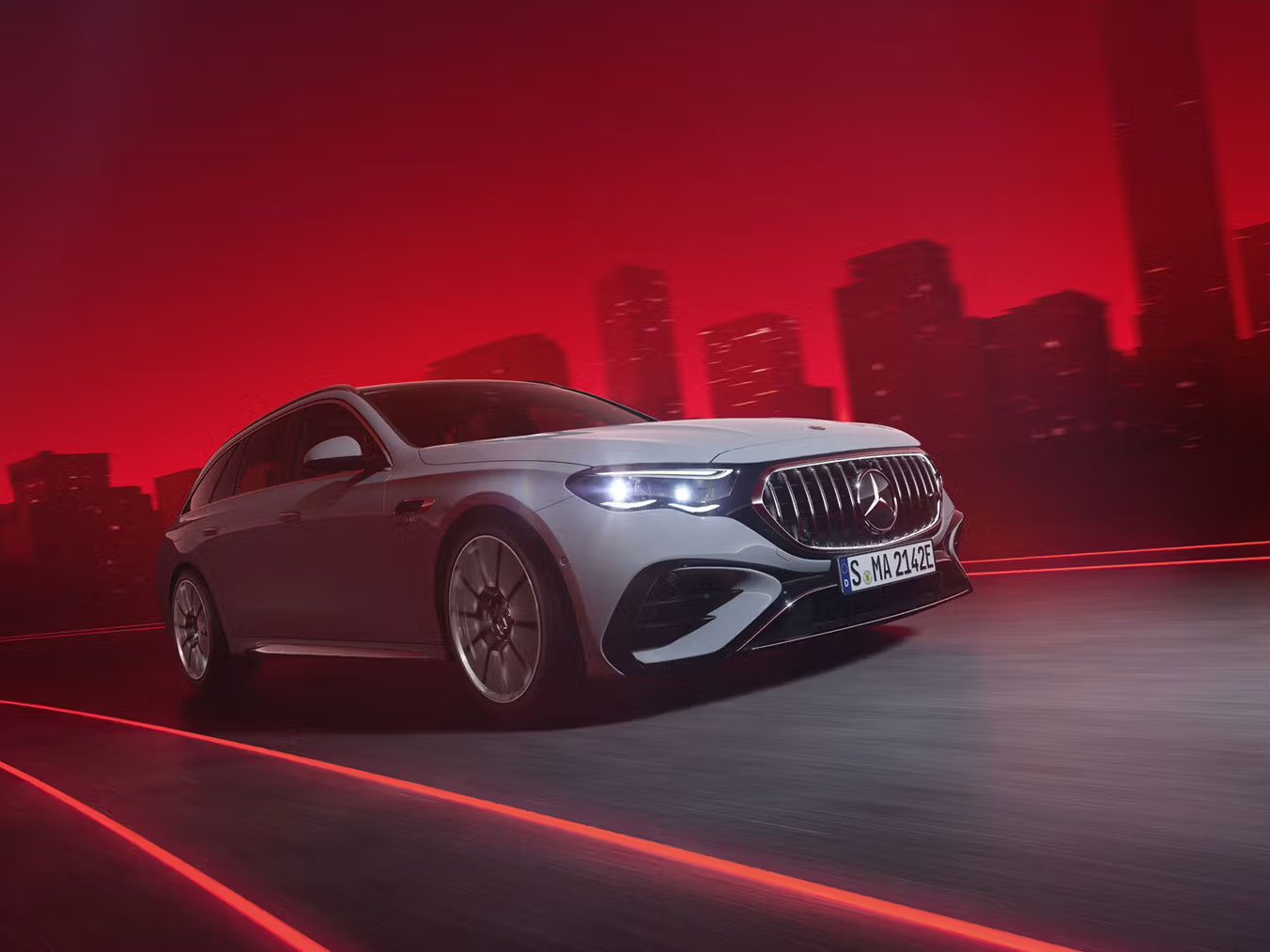
- Performance: BYD Yangwang Z9 GT (858 hp, 125 mi EV range), Mercedes-AMG E53 Wagon (577–604 hp, 21 kWh)

- Luxury SUV: Mercedes GLE PHEV (50+ mi EV), Range Rover 460e/550e (85 km EV), Lexus RX 450h+ (54 km)
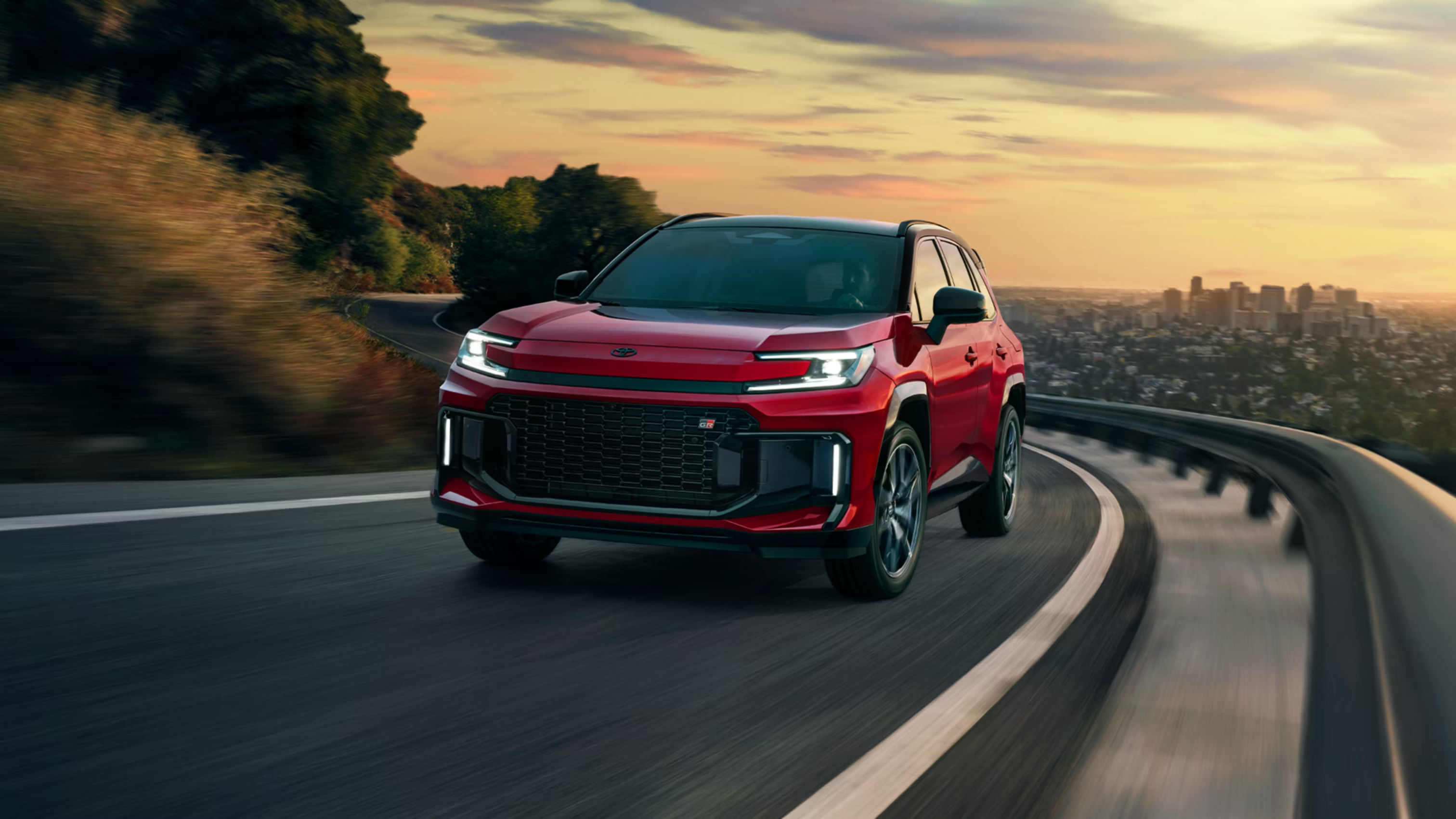
- Mainstream: 2026 Toyota RAV4 PHEV (redesigned, 5.7s 0–100, lower price), Nissan Rogue PHEV (38 mi, 248 hp)

- Value Disruptors: BYD Sealion 5 DM-i from £29,995, Geely Starray (up to 84 mi EV range), Omoda 3 PHEV ‘Super Hybrid System’
Chinese manufacturers — BYD, Geely, Omoda — are dramatically expanding the value ceiling, offering 80+ mile EV ranges at prices that were unimaginable from European or Japanese brands.
Plug-In Hybrid Cars in India: The Opportunity and the Roadmap
India’s PHEV Moment Hybrid vehicle sales in India grew 27% in 2025, driven by rising fuel prices and the practical appeal of electric driving without range anxiety. PHEVs are uniquely suited to India’s current reality: improving but patchy charging infrastructure, long inter-city distances, and a rapidly growing base of home charging adoption in Tier 1 and Tier 2 cities. Currently available PHEVs in India include the Mercedes-Benz GLC 300e (₹67.5 lakh onwards) and select Volvo Recharge models. The GST structure — which taxes PHEVs at the full 43% applicable to conventional vehicles — remains a significant barrier. Industry bodies are lobbying for parity with EVs, which attract 5% GST. A policy correction here could trigger a significant market shift. What to watch: Toyota’s PHEV offensive (RAV4 PHEV, Innova HyCross PHEV discussions), BYD’s aggressive expansion plans, and Hyundai-Kia’s PHEV pipeline for the Indian market.
| India-Specific Insights: Getting More from Your PHEV ▶ The Chauffeur-Driven Battery Hold Strategy: Many premium PHEVs sold in India are chauffeur-driven — and this introduces an underutilised feature worth briefing your driver on. Most 2026 PHEV platforms include a Battery Hold mode, accessible through the drive mode selector or infotainment screen. Activating this mode instructs the car to maintain the current battery charge level by running primarily on the combustion engine during highway cruising. The strategic use: engage Battery Hold on expressway runs between cities so that when you arrive at your destination’s business district, you switch to pure EV mode — arriving silently, emission-free, and without triggering the engine in congested urban air. For executive users commuting between Gurugram and Connaught Place, or Whitefield and MG Road, this single habit can dramatically reduce your carbon footprint and urban noise signature. ▶ Monsoon & Indian Road Infrastructure Readiness Concerns about battery safety in Indian conditions are understandable given the combination of speed breakers (up to 150mm height in some municipalities), waterlogged roads during monsoon, and rough rural surfaces. 2026 PHEVs from premium manufacturers address this directly: battery packs carry IP67 or IP68 sealing ratings, meaning they withstand temporary water immersion up to one metre. Underbody protection is reinforced with high-tensile steel skid plates on models like the Mercedes GLE and Range Rover PHEV. The battery management system also includes voltage isolation monitoring that immediately disconnects the high-voltage circuit in the event of a flood incursion or severe impact, protecting occupants. India-specific variants increasingly receive additional underbody clearance and raised suspension calibrations for this purpose. ▶ Vehicle-to-Load (V2L): Your PHEV as a Mobile Power Bank In a country where power outages remain a daily reality across Tier 2 and Tier 3 cities — and even in premium residential areas during monsoon — the Vehicle-to-Load (V2L) capability of 2026 PHEVs represents significant real-world value. Models equipped with V2L can export AC power (typically 2.2–3.6 kW) from a dedicated socket in the boot or cabin, sufficient to power a ceiling fan, laptop, television, refrigerator, or CPAP machine during a power cut. The BYD Sealion and Hyundai Ioniq models already available or incoming for India support V2L. Crucially, a PHEV’s petrol engine can also recharge the battery while V2L is active, meaning you have an effective on-demand petrol-fuelled generator — a compelling proposition for Indian households and those who travel to remote destinations. |
Expert Maintenance Insights for PHEV Owners
| Maintenance Sidebar: Keeping Your PHEV in Peak Condition PHEVs are mechanically more complex than either a pure ICE or pure EV, and their maintenance requirements reflect this dual-powertrain nature. Owners and service managers who treat them like conventional petrol cars risk costly failures. Here is what the 2026 generation demands: ▶ Pressurised Fuel Tanks: Preventing Stale Petrol A common PHEV usage pattern — particularly for well-charged Indian owners — is covering weeks of daily commuting entirely on battery power without consuming any petrol. This creates a real risk: petrol begins to degrade after 30–60 days in a conventional vented tank, forming varnish deposits that can clog injectors and fuel system components. 2026 PHEVs with larger battery packs address this with hermetically sealed, pressurised fuel tanks (similar in principle to those on the Volkswagen Golf GTE and BMW 3 Series PHEV) that prevent evaporative losses and retard petrol oxidation. Some systems include an automatic ‘engine exercise’ routine — the PCU starts the engine briefly and runs it through a load cycle after 30 days of no-combustion operation to circulate fluids and prevent fuel system stagnation. Owners should be aware that overriding this maintenance cycle can void warranty coverage on fuel system components. ▶ Low-Viscosity Oils Engineered for Stop-Start Architecture PHEVs start and stop their combustion engines far more frequently than conventional cars — sometimes dozens of times in a single urban journey. Each cold-start is the highest-wear moment in an engine’s life, as oil film breaks down at the cylinder wall-piston interface before the lubricant reaches operating viscosity. 2026 PHEV engines require ultra-low-viscosity engine oils — typically 0W-20 or 0W-16 — that achieve full film protection within milliseconds of startup. Standard 5W-30 or 10W-40 oils commonly used at Indian service stations are not compliant with PHEV engine specifications and can cause premature wear. Always verify that your service centre uses the manufacturer-specified oil grade, particularly if they are unfamiliar with PHEV servicing. Additionally, the electric motor’s gearbox requires its own specific ATF (automatic transmission fluid) that is distinct from the ICE gearbox — mixing the two is a critical error. Keep service records of both fluid changes as part of your warranty compliance documentation. |
The Next Frontier: Solid-State Batteries and the Future PHEV
Solid-state battery technology represents the single most consequential upgrade on the near-term PHEV roadmap. Unlike conventional liquid-electrolyte lithium-ion cells, solid-state cells offer:
- Higher energy density via bipolar electrode stacks: Solid-state batteries achieve their energy density advantage through a bipolar electrode architecture — where individual cells share current collectors, enabling them to be stacked in series within a single compact unit. This approach yields significantly higher voltage from a smaller physical footprint, directly addressing the weight penalty that has long been a PHEV criticism. A bipolar solid-state pack of equivalent energy to today’s 30 kWh liquid-electrolyte units could be achieved in roughly 60–70% of the volume and mass.
- Superior thermal stability: Eliminates the need for complex liquid cooling architecture, simplifying packaging and reducing weight further.
- Faster charge acceptance: Solid-state chemistry tolerates higher charge rates — making rapid DC charging for PHEV-scale batteries genuinely practical.
- Longevity: Significantly reduced capacity degradation over charge cycles, extending the useful life of the battery system.
Toyota, investing heavily at its new Michigan battery facility, has indicated that hybrid and PHEV applications will be among the first beneficiaries of solid-state production — likely before full-EV solid-state vehicles reach meaningful scale. The bipolar stack approach is the key manufacturing breakthrough making this timeline viable. Expect the first solid-state PHEV prototypes by 2027–28.
Plug-In Hybrid Limitations: An Honest Assessment
No technology warrants a complete endorsement without a frank accounting of its shortcomings. PHEVs carry the following caveats buyers must understand:
- The utilisation problem: Studies of fleet PHEVs found real-world CO₂ savings far below official figures when drivers didn’t plug in. An uncharged PHEV is simply a heavy petrol car. Environmental benefit is real — but conditional on consistent charging.
- Mechanical complexity: Two drivetrains, a battery management system, and sophisticated software create more potential failure points than a pure ICE or pure EV. Battery recall incidents in 2024–25 (Jeep, Ford, Audi — linked to Samsung SDI cells) highlight that larger PHEV packs are still building their reliability track record.
- Access dependency: The technology’s full benefit requires dedicated charging access. Apartment dwellers and those without home parking capture significantly less of the system’s potential.
FAQs: Plug-In Hybrid Technology
-
What is the difference between a hybrid and a plug-in hybrid?
A standard (self-charging) hybrid uses a small battery that recharges only through regenerative braking and engine overflow — it cannot be plugged in and offers minimal electric-only range. A plug-in hybrid (PHEV) has a significantly larger battery that can be charged from an external power source, enabling 20–125 miles of pure electric driving before the combustion engine starts. Most 2026 PHEVs use a P2 architecture with a disconnect clutch for a genuinely seamless EV experience.
-
How far can a PHEV travel on electricity alone?
In 2026, electric-only PHEV range spans from approximately 20 miles on entry-level models to 125 miles on the BYD Yangwang Z9 GT. Mid-range models typically deliver 40–65 miles of EV range — enough to cover most daily commutes in India and globally without burning any fuel.
-
Is it worth buying a PHEV if I don’t have a home charger?
Without home charging, a PHEV’s benefit is significantly reduced — you will use petrol for most journeys and carry extra battery weight. If you have access to workplace or public charging, a PHEV can still make sense. However, if no charging access is available, a standard hybrid or conventional car will likely offer better real-world value.
-
Are plug-in hybrids better than electric cars for long-distance travel?
Yes, for most users today. PHEVs use the electric motor for short urban trips and seamlessly engage the petrol engine for long highway runs — no charging stops required. Full EVs offer lower running costs and zero tail-pipe emissions but require planned charging stops on journeys beyond the vehicle’s range.
-
What is the best plug-in hybrid in 2026?
441 litres standard (25% more than the petrol Polo), expandable to 1,243 litres with rear seats folded, plus up to 1,200 kg towing capacity.
-
How long does it take to charge a plug-in hybrid?
Charging time depends on battery size and charger type. On a standard domestic socket (2.3 kW), most PHEVs charge overnight in 4–8 hours. On a 7 kW AC wallbox (Level 2), a full charge takes 2–3 hours. DC fast charging, now arriving on premium PHEV platforms, can replenish mid-size PHEV batteries in under 30 minutes.
-
Do plug-in hybrids qualify for subsidies in India?
Currently, PHEVs in India are taxed at 43% GST — the same rate as conventional vehicles — unlike pure EVs which attract 5% GST. This significantly impacts affordability. Industry bodies are actively lobbying for reduced GST on PHEVs, and a policy change here could substantially alter the market.
-
How does Battery Hold mode work in a PHEV?
Battery Hold mode instructs the powertrain control unit to maintain the current battery charge level by running primarily on the combustion engine — rather than depleting the battery. It is most usefully activated on highway runs so that the driver arrives in an urban destination with a full battery and can switch to silent, zero-emission EV mode for city driving. It is a standard feature on most 2026 premium PHEVs and is particularly valuable for chauffeur-driven executive vehicles in Indian cities.
-
Can a PHEV power appliances at home during a power cut?
Yes — PHEVs equipped with Vehicle-to-Load (V2L) technology can export AC electricity (typically 2.2–3.6 kW) to power household appliances including fans, laptops, televisions, and small refrigerators. Because a PHEV retains a petrol engine, it can recharge its own battery while exporting power, making it an effective on-demand petrol-fuelled generator — a highly relevant capability for Indian households.


