India Bans Battery Black Mass Exports: What It Means for Your EV’s Future
Stay connected via Google 'Electric Vehicle' News
Follow BijliWaliGaadi | India's Trusted EV Insights Portal
source on Google
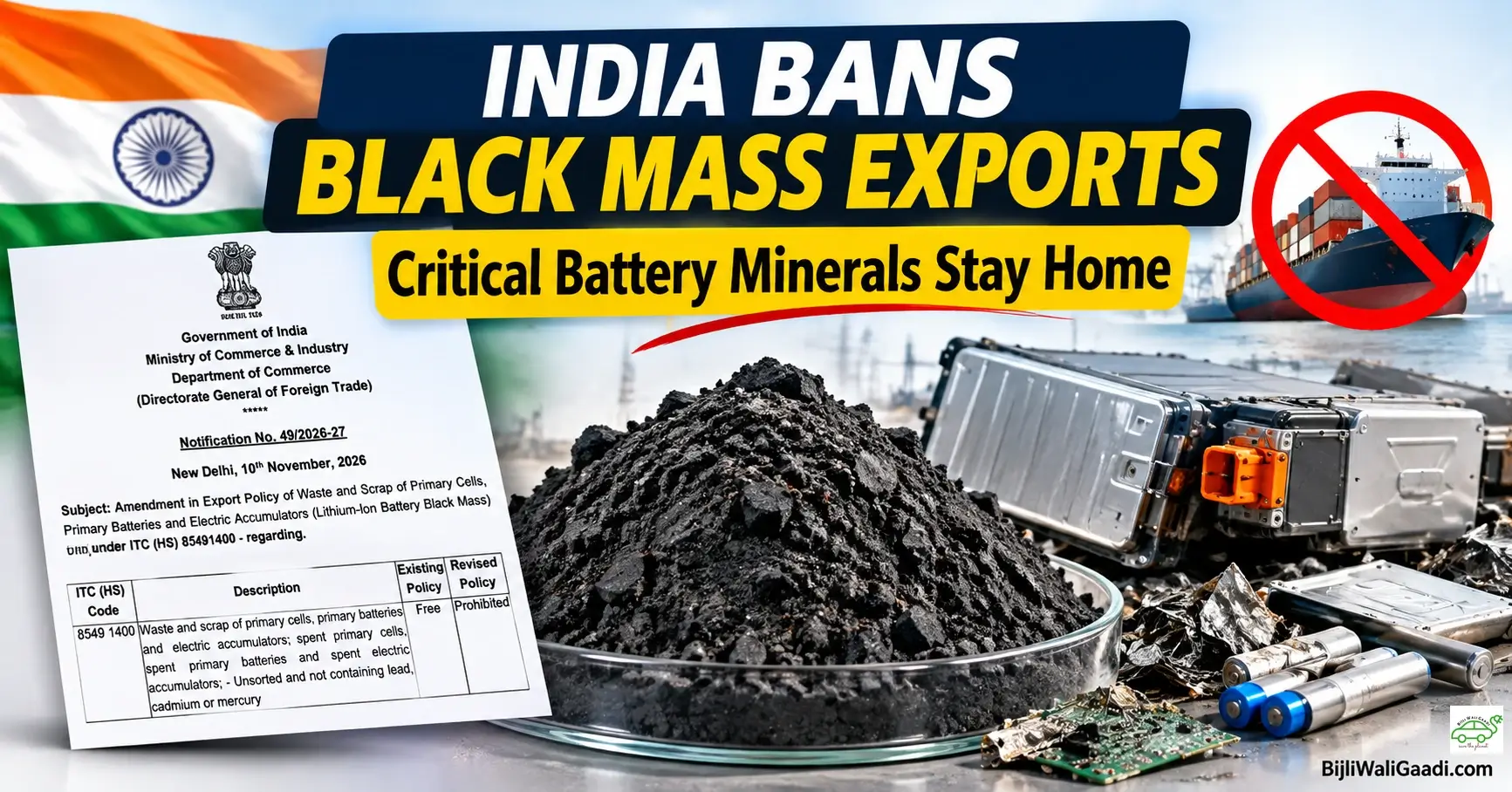
India has stopped the export of unsorted lithium-ion battery scrap, widely called “black mass”, with immediate effect. The Directorate General of Foreign Trade (DGFT) issued the order on 10 November 2026, and it was reported on 11 November. The aim is to keep the battery minerals that India’s electric vehicles depend on inside the country for domestic recovery.
What Exactly Has India Banned Under DGFT Notification 49/2026-27?
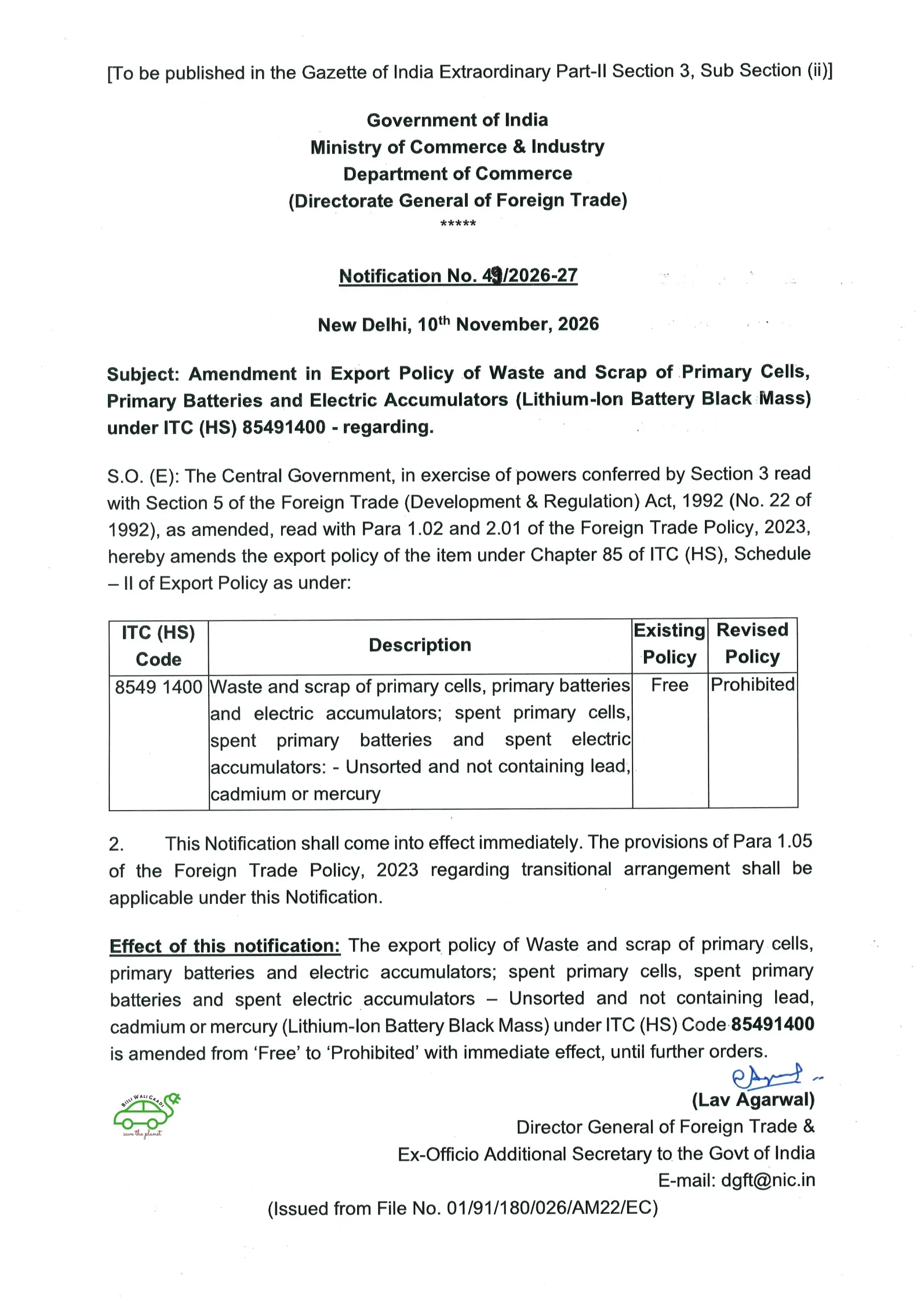
Notification No. 49/2026-27, signed by Director General of Foreign Trade Lav Agarwal, amends the export policy for ITC (HS) code 85491400. This code covers waste and scrap of primary cells, primary batteries and electric accumulators, including spent ones, that are unsorted and do not contain lead, cadmium or mercury.
The policy status moves from “Free” to “Prohibited”. The notification takes effect immediately and stays in force until further orders. It was issued under Sections 3 and 5 of the Foreign Trade (Development & Regulation) Act, 1992, and the transitional arrangement in Para 1.05 of the Foreign Trade Policy 2023 applies. The notification itself labels the material Lithium-Ion Battery Black Mass.
What Is Black Mass and Why Does It Matter for Electric Vehicles?
Black mass is the powdery mixture recovered when lithium-ion batteries are crushed and shredded for recycling. It contains lithium, nickel, manganese, cobalt and graphite.
These minerals are essential to India’s electronics, electric vehicle and renewable energy storage ecosystem. Recyclers refine black mass into lithium carbonate or hydroxide, plus cobalt, nickel and manganese sulphates. Graphite is increasingly being recovered too, while copper and aluminium are usually separated earlier, during mechanical shredding.
Why Did India Block Black Mass Exports Now?
The government’s stated aim is to retain these minerals for domestic recovery. It’s a move to secure critical minerals for India’s EV supply chain.
It also points to a “double loss” India has faced. The country lost the value of exporting black mass, then paid a premium to import refined, battery-grade materials made from the same waste elsewhere. Before the ban, much premium end-of-life battery material was either hoarded by the informal sector or exported to refining hubs in East Asia, leaving domestic recyclers short of feedstock.
How Much Black Mass Can India Generate Each Year?
Industry estimates about 3.2 million tonnes of e-waste, holding roughly 70,000 tonnes of end-of-life batteries, could generate around 30,000 tonnes of black mass a year.
Looking ahead, as per future project formal lithium-ion recycling throughput reaching 80,000 tonnes annually by 2031. It also cites a 19.5% compound annual growth rate, a domestic market of $138 million by 2031, and a NITI Aayog projection of 128 GWh of recyclable battery capacity by 2030.
Can Indian Battery Recyclers Make Money From Domestic Black Mass?
India’s installed recycling capacity can handle upwards of 40,000 to 50,000 tonnes, yet the industry formally processes only about 19,000 tonnes. With plants running below capacity, per-unit costs stayed high.
Hydrometallurgical plants carry heavy fixed costs, and that profitability depends on scale. If plants reach 80% to 100% utilisation, fixed costs spread out and margins can improve. These are the publication’s assessments, not guaranteed outcomes, and the ban does not by itself set recyclers’ costs or prices.
Which Indian Companies Lead Lithium-Ion Battery Recycling?
Some of the top five lithium scrap recyclers are LOHUM Cleantech, Attero Recycling, BatX Energies, Exigo Recycling, and Rubamin / Metastable Materials.
The Material Recycling Association of India (MRAI) welcomed the order. It said domestic recyclers and critical mineral processors may now get greater access to feedstock, calling it an important step toward resource security, investment in indigenous recycling and a self-reliant circular economy.
Which Battery Recycling Rules Will Raise Demand for Domestic Black Mass?
Under the Battery Waste Management Rules, material recovery targets rise to 90% by 2026-27. New EV batteries must also contain at least 5% recycled content by 2027-28, rising to 20% by 2030-31. Together with the ban, these targets push recyclers toward full-cycle refining rather than basic shredding.
What Does the Black Mass Export Ban Mean for EV Makers and Buyers?
For battery makers, recovering lithium, nickel and cobalt from domestic waste can insulate the economy from volatile global commodity prices and reduce import bills. For EV buyers, the sources make no claim about vehicle or battery prices. The practical change is upstream: scrap from retired batteries will increasingly be refined inside India instead of leaving the country.
FAQs: India’s Black Mass Export Ban
Stay connected via Google 'Electric Vehicle' News
Follow BijliWaliGaadi | India's Trusted EV Insights Portal
source on Google