Your Parked EV Could Soon Earn Money in Germany: What the New MiSpeL Rules Really Allow
Stay connected via Google 'Electric Vehicle' News
Follow BijliWaliGaadi | India's Trusted EV Insights Portal
source on Google
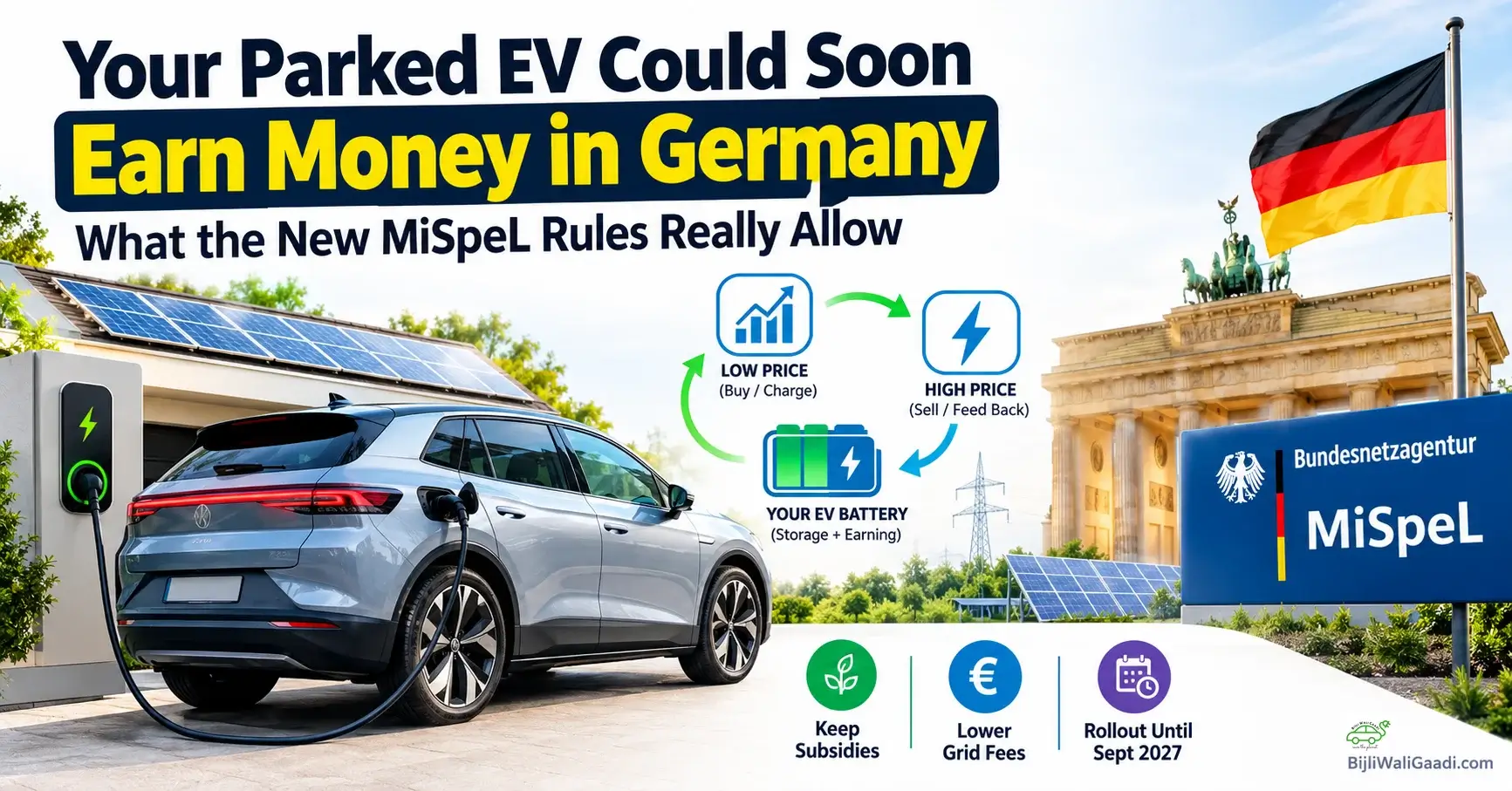
Germany’s grid regulator has removed a long-standing barrier to paid bidirectional charging. What you can actually do with it depends on your meter, your contract, and a rollout that runs until September 2027.
Key Highlights: Germany’s New EV Earning Rules at a Glance
What Is MiSpeL, and Why Does Germany’s New EV Ruling Matter?
MiSpeL stands for Marktintegration von Stromspeichern und Ladepunkten, meaning the market integration of electricity storage and charging points. The Bundesnetzagentur adopted it on 1 October 2026.
Agency president Klaus Müller said the ruling is urgently awaited and will activate countless large and small storage units and charging points for the power system. He said millions of committed households can become active shapers of the energy transition. He also said Germany can become a pioneer in bidirectional charging.
In short, a parked electric car can become more than a parked car: a battery that takes in electricity at one price and gives it back at another.
Why Could German EV Owners Not Earn Money From Parked Cars Before?
Until now, green electricity and grid electricity had to be kept strictly separate in storage systems. Only pure green-power storage could receive support under the EEG, Germany’s Renewable Energy Sources Act.
Bidirectional charging points were excluded altogether. These are charging points that charge a car and can also feed power back from it, much like a home battery.
The regulator says these restrictions meant that the flexibility of storage and charging points was used only to a very limited extent, and that chances to respond to market signals went unused.
How Does the “Buy Low, Sell High” Model Work for Electric Car Owners?
The regulator describes two complementary uses of storage and bidirectional charging points:
- Demand side: Buy electricity on dynamic tariffs, consuming power at times of low market prices and high renewable generation.
- Supply side: Feed electricity back through price-optimised direct marketing, shifting feed-in to times of high market prices.
Households and businesses that can react flexibly benefit from lower electricity costs and higher revenues. The regulator adds that this also helps the electricity market and the integration of renewable energy.
Can You Store Solar and Grid Power in the Same Battery Without Losing Subsidies?
Yes. Under MiSpeL, EEG support is retained and is also paid for temporarily stored renewable electricity.
For grid electricity that was drawn earlier and later fed back, there is a further benefit. The fed-back quantities are netted, so correspondingly fewer levies and grid fees must be paid on the original grid purchase. MiSpeL sets out how the “subsidy-eligible” and “netting-eligible” quantities are determined.
Delineation Option or Flat-Rate Option: Which MiSpeL Route Fits Which Household?
MiSpeL offers two options for determining those quantities.
| Delineation option (Abgrenzungsoption) | Flat-rate option (Pauschaloption) | |
|---|---|---|
| Who can use it | Open to all users | Simplified alternative for households with a solar system of up to 30 kWp |
| How it works | Precise determination of electricity quantities using formulas | Simplified flat-rate assumptions |
| Meters | Usually two; a single meter is enough in special cases | Generally only one |
| Extra condition | Transition-period rules apply | Transition-period rules apply, plus EU state-aid approval of its legal basis |
Both options extend subsidy eligibility to charging points for the first time, treating them like storage systems.
Do You Need Solar Panels to Join? What the Consultation Changed
Not necessarily. After consultation, the regulator extended the rules so they can be used with subsidised renewable plants, with unsubsidised plants, and even without any electricity generation. Simplified formulas were also added for special cases.
The regulator describes the result as a pragmatic, digital solution that leaves maximum freedom for innovation while setting clear guardrails against misuse.
When Can German EV Owners Actually Start? The MiSpeL Timeline
- 31 July 2025: The regulator opens the procedure.
- 18 September 2025: Key points are put out for consultation.
- 5 August 2026: A working draft is published for early market information.
- 1 October 2026: The final MiSpeL ruling is adopted.
- 2 October 2026: A workshop explains the final version to affected companies, network operators, metering operators and associations.
- Until the end of September 2027: This is the transition period for network and metering operators. During it, the options can be used if the network operator and the metering operator agree.
- Flat-rate option: Its use requires the European Commission’s state-aid approval of the underlying legal basis.
Will a Parked EV Really Pay for Itself? An Honest Reality Check
The regulator’s pages describe an opportunity, not a payout. They set out how electricity quantities are accounted for and which subsidies, levies and fees apply. They do not promise any level of earnings.
What you gain depends on how you use the battery: how well you shift consumption to low-price periods and feed-in to high-price periods, and how that fits your tariff and metering. Before committing, check your own setup against the options above and ask your network operator and metering operator whether they already agree to early use.
How Did Germany Get Here? The Law Behind MiSpeL
MiSpeL rests on recent changes to Germany’s renewable energy and energy financing laws, introduced through the so-called Stromspitzengesetz. That law is meant to prevent temporary generation surpluses. It made it easier for storage systems and electric-car charging points to take part in the market and be used in both directions, in combination with renewable plants.
The two new options, the delineation option and the flat-rate option, aim to make better use of the flexibility of storage and charging points. Among other goals, they should help dampen temporary generation surpluses, known as “power peaks.”
More insights: Bundesnetzagentur – Festlegungsverfahren zur Marktintegration von Speichern und Ladepunkten (MiSpeL)
Frequently Asked Questions About Earning Money With an EV in Germany
Stay connected via Google 'Electric Vehicle' News
Follow BijliWaliGaadi | India's Trusted EV Insights Portal
source on Google