Tata Nexon EV Battery Replacement Cost in India (2026): Price, Warranty & Lifespan
Stay connected via Google 'Electric Vehicle' News
Follow BijliWaliGaadi | India's Trusted EV Insights Portal
source on Google
Quick Summary:
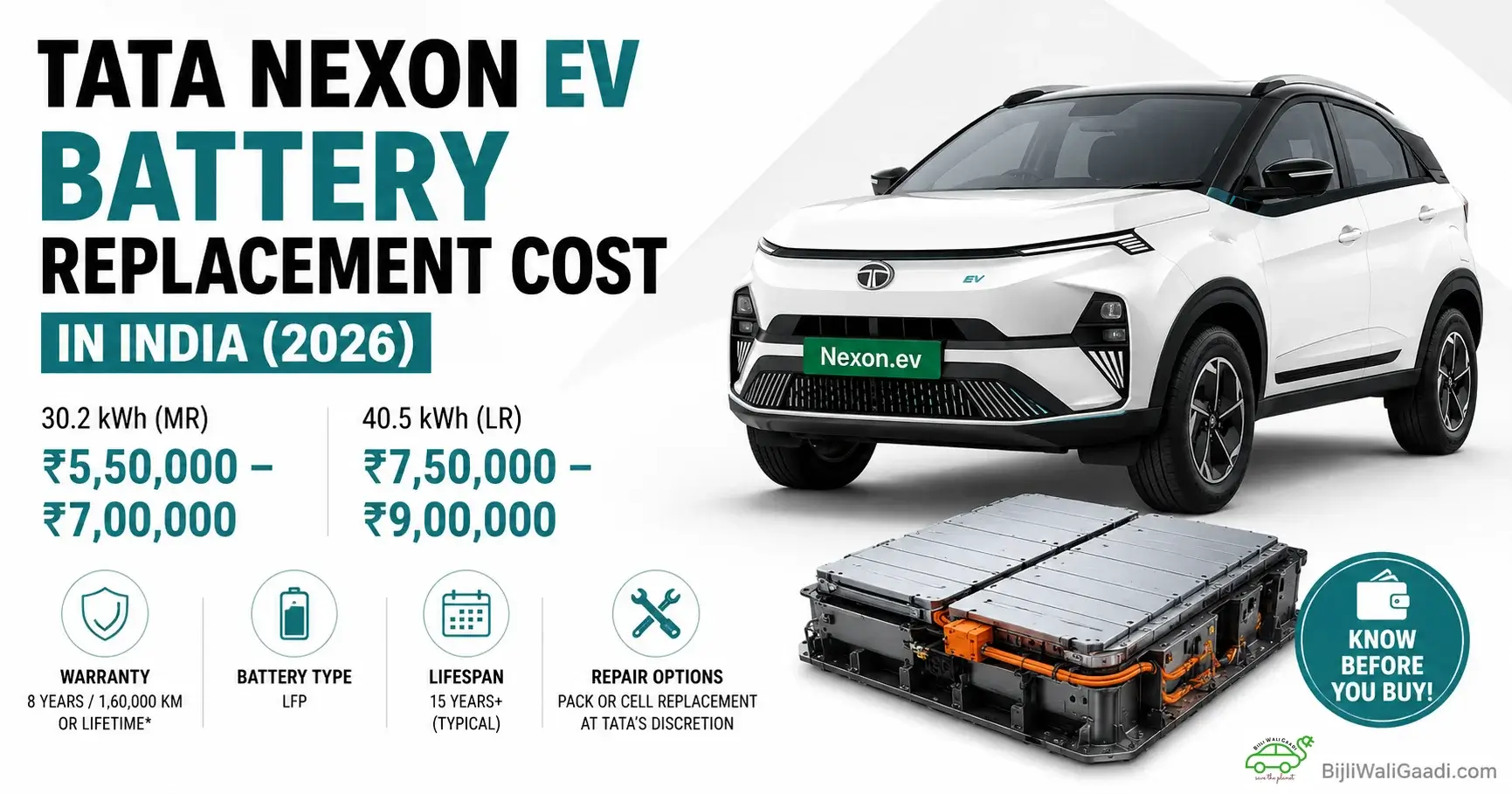
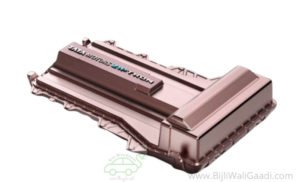
The Tata Nexon EV battery replacement cost in India is estimated between ₹5,50,000 and ₹7,00,000 for the 30.2 kWh (MR) pack, and ₹7,50,000 and ₹9,00,000 for the 40.5 kWh (LR) pack. Both variants use LFP (Lithium Iron Phosphate) cells. The 30.2 kWh (MR) and 40.5 kWh (LR) pack carry the standard 8-year / 1,60,000 km warranty, while the newer 45 kWh Nexon.ev variant is backed by Tata’s Lifetime* HV Battery Warranty with unlimited km for the first owner. Per-kWh, replacement cost works out to roughly ₹18,200 to ₹23,200/kWh across both variants.
TATA Nexon EV Battery Details and Replacement Cost
| Parameter | Nexon EV Medium Range (MR) | Nexon EV Long Range (LR) |
| Vehicle Model | Tata Nexon EV MR | Tata Nexon EV Max / LR |
| Battery Pack Capacity | 30.2 kWh | 40.5 kWh |
| Cell Chemistry / Tech | LFP (Lithium Iron Phosphate) | LFP (Lithium Iron Phosphate) |
| Factory Warranty | 8 Years / 1,60,000 km | 8 Years / 1,60,000 km (Lifetime* HV Battery Warranty applicable on the newer 45 kWh Nexon EV variant — see dedicated section below) |
| Est. Replacement Cost | ≈ ₹ 5,50,000 – ₹ 7,00,000 | ≈ ₹ 7,50,000 – ₹ 9,00,000 |
| Estimated Cost per kWh | ≈ ₹ 18,200 – ₹ 23,200 / kWh | ≈ ₹ 18,500 – ₹ 22,200 / kWh |
| Thermal Management | Liquid Cooled | Liquid Cooled |
Note: All costs above are industry estimates for out-of-warranty replacement. Tata Motors has not published an official, nationwide battery replacement price list; actual quotes may differ by model year, city, and dealership.
A quick note on battery variants: earlier Nexon EV Long Range models — the ones referenced in the cost tables on this page — were equipped with a 40.5 kWh battery pack (the “Max/LR” generation). Tata Motors introduced the 45 kWh battery pack for the Tata Nexon.ev on September 24, 2024 and that battery pack is having Tata’s newer prismatic cell architecture. The Lifetime HV Battery Warranty discussed later in this article officially applies to this newer, eligible 45 kWh Nexon.ev variant — not to the 30.2 kWh MR or 40.5 kWh LR/Max generation. The battery replacement cost estimates in this article refer specifically to the 30.2 kWh and 40.5 kWh generations. The battery replacement cost for the Nexon EV 45 kWh pack is between ~₹8,20,000 and ~₹10,45,000 (calculated into the next paragraph).
Detailed Battery Replacement Cost Breakdown for Tata Nexon EV
Talk to anyone shopping for a used Nexon EV and the conversation eventually lands on one question: what happens when the battery dies after the warranty ends? It’s a fair worry — this single component can cost more than an entire petrol hatchback.
It’s worth stating upfront: the figures discussed in this section are estimated OEM out-of-warranty replacement costs based on industry information, not an official published price list. Tata Motors does not publicly disclose a nationwide battery replacement price schedule, and actual prices can vary depending on model year, location, dealership, and applicable taxes.
Component-Level Costing: The estimated replacement cost quoted in this article refers primarily to the battery pack itself. Based on dealership practices, labour charges, diagnostic requirements, regional pricing, and model year differences, actual customer invoices may differ modestly from the estimates presented in this article. As an editorial estimate — not an official Tata Motors figure — such variation is typically in the range of approximately 5–8%.
Cost Per kWh Analysis: Here’s where the Nexon EV’s economics get genuinely interesting. Run the numbers separately for each pack size:
- 30.2 kWh MR pack priced between ~₹5,50,000 and ~₹7,00,000 works out to ≈ ₹18,200 – ₹23,200 per kWh.
- 40.5 kWh LR pack priced between ~₹7,50,000 and ~₹9,00,000 works out to ≈ ₹18,500 – ₹22,200 per kWh.
The total replacement bill is naturally higher for the LR variant simply because it’s a physically larger pack — more cells, more capacity. But the price-per-kWh across both variants lands in a broadly similar ₹18,200–₹23,200/kWh band once the full range is considered. Based on these inputs the battery replacement cost for TATA Nexon EV 45kWh pack is between ~₹8,20,000 and ~₹10,45,000 (in case battery is needed to replace in out of warranty condition).
Recommendation: Readers should confirm the latest battery replacement price with an authorized Tata Motors service centre before making any purchase decision, as prices may vary across regions, dealerships, and model years.
Does Car Insurance Cover EV Battery Replacement?
Standard comprehensive car insurance generally covers accidental battery damage arising from insured events such as collisions, flooding, or fire. It does not normally cover battery degradation, aging, or normal wear and tear over time — these are treated as maintenance/lifecycle costs rather than insurable events. Actual coverage depends on the specific insurer’s policy wording and any add-on endorsements for EV components. Readers are advised to verify battery-related coverage directly with their insurance provider before assuming a degraded or aged pack would be covered.
Tata’s Nexon.ev 45 kWh Lifetime* HV Battery Warranty: What It Actually Covers
A clarifying note before the details: Tata’s Lifetime* HV Battery Warranty with unlimited km is offered on the newer 45 kWh Nexon.ev variant — a designation distinct from the 30.2 kWh MR and 40.5 kWh LR (Max) variants covered in the cost tables above, which carry the standard 8-year / 1,60,000 km warranty. As per Tata Motors’ official warranty documentation, this Lifetime HV Battery Warranty programme was first introduced on the Harrier.ev and has since been extended to the Curvv.ev and the Nexon.ev 45 kWh. Readers evaluating a specific Nexon EV variant should confirm with an authorized Tata dealership which battery pack and warranty tier apply to their exact vehicle.
This is the detail most owners miss — and it materially changes the out-of-warranty cost equation for eligible buyers. Tata backs the 45 kWh Nexon.ev pack with a *”Lifetime* HV Battery Warranty with unlimited* kms”**, a materially stronger promise than the standard 8-year/1,60,000 km cover. But “lifetime” comes with sharp fine print, per Tata Motors’ official warranty terms:
In short: if you’re buying an eligible variant as the first owner and keeping it for personal use, the “replacement cost anxiety” this article opens with is meaningfully deferred — potentially for 15 years. MR/LR buyers on the standard warranty, and anyone buying a car second-hand without a properly notified ownership transfer, should still budget around the 8-year/1,60,000 km horizon.
The warranty information presented above is based on Tata Motors’ official warranty documentation available at the time of writing. As warranty terms can be updated or revised, owners are recommended to consult the official owner’s manual, the warranty booklet supplied with the vehicle, or an authorized Tata Motors dealership for the latest applicable terms.
OEM Warranty Terms vs Out-of-Warranty Reality
Coverage Scope: Depending on variant and ownership status (see the Lifetime Warranty breakdown above), Nexon EV battery coverage runs from 8 years/1,60,000 km up to 15 years for eligible first-owner vehicles on the 45 kWh Nexon.ev. This covers manufacturing defects and abnormal capacity fade within that window — it is not a blanket “replace on any degradation” promise.
State of Health (SOH) Threshold: As with most EV makers, warranty eligibility is generally assessed after Tata-authorized diagnostics confirm that the battery’s State of Health (SOH) has fallen below the applicable threshold specified in the warranty terms. If the vehicle qualifies, Tata Motors may, at its sole discretion, repair or replace the HV battery pack or individual cells, restoring the pack’s capacity to the higher of its pre-repair steady-state SOH or 80% SOH, per its warranty policy. Final approval remains subject to Tata Motors’ warranty conditions and inspection procedures. Gradual, expected degradation above the applicable threshold is considered normal wear, not a warranty claim.
Warranty Void Traps: A few habits can quietly void coverage: fitting unauthorized fast-chargers or third-party charging accessories, running the pack through repeated deep discharges (draining to near-zero regularly), unauthorized electrical modifications, and water ingress beyond the pack’s rated ingress protection. Owners should stick to Tata-authorized service and charging equipment to keep the warranty intact.
Indian Tropical Climate & Battery Longevity Factors
Thermal Stress: India’s summer ambient temperatures — routinely 40°C to 48°C in cities like Delhi, Nagpur, or Ahmedabad — accelerate the chemical side-reactions inside any lithium cell. LFP chemistry, which the Nexon EV uses across both pack sizes, is inherently more thermally stable and tolerant of heat cycling than NMC, giving it a real-world durability edge in Indian conditions.
Thermal Management Efficiency: The Nexon EV uses a liquid-cooled battery pack on both MR and LR variants, which actively regulates cell temperature during fast charging and hot-weather driving — a meaningful advantage over passively or air-cooled two-wheeler packs, which see far more cycling stress in summer.
Real-World Degradation Expectations: Combining LFP’s inherent stability with active liquid cooling, available field experience suggests Nexon EV packs typically retain a healthy majority of original battery capacity after 5 years / 1,00,000 km of typical Indian driving and charging habits — provided the vehicle isn’t habitually fast-charged to 100% or left at high states of charge in peak summer heat.
Module-Level Repair vs Full Pack Replacement: What Owners Need to Know
Cell/Module Swap Capability: Per Tata Motors’ warranty terms, in the event of a qualifying SOH-related claim, Tata Motors may — at its sole discretion — repair or replace the HV battery pack or individual battery cells, depending on diagnostic findings. The specific repair methodology (module-level, cell-level, or full pack) is determined by Tata Motors’ approved service procedures and the condition of the pack, rather than being a fixed, customer-selectable option. Owners should consult an authorized Tata service centre to confirm which repair approach applies to their specific vehicle and fault condition.
Third-Party Repair Ecosystem: India’s independent EV battery repair ecosystem is still maturing. A small but growing number of specialized workshops in cities such as Bengaluru, Hyderabad, Pune, and Delhi-NCR are building capability in cell-level diagnostics and module replacement for LFP packs, which could eventually undercut OEM pricing — though pursuing this route typically voids any remaining OEM warranty and isn’t yet mainstream or dealer-endorsed at scale.
Salvage & Recycling Credit: Degraded Nexon EV packs still retain meaningful capacity for second-life use, particularly in stationary Energy Storage Systems (ESS). While Tata hasn’t published a fixed buyback rate, the emerging EV battery recycling and second-life market in India means owners may be able to offset part of the replacement cost through a scrap/exchange credit rather than treating the old pack as a total write-off.
Frequently Asked Questions (FAQs)
–
Stay connected via Google 'Electric Vehicle' News
Follow BijliWaliGaadi | India's Trusted EV Insights Portal
source on Google