Tata Tiago EV & Tigor EV Battery Replacement Cost in India (2026)
Stay connected via Google 'Electric Vehicle' News
Follow BijliWaliGaadi | India's Trusted EV Insights Portal
source on Google
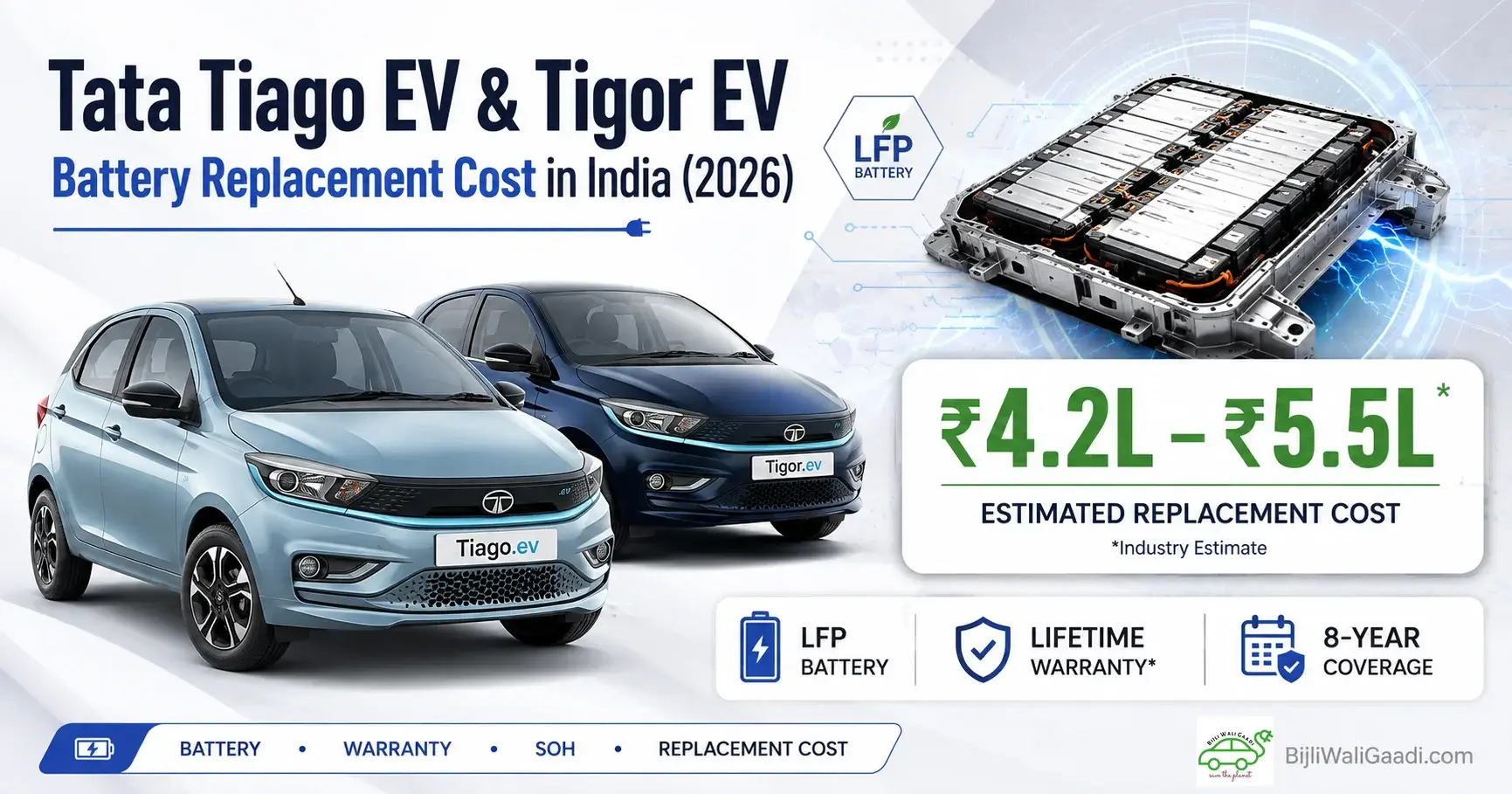
Quick Summary: The Tata Tiago EV runs on a 19.2 kWh or 24 kWh LFP battery, while the Tigor EV uses a larger 26 kWh LFP pack — both built on Tata’s Ziptron architecture. The 24 kWh Tiago.ev carries Tata’s official Lifetime HV Battery Warranty (unlimited km for the first owner); the 19.2 kWh Tiago and the Tigor EV continue on Tata’s standard 8-year/1,60,000 km cover. Industry estimates put the Tata Tiago EV battery replacement cost at roughly ₹4,20,000–₹5,50,000 (part cost estimate) once outside warranty — confirm the current quotation with an authorised Tata Motors EV service centre.
There’s a specific anxiety that sets in around year six or seven of EV ownership in India — right when the odometer clears six figures and the “8-year warranty” sticker starts feeling like a countdown. Tiago EV and Tigor EV owners generally have it easier than owners of bigger SUVs, simply because the pack is smaller — lower absolute replacement bill, though a higher estimated cost per kWh, as we’ll get into. This is a numbers-first look at what a Tata Tiago EV battery replacement price is estimated to run, what actually triggers a replacement under Tata’s official warranty terms, and how the Indian climate treats an LFP pack over a decade of ownership. It pairs well with our broader guide to the hidden costs of EV ownership in India, since battery replacement is just one line item in the real cost-of-ownership picture.
Key Specification & Battery Cost at a Glance
| Parameter | Technical Specification |
| Vehicle Model | Tata Tiago EV (MR/LR) & Tigor EV |
| Battery Pack Capacity | 19.2 kWh (Tiago.ev Medium Range) / 24 kWh (Tiago.ev Long Range) / 26 kWh (Tigor.ev) |
| Cell Chemistry / Tech | LFP (Lithium Iron Phosphate), Ziptron platform |
| Factory Warranty | Tiago.ev 24: Lifetime* HV battery warranty (1st owner) / 8 Yrs / 1,60,000 km (subsequent owners). Tiago.ev 19.2 & Tigor.ev: 8 Yrs / 1,60,000 km |
| Est. Replacement Cost (Part Only, Out-of-Warranty) | ₹4,20,000 – ₹5,50,000 (industry estimate) |
| Estimated Cost per kWh | ≈ ₹17,500 – ₹28,600 (indicative) |
| Thermal Management | Air-cooled battery thermal management system |
See “OEM Warranty Terms” below for the full Lifetime HV Battery Warranty conditions. All cost figures in this article are industry/editorial estimates, not official Tata Motors pricing — see the Disclaimer near the end for the full explanation, stated once for the whole article.
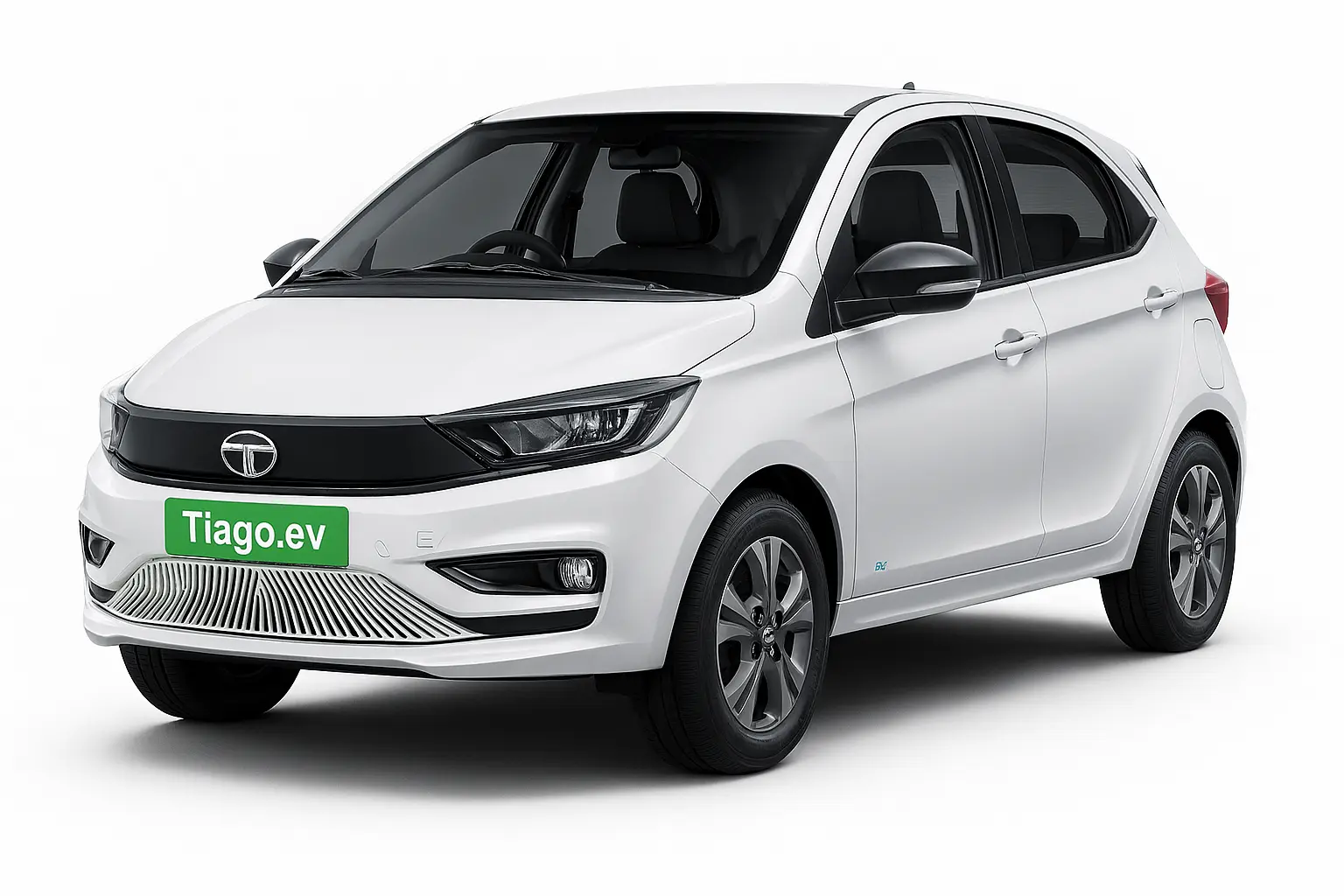
Detailed Battery Replacement Cost Breakdown for Tiago EV & Tigor EV
In short: Tata doesn’t publish an official battery replacement price, so the ₹4,20,000–₹5,50,000 range here is a directional industry estimate — your actual invoice depends on variant, location, and dealership.
Tata Motors does not publish an official, nationwide out-of-warranty battery pack replacement price on its website or in its brochures. The range discussed in this article is drawn from quotations reported by owners and service advisors through authorised Tata Motors service channels.
The final customer invoice can move depending on dealership pricing, labour charges, diagnostics, software calibration, regional pricing, vehicle variant, and model year. As a general guide, actual invoices typically vary by approximately 5–8% from the estimated figures here.
On top of the Tata Tiago battery pack price itself, budget for a couple of additional line items:
- Diagnostic and BMS recalibration charges — typically a few thousand rupees at an authorised service centre, though this varies by location.
- Labour/fitment charges for a full pack swap, since the battery is a structural under-floor unit rather than a bolt-on part.
The only reliable way to get an exact number for your specific VIN and variant is a written estimate from an authorised Tata Motors EV service centre.
Cost Per kWh Analysis: The Tiago/Tigor pack works out to roughly ₹17,500–₹28,600 per kWh. This is an engineering-economics story, not a pricing one. Battery management systems, pack casing, thermal insulation, and busbar wiring cost roughly the same to engineer whether the pack holds 19 kWh or 45 kWh.
Smaller battery packs therefore spread these fixed engineering costs across fewer kilowatt-hours. That’s why their estimated replacement cost per kWh looks higher than a larger pack’s — a function of pack architecture, not cell pricing. (This is our editorial/engineering interpretation, not a cost breakdown Tata Motors has published.)
BaaS / Subscription vs Outright Purchase: Unlike the MG Windsor EV — sold with an official Battery-as-a-Service (BaaS) programme starting around ₹3.5/km for its 38 kWh pack, plus a lifetime warranty for the first owner — Tata does not currently offer a BaaS or battery-rental model on the Tiago EV or Tigor EV. Ownership here is strictly outright-purchase, which makes the warranty terms below more important, not less.
OEM Warranty Terms vs Out-of-Warranty Reality
In short: The 24 kWh Tiago.ev now has a Lifetime HV Battery Warranty for its first owner; the 19.2 kWh Tiago and the Tigor.ev remain on Tata’s standard 8-year/1,60,000 km cover, with replacement tied to a documented State-of-Health threshold rather than a simple range check.
Coverage Scope: Tata Motors’ official Lifetime HV Battery Warranty documentation (published on ev.tatamotors.com) confirms the Tiago.ev 24 (Long Range) now carries a Lifetime HV Battery Warranty with unlimited kilometres for the first private owner. “Lifetime” is formally defined as fifteen years from the vehicle’s first registration date.
If the car changes hands, coverage for the second (or subsequent) owner reverts to 8 years or 1,60,000 km from the original registration date — provided the ownership transfer is formally notified to Tata Passenger Electric Mobility Limited (TPEM). The Tiago.ev 19.2 (Medium Range) and the Tigor.ev are not listed among the models covered by the Lifetime HV Battery Warranty programme as of this writing, and continue on Tata’s standard 8-year/1,60,000 km battery cover. Buyers of these variants should confirm current terms with a dealership, since OEM warranty policies get revised periodically.
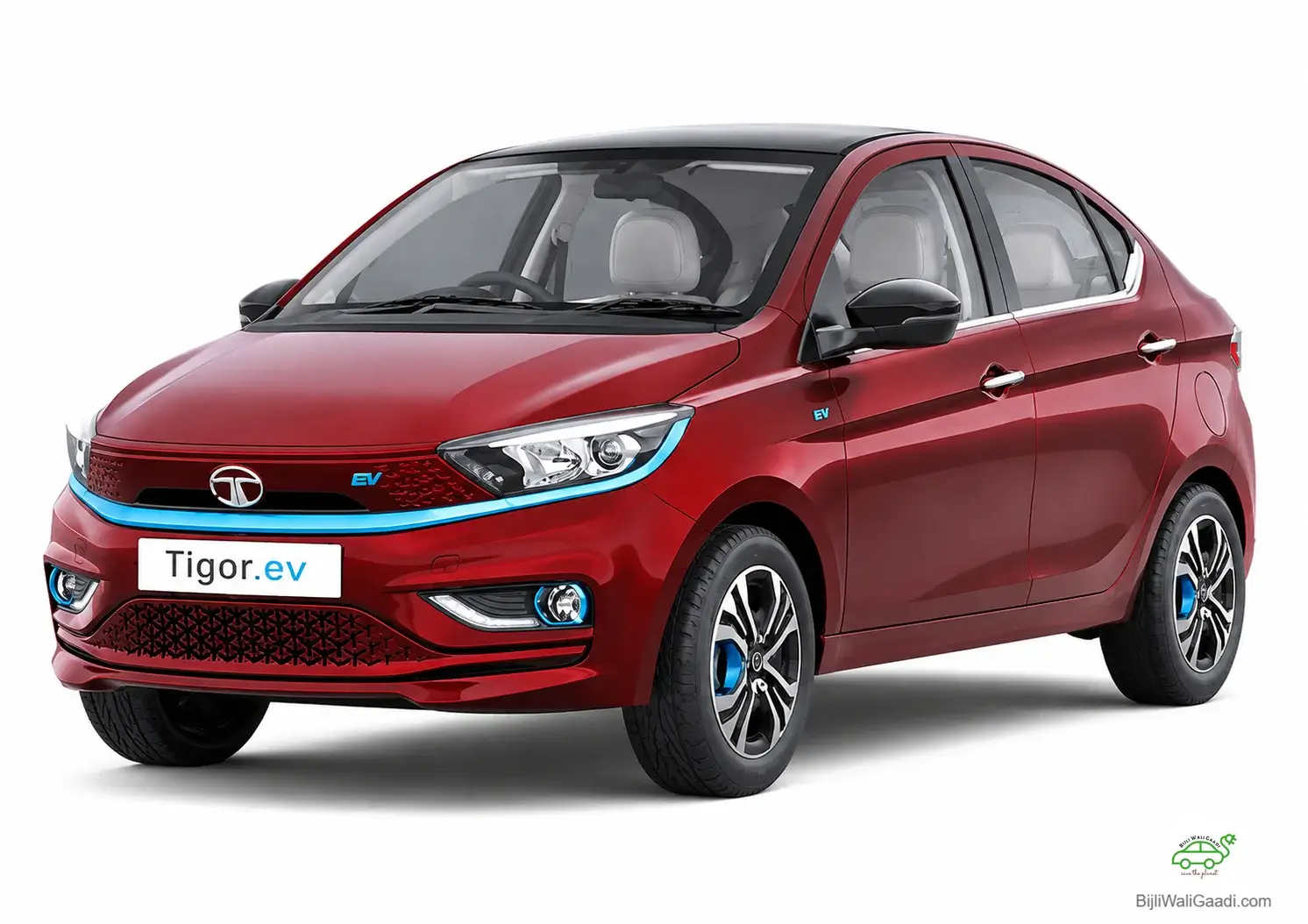
The warranty covers manufacturing defects and specified capacity-retention shortfalls. It is not an unlimited free-replacement guarantee for ordinary, expected battery aging.
State of Health (SOH) Threshold: Tata’s published Lifetime HV Battery Warranty terms state a specific figure. If the HV battery’s SOH falls below 70% of nominal energy during the warranty period, TPEM will repair or replace the pack to restore capacity to either the pre-repair steady-state SOH or 80% SOH, whichever is higher.
This 70% threshold is explicitly documented for the Lifetime HV Battery Warranty programme, which currently covers the Tiago.ev 24. Whether the same figure governs the standard 8-year/1,60,000 km warranty on the Tiago.ev 19.2 and Tigor.ev isn’t separately spelled out in the same public document. Either way, the practical takeaway is the same: range reduction alone does not automatically qualify a battery for warranty replacement. Replacement decisions rest on Tata’s authorised diagnostic procedure and your vehicle’s official warranty terms, not a simple range comparison.
Warranty Conditions Worth Understanding: Tata’s published terms don’t frame this as a list of instant “void triggers” so much as a set of conditions that can affect coverage:
- Using chargers that don’t meet Tata’s recommended specifications for the Ziptron/LFP architecture.
- Improper electrical modifications to the HV system or battery enclosure.
- Unauthorised alterations that damage the battery pack — for instance, compromising the enclosure’s structural or water-sealing (IP67) integrity.
It’s inaccurate to say any single third-party charging accessory automatically voids the warranty. What matters, per the general structure of OEM EV warranties including Tata’s, is whether a device or modification causes damage or falls outside recommended specifications.
On Deep Discharge: This is a matter of general battery care, not a specific, publicly documented Tata warranty clause. Repeatedly running any lithium-ion pack, including LFP, down to very low charge levels before recharging is understood to add stress over the pack’s lifetime. LFP tolerates this considerably better than NMC does, but as good practice, most manufacturers — Tata included, per general Ziptron guidance — recommend avoiding habitual deep discharge and topping up regularly instead.
When Does a Battery Actually Need Replacement?
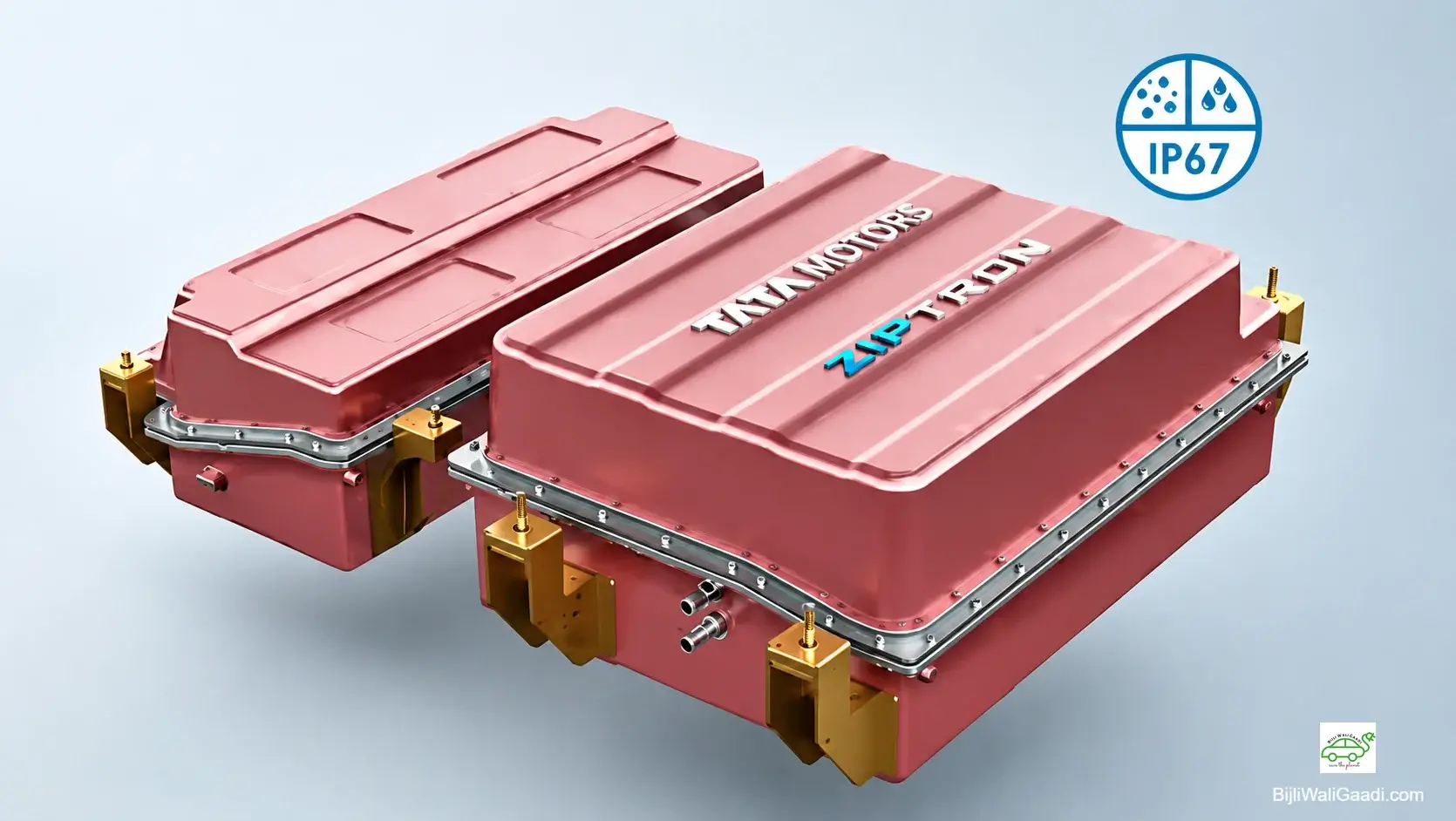
In short: Degradation alone rarely triggers a replacement — it’s usually damage, a hard fault, or a documented SOH breach that does.
A common misconception is that any noticeable Tiago EV battery health decline means an imminent, expensive replacement. In practice, gradual capacity fade is normal aging, and the vehicle keeps working fine at reduced range. Replacement typically becomes necessary because of one of these more specific triggers instead:
- SOH falling below the documented warranty threshold (70% under the Lifetime HV Battery Warranty terms).
- Accident damage to the battery pack or its enclosure.
- Internal battery failure, such as a cell-level fault detected by the BMS.
- Water ingress beyond the pack’s IP-rated tolerance.
- Isolation faults in the high-voltage system.
- Severe cell imbalance that the BMS can no longer safely manage.
- Physical enclosure damage from underbody impacts or off-road use.
- BMS failure itself, in rare cases, if it can no longer reliably manage the pack.
The key point: gradual, expected degradation and an outright replacement are two different things. One is normal; the other needs a diagnostic-confirmed reason.
Indian Tropical Climate & Battery Longevity Factors
In short: LFP handles Indian heat better than NMC chemistry does, though Tata’s Tiago/Tigor thermal management is air-cooled rather than liquid-cooled, and expected SOH retention is an editorial estimate, not an OEM figure.
To keep this section honest, it’s worth separating three kinds of claims: what battery engineering tells us in general, what real-world Indian ownership data suggests, and what Tata Motors has officially stated.
Engineering Understanding: LFP chemistry — used in both the Tiago EV and Tigor EV — is well understood in battery engineering literature to be more thermally stable than NMC. It has a higher thermal runaway threshold and generally slower calendar-aging characteristics. This chemistry-level behaviour is broadly consistent with published findings from internationally recognised battery research organisations such as the U.S. National Renewable Energy Laboratory (NREL), the International Energy Agency (IEA), and the U.S. Department of Energy (DOE) — all of which have documented LFP’s comparatively favourable thermal and calendar-aging profile relative to NMC.
Real-World Observations: Indian summer ambient temperatures of 40°C–48°C in cities like Delhi, Nagpur, and Jodhpur are widely reported by owners and independent reviewers to accelerate calendar degradation in EV battery packs generally — especially with prolonged direct-sun parking followed immediately by charging. Anecdotal owner reports, including one widely shared account of a Tigor EV crossing 2.26 lakh km with reportedly minimal performance loss, suggest Tata’s LFP packs are holding up reasonably well under Indian conditions. Individual accounts aren’t a substitute for large-sample degradation data, though — and Tata Motors hasn’t publicly released that for the Tiago/Tigor line.
Official OEM Statement: The Tiago EV and Tigor EV use what Tata Motors describes as an air-cooled battery thermal management system, distinct from the more extensive cooling architecture on some of Tata’s larger EVs. Tata hasn’t published a specific SOH-retention figure at a defined mileage for these two models.
Editorial Estimate: Based on general Indian usage patterns — frequent short trips, ambient heat exposure, and mostly AC (rather than DC fast) charging — a reasonable estimated real-world expectation is 80–85% SOH retention around the 5-year/1,00,000 km mark. This is our editorial estimate based on typical LFP degradation behaviour and available anecdotal data, not an OEM-published figure. Actual results will vary by usage, climate, and charging habits.
Module-Level Repair vs Full Pack Replacement: What Owners Need to Know
In short: As of 2026, authorised Tata workshops replace the complete pack rather than repairing individual modules — module-level repair exists only outside the OEM network.
Cell/Module Swap Capability: Tata Motors workshops do replace the module sometime depending upon the battery type and diagnostic report.
Third-Party Repair Ecosystem: A limited number of specialised EV battery repair companies advertise module-level or cell-level repairs for LFP packs, particularly in Delhi-NCR, Pune, and Bengaluru — though these operate outside the authorised Tata Motors service network. Using them typically forfeits any remaining OEM warranty, and BMS recalibration quality varies significantly between providers. This remains a niche, not a mainstream, repair pathway in India today.
Salvage & Recycling Credit: Degraded EV packs that no longer meet in-vehicle performance thresholds often retain meaningful residual capacity, making them candidates for second-life stationary Energy Storage System (ESS) applications. India’s formal battery buyback and recycling-credit market is still developing, and Tata Motors hasn’t published a standard buyback schedule for Tiago/Tigor packs specifically. Actual salvage value is best confirmed directly with an authorised recycler or dealership at the time of replacement.
Comparative Snapshot: Tiago EV, Tigor EV & Related Tata/MG Models
| Vehicle | Battery Capacity | Estimated Battery Replacement Cost* | Warranty |
| Tata Tiago.ev (MR) | 19.2 kWh LFP | ≈ ₹4,20,000 – ₹4,80,000 (estimate) | 8 Yrs / 1,60,000 km |
| Tata Tiago.ev (LR) | 24 kWh LFP | ≈ ₹4,80,000 – ₹5,50,000 (estimate) | Lifetime* (1st owner, unlimited km) / 8 Yrs / 1,60,000 km (subsequent owners) |
| Tata Tigor.ev | 26 kWh LFP | ≈ ₹5,00,000 – ₹5,80,000 (estimate) | 8 Yrs / 1,60,000 km |
| Tata Nexon.ev (45 kWh) | 45 kWh LFP | ≈ ₹8,20,000 – ~₹10,45,000 (estimate) | Lifetime* (1st owner, unlimited km) / 8 Yrs / 1,60,000 km (subsequent owners) |
| MG Windsor EV | 38 kWh LFP (Blade cell) | ≈ ₹6,00,000 (outright) or BaaS from ₹3.5/km (excl. charging) | Lifetime (1st owner) / 8 Yrs / 1,60,000 km (subsequent owners) |
Replacement cost figures above are editorial industry estimates for comparison only. Manufacturers generally don’t publish official, nationwide out-of-warranty battery replacement prices for these models — confirm current pricing with the respective vehicle’s authorised OEM service network.
TATA Tiago.ev and TATA Tigor.ev Specifications
| Parameter | Tiago.ev (MR) | Tiago.ev (LR) | Tigor.ev |
| Battery Capacity | 19.2 kWh | 24 kWh | 26 kWh |
| Cell Chemistry | LFP | LFP | LFP |
| Motor Peak Output | 45 kW PMSM (Ziptron) | 55 kW PMSM (Ziptron) | 55 kW PMSM (Ziptron) |
| Peak Torque | 110 Nm | 114 Nm | ~170 Nm |
| AC Charging (15A socket, 10–100%) | ~6.9 hours | ~8.7 hours | ~8.7 hours |
| DC Fast Charging | Supported | Supported | Supported |
| Claimed Range (MIDC/ARAI) | ~250 km (MIDC) | ~315 km (MIDC) | ~315 km (ARAI) |
| Factory Warranty | 8 Yrs / 1,60,000 km | Lifetime HV battery warranty (1st owner, unlimited km) / 8 Yrs / 1,60,000 km (subsequent owners) | 8 Yrs / 1,60,000 km |
A Realistic Ownership Cost Example
In short: Spread across a typical vehicle life, the eventual battery replacement works out to only a few rupees per km — useful context, not a Tata-published figure.
This is an editorial illustration, not an official Tata Motors calculation, but it helps put the headline replacement number in perspective.
Take a Tiago.ev LR (24 kWh) with an estimated mid-range battery replacement cost of about ₹5,15,000, and assume a realistic 12-year, 1,50,000 km ownership life before that replacement becomes necessary. Spread across the vehicle’s life, that works out to roughly ₹3.4 per km — just for the eventual battery line item, not the vehicle’s total running cost.
That framing matters for anyone weighing Tata EV maintenance cost against a comparable petrol Tiago: even a “worst case” battery swap, amortised over a long ownership period, adds a modest per-km cost once you set it against fuel savings and lower routine servicing. Your actual numbers will differ based on how long you keep the car, how it’s driven, and when (or whether) a replacement is ever actually needed.
Should You Worry About EV Battery Replacement?
A quick decision guide for gauging where you stand:
| Condition | What It Generally Means |
| Vehicle age < 5 years | No concern — well within typical LFP performance and warranty coverage. |
| Vehicle age 5–8 years | Check SOH occasionally via an authorised service centre. |
| SOH above 85% | Battery is generally healthy. |
| SOH 70–85% | Continue monitoring; no action typically required yet. |
| SOH below the documented warranty threshold | Visit an authorised Tata EV Service Centre for a diagnostic and warranty assessment. |
A Note on Ownership Cost & Related Reading
Battery replacement is the single biggest line item in Tiago EV ownership cost calculations over a 10–15 year horizon, but it’s rarely the only one — insurance premiums, tyre wear on a heavier EV chassis, and 12V auxiliary battery replacement all add up too. If you’re weighing a used Tata Tiago EV buying guide-style purchase, or comparing this against other Tata EV battery replacement costs across the brand’s lineup, our dedicated EV battery replacement cost in India guide is a useful companion for benchmarking the Tiago/Tigor numbers here against the Nexon, Punch, and rival brands.
Disclaimer
The battery replacement cost figures, per-kWh estimates, and degradation expectations in this article are indicative estimates compiled from industry quotations, owner-reported figures, and editorial analysis — they are not official Tata Motors published prices. Readers are strongly encouraged to confirm the latest battery replacement quotation, warranty status, and SOH diagnostic results directly with an authorised Tata Motors EV service centre before making any purchase, resale, or repair decision.
Frequently Asked Questions (FAQs)
Stay connected via Google 'Electric Vehicle' News
Follow BijliWaliGaadi | India's Trusted EV Insights Portal
source on Google