Why China’s Sodium-Ion HD Truck Breakthrough Matters for India

Sodium-ion Battery Truck | Sodium-ion Battery Technology | FAW Jiefang EV Truck | Heavy-duty electric trucks

China’s commercial vehicle sector just crossed a critical threshold. In mid-2026, FAW Jiefang — the nation’s largest heavy-duty truck manufacturer — and sodium-ion battery specialist HiNa Battery completed nearly seven months of all-scenario road testing on a sodium-ion-powered electric tractor. The results are reshaping the global calculus for electric heavy trucking, with direct implications for India.
What Is the FAW Jiefang and HiNa Battery Sodium-Ion Truck Trial?
The trial centred on a FAW Jiefang J6P new energy pure electric tractor equipped with a 339 kWh high-capacity sodium-ion battery pack developed by HiNa Battery. Over approximately seven months of continuous testing, the vehicle accumulated more than 15,000 km of cumulative road mileage across diverse operating environments.
What Are the Key Technical Results From the FAW Jiefang Sodium-Ion Truck Test?
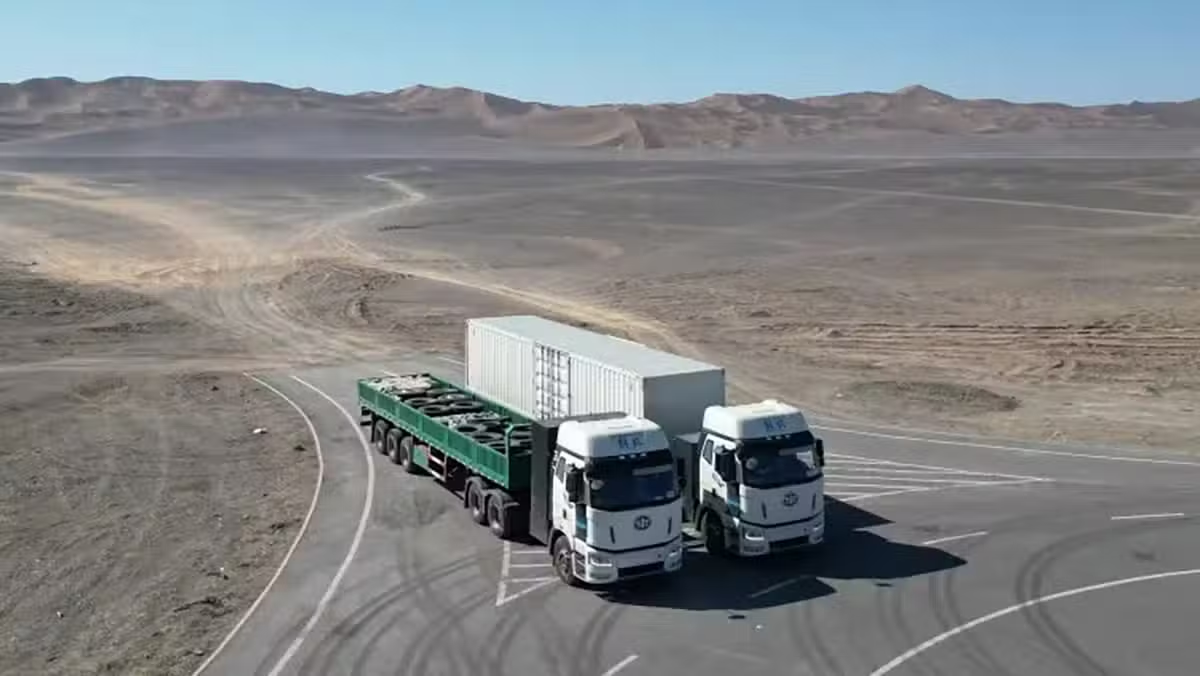
Three headline metrics define this trial’s significance: 90%-plus usable capacity retention at −40°C, full charging in just 20–25 minutes, and a cycle life exceeding 8,000 cycles under fast-charging conditions. These figures collectively address the three biggest barriers to heavy-duty electric truck adoption — cold-weather degradation, slow charging downtime, and premature battery replacement costs.
What Battery Chemistry Does HiNa Use in Its Sodium-Ion Cells?
HiNa Battery’s cells are built around a sodium-copper-iron-manganese-oxide (Na-Cu-Fe-Mn-O) cathode and an anthracite-based soft carbon anode. This chemistry achieves an energy density of 155–165 Wh/kg. The company holds core patents across cathode materials, anode materials, and manufacturing processes, making it one of the few vertically integrated sodium-ion cell developers globally.
How Does Sodium-Ion Stability Compare to Lithium Plating Risks?
Sodium-ion anodes using soft carbon are inherently dendrite-free under normal operating conditions. Unlike graphite anodes in lithium-ion cells — where lithium plating during fast charging can cause internal short-circuits — soft carbon’s disordered structure accommodates rapid sodium-ion insertion without metallic deposition. This structural advantage directly enables HiNa’s validated 20-minute charging without compromising cell integrity or thermal safety.
Why Does China’s 2030 New Energy Heavy Truck Policy Make Sodium-Ion Batteries Strategically Critical?
Eleven Chinese government departments — including the Ministry of Transport and the National Development and Reform Commission — jointly released an implementation plan targeting 40% new energy penetration in heavy-duty trucks by 2030. That translates to over 1.6 million NE-HDTs, representing roughly 20% of all heavy-duty trucks on Chinese roads. Sodium-ion technology is now positioned as a complementary chemistry to LFP for this buildout.
How Does Sodium-Ion Battery Performance Compare to LFP in Cold-Weather Heavy Trucking?
LFP batteries suffer significant capacity loss below −20°C due to sluggish lithium-ion kinetics in the electrolyte. Sodium-ion chemistry inherently resists this degradation because sodium ions move more freely at sub-zero temperatures. The FAW-HiNa trial demonstrated over 90% usable capacity at −40°C — a benchmark that LFP packs at equivalent energy capacity have historically failed to match without expensive thermal management systems.
What Are the Thermal Runaway Thresholds of HiNa’s Na-Cu-Fe-Mn-O Chemistry?

HiNa’s Na-Cu-Fe-Mn-O cathode chemistry exhibits superior thermal stability versus NMC equivalents, with onset-of-decomposition temperatures exceeding 300°C — well above the 200–250°C range where NMC cathodes begin exothermic breakdown. The soft carbon anode does not alloy with sodium, eliminating a primary exothermic failure mode. These thresholds make HiNa’s cells significantly safer under mechanical abuse and overcharge conditions.
How Does the 90% Cold-Weather Retention at −40°C Solve India’s High-Altitude Logistics Problem?
India’s most demanding freight corridors are not urban highways — they are the Himalayan supply lines servicing Ladakh, Sikkim, Arunachal Pradesh, and defense forward bases above 4,000 metres. Winter temperatures on the Manali–Leh Highway or the Zojila Pass routinely drop below −25°C. Conventional LFP trucks face range reductions of 30–40%, making them logistically unreliable for military and civilian cold-chain operations.
Can Sodium-Ion Batteries Power Indian Defense Logistics on Himalayan Routes?
The FAW Jiefang trial data answers this directly: a 339 kWh sodium-ion pack retaining over 90% capacity at −40°C means a truck spec’d for 400 km in temperate conditions will still deliver approximately 360 km at extreme altitude cold. For the Indian Army’s Project Himank operations and BRO supply convoys — where diesel dependency creates both cost and strategic vulnerability — this is a transformational specification.
Why Sodium-Ion Batteries Are Ideal for India’s Cold-Chain and Pharmaceutical Logistics
India’s cold-chain freight sector, valued at over ₹2,000 crore and growing at 14% annually, operates refrigerated trucks that simultaneously power cargo units and propel the vehicle. Sodium-ion’s inherent thermal stability and flat discharge curve at low temperatures make it superior to NMC or LFP alternatives for reefer truck applications — without requiring energy-intensive battery heating systems that erode payload range across Himalayan corridors.
Payload vs. Cost: The Honest Trade-Off Analysis of Sodium-Ion vs. Lithium in Indian Fleet Economics
Sodium-ion technology at 155–165 Wh/kg carries a measurable weight penalty versus NMC lithium-ion cells (250–300 Wh/kg) and even versus LFP (170–190 Wh/kg). For a 339 kWh truck pack, this means a heavier battery system that modestly reduces net payload capacity. Indian fleet operators running 49-tonne GVW tractor-trailers on NH-44 or the Golden Quadrilateral must factor this differential carefully into load planning.
Battery Chemistry Comparison — 2026 Commercial Status
| Battery Metric (2026 Status) | HiNa Sodium-Ion (Na-ion) | Conventional LFP | Premium NMC |
| Energy Density | 155–165 Wh/kg | 170–190 Wh/kg | 250–300 Wh/kg |
| Capacity Retention at −40°C | 90%+ | < 50% (needs heavy TMS) | ~60–70% |
| Fast Charging (10–80%) | 20–25 Mins | 40–50 Mins | 30–40 Mins |
| Estimated Cycle Life | 8,000+ Cycles | 4,000–6,000 Cycles | 2,000–3,000 Cycles |
| Target Cell Cost (Scale) | $40–$50 / kWh | $65–$80 / kWh | $90–$110 / kWh |
Table 1: Key performance and cost metrics across sodium-ion, LFP, and NMC chemistries relevant to Indian heavy-duty fleet procurement.
Does Sodium-Ion’s 8,000-Cycle Life Justify the Weight Penalty for Indian Fleet Operators?
The Total Cost of Ownership (TCO) calculation strongly favours sodium-ion for high-utilisation fleets. An 8,000-cycle life under fast-charging conditions — assuming one cycle per day — translates to over 21 years of calendar life, far exceeding the 7–10 year operational lifespan of a commercial truck. Combined with 20-minute recharging that minimises idle time at logistics hubs, the per-kilometre cost economics become compelling even after accounting for the payload trade-off.
Sodium-Ion Battery Cost Advantage: What Indian Fleet Managers Need to Know in 2026
As comprehensively analysed by BijliWaliGaadi’s 2026 Sodium-Ion Battery Market Outlook, sodium-ion cell costs are converging toward the $40–50/kWh range at scale — meaningfully below current LFP pricing in India after import duties. Sodium’s raw material abundance eliminates cobalt and lithium price volatility that has plagued Indian EV fleet procurement. For logistics companies running 50–500 truck fleets, predictable battery replacement costs over a decade-long operational cycle are a decisive balance-sheet advantage.
How Do Sodium-Ion Battery Lifespans Align with India’s Vehicle Scrappage Policy?
India’s commercial vehicle scrappage policy mandates deregistration after 15 years for goods carriers. A sodium-ion pack with an 8,000-cycle life and one charge per operational day outlasts the truck’s entire registration window by a substantial margin. This means fleet operators can — in principle — harvest and repurpose end-of-vehicle battery packs for stationary grid storage, dramatically improving asset return on investment and reducing effective battery cost per kilometre.
What Megawatt Charging Infrastructure Is Needed for 20-Minute Heavy Truck Charging in India?
A 339 kWh sodium-ion pack charged to 80% in 20 minutes demands a sustained peak power draw of approximately 800 kW to 1 MW per truck. Deploying this at Indian highway logistics parks — such as those along NH-48 or the Delhi–Mumbai Expressway — requires dedicated feeder connections, battery-buffered charging stations, or on-site renewable energy microgrids. NHAI’s emerging EV corridor framework must explicitly plan for megawatt-class charger infrastructure to enable sodium-ion HDT operations at commercial scale.
How Sodium-Ion Batteries Can Reduce India’s Lithium Import Dependency and Strengthen Supply Chain Security
India currently imports over 95% of its lithium requirements, primarily from Australia and Chile, with cell manufacturing concentrated in China. This dependency exposes Indian EV fleet operators — and India’s broader electrification ambitions under the PM e-DRIVE scheme — to geopolitical supply disruptions and currency-driven cost volatility. Sodium-ion chemistry offers a structurally different and strategically superior supply equation.
Why India’s Abundant Raw Materials Make Sodium-Ion Battery Manufacturing Viable Domestically
Sodium, the sixth most abundant element on Earth, can be derived from sodium carbonate (soda ash) — a material India produces domestically in significant quantities, particularly in Gujarat. The anthracite-based soft carbon anode in HiNa’s cells has potential sourcing from India’s coal derivatives sector. A domestic sodium-ion manufacturing ecosystem, seeded by technology partnerships with HiNa, could position India as both a self-sufficient EV battery market and a regional export hub.
Why Are Sodium-Ion Batteries Easier to Recycle in the Indian Domestic Market?
Sodium-ion cells contain no lithium, cobalt, or nickel — the three heavy metals driving end-of-life hazardous waste complexity in conventional EV battery recycling. India’s nascent EV battery recycling ecosystem, currently straining to handle LFP and NMC black mass, would face far lower regulatory, metallurgical, and capital barriers processing sodium-ion packs. The absence of high-value heavy metals also reduces theft-driven informal dismantling, a persistent problem in India’s recycling supply chain.
Which Indian Battery Manufacturers Are Best Positioned to Adopt Sodium-Ion Technology?
India’s PLI framework for Advanced Chemistry Cells (ACC) was designed with lithium-ion in mind, but its technology-neutral provisions allow sodium-ion chemistry to qualify. Companies such as Amara Raja Energy & Mobility, Exide Energy Solutions, and Tata Group’s battery ventures have the electrochemical manufacturing expertise and capital base to license or co-develop sodium-ion cell production — mirroring India’s pharmaceutical generic-scaling model.
How Can India’s PM e-DRIVE Scheme Incentivize Sodium-Ion Commercial Fleets?
India’s PM e-DRIVE scheme currently prioritises electric two-wheelers, three-wheelers, and buses for demand-side subsidies. A targeted extension to heavy-duty commercial trucks using sodium-ion battery packs — with a performance threshold tied to cold-weather retention and cycle life — would align procurement incentives with India’s dual strategic objectives of freight decarbonisation and domestic battery supply chain independence. A phased 2027–2030 implementation timeline maps directly onto projected sodium-ion HDT commercial availability windows.
What Does the FAW Jiefang–HiNa Trial Mean for the Future of Sodium-Ion EV Trucks Globally?
The FAW Jiefang J6P trial is not a proof-of-concept experiment — it is a commercial validation programme. A 15,000 km, seven-month all-scenario test on a production-representative vehicle, yielding bankable performance data across extreme cold, rapid charging, and high-cycle-count conditions, constitutes the technical dossier needed for fleet procurement decisions. CATL, BYD, and other major sodium-ion developers are assessing their own HDT roadmaps using this data.
When Will Sodium-Ion Heavy-Duty Electric Trucks Reach Commercial Availability?
China’s 2030 HDT electrification targets, combined with the technical maturity demonstrated by the FAW-HiNa trial, suggest commercial availability of sodium-ion HDTs within the 2027–2028 timeframe for China’s domestic market. For India, the pathway is linked to import cost dynamics and domestic ACC PLI scale-up. Given accelerating EV freight policy signals, the window for meaningful sodium-ion truck deployment in India opens between 2028 and 2030.
Key Takeaway: Why Sodium-Ion Battery Technology Is the Most Consequential EV Development for Indian Logistics in 2026
The FAW Jiefang and HiNa Battery trial delivers a precise, data-backed answer to the hardest questions in electric heavy trucking: performance at extreme cold, charging speed at scale, and long-term durability under commercial-cycle conditions. For India — navigating the twin imperatives of freight decarbonisation and strategic supply chain independence — sodium-ion technology is not a future option. It is an actionable priority demanding immediate policy attention, manufacturing investment, and fleet procurement planning from both public and private sectors.