TATRA’s First Hybrid Truck Can Drive Up to 70 km on Electricity
Stay connected via Google 'Electric Vehicle' News
Follow BijliWaliGaadi | India's Trusted EV Insights Portal
source on Google
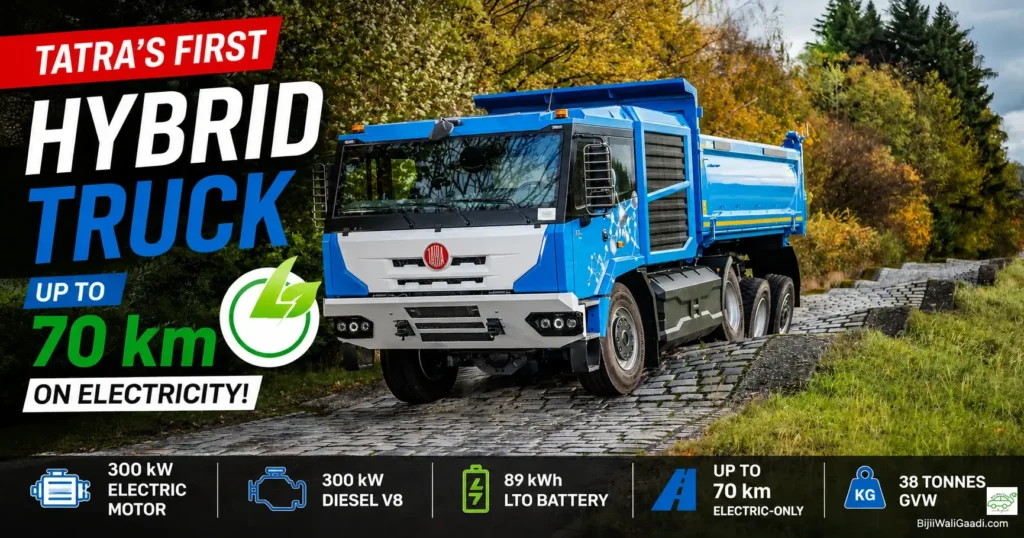
Quick summary: The TATRA FORCE e-DRIVE Hybrid is TATRA’s first hybrid-drive truck — an 8×8 prototype built as a parallel plug-in hybrid. It combines a 300 kW diesel V8 with a 300 kW/500 kW Danfoss electric motor and an 89 kWh LTO traction battery, giving it up to 70 km of electric-only driving alongside full diesel capability.
A heavy-duty TATRA truck can now cover the final stretch of a job site in silence, on electricity alone, before switching back to diesel for the terrain that made TATRA’s name. That is the TATRA FORCE e-DRIVE Hybrid, an 8×8 prototype and TATRA’s first truck built with a hybrid drive. It pairs a diesel engine with an electric motor and an LTO traction battery in a parallel plug-in hybrid layout, and TATRA states it can travel up to 70 km on electric power alone — a genuinely useful capability in a segment defined by torque and off-road capability rather than electrification.
What Is the TATRA FORCE e-DRIVE Hybrid Truck?
TATRA FORCE e-DRIVE is a development platform, not a single vehicle. TATRA TRUCKS uses the name for several alternative-powertrain paths built on its FORCE heavy-duty truck: a battery-electric vehicle (BEV), a hydrogen fuel-cell vehicle (FCEV), a battery-electric vehicle with a range extender (BEV REX), and the plug-in hybrid covered here. The programme began in 2023 and spans chassis configurations from 4×4 to 8×8.
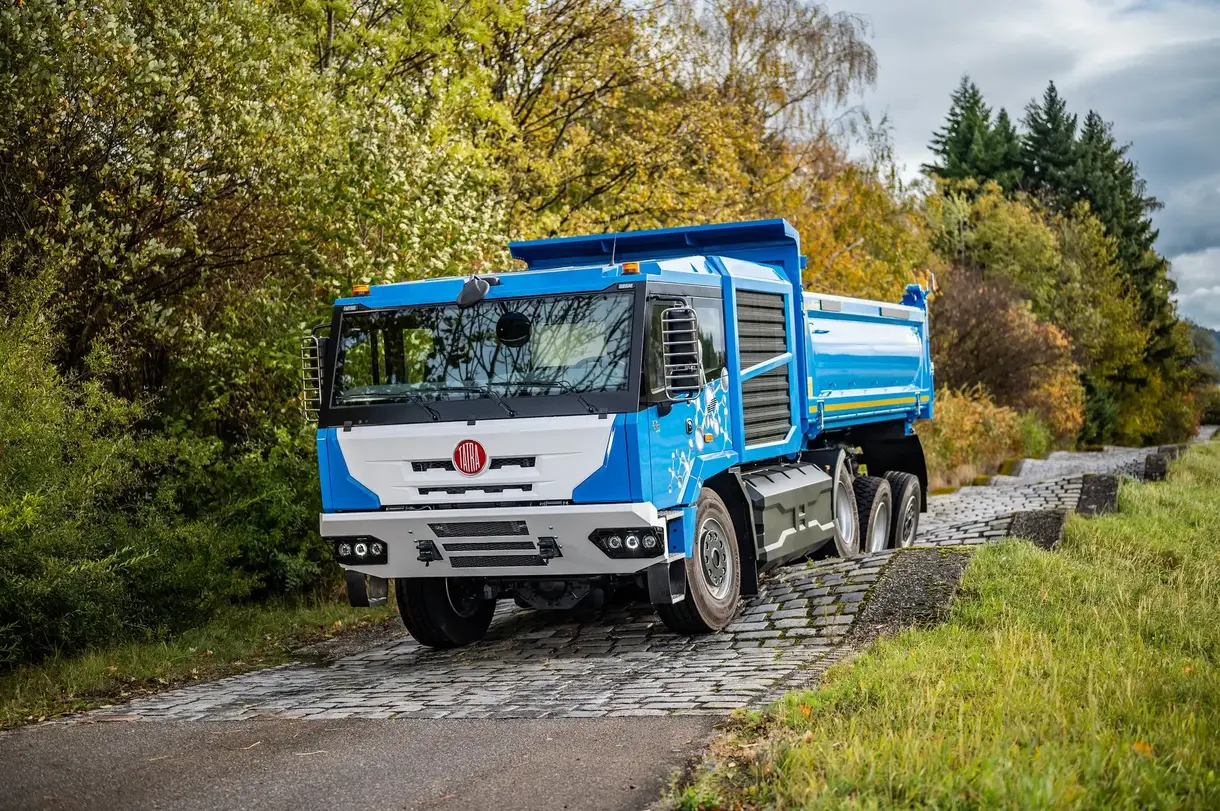
The vehicle TATRA identifies as its first hybrid-drive truck is a distinct 8×8 development vehicle, separate from the TATRA FORCE e-DRIVE FCEV — a hydrogen fuel-cell prototype built on an 8×6 chassis. The hybrid keeps a diesel engine as one of two power sources and adds an electric motor and traction battery alongside it, so the truck can run on diesel, on electricity, or on both together. As a prototype, it is a development and demonstration vehicle rather than a truck currently offered for general sale.
How Does TATRA’s Hybrid Powertrain Work?
TATRA describes the system as a parallel plug-in hybrid: the diesel engine and electric motor are connected so that either can drive the wheels independently, or both can work together through the same drivetrain. In practice, that gives the truck three operating modes — electric motor alone, diesel engine alone, or diesel and electric power combined for maximum torque and traction.
The diesel side is an air-cooled TATRA V8 producing 300 kW and 2,100 Nm of torque, TATRA’s traditional engine architecture for extreme-duty applications. The electric side uses a Danfoss EM-PMI375-T1100 permanent-magnet synchronous motor, rated at 300 kW continuous and 500 kW peak output, with 2,400 Nm of torque — enough to move the truck under electric power alone without help from the diesel engine. Power for the electric motor comes from an 89 kWh lithium-titanate-oxide (LTO) traction battery, sent to the wheels through an Allison 4900 seven-speed automatic transmission paired with TATRA’s own step-down gearbox, across a full 8×8 drivetrain.
| Specification | TATRA FORCE e-DRIVE Hybrid 8×8 |
| Vehicle type | Parallel plug-in hybrid prototype |
| Diesel engine | TATRA air-cooled V8 |
| Diesel output | 300 kW |
| Diesel torque | 2,100 Nm |
| Electric motor | Danfoss EM-PMI375-T1100 PMSM |
| Electric output | 300 kW continuous / 500 kW peak |
| Electric motor torque | 2,400 Nm |
| Battery chemistry | LTO |
| Battery capacity | 89 kWh |
| Transmission | Allison 4900, 7-speed automatic |
| Drivetrain | 8×8 |
| Electric-only driving | Up to 70 km |
| Maximum GVW | Up to 38 tonnes |
| Payload | 22 tonnes |
The choice of LTO — lithium-titanate-oxide — chemistry is notable in itself. LTO cells trade some energy density for high power delivery and robustness, characteristics that matter more in a heavy-duty truck subjected to repeated hard acceleration, heavy loads and demanding duty cycles than raw range does. TATRA has not published cycle-life, charging-time or long-term durability figures for this battery, so those characteristics should be understood as general properties of LTO chemistry rather than confirmed performance claims for this specific pack.
Why Up to 70 km of Electric-Only Driving Matters
On its own, “up to 70 km” says little. In context, it says a great deal, because heavy-duty trucks regularly operate where a running diesel engine is unwelcome:
Electric-only driving doesn’t need to cover long distances to be useful — it needs to cover the segment of a route or task where diesel power is undesirable. TATRA frames its electric-only mode this way: locally emission-free, very quiet, and with a reduced thermal footprint, suited to urban and environmentally sensitive operation. The 70 km figure is TATRA’s stated capability, not an independently verified real-world range, and actual electric-only distance will vary with payload, terrain and driving conditions like any other truck specification.
TATRA’s Backbone Chassis Remains Central to the Hybrid System
What separates TATRA from most heavy-duty builders isn’t the drivetrain — it’s the chassis. TATRA’s design, known as TATRA-Mobility, is built around a backbone tube chassis with an integrated auxiliary transmission, swinging half-axles, and air suspension. The architecture is engineered to maintain structural rigidity along the central tube while allowing each independently suspended axle to articulate freely over uneven or extreme terrain — the combination behind TATRA’s reputation off-road.
TATRA’s stated philosophy across the e-DRIVE range, hybrid included, is to preserve this chassis concept rather than build an electrified truck around a different structure. On its hydrogen prototype, TATRA has described positioning the traction electric motor in a protected zone above the backbone tube so the added hardware doesn’t compromise chassis rigidity — a principle carried across the e-DRIVE family. The engineering challenge isn’t building an electric or hybrid truck in the abstract; it’s integrating a substantial hybrid powertrain into an established chassis architecture without altering what makes it work off-road.
Hybrid vs Hydrogen vs Battery-Electric TATRA: Why the Difference Matters
TATRA’s e-DRIVE name covers several mechanically distinct development vehicles, and conflating their specifications is easy to do but technically wrong.
| Powertrain | Primary Energy Source | Key Characteristic |
| Hybrid | Diesel + electricity | Parallel plug-in hybrid; diesel engine and electric motor can drive independently or together; up to 70 km electric-only |
| FCEV | Hydrogen + fuel cells | Onboard hydrogen tanks feed fuel cells generating electricity for a traction motor; built as an 8×6 prototype |
| BEV | Battery electricity | Fully battery-electric propulsion, no onboard combustion engine |
| BEV REX | Battery + range extender | Battery-electric drive with a diesel or hydrogen-gas engine acting purely as a range extender |
These are not interchangeable trims of one product but separate development paths sharing a platform name. The TATRA FORCE e-DRIVE FCEV, built on an 8×6 off-road chassis, uses its own fuel-cell system and battery pack, entirely distinct from the hybrid’s 89 kWh LTO battery. The hybrid, by contrast, is the 8×8 vehicle TATRA identifies as its first hybrid-drive truck, and its specifications — the 300 kW diesel V8, the 300/500 kW Danfoss motor, the 89 kWh LTO pack — belong to it alone.
What the Hybrid TATRA Means for Heavy-Duty Electrification
For this specific prototype, the case for hybridisation rests on combining strengths rather than choosing between them. The diesel engine supplies the range and continuous torque heavy-duty operation demands; the electric motor and LTO battery supply genuinely emission-free, quiet running exactly where that matters — inside a low-emission zone, on a sensitive site, or during an early shift near housing. The parallel layout means the truck can also call on both power sources together when maximum traction is needed, rather than treating electrification as a compromise on capability.
TATRA has not published fuel-consumption savings, operating-cost figures, or a production timeline for this prototype, and none of those should be assumed from the specifications above. What the hardware does confirm is that TATRA has built a heavy-duty hybrid powertrain substantial enough to move the truck on electric power alone, not a token electrical assist bolted onto a conventional diesel driveline.
TATRA’s Bigger e-DRIVE Strategy
The FORCE e-DRIVE Hybrid is one branch of a broader development programme. TATRA’s own description of the e-DRIVE range places BEV, FCEV, plug-in hybrid, and BEV REX development paths alongside each other as parallel routes toward reduced local emissions, all built on the TATRA-Mobility chassis and sharing a newly developed electronic and electrical architecture. The hydrogen FCEV prototype exists to prove out fuel-cell propulsion; the hybrid exists to prove that a heavy-duty diesel truck can gain genuine electric-only capability without giving up the range and flexibility operators depend on.
Seen together, these prototypes show a specialist manufacturer testing several electrification routes in parallel rather than committing to one. The significance of the FORCE e-DRIVE Hybrid isn’t the addition of an electric motor in isolation — it’s that TATRA has integrated a substantial, capable hybrid powertrain into its established backbone-chassis architecture without changing what makes a TATRA a TATRA underneath.

Frequently Asked Questions
Stay connected via Google 'Electric Vehicle' News
Follow BijliWaliGaadi | India's Trusted EV Insights Portal
source on Google