Nissan Qashqai Travels 1,980 km on One Tank to Set New Guinness World Record
Stay connected via Google 'Electric Vehicle' News
Follow BijliWaliGaadi | India's Trusted EV Insights Portal
source on Google
Nissan Qashqai e-POWER | Nissan Qashqai 1980 km | Qashqai Guinness World Record | Qashqai hybrid | Nissan e-POWER
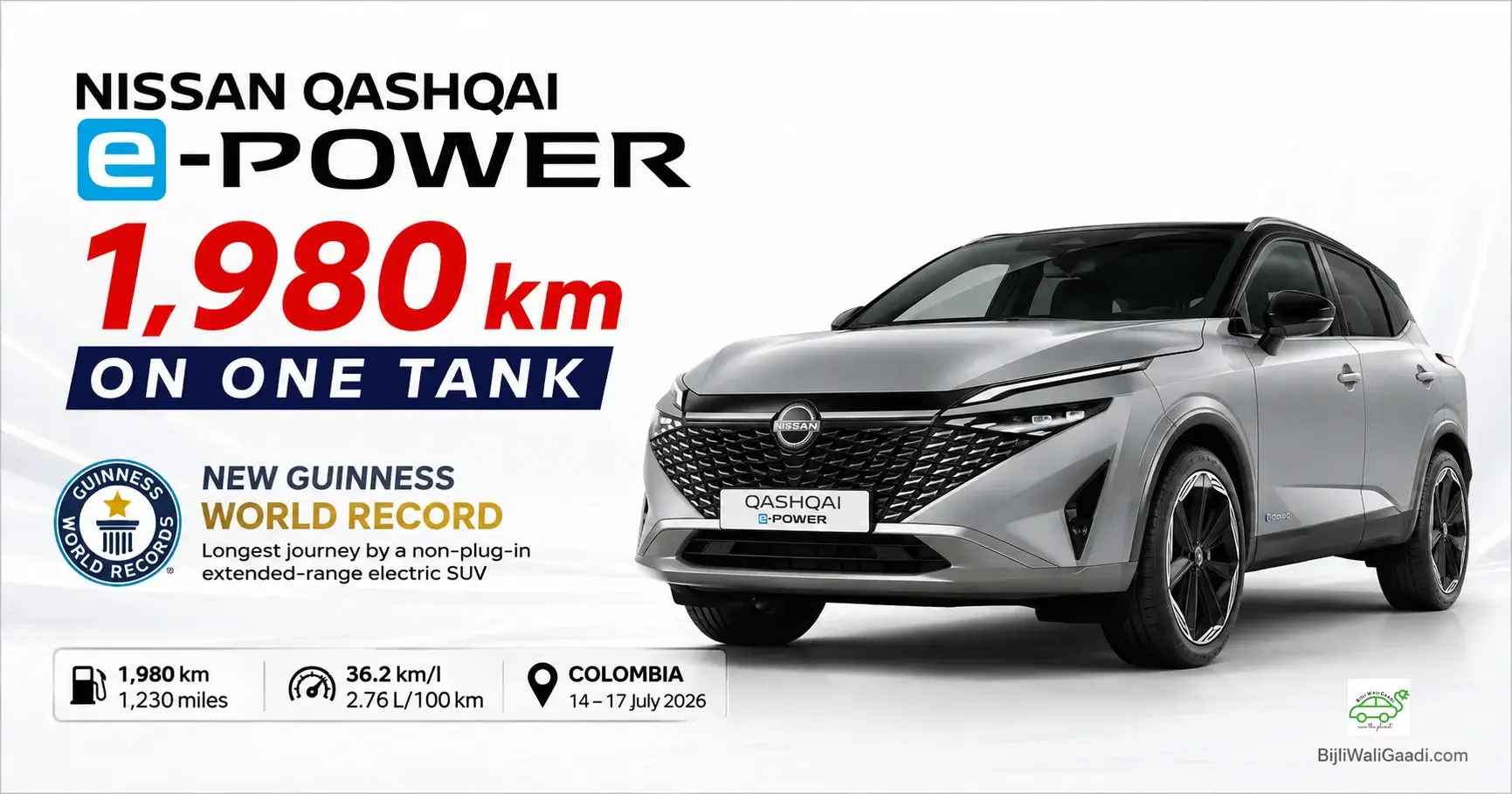
Nissan Qashqai e-POWER Covers 1,980 km Without Refuelling
A Nissan Qashqai e-POWER has covered 1,980 km (1,230 miles) on a single tank of petrol in Colombia, without external charging or refuelling, earning a Guinness World Records title for the longest journey by a non-plug-in extended-range electric SUV. The record run reportedly averaged 36.2 km/l, equivalent to about 2.76 L/100 km, according to Nissan’s Colombia announcement — putting the spotlight not on battery size, but on Nissan’s unusual electric-drive hybrid architecture.
The car was a Euro-spec Qashqai fitted with Nissan’s third-generation e-POWER system, driven from Bogotá to Colombia’s Caribbean coast between 14 and 17 July 2026 and independently monitored by Guinness World Records judges throughout. The route mixed dense city traffic, mountain roads, and coastal highway — not a controlled test track — which is why the result matters. It says something about how the powertrain behaves in the real world, not just in a lab.
What makes the number remarkable isn’t just its size — it’s that the Qashqai achieved it using a genuinely small hybrid battery and a petrol engine that does not mechanically drive the wheels at all.
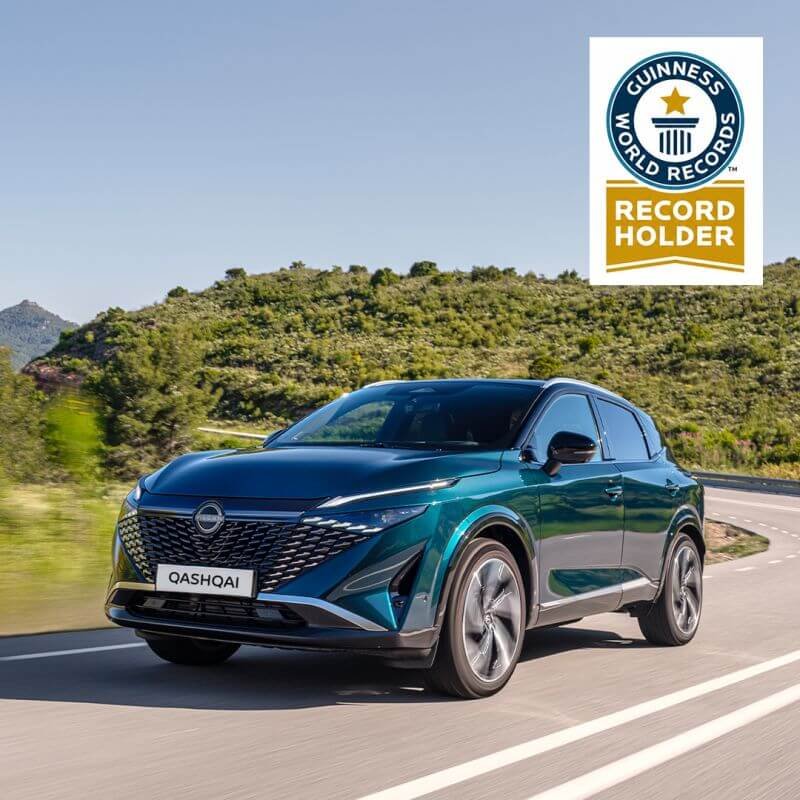
How the Qashqai e-POWER Achieved Such Extreme Efficiency
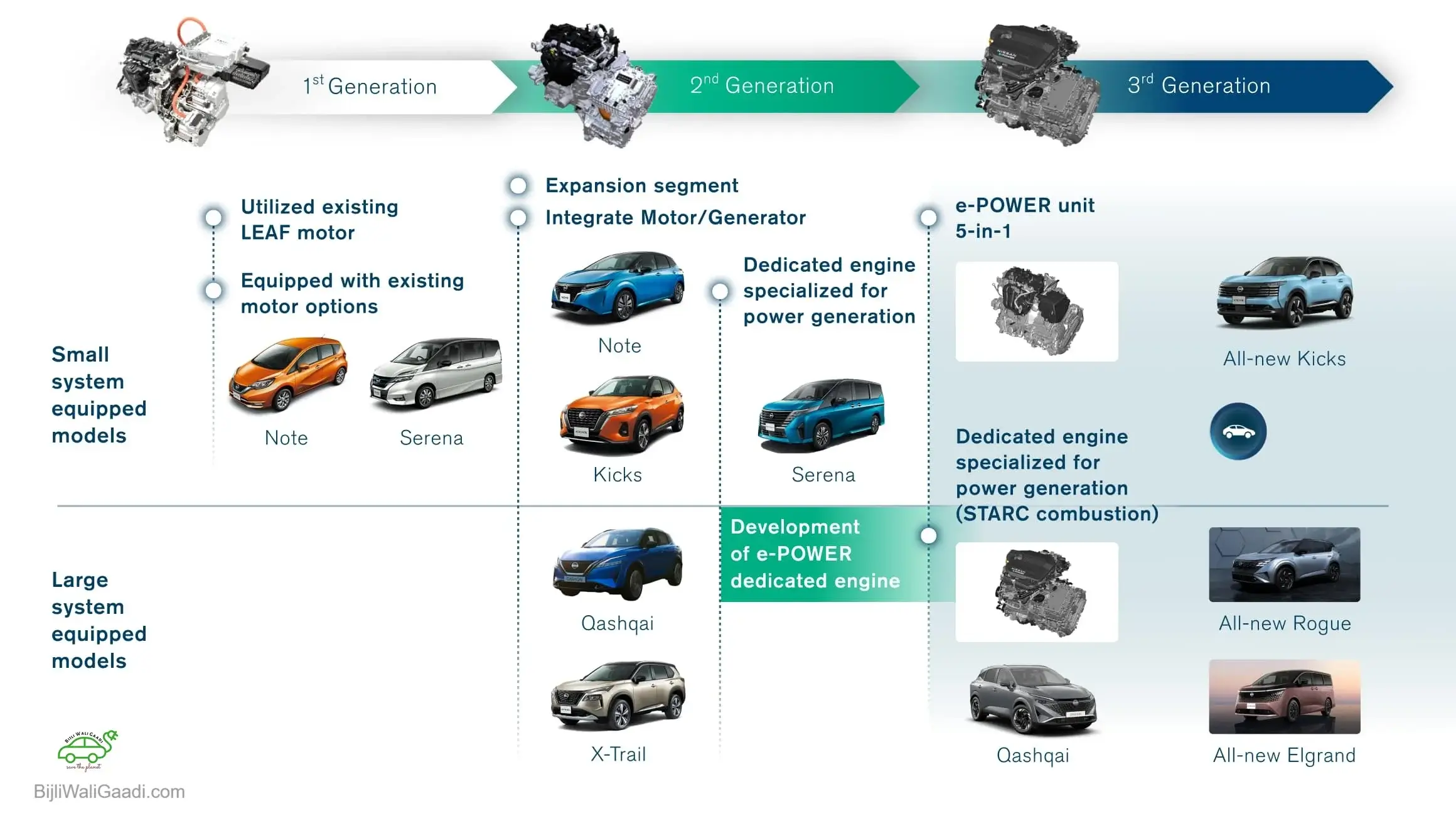
Nissan’s e-POWER Gen3 pairs a 1.5-litre three-cylinder petrol engine with a permanent-magnet synchronous electric motor and a small lithium-ion battery. In the UK-spec Qashqai, the engine produces 116 kW (158 PS), while the electric motor delivers up to 140 kW (190 PS) in Standard mode or 151 kW (205 PS) in Sport mode, with 311 Nm and 330 Nm of torque respectively, per Nissan’s UK specification sheet.
The efficiency comes from how the architecture separates two jobs that a conventional engine normally has to do at once. Because the petrol engine is dedicated to electricity generation rather than directly responding to wheel torque demand, Nissan can operate it within a more tightly controlled range of load and speed, letting the powertrain prioritize efficient energy generation while the battery and electric motor handle rapidly changing propulsion demands. Nissan says the dedicated e-POWER engine achieves up to 42% net thermal efficiency; its generator-only role gives engineers more freedom to optimize combustion and operating points than would be possible if the same engine also had to satisfy sudden wheel-load changes directly.
The route’s major altitude changes also created opportunities for regenerative braking to recover energy that would otherwise have been lost as heat during deceleration. That recovered energy could then be reused by the electric drive system, although Nissan has not published a detailed energy breakdown showing how much of the record’s efficiency came from regeneration specifically.
Nissan e-POWER Is Electric Drive Without External Charging
This is the detail worth being precise about: the Qashqai e-POWER is not a battery-electric vehicle, and describing it as a conventional hybrid understates how different its architecture is. It’s a series hybrid — sometimes described as an electric-drive hybrid — where the driven wheels receive propulsion exclusively from the electric motor. The petrol engine is dedicated to generating electricity, while the electric motor provides propulsion: it does not mechanically drive the wheels, but instead operates as an electricity generator within the e-POWER architecture.
That electricity either flows straight to the motor or tops up the battery, which acts as an energy buffer, for later use. The Qashqai e-POWER does not need external charging because its petrol engine generates electricity on board, while the electric motor drives the wheels.
That’s a meaningfully different layout from other hybrids on the market:
- Conventional parallel hybrid: engine and motor can both mechanically contribute to propulsion, sometimes together, sometimes alternating.
- Series hybrid / e-POWER: the petrol engine generates electricity only; the electric motor alone drives the wheels.
- Battery EV: a much larger traction battery stores all the energy the car needs, recharged externally.
- Plug-in hybrid: a bigger battery allows genuine electric-only miles, but the engine can still drive the wheels directly when needed.
Conventional hybrids can deliver strong efficiency, but their architecture still allows the combustion engine to participate mechanically in propulsion. e-POWER takes a different approach by making the electric motor solely responsible for wheel propulsion, which is why the driving character feels closer to an EV even though the car never needs a plug.
Qashqai e-POWER Gen3: Key Powertrain Specifications
| Specification | Qashqai e-POWER Gen3 |
| Petrol engine (generator) | 1.5-litre 3-cylinder, 116 kW (158 PS) |
| Electric motor | Permanent-magnet synchronous motor |
| Maximum motor output | 140 kW (190 PS) Standard / 151 kW (205 PS) Sport |
| Battery | Lithium-ion, 346–349 V, 96 cells |
| Usable battery capacity | 1.97 kWh usable* |
| Fuel tank | 55 litres |
| Drive | Front-wheel drive |
| WLTP combined fuel economy | 4.3–4.5 L/100 km |
*Battery capacity shown is the usable capacity specified in Nissan’s UK technical documentation. Nissan’s current UK online specification lists 2.1 kWh battery capacity; market specifications and reporting conventions may differ, and the exact Colombian-market pack has not been independently confirmed.
1,980 km Record vs Normal Qashqai e-POWER Range
Here’s the important reality check. Nissan’s UK brochure states that under official WLTP combined testing, a fully-equipped Qashqai e-POWER’s single tank is good for up to 795 miles (roughly 1,280 km) on higher-efficiency grades, or up to 759 miles on the Tekna+ model shown in Nissan’s materials — already a strong number for a compact hybrid SUV, but well short of the 1,230 miles the record attempt achieved.
The gap is exactly what you’d expect from a record run versus daily driving. At a reported 2.76 L/100 km, the record run’s fuel consumption was roughly 36–39% lower than the official 4.3–4.5 L/100 km WLTP combined figure. That difference reflects highly optimized conditions: the route’s altitude changes, regenerative braking opportunities, driving strategy and energy management tuned specifically for the attempt — not something a standardized WLTP test is designed to replicate. Ordinary owners shouldn’t expect 1,980 km, or 2.76 L/100 km, from everyday driving. WLTP remains the standardized figure that reflects realistic ownership use; the record shows what the architecture is capable of under carefully managed conditions.
Why This Hybrid Powertrain Matters for the EV Era
Battery EV adoption remains uneven — charging infrastructure, cost, and range anxiety still shape buying decisions, especially for drivers who cover long distances or live somewhere charging isn’t yet convenient. e-POWER’s proposition sits in a specific gap: EV-like throttle response and quietness, refuelling that takes minutes rather than tens of minutes even at the fastest public chargers, and a familiar ownership pattern that doesn’t require home charging infrastructure at all.
That combination is central to what e-POWER offers: electric-motor propulsion without dependence on external charging, for drivers who want the feel of electric driving without changing how they refuel.
Nissan Qashqai e-POWER Record: What It Really Proves
The 1,980 km run isn’t a claim that hybrids beat EVs, and Nissan hasn’t framed it that way. What it demonstrates is narrower and more useful: that an electric-drive hybrid, built around a small battery and a generator engine tuned for thermal efficiency, can deliver genuine long-distance confidence without asking the driver to think about charging stations or fuel stops for days at a time.
As the industry keeps sorting through EVs, hybrids, plug-ins, and range extenders as parallel paths rather than a single finish line, records like this one are a reminder that architecture matters as much as battery size. The Qashqai didn’t achieve the record simply by carrying more fuel. It achieved it by combining a generator-focused petrol engine, electric-motor propulsion, regenerative braking, and tightly managed energy flow into an exceptionally efficient long-distance powertrain.

Stay connected via Google 'Electric Vehicle' News
Follow BijliWaliGaadi | India's Trusted EV Insights Portal
source on Google