MAHLE’s New Range Extender Aims to Push Electric Trucks Past 800 km
Stay connected via Google 'Electric Vehicle' News
Follow BijliWaliGaadi | India's Trusted EV Insights Portal
source on Google
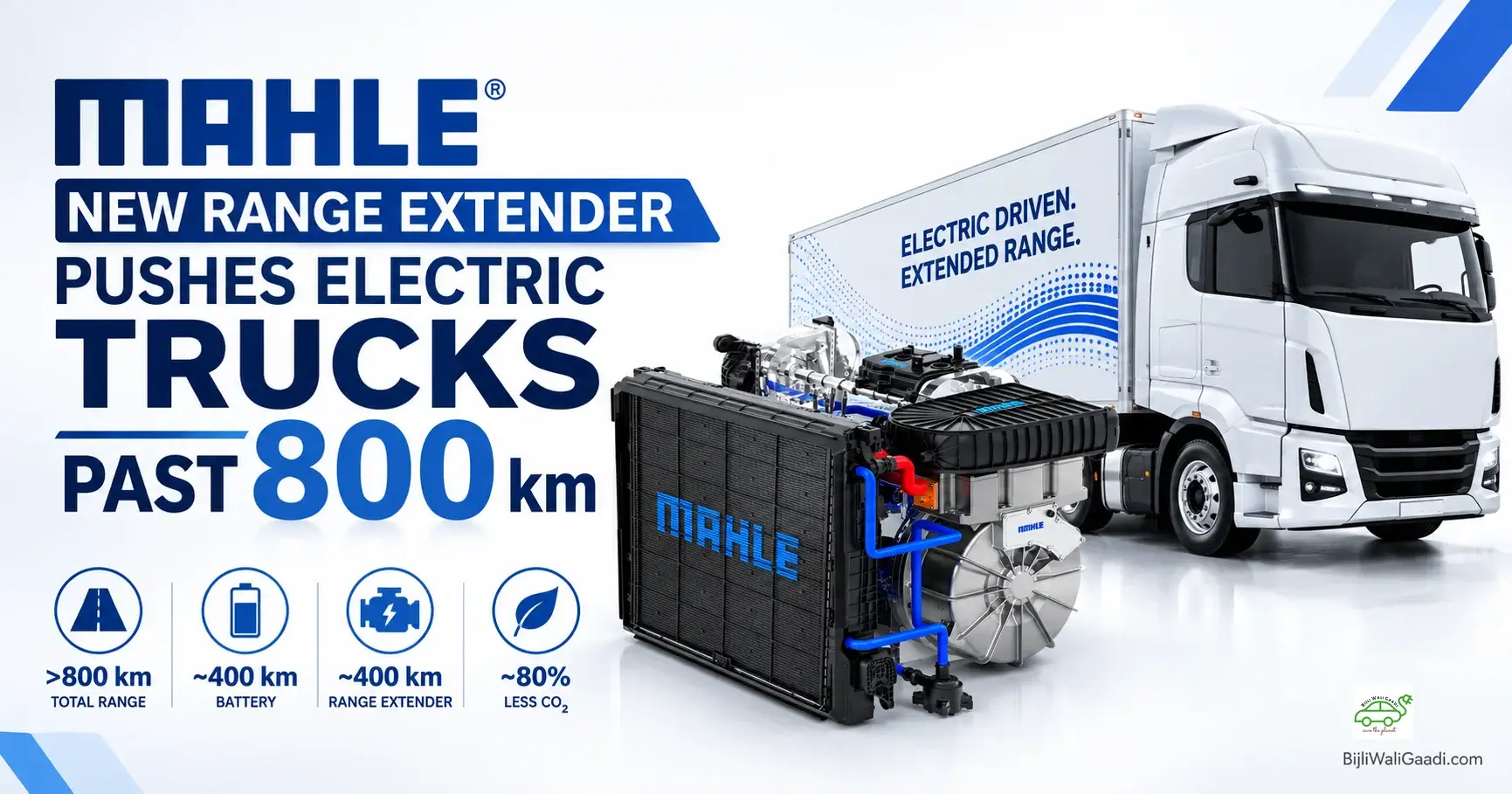
Quick Summary: MAHLE will unveil a range extender system for battery-electric trucks at IAA Transportation 2026. Pairing a smaller battery with an onboard combustion-engine generator, the setup can reportedly deliver over 800 km total range while cutting CO2 by roughly 80 percent versus a conventional diesel drivetrain. It’s a technology premiere, not a production launch.
Heavy electric trucks face a stubborn problem: fleets need long range and dependable schedules, but charging infrastructure for commercial vehicles remains patchy in much of Europe and beyond.
MAHLE’s answer, unveiled ahead of IAA Transportation 2026, pairs a smaller onboard battery with a compact combustion-engine-driven generator, while keeping the truck’s wheels driven entirely by electric motors. The Stuttgart-based supplier says the combination can push total range past 800 km without a mid-route charging stop.
Worth being precise: this is a technology world premiere, not a production truck on fleet routes. MAHLE hasn’t announced a launch date, OEM partner, or pricing.
What Is MAHLE’s Range Extender?
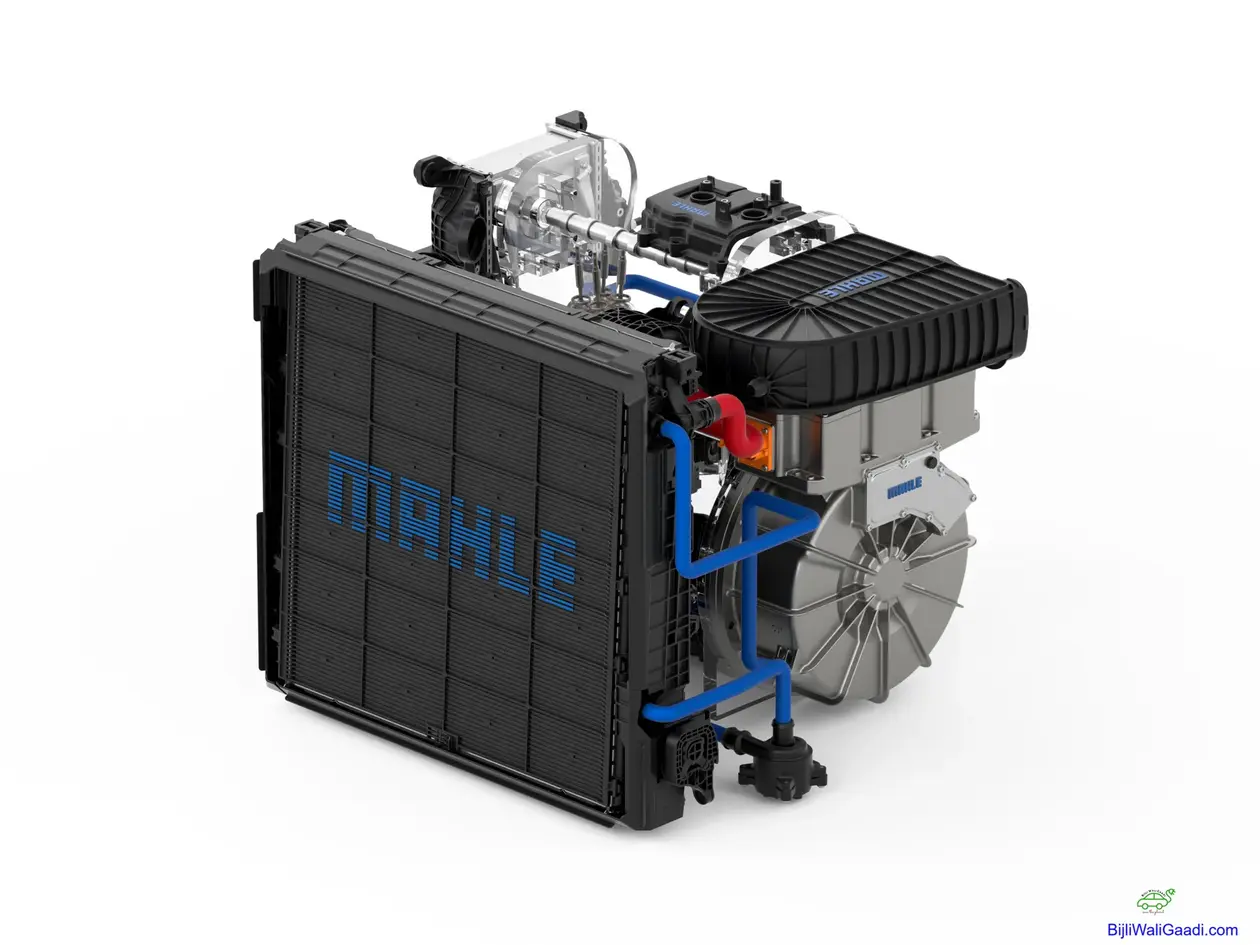
The system is a self-contained “box” combining a high-voltage generator, a compact combustion engine, fuel and AdBlue tanks, exhaust treatment, and thermal management — sized to fit inside a truck’s normal battery space. Dr. Marco Warth, MAHLE’s VP of Corporate Research, calls it an “emergency power unit” that switches on precisely when extra range is needed.
How MAHLE’s Range Extender Works
The truck stays electrically driven at all times: the battery powers the drivetrain normally, and when charge runs low, the combustion engine spins the generator, feeding electricity to the drive system — fuel → engine → generator → electricity → electric drive.
The engine never mechanically turns the wheels; its only job is generating power. That’s why this isn’t a conventional parallel hybrid, but an electric truck with an onboard charging source.
Key Specifications
| Metric | MAHLE’s stated figure |
| Generator continuous / peak output | 110 kW / up to 130 kW |
| Generator power density | more than 7 kW/kg |
| Total range | more than 800 km |
| Battery / range-extender contribution | ~400 km / ~400 km |
| Rear axle load / total weight reduction | ~400 kg / ~600 kg |
| Thermal management (high/low-temp) | 48 kW / 15 kW |
| CO2 reduction | ~80% vs. conventional drive |
MAHLE credits the power density to a newly developed oil cooling system, and says the thermal management setup keeps the range extender stable under heavy-duty, full-load conditions.
MAHLE is also introducing an updated Power Cell Unit and oil management module, promising higher performance and longer service life. Depending on housing material, it estimates these could cut material costs up to 20 percent, CO2 footprint up to 50 percent, and weight up to 25 percent — component-level estimates, not verified savings for a complete truck.
How the System Can Push Range Beyond 800 km
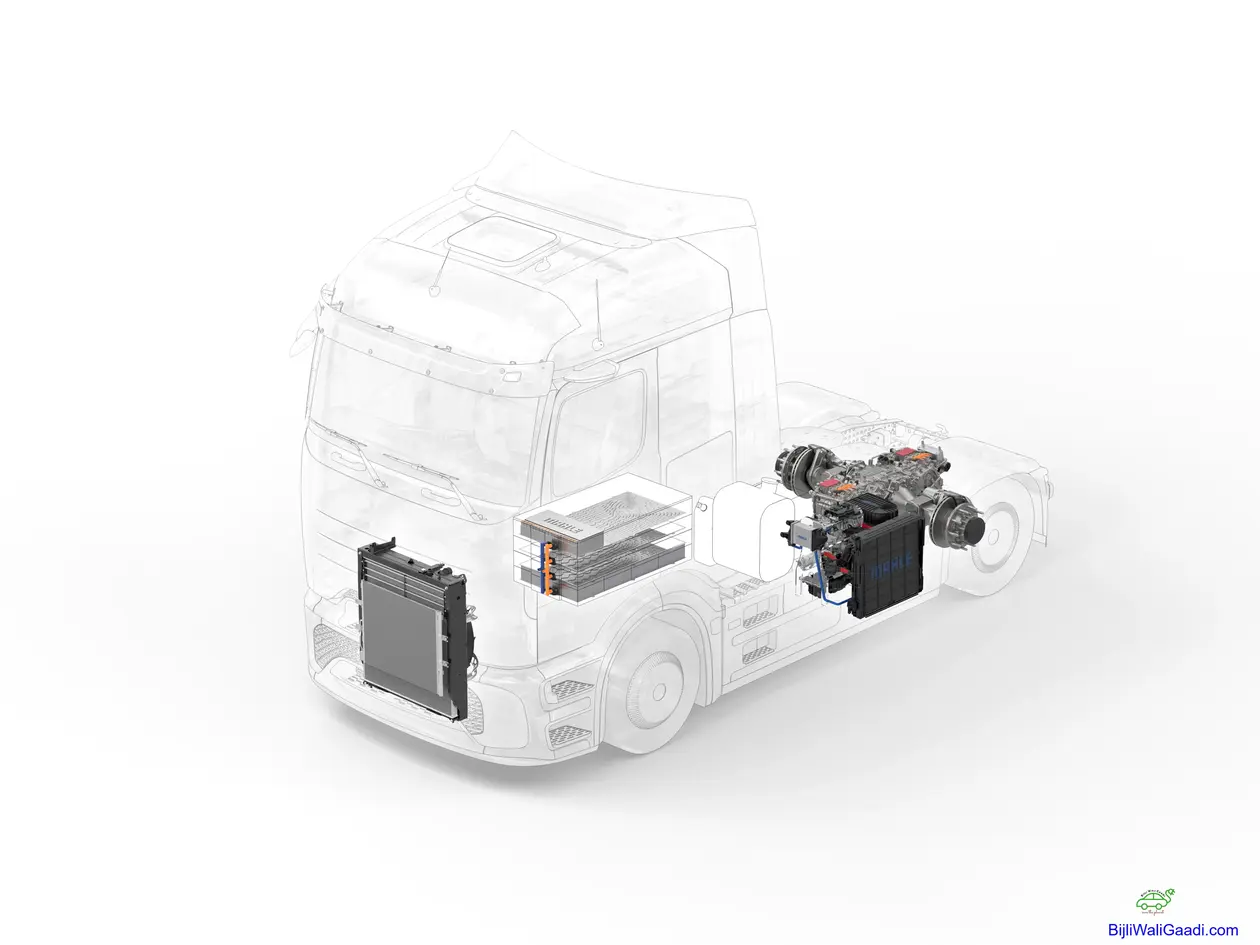
MAHLE says the configuration can cover more than 800 km total — roughly 400 km from the battery, another 400 km from the range extender. These are the company’s own figures, not results from an independent road test; actual range will vary with payload, terrain, and driving style.
Why the Smaller Battery Matters
MAHLE says the system can replace about one-third of the battery capacity otherwise required, letting the truck run a smaller pack. A lighter battery cuts overall vehicle mass and rear axle load — MAHLE cites roughly 400 kg and 600 kg respectively — which could ease pressure on payload capacity. No specific payload gain has been published, so that benefit remains directional rather than quantified.
CO2 Reduction and Renewable Fuels
MAHLE says a truck running on the range extender emits about 80 percent less CO2 under real-life conditions than one with a conventional drive system. Running the biofuel-ready engine on renewable fuels such as HVO100 can bring emissions close to zero, per the company’s own assessment — a claim about carbon output under that scenario, not zero tailpipe pollutants or zero lifecycle impact.
Why This Could Matter to Truck Fleets
The pitch is straightforward: a smaller, lighter battery could mean more usable payload and lower energy overhead, while reduced dependence on charging keeps routes from being hostage to a busy station. Warth puts it bluntly — if a charging station is busy or a route detours around weather, “other fleets can be stranded; an e-truck with range extender just carries on.”
MAHLE argues this could lower total cost of ownership over a truck’s life, though it hasn’t published a universal savings figure — operators will need their own route-specific numbers once real pricing emerges.
What MAHLE’s Range Extender Doesn’t Solve
The system still burns fuel and carries a combustion engine, so maintenance and fuel logistics shrink rather than disappear. HVO100 availability varies by region, and the added subsystem means more components that can need servicing.
It reduces dependence on charging infrastructure rather than eliminating it, and MAHLE hasn’t published a full cost comparison against an equivalent battery-only truck. Real-world range, as with any truck, hinges on payload, terrain, weather, and driving behavior.
MAHLE’s Separate Rare-Earth-Free MCT Motor
Alongside the range extender, MAHLE is showing a second, unrelated world premiere: the MAHLE Contactless Transmitter (MCT), an electric motor for heavy-truck drive axles — a distinct product, not a part of the range extender.
The MCT uses no permanent magnets and needs no rare-earth elements, saving up to 3 kg of rare-earth material per vehicle versus a benchmark motor. MAHLE describes it as 10 percent lighter and more efficient under real-world driving, with 370 kW peak output, torque exceeding 900 Nm at 3,900 rpm, and roughly 95 percent VECTO-cycle efficiency.
MAHLE’s Position in Truck Electrification
MAHLE frames both premieres as part of a broader push. The company says it supplies components for every battery-electric and fuel-cell truck sold in Europe, sells around 8 million electric drive systems and ancillaries annually, and expects 35-plus electrified platforms to launch on its technology by 2029. Commercial vehicles make up roughly a fifth of MAHLE’s automotive business, across 120-plus customers, with Asia named its biggest growth opportunity.
Why Combustion Engines and Renewable Fuels Still Matter
MAHLE’s own forecast puts ICE’s share of commercial vehicles at around 83 percent today, dropping only to about 73 percent by 2035 — a reminder that electrification won’t displace diesel trucks overnight. The company argues renewable fuels like HVO100 and bio-LNG can cut emissions from the existing fleet meanwhile, a case CEO Arnd Franz has also made to regulators, calling for EU CO2 fleet rules and AFIR to reflect market realities and treat range extenders as part of the electrification toolkit.
IAA Transportation 2026: When and Where to See It
MAHLE will present the range extender as a world premiere at IAA Transportation 2026, running September 15–20 in Hanover, Germany, under the theme “Electrified. Efficient. Economical.” The MCT motor debuts at the same event.
Frequently Asked Questions
Stay connected via Google 'Electric Vehicle' News
Follow BijliWaliGaadi | India's Trusted EV Insights Portal
source on Google