Hyundai Creta Electric BaaS at Rs 10.99 Lakh: Is Battery-as-a-Service India’s Smartest EV Play in 2026?


On July 02, 2026, Hyundai Motor India Limited (HMIL) rewrote the affordability equation for the electric SUV segment. By introducing the Hyundai Creta EV BaaS ownership model, HMIL has decoupled the vehicle chassis from its most expensive component — the battery pack — pushing the entry price down to Rs 10.99 Lakh ex-showroom. This isn’t a discount; it’s a structural pricing innovation. For a market conditioned to treat EV upfront cost as the primary barrier, Hyundai’s Battery-as-a-Service India strategy directly targets that psychological and financial wall, and the ripple effects for competitors are immediate and severe.
Table of Contents
Why This Launch Matters Beyond the Price Tag
The Hyundai Creta EV price in India 2026 conversation has always centered on one obstacle: battery cost. By separating vehicle ownership from battery ownership, HMIL imports a subscription-economy logic — familiar from telecom and software — into automotive retail, marking a foundational shift in how Indian consumers evaluate electric SUV affordability.
The Economics of the Hyundai BaaS Program
Hyundai Creta Electric BaaS: Decoding the Rs 3.9 Per Km Battery Lease
The Creta EV battery lease price is structured as a pay-per-use model at Rs 3.9 per kilometer, billed as a flexible rental rather than a fixed EMI. This shifts the cost burden from a large one-time capital outlay to a variable operating expense tied directly to usage. Low-mileage owners benefit disproportionately, while high-mileage users must run the numbers carefully before committing.
Factoring in Home Charging and Grid Tariffs
Crucially, the Rs 3.9 per km figure is only the battery rental component — it does not include the electricity itself. Home charging adds roughly Rs 1.00 to Rs 1.20 per km, based on average domestic slab rates of Rs 7-9 per unit required to charge either the 42 kWh or 51.4 kWh packs. This means the true, real-world Creta Electric running cost per km lands closer to Rs 4.90 to Rs 5.10 per km, not Rs 3.9 alone.
This distinction matters for any honest Creta EV running cost comparison. Buyers evaluating the Hyundai BaaS program purely on the headline rental figure risk understating their actual monthly outlay by roughly 25-30% — a calculation most surface-level coverage of the Creta Electric BaaS price fails to perform.
Creta Electric Running Cost Per Km: The Real Math
To evaluate genuine running costs, both the battery rental and home charging component must scale together with distance driven. Below is a breakdown across common Indian urban and highway usage thresholds, using the blended Rs 5.00 per km real-world figure:
| Monthly Distance | Battery Rental (Rs 3.9/km) | Charging Cost (~Rs 1.10/km) | Total Real-World Cost |
| 1,000 km | Rs 3,900 | Rs 1,100 | Rs 5,000 |
| 1,500 km | Rs 5,850 | Rs 1,650 | Rs 7,500 |
| 2,000 km | Rs 7,800 | Rs 2,200 | Rs 10,000 |
This table should anchor every buyer’s decision-making. A typical urban commuter driving under 1,000 km monthly still pays roughly Rs 5,000 total for the electric SUV battery subscription India experience — a figure that comfortably undercuts fuel budgets for an equivalent ICE SUV. Fleet operators or high-mileage users crossing 2,000 km monthly should model the full Rs 10,000 figure rather than the rental-only number.
Battery Ownership and Degradation Risk Transfer
A crucial, underdiscussed element of the electric SUV battery subscription India model is risk transfer. Under BaaS, Hyundai — not the customer — retains legal ownership of the battery pack, meaning degradation risk and replacement liability sit with HMIL. This de-risks the purchase decision for buyers anxious about long-term battery health, converting a depreciating asset concern into a fixed monthly line item.
Creta Electric vs Full Ownership Cost: A Genuine Comparative Audit
The Rs 7.04 Lakh Upfront Delta
Regular full-ownership pricing for the Creta EV spans Rs 18.03 Lakh to Rs 24.70 Lakh, meaning the BaaS entry point undercuts the base full-ownership variant by roughly Rs 7.04 Lakh at launch. This capital is freed up entirely — usable for a down payment elsewhere, investment, or simply reduced loan exposure, which matters enormously to India’s EMI-sensitive buyer segment.
Calculating the Breakeven Point
Treating the Rs 7.04 Lakh differential as a “prepaid battery” against BaaS rental payments produces a breakeven timeline. At 1,000 km/month, breakeven arrives near 15 years; at 1,500 km/month, roughly 10 years; and at 2,000 km/month, closer to 7.5 years. Given Hyundai’s 8-year/160,000 km battery warranty, this analysis favors BaaS economics for most ownership durations near the warranty horizon.
Who Actually Wins the Creta EV BaaS Price Argument
Buyers driving under 1,500 km monthly, first-time EV adopters wary of battery degradation risk, and cost-conscious urban professionals extract the most value from Hyundai Creta Electric price 10.99 lakh positioning. Conversely, high-mileage intercity travelers and fleet buyers should model both paths meticulously, since full ownership may prove cheaper across an extended, high-utilization lifecycle.
Loan Interest and Compounding Savings
Beyond the Rs 7.04 Lakh gap, buyers financing via auto loans should factor in compounding interest savings. A smaller principal under BaaS translates into a lower loan amount, reduced EMI outflow, and materially less interest paid over a typical 5-7 year tenure — an advantage that widens the Creta Electric vs full ownership cost gap beyond the sticker-price difference alone.
Deep Dive Into Technical Specs & Updates
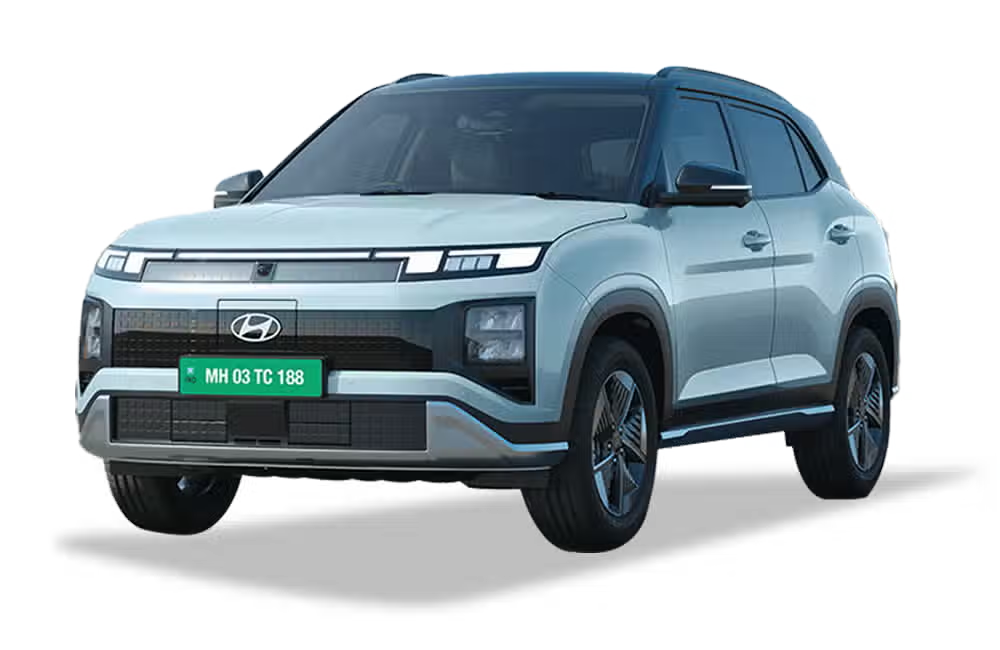
Battery Architecture: 42 kWh vs 51.4 kWh
The Hyundai Creta Electric specs 42 kWh short-range variant delivers up to 420 km on the MIDC cycle, while the Hyundai Creta EV 51.4 kWh range configuration extends this to 510 km MIDC. Real-world highway figures will trail these certified numbers, as is standard across MIDC-rated EVs, but the spread offers meaningful flexibility depending on commute distance and charging access.
Charging Speed and the 7.4 kW Home Upgrade
DC fast charging takes the Creta Electric from 10% to 80% in just 39 minutes, a competitive figure for the segment. Home Charger variants now bundle a 7.4 kW wall box charger as standard — replacing the previous slow charger — cutting overnight replenishment time and improving the experience for BaaS customers reliant on home charging.
Performance, Thermal Management, and Safety Tech
The long-range variant accelerates 0-100 km/h in 7.9 seconds. Active Air Flaps (AAF) optimize aerodynamic drag and battery thermal regulation. Owners also get Vehicle-to-Load (V2L) support, Single Pedal Drive (i-Pedal), Digital Key access via smartphone/smartwatch, and Hyundai SmartSense Level 2 ADAS — a comprehensive suite few rivals match at this price bracket.
Practical Upgrades and Validated Reliability
An integrated Side Foot Step now ships across all variants, responding directly to consumer feedback around cabin ingress and egress. Reinforcing durability credentials, the Creta Electric recently entered the India Book of Records after covering 1,326.5 km in 24 hours, a real-world endurance benchmark few electric SUVs in India have attempted.
Competitive Landscape in India’s Electric SUV Segment 2026
Hyundai’s Direct Retaliation Against MG’s Pioneering BaaS Model
Hyundai’s BaaS program is a direct corporate counter-attack against the MG Windsor EV, which pioneered the battery-rental concept in the Indian electric SUV market 2026 landscape. By matching and arguably surpassing MG’s subscription framework at scale, Hyundai becomes the first legacy mid-size SUV manufacturer in India to retaliate this aggressively — a move that could turn BaaS into the defining industry-wide pricing trend of 2026, sidestepping sticker-price wars to attack battery capital cost at its root.
Mahindra BE 6, Tata Curvv/Sierra EV, and Maruti eVitara
The Mahindra BE 6 leans on design differentiation and a dedicated EV platform rather than pricing disruption. Tata’s Curvv EV and Sierra EV compete on brand trust and charging network depth, while the Maruti eVitara leans on service network and first-time-buyer goodwill. None counters with a comparable subscription framework, leaving them exposed against the Rs 10.99 Lakh Creta Electric BaaS positioning.
Why Rivals Face a Structural Disadvantage
Beyond MG, none of Hyundai’s remaining competitors offer a comparable subscription pathway at this scale. Unless Mahindra or Tata rapidly counter with their own leasing frameworks, Hyundai effectively owns the “low-entry-cost EV SUV” narrative through 2026 — an edge difficult to replicate without similar backend financing infrastructure.
The Resale Paradox: How BaaS Affects Used EV Markets
Battery Lease Transferability and Legal Ownership
Reselling a BaaS-purchased Creta Electric isn’t as simple as handing over the keys. Since Hyundai retains legal ownership of the battery pack, the underlying subscription contract must be formally transferred to the new owner through HMIL’s financing partner. This adds an administrative layer absent from conventional used-car sales, requiring processing time and eligibility checks before a resale can legally close.
Impact on Depreciation and Long-Term Value Retention
Paradoxically, this complexity may protect long-term value. Decoupling the battery from the chassis insulates second-hand buyers from the single biggest EV resale fear: an out-of-warranty battery failure requiring costly replacement. Since HMIL contractually owns and maintains the pack, used Creta Electric BaaS buyers inherit predictable running costs rather than an unknown liability — potentially strengthening chassis-level resale value.
The Verdict: Who Should Choose Hyundai BaaS Ownership
The Hyundai Creta EV BaaS model isn’t a universal answer — it’s a precision instrument for a specific buyer: cost-sensitive, moderate-mileage, first-time EV owners prioritizing lower upfront exposure over long-term asset ownership. High-mileage users and those prioritizing resale simplicity should default toward full ownership, since a company-owned battery pack introduces contract-transfer steps at resale.
For everyone else, Rs 10.99 Lakh with a scalable Rs 3.9 per km rental — plus roughly Rs 1.00-1.20 per km in home charging — is the most financially rational entry point into a genuine electric SUV yet offered in India, and a benchmark every rival, starting with MG, must now answer.