EV Home Charger Installation Guide for Apartments (2026)
Stay connected via Google 'Electric Vehicle' News
Follow BijliWaliGaadi.com | India's Trusted EV Insights Portal
source on Google
EV Home Charger Installation | Apartment EV Charger India | RWA NOC for EV Charger | EV Charger Installation Guide India
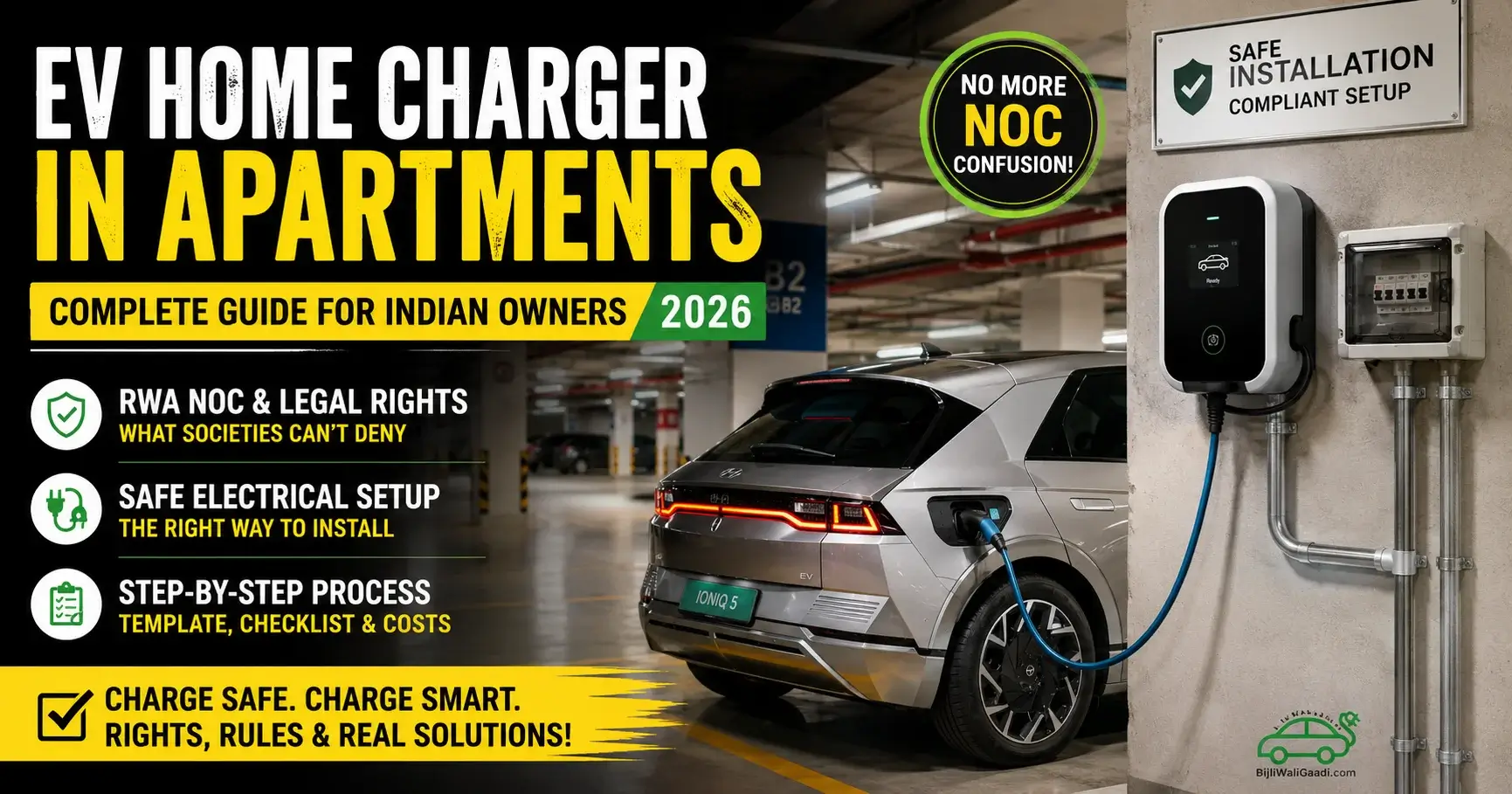
Your Nexon EV, Punch EV, or Ioniq 5 just got delivered. You’re excited to plug in at home tonight. Then the RWA secretary drops the line every EV owner in India dreads: “Sorry, no charging points allowed in the basement. Fire hazard. No policy exists for this.”
It’s a familiar script by now. Scroll through social media platforms on any given weekend and you’ll find someone venting about it — extension cords snaking across a basement floor, a Rs 100 stamp-paper undertaking nobody asked for, a committee that keeps promising a decision “next meeting.” Ask around enough and a pattern emerges: most of this isn’t malice. It’s a committee that hasn’t actually read the current guidelines, staring down a request they don’t quite know how to process.
This guide is meant to fix that gap. Here’s where you actually stand legally, what a proper wiring setup looks like, a template you can hand your society tomorrow, and honest numbers on what the whole exercise should cost.
The Legal Reality: Can Your Housing Society Legally Say “No”?
A resident welfare association generally cannot deny a technically compliant EV charger installation just because it doesn’t have an EV policy on paper. Genuine safety, structural, electrical capacity, statutory, or regulatory concerns are a different matter — an apartment association is well within its rights to ask for a wiring diagram, an installer’s certification, or proof that the building’s wiring can actually take the extra load. Refusing on vague grounds is a different story from refusing because the transformer genuinely can’t cope.
The Ministry of Power‘s Guidelines for Installation and Operation of EV Charging Infrastructure, 2024 lay out that residents can install private charging points in their own designated parking spaces, with the DISCOM expected to supply power through the resident’s existing meter or a dedicated sub-meter. Societies aren’t supposed to invent hurdles or arbitrary conditions for a compliant setup. Around the same time, the Ministry of Housing & Urban Affairs amended the Model Building Bye-Laws to require at least 20% of parking spots to be EV-ready, with load provisioning built in at a 1.25x safety margin.
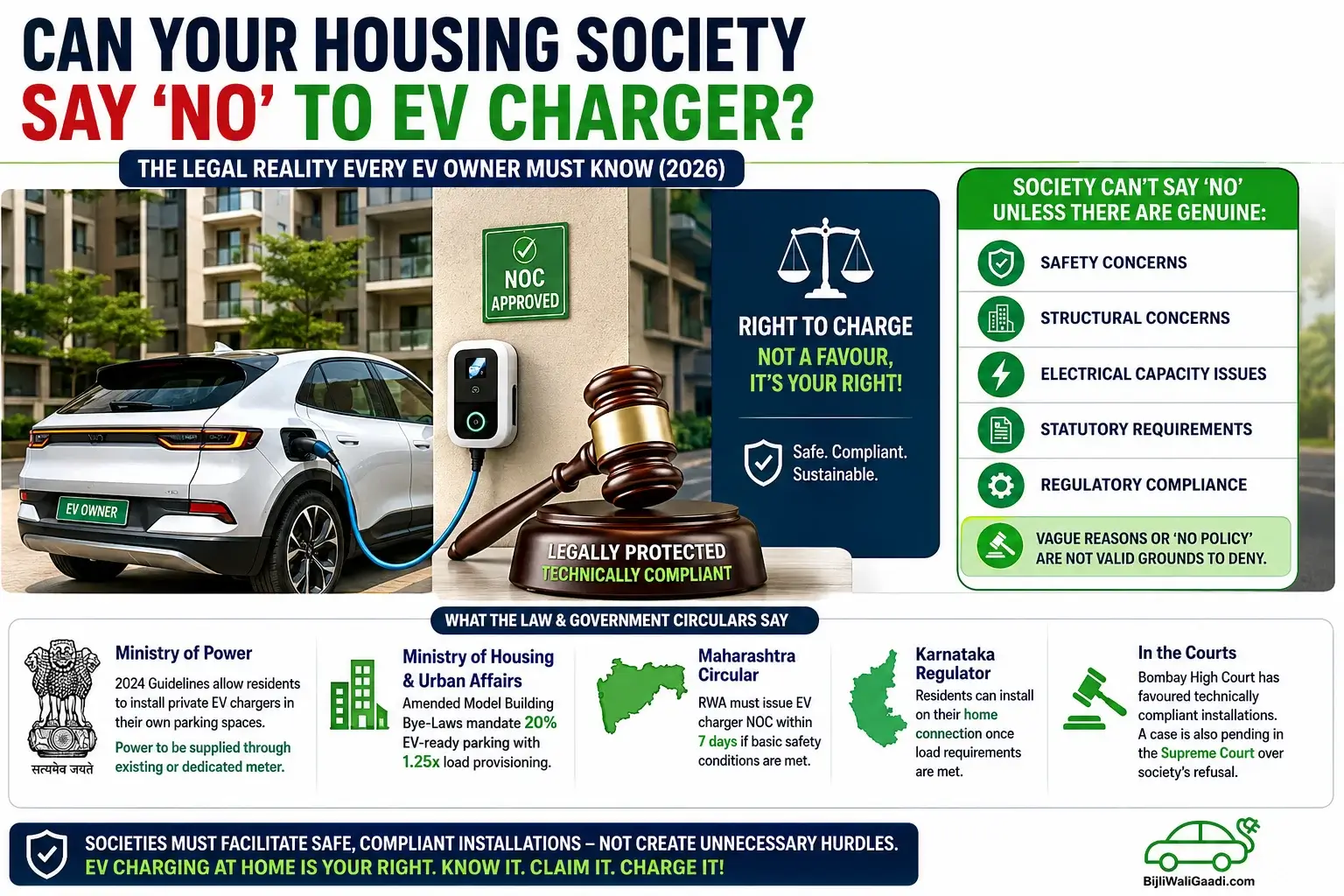
State circulars add more teeth to this. Maharashtra’s Cooperative Housing circular tells societies to process an EV charger NOC within 7 days, provided basic safety boxes are ticked. Karnataka’s electricity regulator takes a broadly similar line — residents can install on their home connection once load requirements check out, and the committee’s job is to facilitate a safe installation rather than sit on the file.
The courts have been drawn into this too. The Bombay High Court has looked at disputes where societies denied EV charging permission on essentially arbitrary grounds, and the observations coming out of these cases have leaned toward protecting technically compliant installations. Separately, a Noida resident has taken his society’s refusal to provide adequate charging infrastructure all the way to the Supreme Court, and the bench has issued notices to the parties involved. None of this is settled law across every state yet, so treat it as a strong policy direction rather than a guaranteed legal outcome — and it’s worth checking the latest orders applicable to your state before you start quoting case law at your managing committee.
One thing installers mention often: the stamp-paper demand and the “run a cord from your balcony” workaround usually come from a committee that’s improvising because nobody has shown them the actual 2024 guidelines yet. Handing over the circular alongside a proper technical application tends to work far better than arguing about it in the residents’ WhatsApp group.
Step-by-Step: How to Secure RWA NOC Without Friction
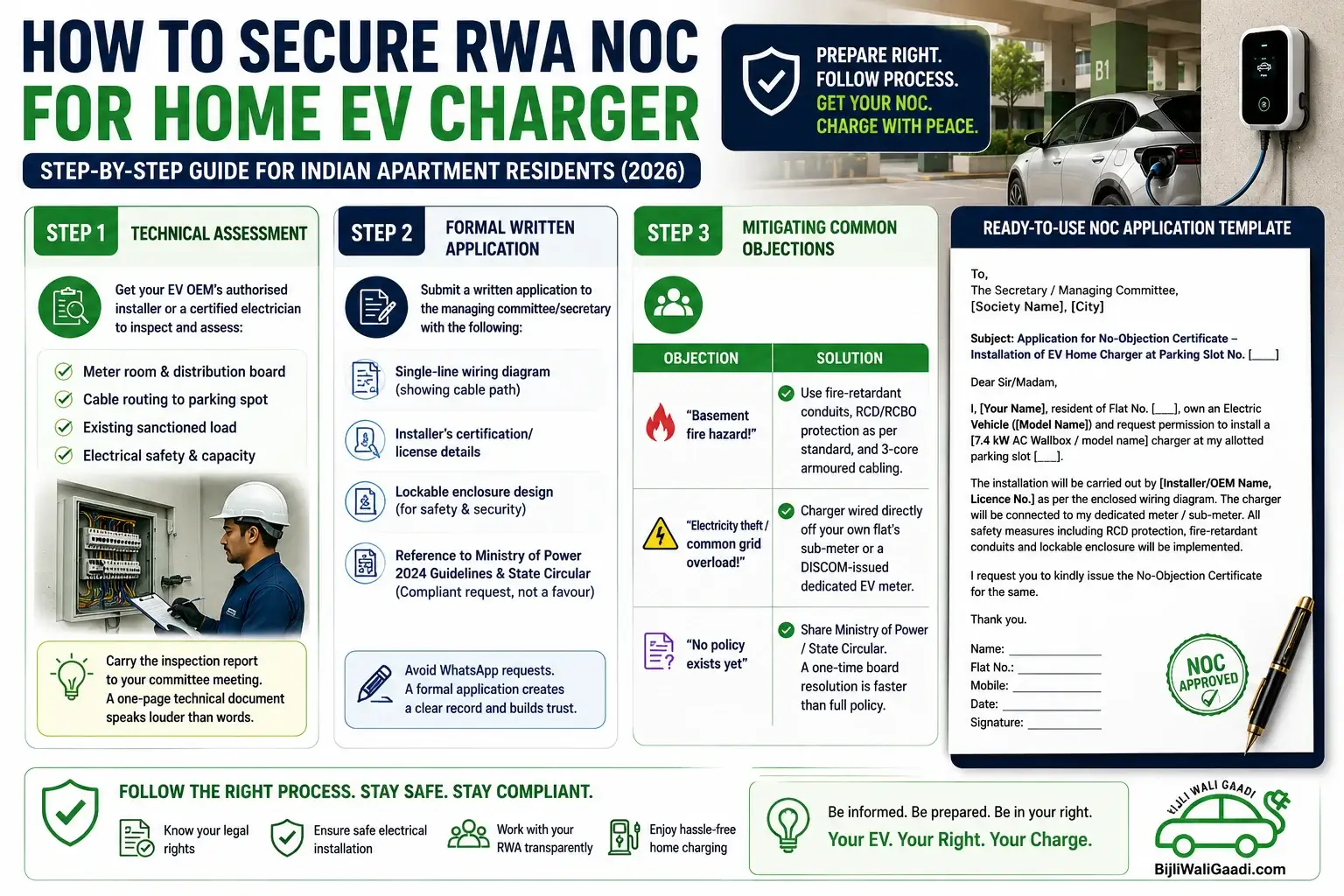
Step 1 — Technical Assessment
Get your EV OEM’s authorised installer, or a certified electrician, to physically walk the route — meter room, cable path, parking spot, the works — and check your flat’s existing sanctioned load. Carry that inspection report to your committee meeting. A one-page technical document does more work than any verbal argument.
Step 2 — Formal Written Application
Skip the WhatsApp message. A written application to the managing committee or secretary should include:
Step 3 — Mitigating Common Objections
| Objection | Fix |
| “Basement fire hazard!” | Fire-retardant conduits, residual current protection sized to the charger and applicable standard, 3-core armoured cabling instead of loose wiring |
| “Electricity theft / common grid overload!” | Charger wired directly off your own flat’s sub-meter or a DISCOM-issued dedicated EV meter — the society’s common supply never enters the picture |
| “No policy exists yet” | Point them to the applicable Ministry of Power or state circular; a one-time board resolution is faster than drafting a full policy from scratch |
Ready-to-use NOC Application Template
To,
The Secretary / Managing Committee, [Society Name], [City]
Subject: Application for No-Objection Certificate — Installation of EV Home Charger at Parking Slot No. [___]
Dear Sir/Madam,
I, [Your Name], resident of Flat No. [], own an Electric Vehicle ([Model Name]) and request permission to install a [7.4 kW AC Wallbox / model name] charger at my allotted parking slot [].
The installation will be carried out by [Installer/OEM Name, Licence No.] as per the enclosed single-line wiring diagram, using 3-core armoured copper cable sized appropriately for the cable run, with a 32A MCB and residual current protection (Type A or Type B RCCB/RCBO, as recommended by the charger’s installation manual, applicable Indian Standards, and the IEC 61851 series) for circuit protection, drawn directly from my flat’s electricity sub-meter. No common society supply will be used.
This request is made in line with the Ministry of Power’s Guidelines for Installation and Operation of EV Charging Infrastructure (2024) and applicable state circulars addressing timely NOC processing for EV charger installations.
I request the committee to kindly process the NOC at the earliest, in keeping with the applicable circular timelines.
Regards, [Name, Flat No., Contact, Date]
Common Reasons Apartment EV Charger Applications Get Delayed
Talk to enough installers and a few recurring culprits come up.
Paperwork gaps top the list — a missing wiring diagram or an installer’s credentials left out, and the whole file goes back for resubmission. Sanctioned load headroom is another one; sometimes the flat’s existing connection genuinely can’t absorb the extra draw without a DISCOM upgrade first, and no amount of committee goodwill changes that. Plenty of committees are simply handling their first-ever EV charger request and default to delay while they figure out the process. Shared meter room access can turn into its own small saga if the society worries about liability when an outside installer needs entry. And buildings with strict fire-NOC compliance sometimes want the fire-retardant conduit and enclosure specifications in writing before they’ll sign off on anything.
Get ahead of these in your application rather than discovering them after a rejection, and the timeline usually shrinks considerably.
Checklist Before Your Installer Arrives
Electrical Setup & Technical Blueprint
Sanctioned Load: It’s Not Just Simple Addition
The tempting shortcut is “existing load plus charger rating equals what I need to apply for.” DISCOMs don’t quite see it that way. A few factors sit underneath the final number:
As a working example, a flat sanctioned at 3 kW planning to add a 7.4 kW wallbox typically ends up applying for an upgrade somewhere around the 10 kW mark. What actually gets sanctioned is the DISCOM’s call, not a fixed formula. An installer or licensed electrical contractor can give you a reasonable estimate before you file, but treat it as exactly that — an estimate, not a promise.
Charger Tiers
Wiring & Safety Specs
| Component | Specification | Purpose / Standard |
| Cable Type | 6–10 mm² 3-Core Armoured Copper (final size confirmed by installer) | Sized for cable run length, voltage drop, and heating over distance |
| Circuit Protection | 32A MCB + residual current device sized per charger and applicable standard | Protects against leakage current and short circuits |
| Earthing | Earthing system compliant with applicable standards, verified by installer | Prevents charging shocks and vehicle isolation faults |
| Metering | Dual-source tap from flat DB or dedicated DISCOM EV meter | Accurate billing without touching common society supply |
| Charger Hardware & Protection | Compliant with applicable Indian Standards, the IEC 61851 series, Central Electricity Authority (CEA) Safety Regulations, and the National Electrical Code of India (SP 30) | Governing framework for EV conductive charging systems in India |
Every installer worth hiring will bring their own view on RCCB type. Many current-generation wallboxes have integrated 6 mA DC leakage detection built into the charger itself. Where that protection already exists and applicable standards permit it, a standard Type A RCCB upstream may be enough. Where it doesn’t, a Type B RCCB or RCBO is usually the safer call, since it catches DC leakage current a Type A unit simply won’t register. This isn’t a one-size-fits-all decision — follow the charger’s installation manual and the OEM’s written recommendation, and push back on any installer trying to skip the check to save a few thousand rupees.
Worth knowing before you go shopping: Type B RCCBs and RCBOs aren’t something your neighbourhood electrical shop is likely to have sitting on a shelf the way Type A units are. Ask your OEM’s authorised installer or a specialised electrical distributor to source it rather than losing a weekend hunting for one locally.
Cable Sizing Isn’t a One-Size-Fits-All Number
The 6–10 mm² figure is a starting point, nothing more. What actually determines the right gauge:
- Cable run length — longer runs need thicker conductors to keep voltage drop in check
- Installation method — conduit-run, tray-mounted, or buried cable each behave differently under load
- Voltage drop — Indian wiring codes cap this within a small percentage over the full run
- Ambient temperature — a basement or an enclosed shaft runs hotter than an open-air route
- Grouping factor — cables bundled together in the same conduit or tray need derating
- Applicable Indian Standards and the National Electrical Code of India (SP 30)
More than one installer has shown up expecting a 20-metre run and found the actual distance closer to 60, once they’ve walked the site properly. That gap is exactly where undersized cable starts causing voltage drop and warm cable jackets down the line. The final call on cable size belongs to your installer after an actual site survey — never to a generic guide, this one included.
Earthing, Simplified
Not every flat needs a brand-new dedicated earthing pit. Plenty of buildings already have an earthing system capable of supporting an EV charging circuit, as long as it’s verified as compliant. The requirement is that the charging circuit connects to an earthing system meeting applicable standards, with earth resistance checked and confirmed adequate by your installer. If the building’s existing earthing turns out to be inadequate, or nobody’s quite sure of its condition, a dedicated pit becomes the sensible option — but that’s a site-specific decision, not a blanket rule for every apartment.
Voltage Drop on Long Cable Runs
Apartments where the parking slot sits 40–70 metres or more from the meter room run into voltage drop as a real, practical issue rather than a textbook footnote. Undersized cable over that kind of distance can leave the charger underperforming, running hotter than it should, and tripping protection devices at odd moments. It’s one of the better reasons to insist on a proper site survey instead of trusting a generic cable spec — a 15-metre run and a 60-metre run simply don’t call for the same gauge.
Surge Protection
Buildings in areas with frequent voltage fluctuations, or where the charging circuit runs through a lightning-exposed wiring path, often benefit from a Type II Surge Protection Device (SPD) on the charger’s supply line. It catches transient voltage spikes that a standard MCB or RCCB was never designed to handle. Whether your installation actually needs one depends on local grid conditions — ask your installer rather than assuming either way.
Enclosure Ratings for Semi-Open Parking
If your parking spot is open, semi-covered, or gets a bit of rain and dust, the charger enclosure’s ingress protection rating starts to matter. IP54 or IP55 rated enclosures work for semi-protected spots; IP65 makes more sense where there’s real weather exposure. Confirm this with your OEM or installer instead of assuming — an indoor-rated unit installed in an exposed corner will degrade faster, and some warranty terms hinge on this exact detail.
Dynamic Load Management & Smart Charging Features
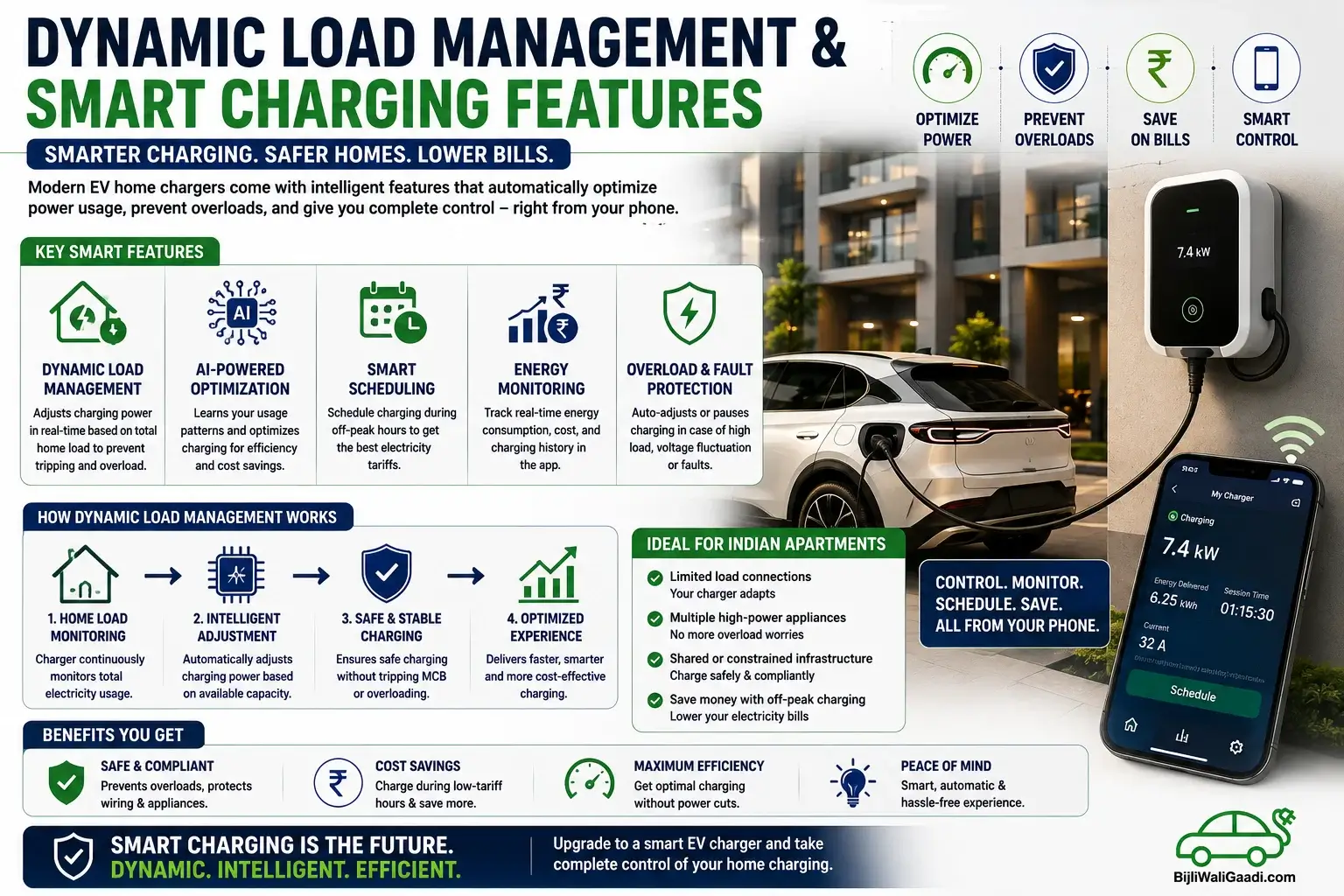
Dynamic load management is one of the more genuinely useful features to have shown up in wallboxes recently. It reads what else is drawing power in your flat or building at a given moment and adjusts the charging current accordingly — throttling down during peak household demand, ramping back up once that load clears. In apartments where sanctioned load headroom is tight, this single feature can be the difference between a smooth installation and a constant tripping breaker. Not every OEM or aftermarket charger supports it, though, so it’s worth confirming this specifically before you buy rather than assuming it’s included.
Beyond load management, several current-generation chargers also offer Wi-Fi connectivity, OTA firmware updates, scheduled charging to take advantage of off-peak tariffs where available, solar integration for households running rooftop solar, and energy monitoring that shows exactly how much the EV adds to the monthly bill. None of this is standard across the board — Wi-Fi, app functionality, OTA support, solar integration, and energy monitoring vary quite a bit between manufacturers, and sometimes between models from the same manufacturer. If a specific feature matters to you, check the spec sheet rather than assuming it comes bundled in.
Documents Required for DISCOM Load Enhancement
The list shifts a little depending on state and DISCOM, but generally you’ll need:
Forms, procedures, and turnaround times differ from one DISCOM to another, so it’s worth a quick check of your specific utility’s EV charging or load enhancement page before filing anything.
How Long Does Installation Usually Take?
Once the RWA NOC and DISCOM load sanction are both in hand, the physical work — cabling, protection devices, mounting the charger, testing everything — usually wraps up in a single day for a straightforward run. Longer cable routes or basement installations needing conduit work can stretch that to two or three days. The real variable, though, is everything before the installer even shows up. NOC processing and DISCOM load enhancement together can take anywhere from a week to over a month, depending largely on how organised your paperwork is and how responsive your society and DISCOM turn out to be.
Cost Breakdown: What Should You Realistically Spend?
Hardware often comes bundled free with the EV itself; aftermarket smart wallboxes generally run somewhere between ₹15,000 and ₹45,000 depending on the brand and feature set.
Cabling costs are best treated as indicative market ranges rather than fixed numbers — a rough sense might put 4 mm² cable around ₹230 per metre and 10 mm² armoured copper closer to ₹550 per metre, but actual pricing shifts with copper rates, cable brand, insulation quality, armouring specification, and how complex the installation route turns out to be. Get an actual quote for your specific run rather than budgeting off a generic figure.
DISCOM load enhancement fees and installation labour vary by city and by how far the cable has to travel.
Realistically, budget somewhere between ₹12,000 and ₹45,000 depending on distance from meter room to parking spot and whether a load upgrade is needed. Basement -2/-3 parking with a long cable run tends to land at the higher end; ground-floor or podium parking near the meter room usually comes in cheaper. Quite a few owners who’ve gone through this end up choosing a dedicated DISCOM EV meter simply because it makes the billing conversation with the rest of the household, or the society, much simpler later on.
Bottom line: the regulatory and policy direction increasingly supports residents pursuing technically compliant private EV charging installations. Walk in with a proper technical report, a complete written application, and the right circular reference, and most of the friction with your housing society tends to resolve well before it turns into an actual fight.
A note on safety: everything described in this guide — wiring, circuit protection, earthing, and metering — should be carried out only by a licensed electrician or the EV manufacturer’s authorised installer. This article is meant to help you understand the process and speak knowledgeably with your installer and your society, not as a substitute for a qualified professional’s on-site assessment.
FAQ
Stay connected via Google 'Electric Vehicle' News
Follow BijliWaliGaadi.com | India's Trusted EV Insights Portal
source on Google