Australia EV Market 2026: 49.16% Is More Than Just a Number—Here’s Why
Stay connected via Google 'Electric Vehicle' News
Follow BijliWaliGaadi | India's Trusted EV Insights Portal
source on Google
Australia EV market 2026 | Australia EV market share | Australia EV sales July 2026 | AAA EV Index June 2026 | VFACTS July 2026 EV sales | Australia electric vehicle market.
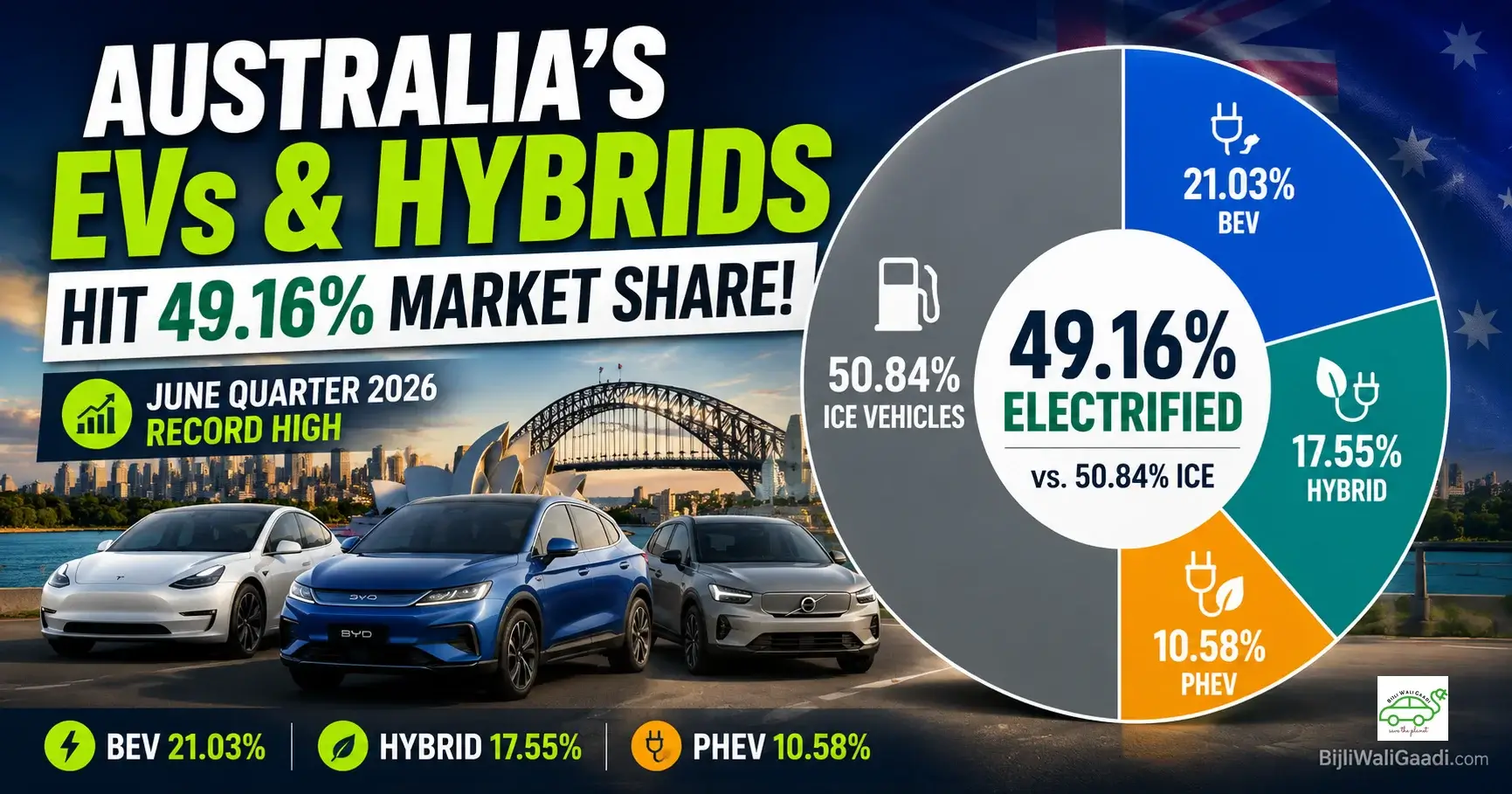
Petrol and diesel vehicles are losing ground in Australia’s new-car market, and the latest official sales data shows the decline continued into the new financial year.
The Australian Automobile Association‘s (AAA) EV Index confirms that electrified vehicles — battery EVs, plug-in hybrids, and conventional hybrids combined — captured a record 49.16% share of new light vehicle sales in the June 2026 quarter. That pushed Internal Combustion Engine (ICE) vehicles down to their lowest market share on record: 50.84%. Newly released VFACTS figures for July, published by the Federal Chamber of Automotive Industries (FCAI), confirm that electrified vehicle sales remained strong into the following month.
For a country long associated with large SUVs, long highways, and a strong preference for combustion-engine vehicles, this marks one of the most significant shifts in Australia’s automotive market in recent decades. Here is what the AAA’s June quarter data shows, verified against the latest official releases from the AAA, FCAI/VFACTS, the Electric Vehicle Council (EVC), and the Australian Automotive Dealer Association (AADA).
Australia Automotive Market Key Highlights: June 2026 Quarter at a Glance
| Metric | Figure |
| Electrified Vehicle Market Share (BEV + PHEV + Hybrid) | 49.16% |
| ICE Vehicle Market Share | 50.84% |
| Battery Electric Vehicle (BEV) Market Share | 21.03% |
| Plug-in Hybrid (PHEV) Market Share | 10.58% |
| Conventional Hybrid Market Share | 17.55% |
| Total New Vehicle Sales (June Quarter) | 330,111 |
Source: Australian Automobile Association (AAA) EV Index — June Quarter 2026
Visual: Australia’s June 2026 New Vehicle Market Mix
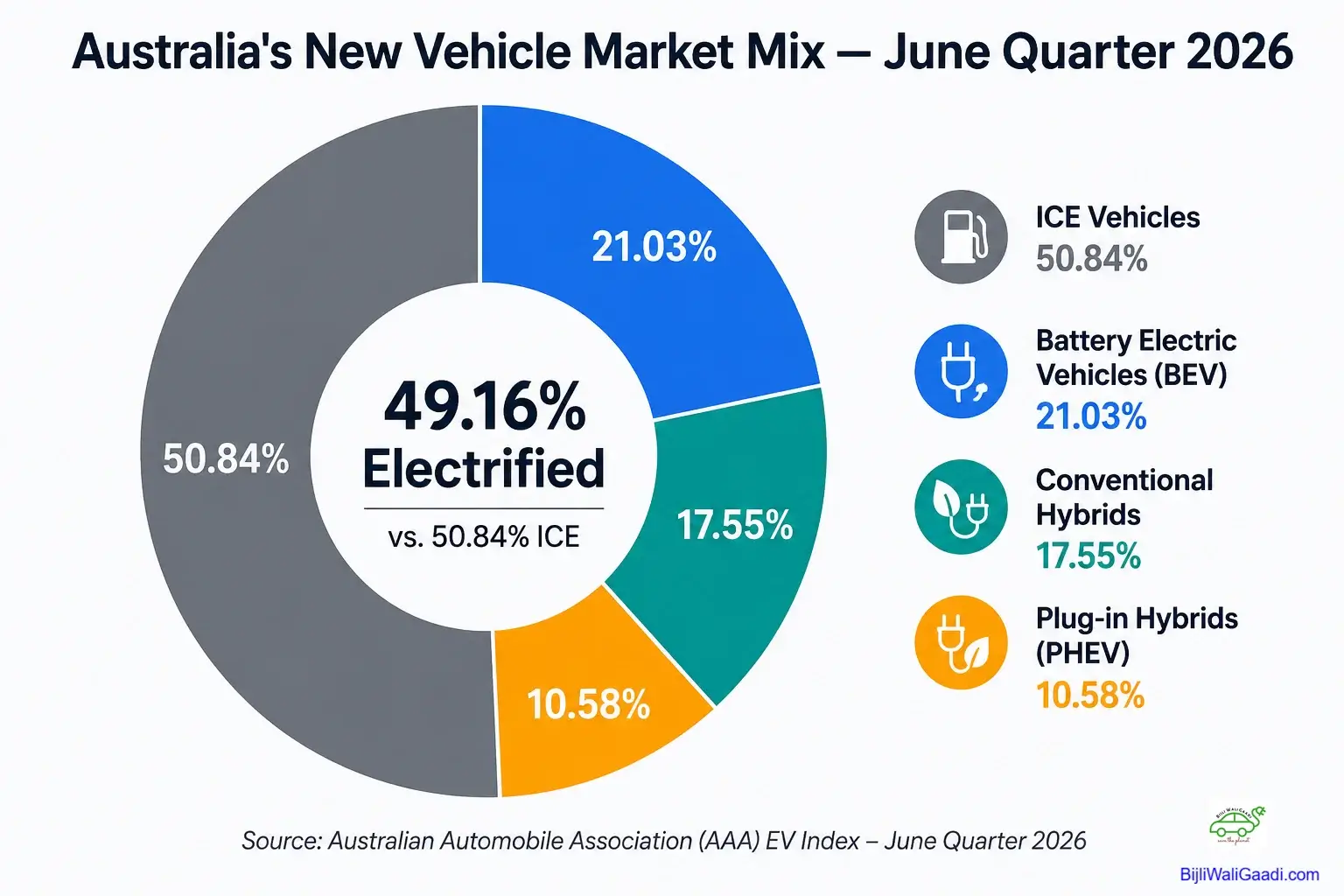
Australia’s New-Car Market Hit a Record 49.16% Electrified Share in the June Quarter
According to the AAA, since the EV Index began tracking this data in 2022, the share of ICE vehicles has fallen from almost nine in every ten new-vehicle sales to around five in every ten today. The June quarter delivered the largest single-quarter decline in ICE market share the index has ever recorded, with ICE vehicle sales falling from 180,539 units (64.23% share) in the March quarter to 167,840 units (50.84% share) by June — a drop of more than 13 percentage points in three months.
A near-50/50 split between electrified and combustion vehicles would have seemed unlikely just a few years ago for a market as geographically vast, and traditionally reliant on utes and SUVs, as Australia’s. This shift occurred against the backdrop of a record-breaking overall new-vehicle market, with the AAA confirming 330,111 total new vehicles sold during the quarter — the highest quarterly figure on record. Electrified vehicles were not simply gaining share of a shrinking market; their growth was strong enough to offset the decline in petrol and diesel sales.
Battery EVs Overtook Hybrids for the First Time Since Mid-2023
The standout performer of the June quarter was the battery electric vehicle (BEV) segment, which posted its strongest quarterly result on record.
BEV sales more than doubled between the March and June quarters:
- Q1 2026: 34,435 BEVs sold
- Q2 2026: 69,414 BEVs sold — up 137% year-on-year
That surge lifted BEV market share from 12.25% in the March quarter to 21.03% in June — a record for the EV Index and enough to overtake conventional hybrids as Australia’s most popular electrified powertrain for the first time since mid-2023.
Plug-In Hybrids and Conventional Hybrids Also Notched Fresh Records in the Same Quarter
While BEVs stole the spotlight, plug-in hybrids (PHEVs) and conventional hybrids both delivered records of their own — proof this isn’t a single-technology story.
Plug-in hybrids hit an all-time high of 10.58% market share, with 34,937 units sold — up 82% on the March quarter. PHEVs continue to appeal to buyers who want electric-first daily driving with the reassurance of a petrol engine for longer trips, a relevant proposition given Australia’s regional and outback distances.
Conventional hybrids, meanwhile, notched their own quarterly high, with 57,919 sales and a 17.55% market share. Toyota’s long dominance of the hybrid segment has clearly primed Australians for electrified motoring, even as BEVs have now technically overtaken hybrids in outright share.
July 2026 Official VFACTS Data Confirms the Electric Momentum Continued
With the June quarter locked in as an official record, newly released VFACTS figures for July — published by the Federal Chamber of Automotive Industries (FCAI) in conjunction with the Electric Vehicle Council — confirm the shift continued into the new financial year rather than stalling.
A total of 108,577 new vehicles were delivered across Australia in July 2026, a new record for the month, edging past the previous July high of 104,244 set in 2025. Battery electric vehicles accounted for 23,510 of those sales, or 21.7% of the market — the second consecutive month BEVs have exceeded a one-in-five share, following the record set in June. On a year-to-date basis, Australians have purchased 127,244 BEVs in 2026, giving electric vehicles a 17.3% share of the national market for the year to date.
FCAI chief executive Tony Weber said the July figures reflected the resilience of the Australian market despite ongoing cost-of-living pressures, and cautioned that public charging infrastructure would need to expand rapidly — particularly in regional areas and for motorists without home charging — to sustain consumer confidence as electric vehicles account for a growing share of the national fleet.
Separately, the Electric Vehicle Council’s July 2026 Vehicle Sales Report — which covers only the brands that report sales data directly to the EVC, namely Tesla and Polestar, and does not represent the full Australian EV market — recorded 4,921 combined BEV deliveries in July, up from 1,147 in July 2025. On a calendar-year basis, combined Tesla and Polestar sales reached 29,711 vehicles, an 80.4% increase over the 16,466 recorded across the same period in 2025, with year-on-year BEV growth in Victoria, Queensland, NSW, and the ACT all more than tripling July 2025 figures. EVC chief executive Julie Delvecchio said the underlying trend remained clear, with EV sales well ahead of the prior year and consumer choice continuing to expand.
Medium SUVs — Australia’s Favourite Vehicle Type — Are Turning Electric Fast
Numbers on a page are one thing. But nowhere is the shift more visible — or more relatable to everyday Australian buyers — than in the medium SUV segment, the nation’s single most popular vehicle category.
In just over four years, BEVs have gone from less than 1% of medium SUV sales to 37.30%, according to the AAA. This is the segment that includes the family cars parked in driveways from Perth to Penrith. This indicates that electrification has moved beyond early adopters and into Australia’s highest-volume vehicle segment.
EV Affordability Has Reached a Genuine Tipping Point in Australia
A common objection to EV ownership in Australia has always been price. That barrier is easing.
According to a recent RACV review of Australian EV pricing, there are now at least 13 EV models available under AU$40,000 drive-away, up from just a handful in 2023, putting battery electric vehicles within reach of a much broader slice of buyers — tradies, young families, and first-time new-car purchasers who previously assumed EVs were the preserve of the well-heeled.
Chinese-owned brands have driven much of this shift: BYD alone held 28.1% of Australia’s BEV market in the first half of 2026, according to sales data compiled by CarExpert from FCAI and EVC figures, ahead of Tesla on 22.3%. Combined with other Chinese-owned brands such as Geely, MG, GWM, and Chery, Chinese-owned marques now account for the majority of new BEVs sold in Australia.
Australia’s Used EV Market Is Growing Even Faster Than New EV Sales
It’s not just showrooms feeling the shift. According to the Australian Automotive Dealer Association (AADA) and AutoGrab, used EV sales grew 54.6% year-on-year in the first half of 2026 — even as the broader second-hand market contracted by 6.6%, with sales falling a further 16.2% in June alone. The AADA also reported that the average time to sell a used EV fell from more than 60 days in January to fewer than 40 days by June, a signal that consumer confidence in battery longevity and resale value is maturing.
How Does Australia’s EV Uptake Compare With China, Europe, and the US Right Now?
Australia’s rapid climb is striking alongside other major markets, though direct comparisons require care, since reporting bodies define “electrified” differently. According to the International Energy Agency’s (IEA) Global EV Outlook 2026, China’s electric car sales — including battery electric and plug-in hybrid models — are projected to reach nearly 60% of total car sales in 2026, up from around 55% in 2025.
In Europe, the European Automobile Manufacturers’ Association (ACEA) reported that battery electric vehicles held a 20.7% share of new EU car registrations in the first half of 2026, up from 15.6% a year earlier, with plug-in hybrids adding a further 9.8% and conventional hybrids 37.3%. In the United States, Cox Automotive data shows battery electric vehicle market share fell to around 6% in the most recent quarter, down sharply from a pre-expiry peak of 7.5% in the third quarter of 2025, after the federal EV tax credit lapsed at the end of September 2025.
Against that backdrop, Australia’s 21.03% BEV share for the June quarter sits well above the current US figure and is broadly comparable to the EU’s H1 2026 BEV share, while remaining behind China’s combined electrified share. FCAI chief executive Tony Weber has said Australia’s public charging network will need to expand rapidly to keep pace with growing EV adoption, particularly in regional areas and for motorists without access to home charging.
The broader trend echoes across the Tasman too. New Zealand buyers have long shown strong appetite for hybrid and electric vehicles, and many of the same forces reshaping Australia’s market — improved affordability, wider model choice, and growing confidence in battery technology — are playing out in New Zealand showrooms as well.
What the Latest Data Means If You’re Shopping for a New Car Right Now
For buyers weighing up their options, the June quarter and July data together offer a few practical takeaways:
What the 49.16% Figure Means for Australia’s 50% Electric Vehicle Threshold
At 49.16% for the June quarter, and with July’s official VFACTS figures showing BEV share holding above 20% for a second straight month, the gap between electrified and ICE vehicle sales has narrowed to 1.68 percentage points. Current market data suggests this gap could close further in coming quarters, though the AAA EV Index and VFACTS figures are released on a rolling basis and no single quarter should be treated as confirmation of a longer-term trend. What is clear from the data available so far is that the growth has been broad-based: BEVs, PHEVs, and hybrids all posted records simultaneously in June, and July’s figures did not show the pullback that might be expected after a record end-of-financial-year month.
The Bottom Line for Australian and New Zealand Car Buyers
The AAA’s June quarter EV Index does more than report a single number — it documents a measurable shift in Australia’s motoring market, and July’s official VFACTS data suggests the June quarter was not an isolated result. ICE vehicles, which dominated the market for well over a century, now hold their lowest-ever recorded share, while battery EVs, plug-in hybrids, and hybrids together are approaching an outright majority of new-vehicle sales.
Whether you’re a long-time EV owner or someone still weighing up the switch, the data indicates that Australia’s new-car market in 2026 looks materially different from just a few years ago, based on the official figures released to date.
Taken together, the June 2026 quarter represents a measurable turning point in the AAA EV Index’s four-year history. With electrified vehicles at 49.16% and ICE vehicles at 50.84%, Australia sits within 1.68 percentage points of the symbolic 50% threshold. If current trends continue, this gap may close in a future quarter, though that outcome is not yet confirmed by official data. Should electrified vehicles eventually overtake ICE vehicles on a sustained basis, the implications would extend beyond a single headline figure. For consumers, it would reflect electrified vehicles becoming the default choice across the country’s highest-volume vehicle segments rather than an alternative one.
For manufacturers, it would reinforce the case for continuing to expand affordable model line-ups below the AU$40,000 mark. For policymakers and charging network operators, it would sharpen the need to expand infrastructure — particularly in regional and outer-metropolitan areas — in line with FCAI chief executive Tony Weber’s stated concerns about charging capacity keeping pace with fleet growth. These are outcomes current data points toward, not certainties; the AAA EV Index and VFACTS report on a quarterly and monthly basis, and future results could diverge from the trend described here.
Stay connected via Google 'Electric Vehicle' News
Follow BijliWaliGaadi | India's Trusted EV Insights Portal
source on Google