Charger On Wheels: How Mobile EV Charging Comes to Your Car
Stay connected via Google 'Electric Vehicle' News
Follow BijliWaliGaadi | India's Trusted EV Insights Portal
source on Google
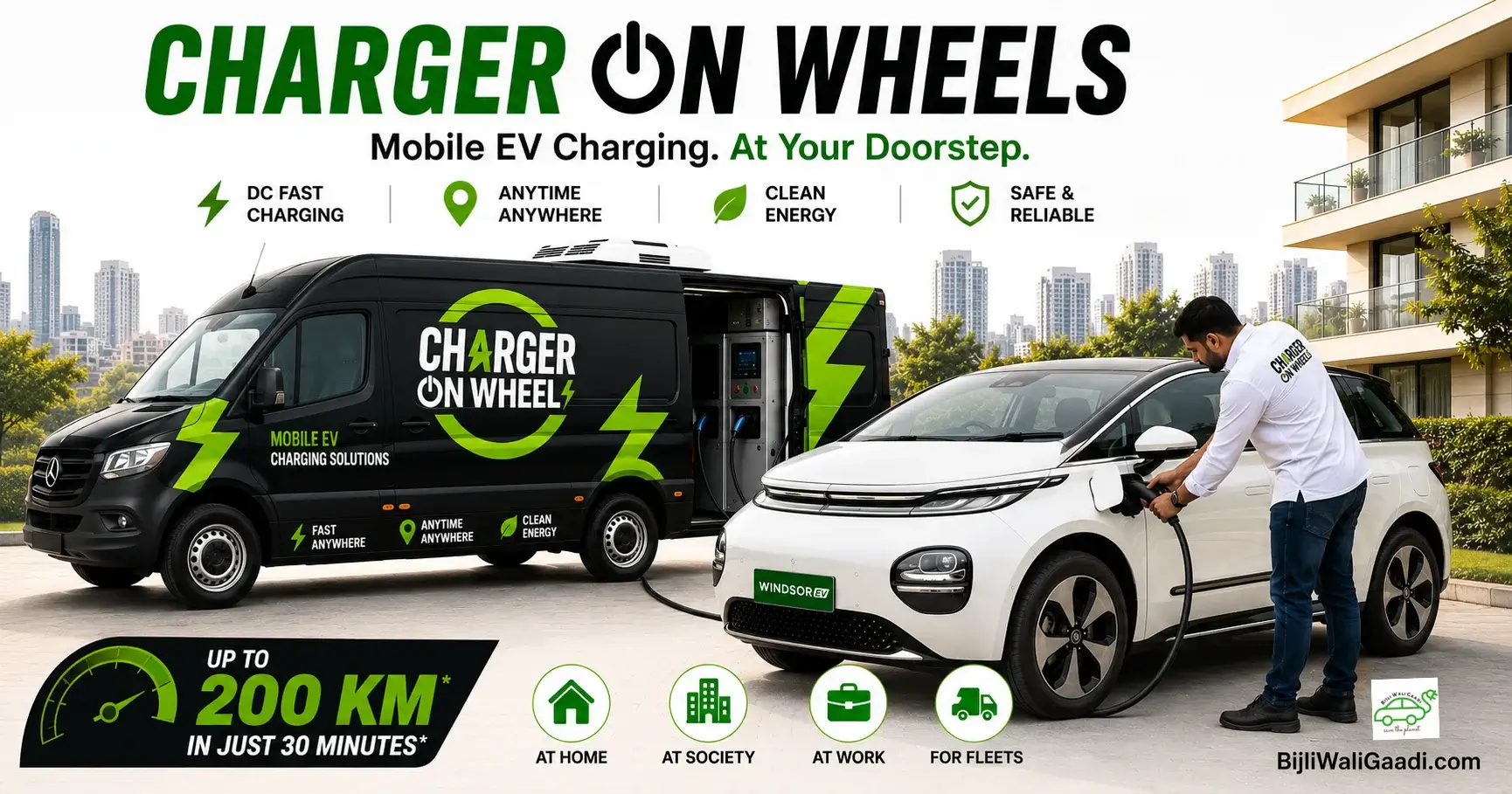
You’re parked at home in Gurugram, the battery is down to single digits, and the nearest public charger is either occupied or a detour you don’t have time for. It’s a situation plenty of EV owners in Indian cities have run into — and it’s the exact problem a Gurugram-based startup called Charger On Wheels is trying to solve differently.
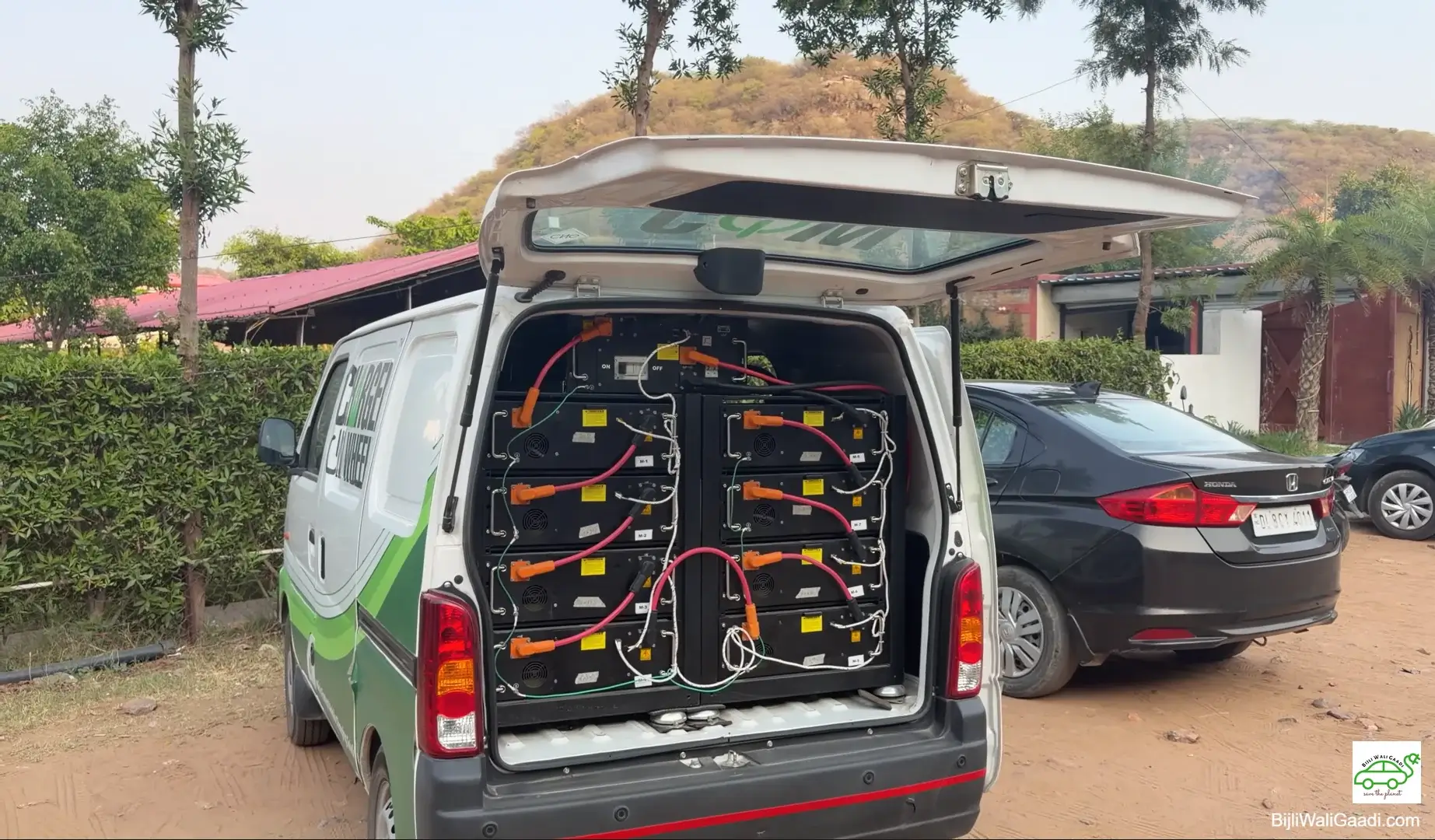
Instead of sending drivers to a charging station, Charger On Wheels sends a mobile DC fast-charging unit to wherever the vehicle is parked. It’s a model built specifically for Indian housing realities, where fixed home chargers aren’t always an option.
What Is Charger On Wheels and How Does Its Mobile EV Charging Service Work?
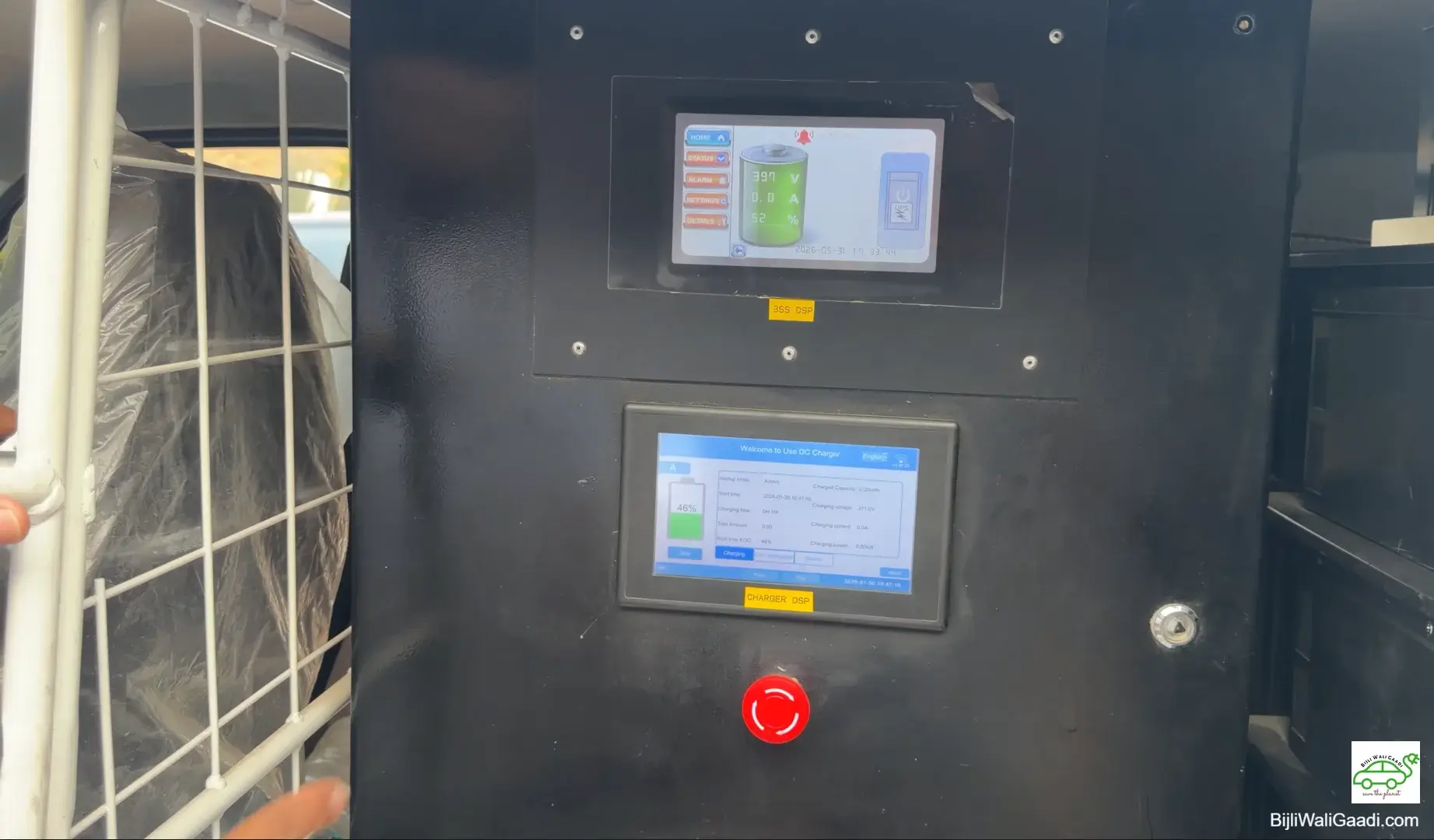
Charger On Wheels is an on-demand mobile EV charging service that brings a self-powered DC fast charger to a vehicle’s parking spot instead of requiring the driver to travel to a station.
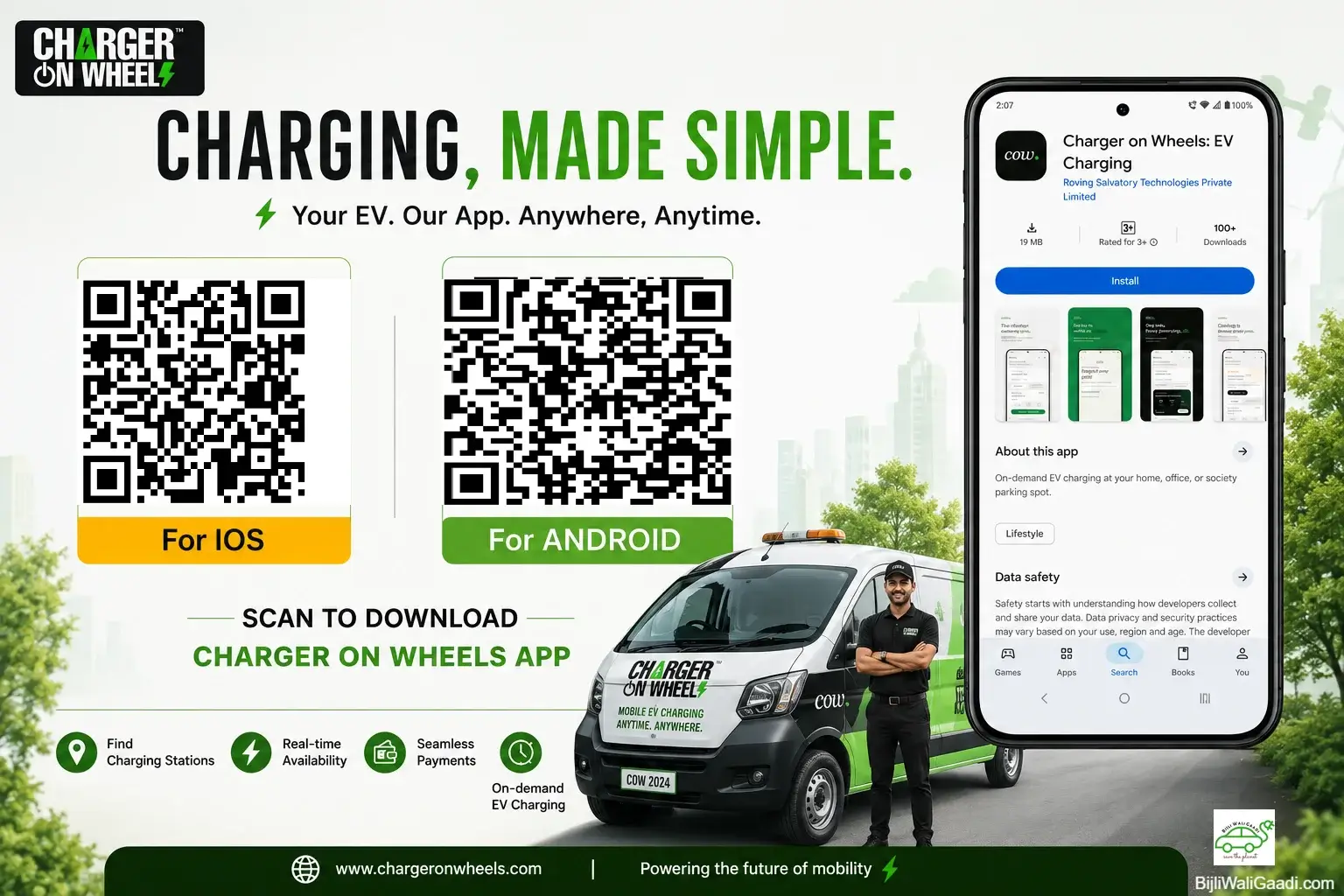
A customer books a session through the Charger On Wheels app, choosing a time slot and confirming the parking location. A trained operator then drives the mobile charging unit to that spot and connects to the vehicle using a CCS2 or Type 2 connector, depending on the car. No cabling runs across a basement floor, and no dedicated charging bay is required — the session is tied to the customer’s address, not a fixed piece of hardware.
How Can Charger On Wheels Help When an EV Battery Runs Low?
For an EV owner, a service like this is most useful in a few specific situations rather than as an everyday replacement for home charging.
This is a narrower, more practical use case than “solving” India’s charging gap — it’s a buffer for specific moments where fixed infrastructure falls short.
What Services Does Charger On Wheels Offer to EV Owners, RWAs and Fleets?
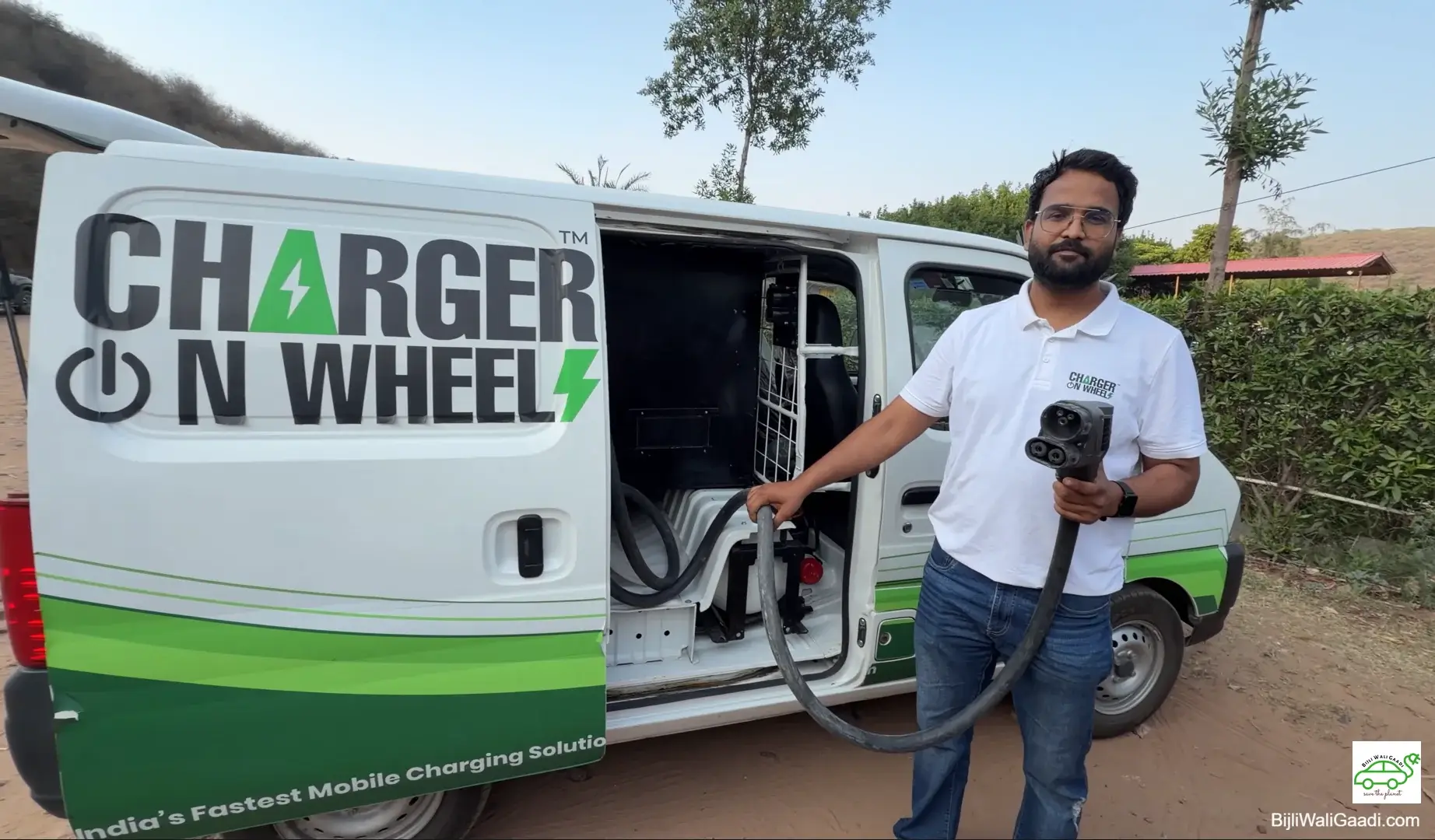
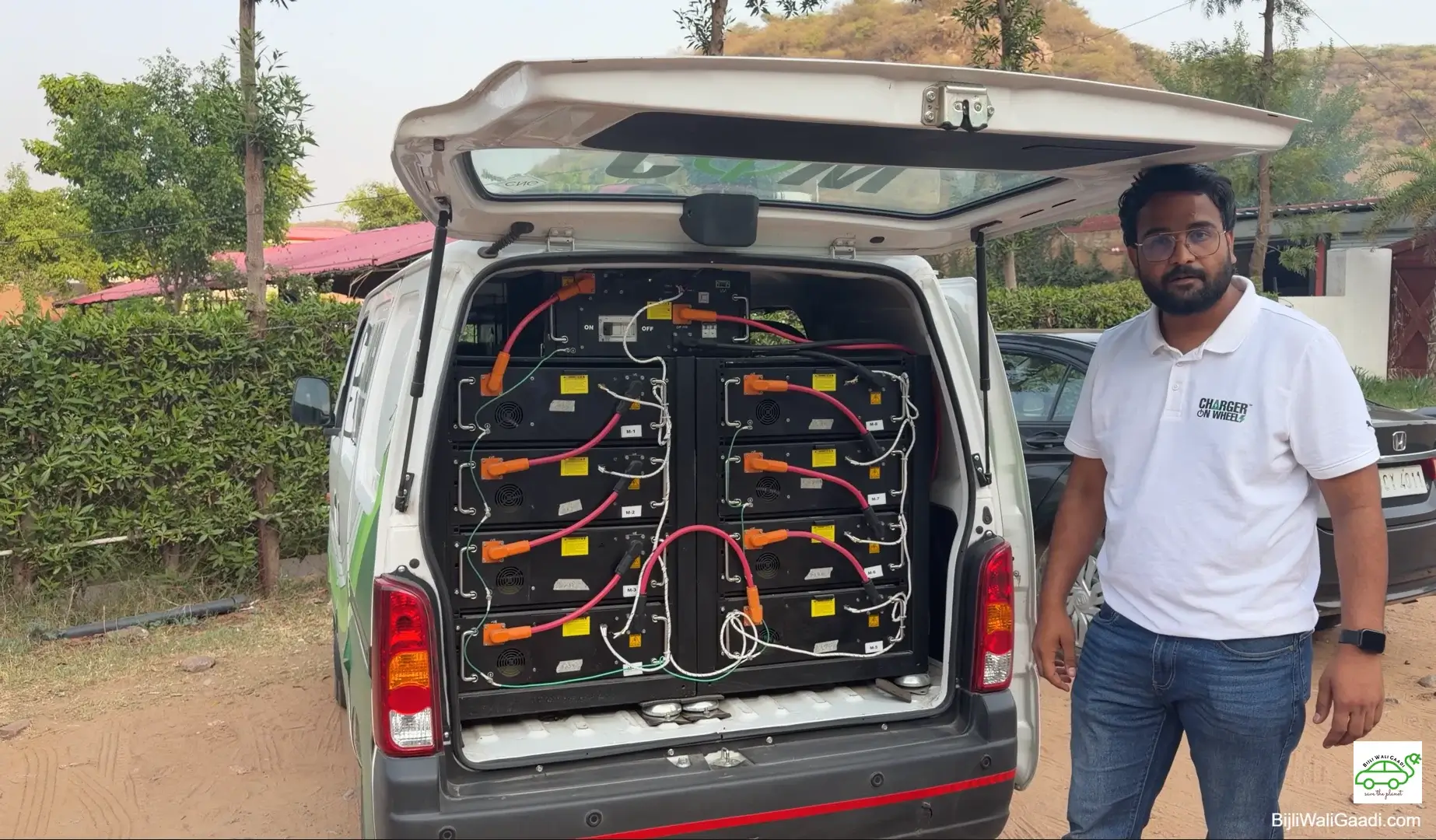
Charger On Wheels structures its service around three distinct user groups.
Mobile EV Charging for Residents and EV Owners
Residents can book doorstep DC fast charging, use rescue sessions during low-battery situations, and cover two vehicles under most subscription plans.
EV Charging Solutions for RWAs and Residential Developers
For developers and Resident Welfare Associations, the pitch is avoiding basement trenching, transformer upgrades, and per-bay charger installations. Charger On Wheels says this approach can help societies address EV-ready parking requirements without conventional construction and dedicated charger installations — a proposition attributed to the company’s own messaging rather than an independently verified nationwide regulation, since EV-ready parking norms can vary by state and municipal body.
Mobile Charging for Electric Vehicle Fleets
Fleet operators can pre-book depot-side charging sessions for last-mile and ride-hailing vehicles, aimed at reducing detours to public charging points during operating hours.
How Does the Charger On Wheels EV Charging Process Work?
The customer journey, as described by the company, follows four steps: request a session through the app and confirm the parking spot; the operator arrives with the mobile unit; charging happens on-site with power tapering automatically as the battery nears 80%; and the customer gets a notification and settles payment in-app once the session ends.
How Fast Can Charger On Wheels Charge an Electric Vehicle?
Charger On Wheels advertises a typical DC fast-charging session as delivering up to roughly 200 km of range in about 30 minutes, using CCS2 and Type 2 connectors.
These are company-stated figures, not guaranteed outcomes for every vehicle. Actual range added in a real session depends on the EV model, battery capacity, the state of charge at the start of the session, the vehicle’s own charging curve, ambient temperature, and any charging-rate limits set by the car’s Battery Management System. A smaller-battery hatchback and a larger SUV won’t necessarily gain the same range in the same 30 minutes.
Where Is Charger On Wheels Available in India?
Charger On Wheels currently operates only in Gurugram (Gurgaon). Bengaluru, Hyderabad, Mumbai and Pune are listed by the company as upcoming markets — announced expansion plans, not cities where the service is live today. Anyone searching “Charger On Wheels Bangalore” or “Charger On Wheels Hyderabad” should treat these as future-availability queries for now.
Why Could Mobile EV Charging Matter for India’s Growing EV Market?
Mobile, on-demand charging can act as a complement to home, workplace, public and fleet charging — filling specific gaps rather than replacing any of them. In residential complexes where fixed charger installation involves civil work, permissions, or fire-safety review, a mobile session can offer a working alternative in the interim. This isn’t a claim about India’s charging infrastructure as a whole; it’s a description of one narrow but real use case mobile charging can address.
Can Charger On Wheels’ Mobile Charging Model Scale Across Indian Cities?
Charger On Wheels has publicly announced plans to expand into Bengaluru, Hyderabad, Mumbai and Pune, alongside its existing Gurugram operations. The company describes its approach as asset-light. Whether that ultimately includes a franchise or local-partner structure hasn’t been established in company statements reviewed for this article, so that possibility should be read as an industry-typical scaling path an asset-light mobile-charging operator might pursue — not as a confirmed Charger On Wheels plan. Execution, operator availability, and demand density in each new city will determine how quickly this expansion actually happens.
On the technology side, Charger On Wheels has received backing from Exicom Tele-Systems Limited (NSE: EXICOM, BSE: 544133), a listed Indian manufacturer of EV charging and critical-power systems. Exicom announced this support in September 2025, describing its role as a technology enabler supplying hardware and technical expertise for the mobile charging fleet. No investment amount or equity stake has been publicly disclosed, and this backing should be understood as a technology partnership rather than a confirmed funding round.
What Should EV Owners Check Before Using Charger On Wheels?
Before booking, it’s worth confirming current city availability, connector compatibility (CCS2 or Type 2) with your specific EV, the session limits and rescue-session terms on your chosen subscription, and how many vehicles a plan actually covers. These details are stated on the company’s app and website and can change, so checking current terms directly is the safer approach. To checkout their latest subscription plan visit Charger On Wheels — Mobile EV charging, on demand.
Is Charger On Wheels a Replacement for Public EV Charging?
No. It’s better understood as a complementary charging option rather than a substitute for home, workplace or public charging infrastructure.
Mobile charging solves a scheduling and access problem — getting a session without visiting a station — but it doesn’t add charging capacity to a city’s grid or replace the need for public fast-charging corridors on highways and busier commercial routes. For daily home charging needs and long-distance travel, fixed infrastructure still does the heavier lifting.
Can Charger On Wheels Become a Major Mobile EV Charging Network in India?
Charger On Wheels is currently operating in a single city, with announced plans to expand into several more. Its relevance lies in offering a lower-construction alternative for specific charging gaps — not in claiming to solve India’s charging infrastructure challenge on its own. Whether it becomes a larger network will depend on how reliably it executes in new cities, how it manages operator training and fleet uptime at scale, and how strong actual demand turns out to be once it moves beyond Gurugram. Those remain open questions rather than settled outcomes.
Note: some of the images used in this article are snapshot from the Youtube video by Satish K Videos EXTRA
Stay connected via Google 'Electric Vehicle' News
Follow BijliWaliGaadi | India's Trusted EV Insights Portal
source on Google