Kawasaki CORLEO: The 150cc Hydrogen Vehicle With Four Robotic Legs
Stay connected via Google 'Electric Vehicle' News
Follow BijliWaliGaadi | India's Trusted EV Insights Portal
source on Google
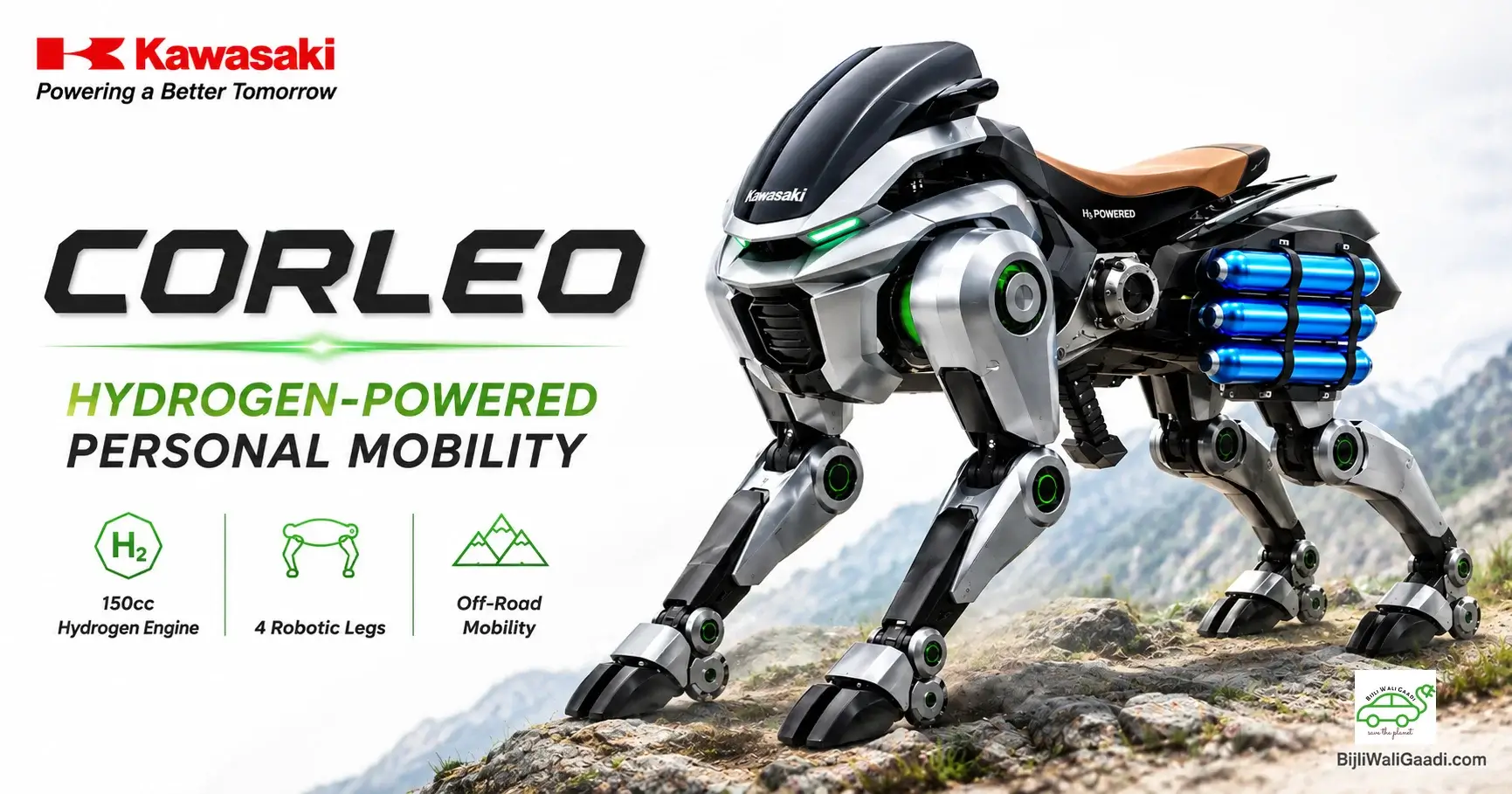
Kawasaki has built a vehicle with no wheels.
In their place are four robotic legs, a rider’s saddle, handlebars, and — hidden behind the seat — a small hydrogen engine. Kawasaki calls it CORLEO, shown as a concept at Expo 2025 Osaka, Kansai, Japan, positioned as a new category of personal mobility built around the “Fun to Ride” character of Kawasaki’s motorcycles.
If there are no wheels, how does it actually move?
What Is Kawasaki CORLEO?
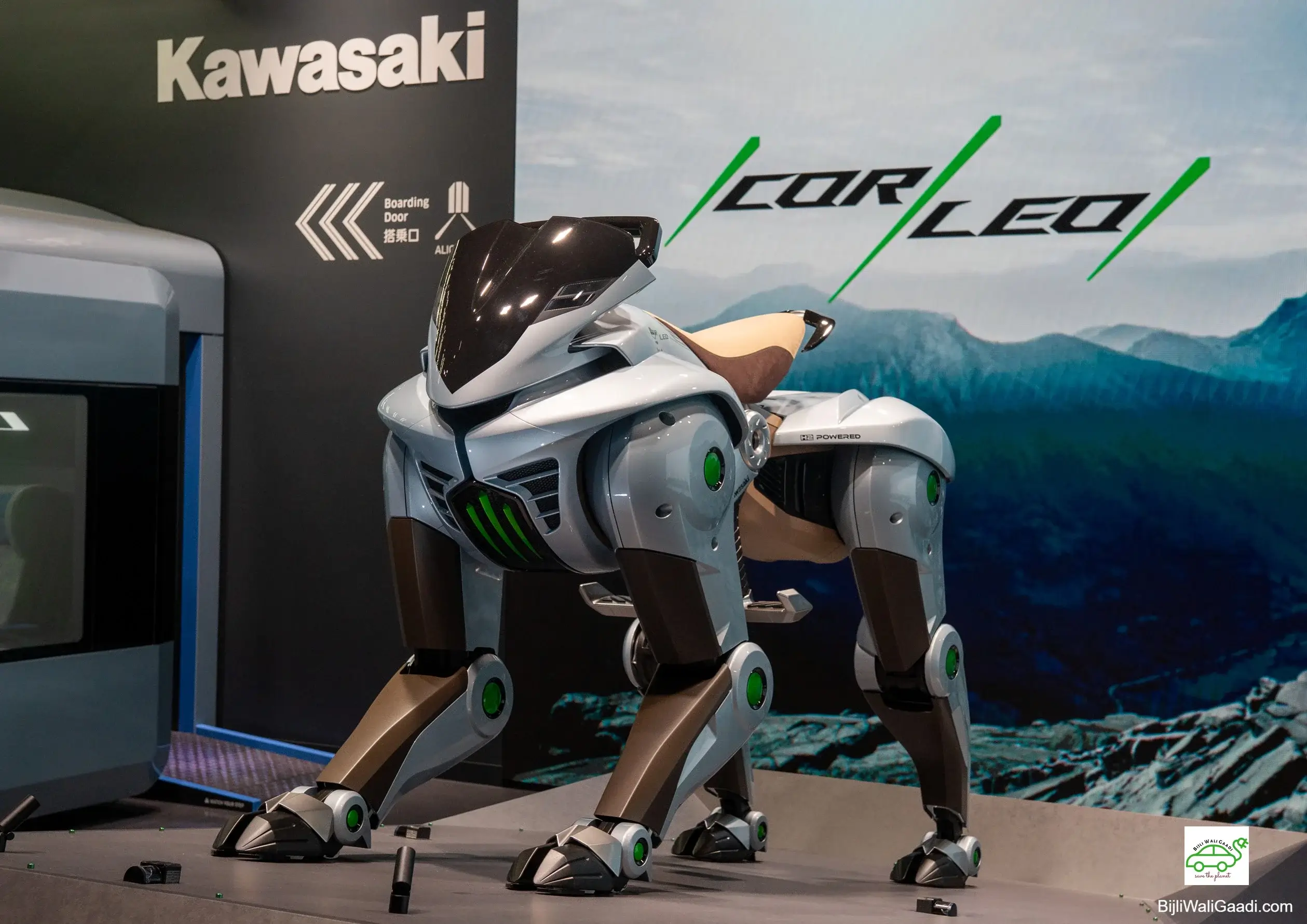
CORLEO is Kawasaki Heavy Industries‘ concept for off-road personal mobility, built around four robotic legs, each incorporating a drive unit, instead of a wheeled chassis. It is not a motorcycle, an ATV, an electric scooter, or a general-purpose walking robot. Kawasaki designed it specifically for rough, off-road terrain — grasslands, rocky ground, rubble fields — where a rider sits, steers, and shifts their weight much as they would on a motorcycle, but the machine beneath them walks.
That answers what CORLEO is. It doesn’t yet answer where the movement comes from.
How Does Kawasaki CORLEO’s Hydrogen Engine Work?
Tucked behind the rider is a 150cc hydrogen engine. It draws hydrogen from a canister mounted at the rear of the vehicle. Kawasaki uses this engine for power generation.
That single detail changes how you should picture CORLEO working. Kawasaki describes the 150cc hydrogen engine as a power-generation source, with the resulting electricity powering drive units installed in the vehicle’s four legs — not a hydrogen-burning engine driving those legs directly, the way a combustion engine drives a rear wheel.
Does CORLEO Use a Hydrogen Fuel Cell?
No — and this distinction matters. CORLEO should not be confused with a hydrogen fuel-cell vehicle. Kawasaki’s own material describes a 150cc hydrogen engine used for power generation, not a fuel-cell stack converting hydrogen directly into electricity through a chemical reaction. That makes CORLEO’s hydrogen engine a mechanically different path to the same practical result as a fuel cell: electricity available on demand.
So the electricity exists. The next question is obvious — how does it actually move four legs?
How Do CORLEO’s Four Robotic Legs Move?
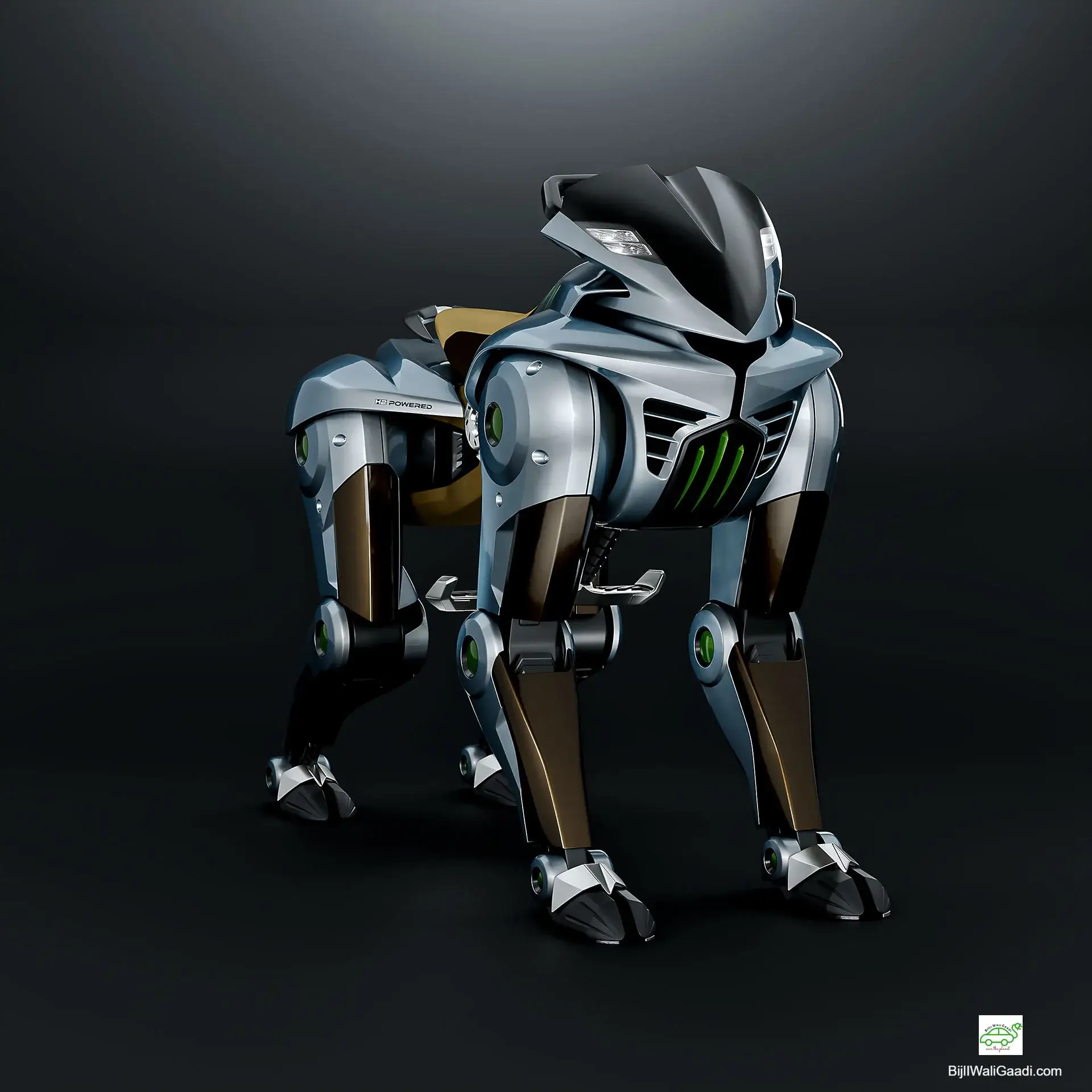
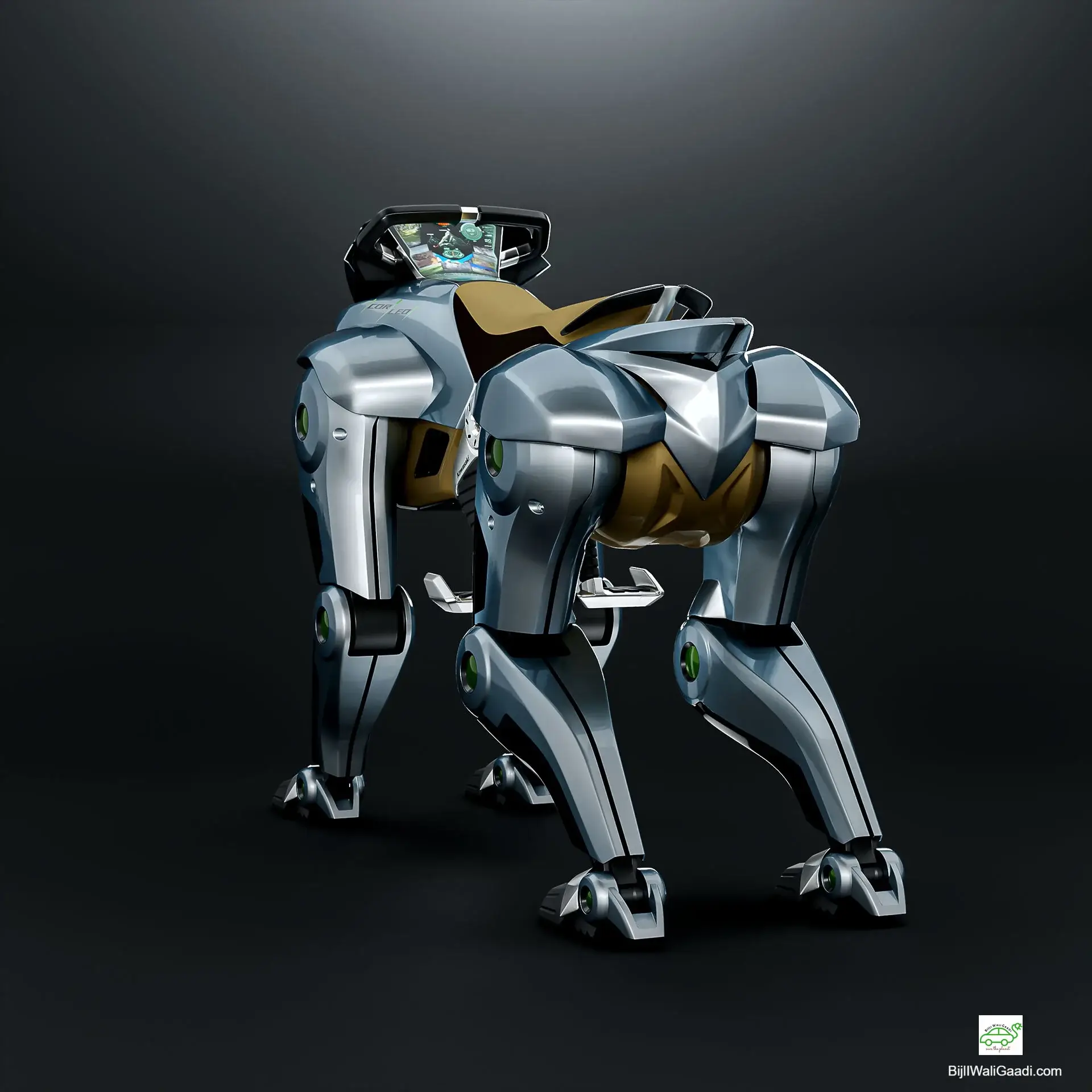
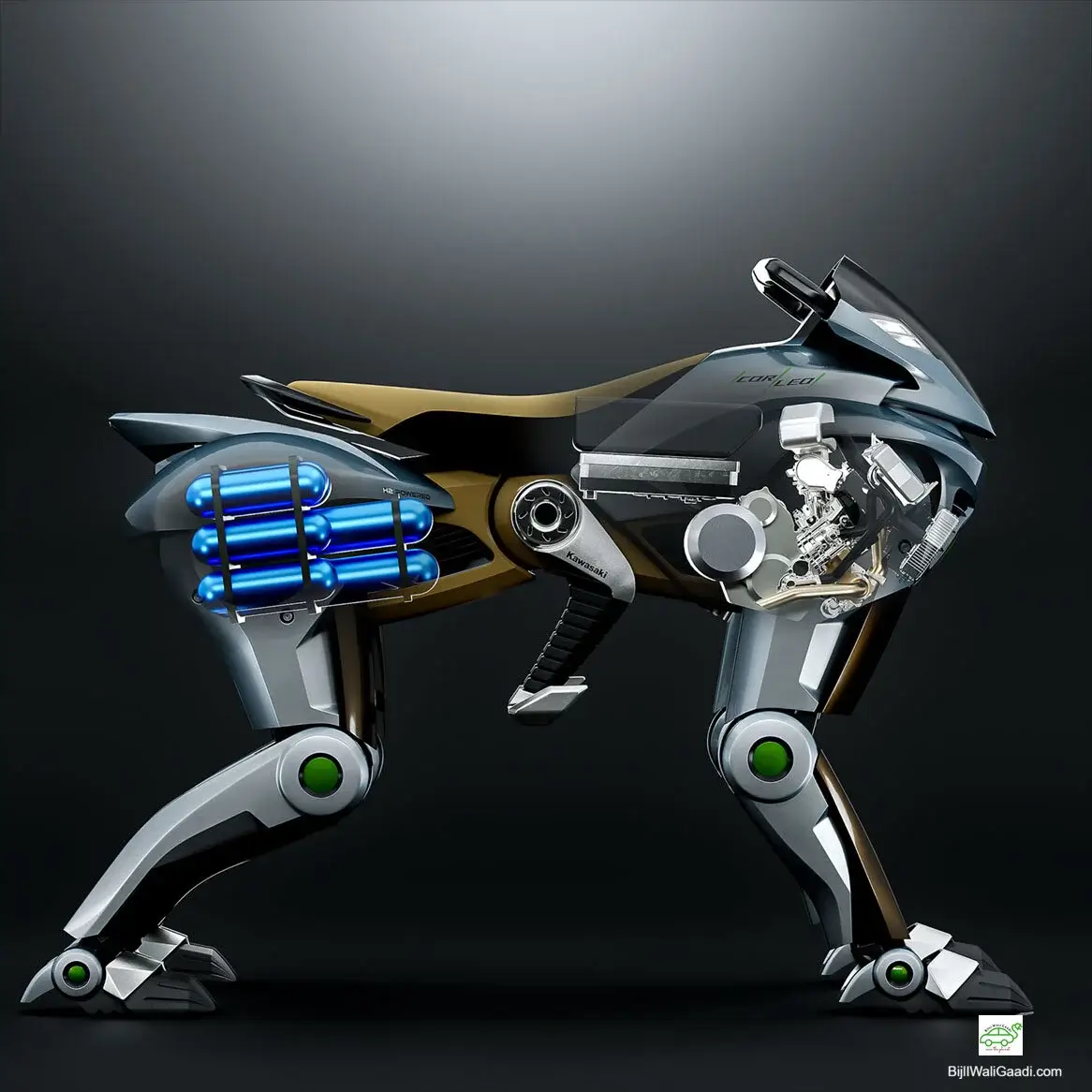
The generated electricity powers drive units installed in each of CORLEO’s four legs, rather than a single shared axle turning a set of wheels.
The full chain looks like this:
Hydrogen canister → 150cc hydrogen engine → electricity → drive units in the four robotic legs → movement
It’s a fundamentally different architecture from a battery-electric vehicle, where a battery pack stores energy and an inverter feeds a motor. It’s also different from a fuel-cell EV, where a fuel-cell stack — not a small engine — produces the electricity. CORLEO’s disclosed hydrogen-to-electricity-to-drive architecture sits in its own category.
Four legs, each with a drive unit, raise a harder problem, though. A car has a steering wheel. A motorcycle has a throttle and a lean angle. What do you do with four legs?
How Does the Rider Control Kawasaki CORLEO?

The rider doesn’t operate CORLEO through a conventional throttle-and-brake setup alone. Kawasaki describes a control system built around weight shifts, detected through the steps — essentially footrests — and the handlebars. Move your weight, and the machine responds accordingly.
There’s also an adjustable stirrup. By changing its length, the rider can maintain an optimal posture as the legs move beneath them. It’s less like operating a machine and more like riding one — an extension of the same “Fun to Ride” instinct Kawasaki builds into its motorcycles, just translated onto legs instead of wheels.
Control is one problem solved. Surviving uneven ground is another.
How Does CORLEO Handle Rough Terrain?
Two features do the real work here.
The first is the Swing Arm. The rear leg unit can swing up and down independently from the front leg unit, absorbing shocks while walking or running. When CORLEO climbs steps, this same mechanism lets the rider avoid tilting their head upward — keeping their eyes on the road ahead instead of the obstacle above.
The second is the hooves. Each leg ends in a hoof with a left-right divided structure made of rubber — a material chosen because it absorbs surface irregularities and resists slipping. Kawasaki states these hooves are built to adapt across grasslands, rocky areas, and rubble fields.
But a machine that can walk over uneven terrain still needs to tell its rider where that terrain leads.
What Does CORLEO’s Navigation System Show the Rider?
An onboard instrument panel displays the hydrogen level, a route to the summit, and the vehicle’s centre-of-gravity position, along with other riding information. At night, CORLEO projects markers onto the road surface ahead, indicating the path forward before the rider reaches it.
None of this is described by Kawasaki as autonomous navigation. It’s a rider-information layer — designed to support a human who is still doing the riding, not replace them.
By this point, CORLEO looks like a genuinely engineered machine, not a rendering. There is, however, an important distinction between demonstrating a technology and putting it into a showroom.
Is Kawasaki CORLEO a Production Vehicle?
No. CORLEO remains a concept vehicle, shown at Expo 2025 Osaka, Kansai, Japan. Kawasaki has not disclosed a launch date, production timeline, pricing, range, top speed, hydrogen tank capacity, or hydrogen consumption in the referenced material. Where Kawasaki hasn’t published a figure, this article doesn’t guess one — those specifications simply aren’t public yet.
What Kawasaki has shown is a complete, working idea: a hydrogen engine generating electricity for drive units in four robotic legs, controlled by a rider’s own body, built to walk where wheels can’t. Whether that idea ever reaches production is a separate question from whether the engineering behind it is real — and right now, only the engineering has been confirmed.
CORLEO doesn’t prove that legged, hydrogen-electric vehicles are about to replace wheels or batteries. What it does show is that Kawasaki is testing a different definition of what “riding” could mean — one where the machine beneath you moves less like a vehicle, and more like something alive.
FAQs
Stay connected via Google 'Electric Vehicle' News
Follow BijliWaliGaadi | India's Trusted EV Insights Portal
source on Google