Sodium-Ion Battery for Home Solar Storage: Can It Really Replace Lithium-Ion?
Stay connected via Google 'Electric Vehicle' News
Follow BijliWaliGaadi | India's Trusted EV Insights Portal
source on Google
sodium-ion battery | sodium-ion home battery | sodium-ion battery for solar | sodium-ion vs lithium-ion | solar energy storage | lithium-ion battery | Eleven Energy | Galvani battery | battery technology | home energy storage
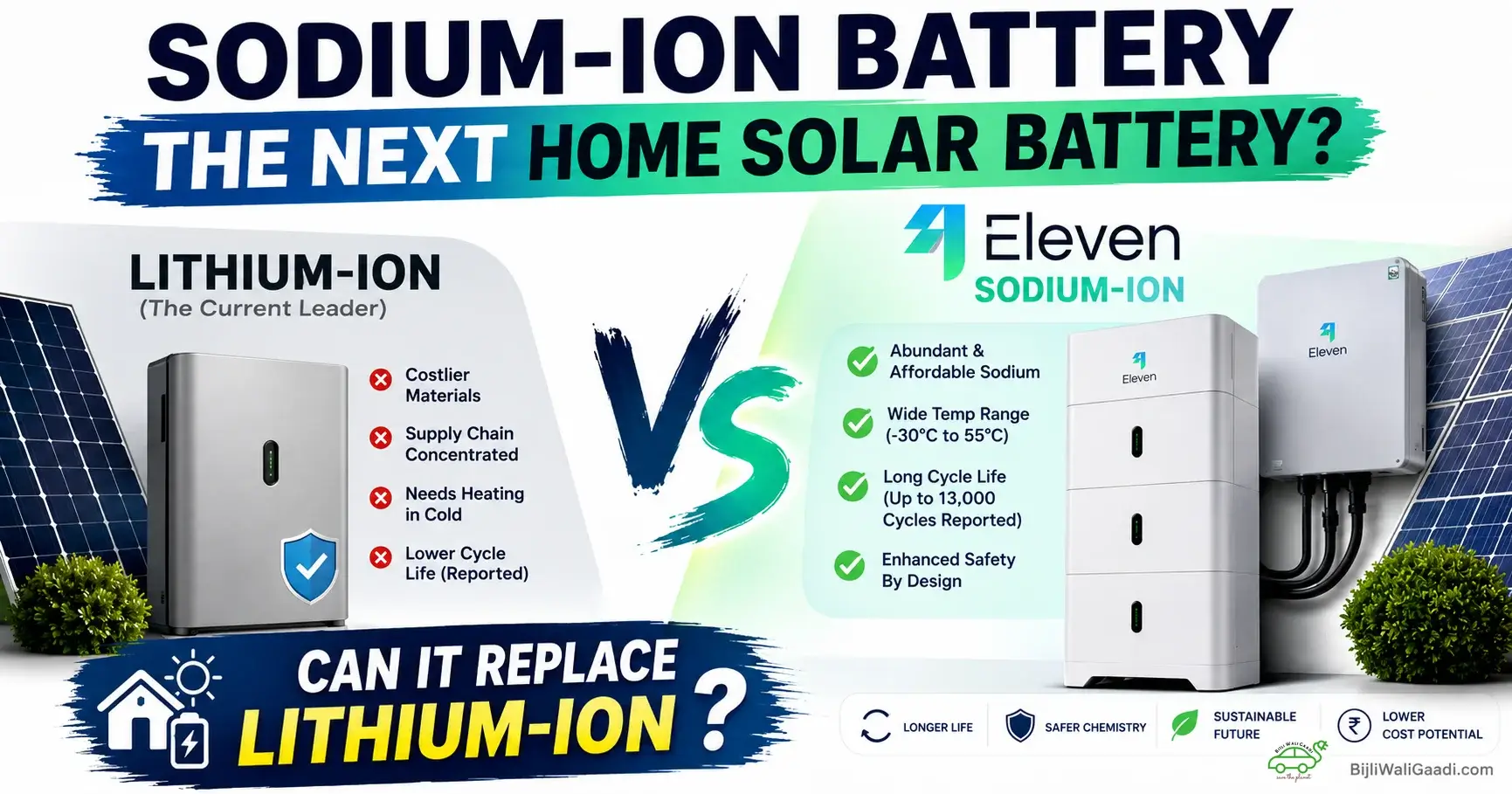
Lithium-ion has run the home battery market for over a decade. But a sodium-ion battery built from one of the most abundant elements on Earth is now emerging as a genuine option for stationary solar energy storage — and Eleven Energy‘s Galvani system shows why. Short answer: sodium-ion won’t erase lithium-ion everywhere, but for home solar storage it makes a strong case, because a home battery doesn’t need to be small or light — it needs to deliver durable, safe, economically sensible storage over a long service life.
Can a Sodium-Ion Battery Really Replace Lithium-Ion at Home?
Not universally — but for home solar storage specifically, sodium-ion is a realistic, well-suited alternative. Lithium’s small atomic size gives it unmatched energy density, which is why it dominates phones and EVs, where every kilogram matters. A wall-mounted or utility-room battery has no such constraint. What matters more there is cycle durability, wide-temperature operation, safety margin and long-term economics — areas where sodium-ion performs strongly. The right question isn’t “will sodium-ion kill lithium-ion?” but where does it make more sense?
What Is Sodium-Ion Battery Technology and How Does It Work?
A sodium-ion battery is a rechargeable battery that uses sodium ions instead of lithium ions to store and release electrical energy. It works on the same “rocking-chair” principle as lithium-ion: on charge, sodium ions (Na⁺) move from cathode to anode through an electrolyte and separator, while electrons travel through the external circuit; on discharge, the process reverses.
It isn’t simply “a battery made of table salt” — a working cell still needs an engineered cathode, anode, electrolyte and separator, with sodium only the charge-carrying ion. Sodium sits one row below lithium on the periodic table, giving it a larger ionic radius, which makes sodium-ion cells somewhat bulkier for equivalent capacity — a real drawback in an EV, but a minor one against a garage wall.
Why Sodium-Ion Batteries Are Well Suited to Solar Home Energy Storage
Sodium is abundant, found widely in common salts rather than concentrated in a handful of mining regions — pointing toward a more resilient supply chain than lithium’s. For solar households, the energy flow is simple: solar panels → inverter → home loads → sodium-ion battery → evening electricity. Excess daytime solar is stored rather than wasted, cutting grid dependence and, on smart tariffs, letting households shift consumption to cheaper periods. As explained in BijliWaliGaadi’s Sodium-Ion Battery Market Outlook, this abundance and cost logic is driving sodium-ion’s rapid commercialisation beyond the lab.
Sodium-Ion vs Lithium-Ion: Which Is Better for Home Batteries?
| Parameter | Sodium-ion | Lithium-ion |
| Energy density | Lower Wh/kg — needs more volume for equal capacity | Higher — ideal where space/weight is critical |
| Weight/size | Approximately 15–20% greater volume and weight | Compact, lightweight |
| Raw-material availability | Sodium is abundant and widely distributed | Lithium supply is more geographically concentrated |
| Cycle life | Strong reported cycling durability in testing | Also strong, especially LFP chemistry |
| Cold-temperature performance | Eleven Energy specifies a wide operating range for Galvani; heating requirements depend on system design | Often needs internal heaters in cold climates |
| Safety | Potential intrinsic safety advantages, depending on chemistry and cell design | LFP lithium-ion already has a strong safety record |
| Solar storage suitability | Well suited — size/weight matter less indoors or outdoors | Also suitable, especially where space is tight |
| EV suitability | Limited by lower energy density | Preferred chemistry today |
| Technology maturity | Newer to market, scaling quickly | Mature, well-established supply chain |
| Stationary-storage potential | High — a natural fit | High — proven track record |
The takeaway: a home battery doesn’t need to match an EV battery’s energy density — and that single fact reshapes which chemistry makes sense where.
How Eleven Energy’s Galvani Sodium-Ion Home Battery Works
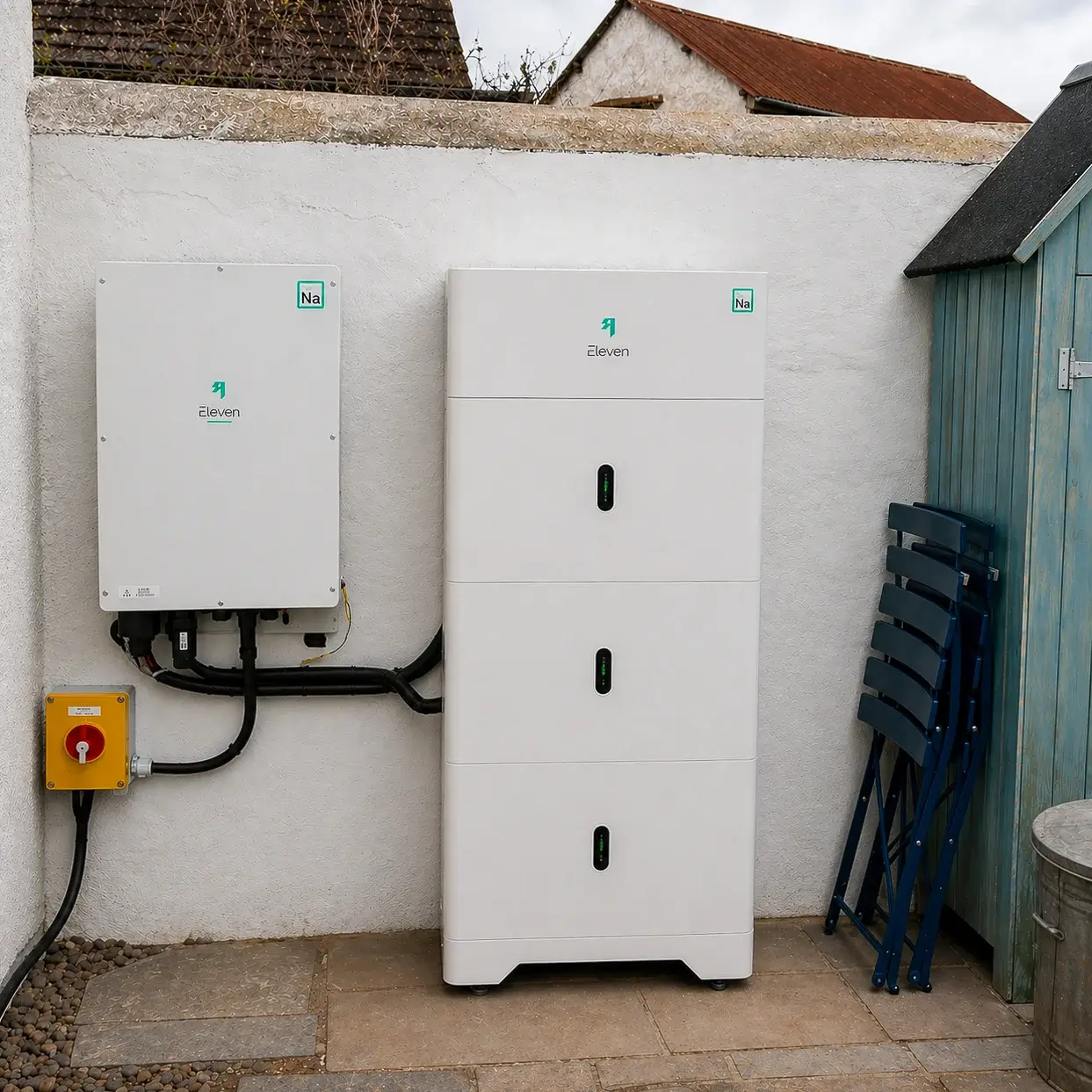
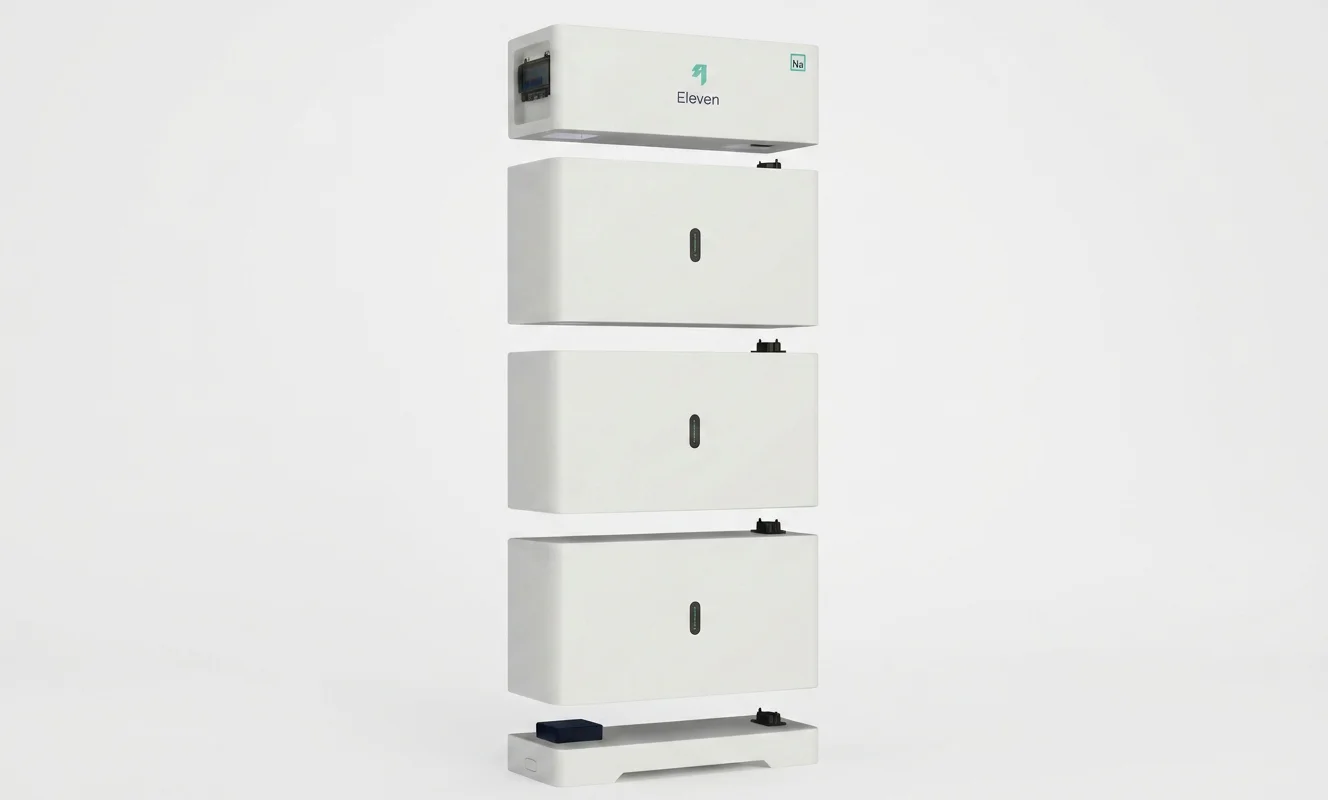
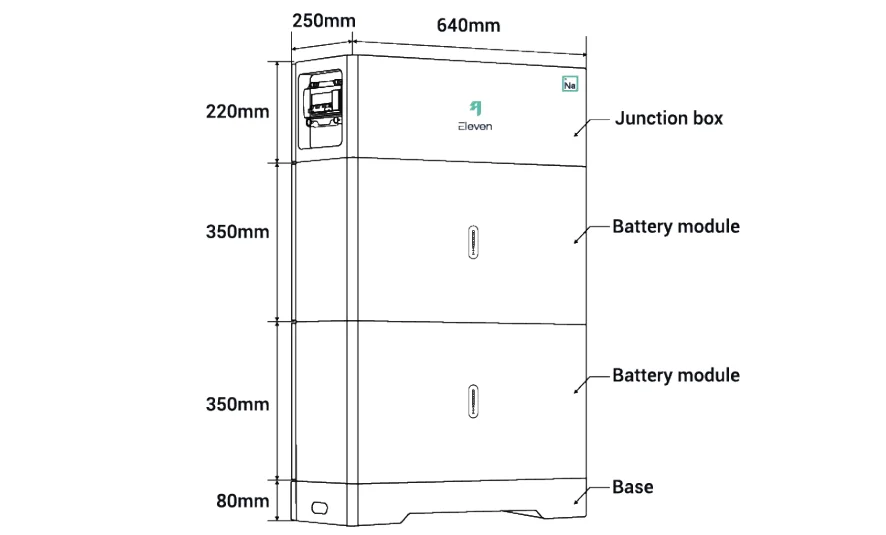
Eleven Energy builds its residential system around three main components: the Galvani battery, a hybrid inverter, and an app-based energy-management layer.
Galvani’s Stackable Sodium-Ion Battery Modules
Each Galvani module has a 4.5 kWh nominal capacity, with up to four modules per stack and up to 16 modules across four stacks per inverter. A full 16-module configuration provides 72 kWh of nominal capacity before accounting for the system’s usable-capacity limits. One of the installer described the earlier rack-mounted design giving way to this stackable format so homeowners could scale capacity to their property and solar output.
Eleven Energy’s Hybrid Inverter for Sodium-Ion Systems
The inverter converts DC from the solar array and battery into usable AC power while managing charge and discharge. Eleven Energy offers hybrid inverter options from 3.6 kW to 12 kW, allowing systems to be sized for different residential energy requirements. Homeowners in the video used the larger models alongside multiple Galvani modules.
Smart Energy Management Through the Eleven Energy App
The app runs on manual schedules or an “optimise my system” mode weighing weather forecasts, tariff data and past consumption to decide when to charge, discharge or export. The video described pausing battery discharge while an EV charges overnight, and diverting surplus solar into an immersion heater rather than exporting it cheaply.
How Galvani Performs in Hot and Cold Temperatures
Eleven Energy specifies a wide operating range for Galvani — charging between -20°C and 55°C and discharging between -30°C and 55°C — with IP65 protection for indoor or outdoor installation. This reduces the need for the type of battery heating used by some lithium-ion systems in cold conditions, a point raised in the video. Round-trip efficiency is another important specification for home batteries, since it determines how much stored electricity can ultimately be recovered for household use.
Galvani’s Warranty, Cycle Life and Long-Term Durability
Officially, Galvani carries a 10-year, 8,000-cycle product warranty. Separately, independent media reported that Eleven Energy cells subjected to roughly 13,000 charge-discharge cycles in internal testing — equivalent to once a day for about 35 years — retaining approximately 85% of original capacity. That’s a strong result, but a reported lab finding, not an independently verified 35-year lifespan guarantee. Treat the warranty as the binding commitment and the cycle-test data as supporting evidence.
Is a Sodium-Ion Home Battery Safer Than Lithium-Ion?
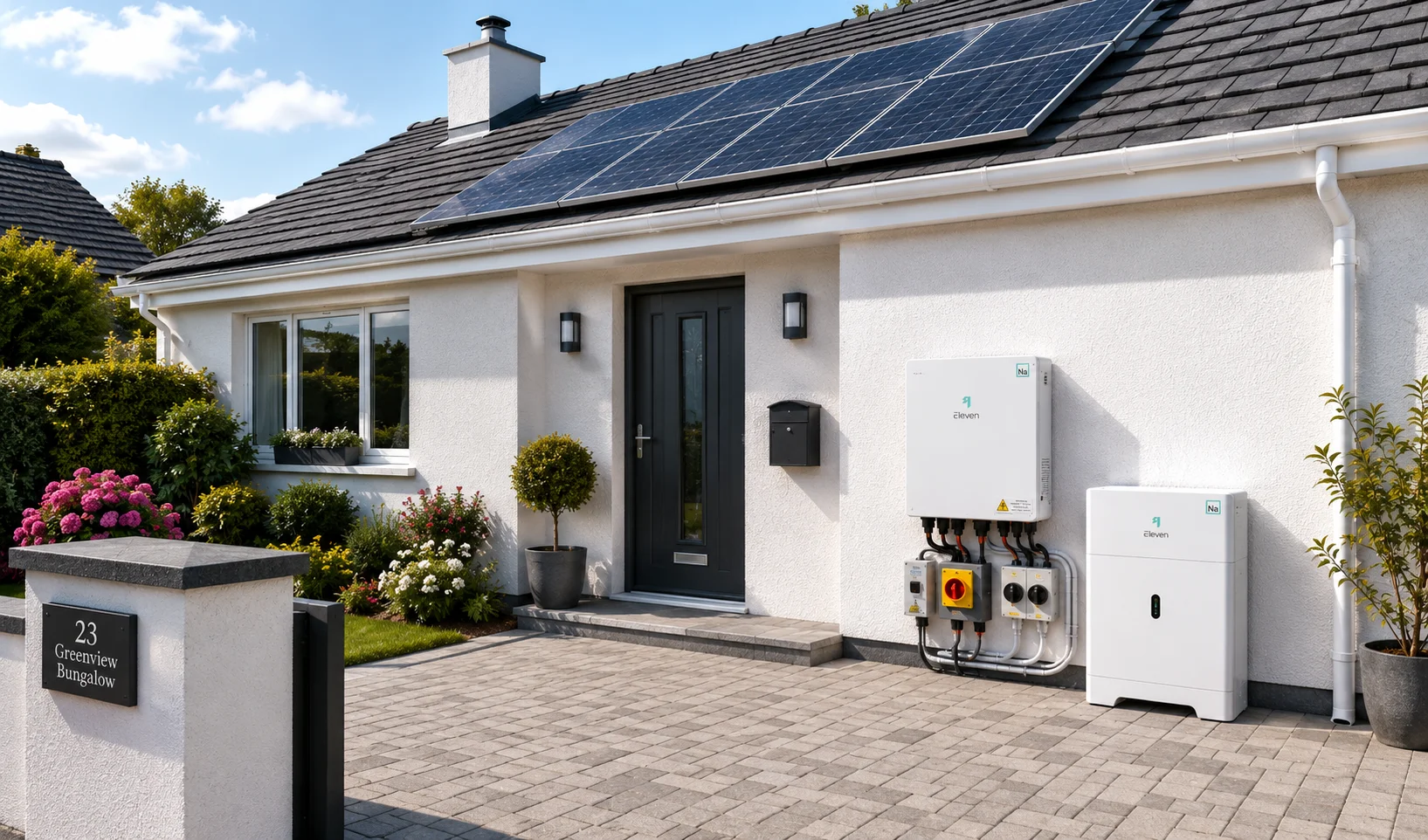
Lithium-ion systems, particularly LFP (lithium iron phosphate) chemistry, already have a strong safety record when properly engineered, installed and managed by a battery management system (BMS). Sodium-ion cells are reported by manufacturers, including Eleven Energy, to offer additional intrinsic safety margins suited to stationary use. But safety ultimately depends on cell chemistry, thermal management, the BMS, enclosure design and installation — not chemistry alone. Neither technology should be called “dangerous” or “fireproof.”
Environmental Impact of Sodium-Ion vs Lithium-Ion Batteries
Sodium’s abundance and wide distribution can reduce dependence on lithium and, depending on the cell chemistry, other constrained battery materials. That said, mining, refining, manufacturing, transport and recycling all carry environmental footprints regardless of chemistry — sodium-ion is not impact-free, just differently sourced.

Could Sodium-Ion Home Batteries Work in India’s Solar Market?
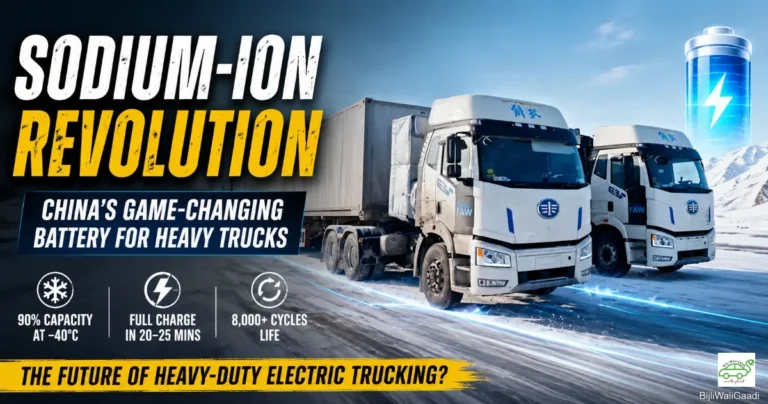
India’s rooftop solar sector is expanding fast, and homes face real drivers for storage: intense summer heat, variable grid reliability, and a policy push toward domestic battery manufacturing. Sodium’s raw-material abundance and wide temperature tolerance align well with Indian conditions in principle, and coverage of China’s Sodium-Ion Electric Truck Push and What It Means for India shows the chemistry scaling fast across Asian manufacturing.
But sodium-ion’s relevance to India’s future storage market does not mean the Eleven Energy Galvani system is currently available to Indian homeowners. Eleven Energy sells through its UK distributor, Midsummer Energy, and has recently expanded into Ireland, with no official confirmation of Indian availability today. Technology relevance and current product availability are two separate questions, and only the first applies here.
Final Verdict: Should You Choose Sodium-Ion or Lithium-Ion for Your Home?
If floor space is extremely tight, lithium-ion — especially LFP — remains a mature, well-proven choice. If you value wide temperature tolerance, an abundant supply chain and strong reported cycle durability, and can accept a slightly larger, heavier unit, sodium-ion systems like Eleven Energy’s Galvani are a credible, increasingly commercial alternative — as also reflected in large-scale deployments covered in BijliWaliGaadi’s CATL TENER Sodium-Ion BESS Engineering Analysis. The decision comes down to your property and priorities, not a universal winner.
Sodium-Ion Battery FAQs: Your Questions Answered
Stay connected via Google 'Electric Vehicle' News
Follow BijliWaliGaadi | India's Trusted EV Insights Portal
source on Google