Hydrogen-Powered JCB HYDROMAX Sets 406.320 MPH World Land Speed Record
Stay connected via Google 'Electric Vehicle' News
Follow BijliWaliGaadi | India's Trusted EV Insights Portal
source on Google
JCB HYDROMAX world land speed record | JCB HYDROMAX 406.320 mph | hydrogen land speed record | JCB hydrogen engine, hydrogen-powered vehicle
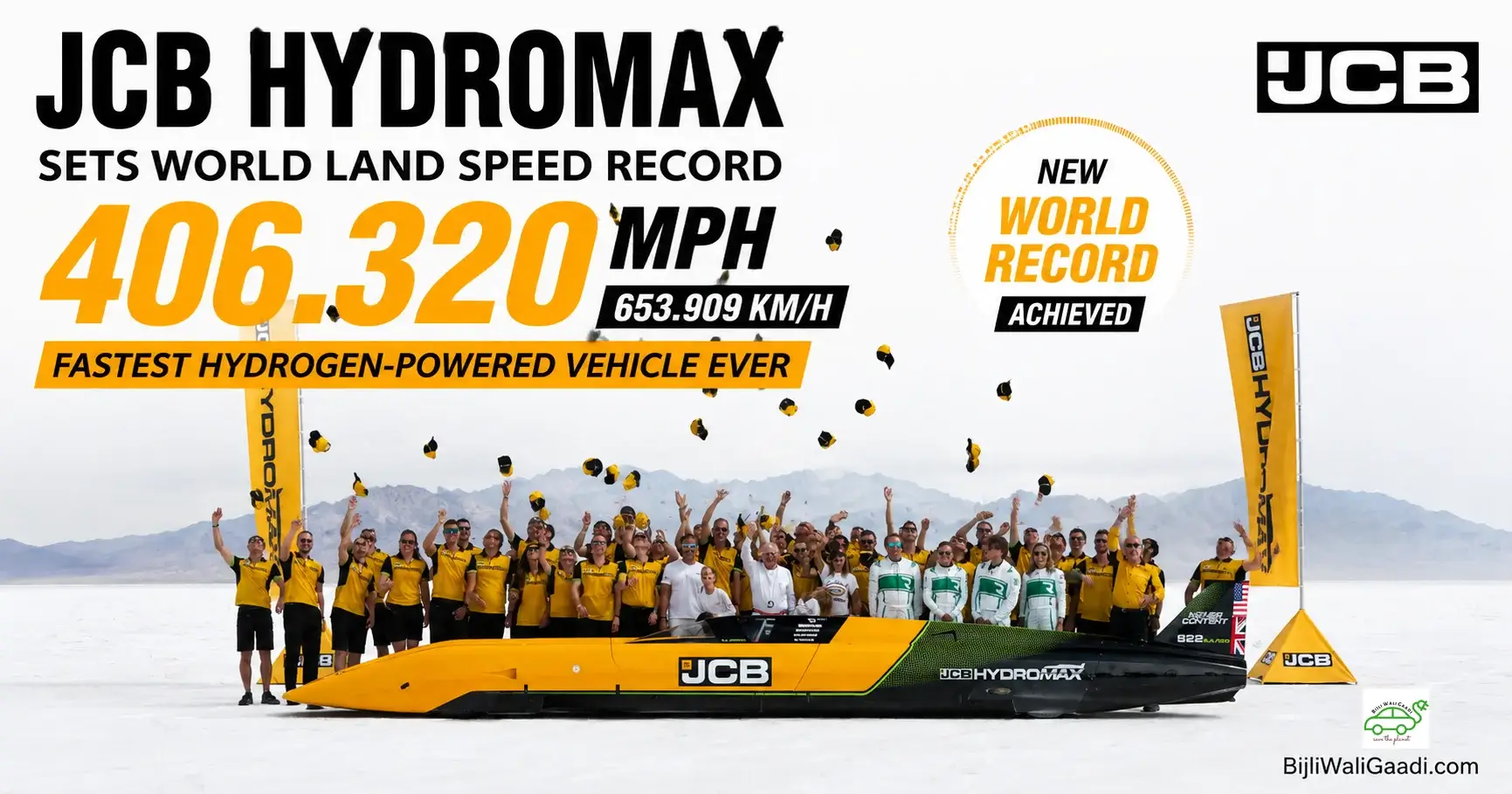
Hydrogen-Powered JCB HYDROMAX Sets World Land Speed Record at 406.320 MPH
British engineering major JCB has set a new world land speed record with its hydrogen-powered JCB HYDROMAX, hitting an average speed of 406.320 mph (653.909 km/h) at the Bonneville Salt Flats in Utah. The record was achieved on August 11, 2026, with Wing Commander Andy Green OBE — the fastest man on Earth — behind the wheel. It marks the fastest speed ever recorded by a hydrogen-powered vehicle, confirming hydrogen internal-combustion technology’s potential for extreme performance while producing zero CO₂ at the tailpipe.
JCB HYDROMAX Hits 406.320 MPH
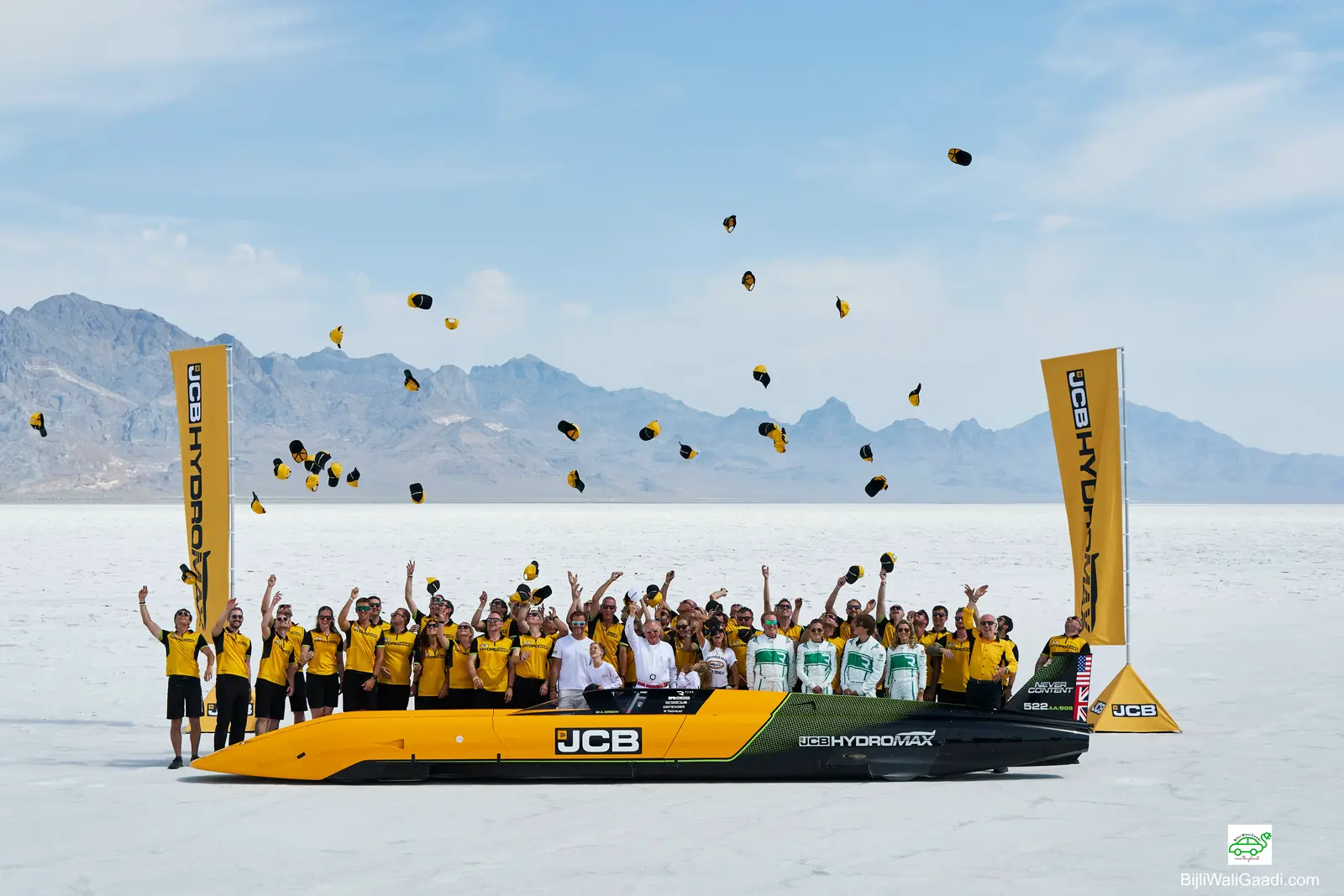
HYDROMAX‘s record run consisted of two timed passes across the Bonneville salt, as required under FIA rules. The car averaged 400.623 mph on its first run and 412.135 mph on the return leg, completed in the opposite direction within an hour — giving the official average of 406.320 mph (653.909 km/h).
The mark stands as a provisional FIA World Flying Record Start Land Speed Record in Category A, Group XIV, Class 7, pending official ratification by the Fédération Internationale de l’Automobile (FIA). It comfortably beats the previous FIA-recognised hydrogen internal-combustion record of 185.5 mph, set by the BMW H2R in 2004, and also exceeds the 303 mph mark held by hydrogen fuel-cell vehicles — making HYDROMAX the fastest hydrogen-powered vehicle of any kind built so far.
Notably, HYDROMAX also surpassed JCB’s own 350.092 mph world diesel land speed record, set by the JCB Dieselmax on the same salt flats in August 2006 — also driven by Green. That diesel record still stands in its own category, but two decades on, JCB has topped it with a zero-tailpipe-emission powertrain.
What Powers the JCB HYDROMAX?
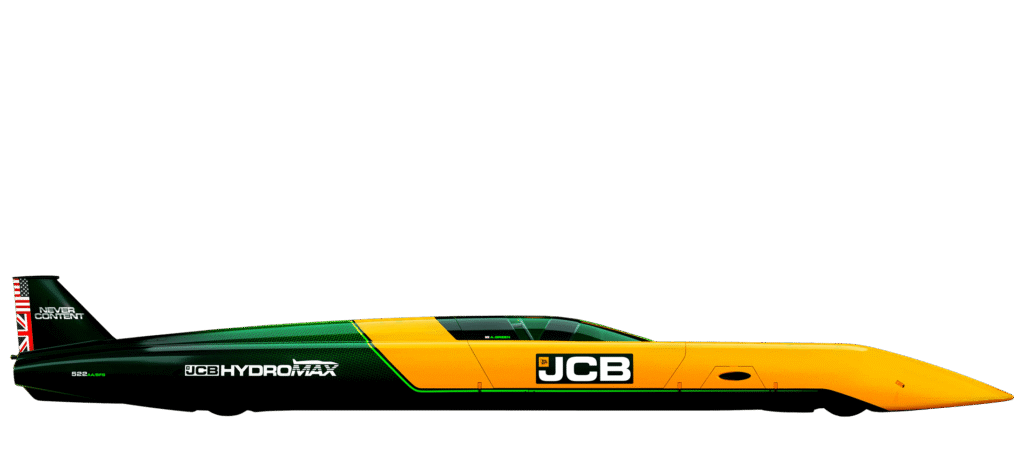
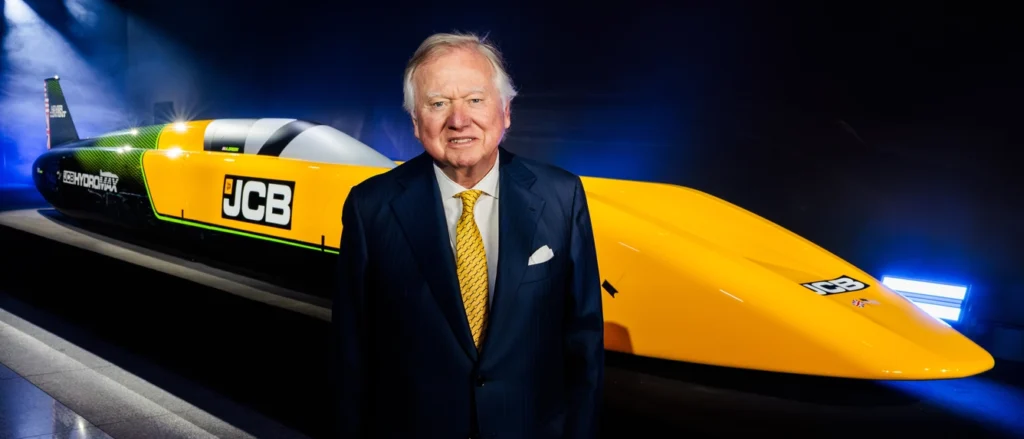
Unlike a hydrogen fuel-cell vehicle, HYDROMAX runs on a hydrogen internal-combustion engine — hydrogen is burned directly rather than converted to electricity via a fuel cell. The 32-foot, twin-engined streamliner uses two of JCB’s production-based hydrogen “digger” engines, delivering a combined 1,600 bhp.
These are not bespoke racing units. They’re manufactured at JCB’s engine factory in Foston, Derbyshire, and are the same basic engines currently powering JCB construction machines rolling off UK production lines, developed as part of the company’s £100 million hydrogen engine programme.
Ahead of the record run, HYDROMAX had already broken through 368.347 mph during the Southern California Timing Association’s Bonneville Speed Week, setting a class record in the Blown Gas Streamliner category — an important step in validating the car before its FIA attempt.
From Hydrogen Project to World Record
As BijliWaliGaadi previously reported, JCB developed the HYDROMAX as a hydrogen-powered land-speed project designed to follow in the footsteps of the JCB Dieselmax, which set the world diesel land speed record in 2006. That earlier coverage detailed the car’s development and JCB’s broader hydrogen ambitions; this record run is the culmination of that programme.
JCB Chairman Lord Bamford, who conceived the hydrogen land-speed bid, said the project shows that hydrogen combustion “works today at the highest level with zero emissions.” JCB Engineering Director Ryan Ballard called it the result of an intense development effort that began in February 2025.
Why the 406 MPH Record Matters
The HYDROMAX record demonstrates that hydrogen internal-combustion engines — already used in everyday construction equipment — can be pushed to extreme performance levels without relying on battery-electric or fuel-cell architecture. It’s a meaningful data point for hydrogen mobility, particularly in heavy machinery and off-highway applications where JCB has deep expertise.
This doesn’t mean hydrogen combustion is superior to battery-electric propulsion across the board; the two technologies serve different use cases, and battery-electric vehicles remain far more efficient for typical road use. What the record does show is that hydrogen combustion engineering has matured enough to deliver genuine high-performance results using largely production-based components.
JCB Hydromax — Technical Specifications
| JCB Hydromax — Technical Specifications | |
| Overall length | 32 feet (approximately 9.75 metres) |
| Powertrain configuration | Twin hydrogen ICE, all-wheel drive |
| Engine type | Production-based JCB four-cylinder, turbocharged H2ICE |
| Individual engine output | 800 horsepower each (production: 80hp each) |
| Combined system power | 1,600 bhp (1,579 bhp per Autocar; 1,600 bhp per FIA/JCB) |
| Transmission | Twin-transmission and clutch system (Xtrac) |
| Drive configuration | All four wheels driven |
| Engine angle | 82 degrees (to accommodate tank and cooling package) |
| Lubrication | Dry sump with separate oil reservoir and air separator |
| Emissions | Water vapour; trace NOx from high-temperature combustion |
| Target speed | Exceed 350 mph (surpass Dieselmax FIA record) |
| Car build partner | Prodrive (Oxfordshire) |
| Engine development | Ricardo (engine tuning and calibration) |
| Transmission supplier | Xtrac |
| Driver | Wing Commander Andy Green OBE |
| Weight vs Dieselmax | 10% lighter |
| Aerodynamic efficiency | 10% more slippery (lower drag coefficient) |
| Bonneville track length | 9 miles (versus 11 miles in 2006) |
| Altitude at Bonneville | ~1,300 metres above sea level |
| Record attempt venue | Bonneville Salt Flats, Utah, USA — August 2026 |
| Governing body | FIA (Fédération Internationale de l’Automobile) |
What JCB HYDROMAX Demonstrates About Hydrogen
HYDROMAX is ultimately an engineering demonstration — proof that a digger engine, adapted and refined, can be made to travel at over 400 mph. FIA President Mohammed Ben Sulayem called it a milestone showing how “innovation, performance, speed, and sustainability can go hand in hand.” With ratification still pending, the 406.320 mph run stands for now as the clearest evidence yet of what hydrogen-powered propulsion can achieve under extreme conditions.
–
Stay connected via Google 'Electric Vehicle' News
Follow BijliWaliGaadi | India's Trusted EV Insights Portal
source on Google