MINI EV Battery Replacement Cost in India: Cooper SE, Cooper E, Aceman & Countryman
Stay connected via Google 'Electric Vehicle' News
Follow BijliWaliGaadi | India's Trusted EV Insights Portal
source on Google
MINI EV battery replacement cost in India | MINI Cooper SE battery replacement cost | MINI Cooper SE 32.6 kWh battery replacement cost | MINI Cooper SE 54.2 kWh battery replacement cost | MINI Countryman 64.7 kWh battery cost
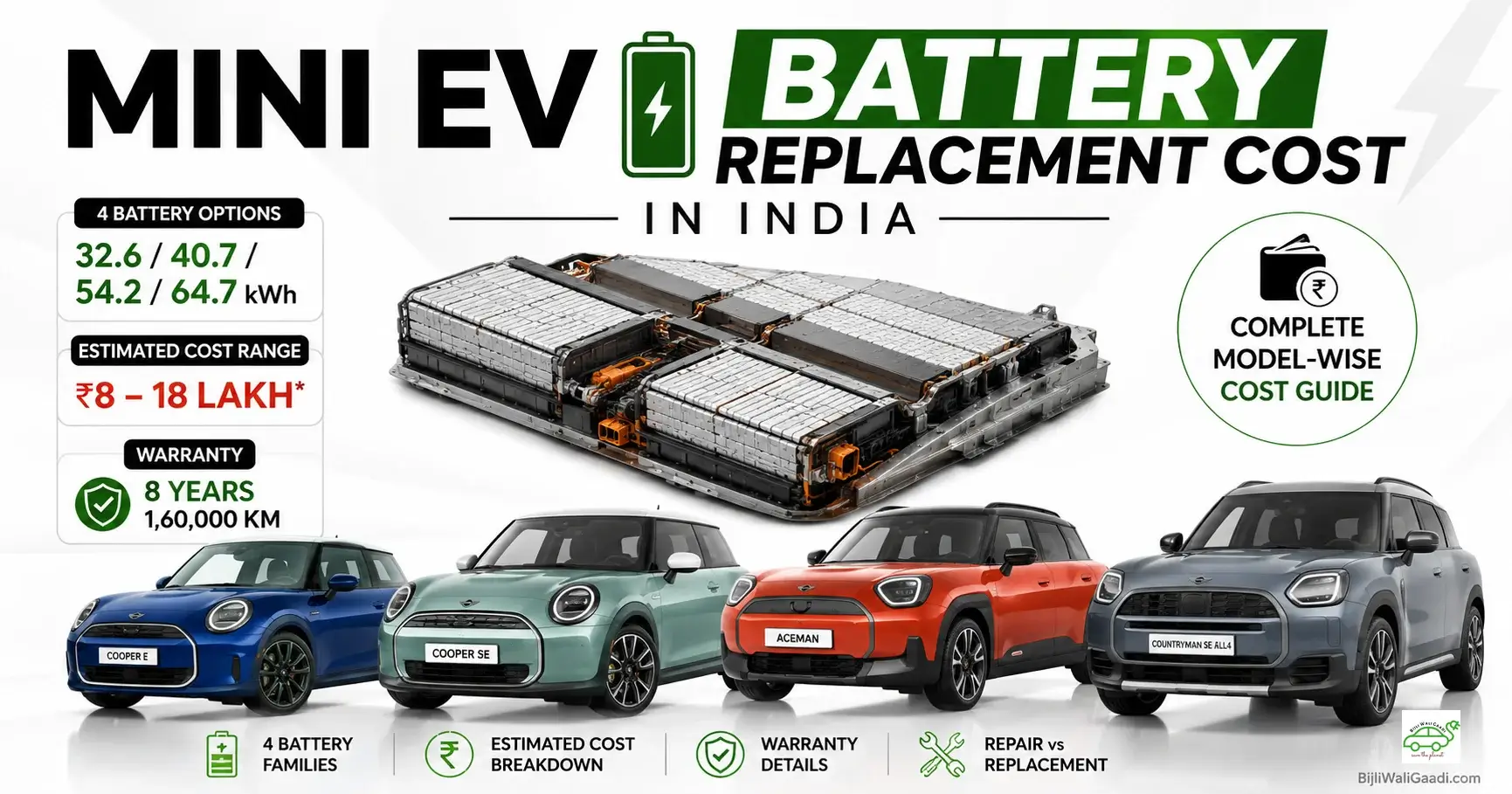
Quick Answer: MINI has introduced four distinct high-voltage battery capacities across its electric lineup in India: 32.6 kWh gross (28.9 kWh net) on the first-generation Cooper SE, 40.7 kWh gross (36.6 kWh net) on the Cooper E, 54.2 kWh gross (49.2 kWh net) shared by the second-generation Cooper SE and the Aceman E/SE, and 66.45 kWh gross (64.7 kWh net) shared by the Countryman E and Countryman SE ALL4. All carry MINI India’s 8-year/1,60,000 km high-voltage battery warranty. MINI India has not published a customer-facing replacement-pack price for any of these packs. BijliWaliGaadi’s editorial estimate for an out-of-warranty pack ranges from ₹8–11 lakh for the first-generation Cooper SE up to ₹16–18 lakh for the second-generation Cooper SE and Aceman — planning estimates, not official MINI quotations.
MINI’s electric range in India isn’t a one-battery story anymore. Depending on which generation and body style you own — the original Cooper SE hatch, the newer Cooper E or Cooper SE, the Aceman crossover, or the Countryman SUV — you’re looking at one of four genuinely different battery packs, built on three different vehicle architectures. That matters a great deal when the question turns to what a replacement costs after the factory warranty runs out, because “the MINI EV battery” isn’t a single part number — it’s at least four.
This article walks through all six electric MINI variants sold or offered in India, the exact battery capacity behind each, and BijliWaliGaadi’s editorial cost estimates for each one.
MINI Electric Battery Options in India: 32.6, 40.7, 54.2 & 64.7 kWh
| Model | Generation / Platform | Battery Gross | Battery Net | Chemistry | WLTP Range | Power / Torque | DC Charging | AC Charging |
| Cooper SE (1st-gen, 2022–2023) | 1st-Gen, F56 (ICE-adapted) | 32.6 kWh | 28.9 kWh | Li-ion (NMC), ~350V | 270 km | 184 hp / 270 Nm | 50 kW, 0–80% ≈36 min | 11 kW, 0–80% ≈2.5 hrs |
| Cooper E | 2nd-Gen, J01 (dedicated EV) | 40.7 kWh | 36.6 kWh | Li-ion (NMC) | 305 km | 184 hp / 290 Nm | 75 kW, 10–80% ≈28 min | 11 kW, 0–100% ≈4.5 hrs |
| Cooper SE (2nd-gen) | 2nd-Gen, J01 (dedicated EV) | 54.2 kWh | 49.2 kWh | Li-ion (NMC) | 400 km | 218 hp / 330 Nm | 95 kW, 10–80% ≈30 min | 11 kW, 0–100% ≈5.25 hrs |
| Aceman E / SE | J05 (dedicated EV) | 54.2 kWh | 49.2 kWh | Li-ion (NMC) | 305–406 km | 184–218 hp | 70–95 kW, 10–80% ≈30 min | 11 kW, 0–100% ≈5.75 hrs |
| Countryman E SAV | U25 (FAAR EV) | 66.45 kWh | 64.7 kWh | High-voltage Li-ion | 462 km | 204 hp / 250 Nm | 130 kW, 10–80% ≈29 min | 11/22 kW, 0–100% ≈3.75 hrs |
| Countryman SE ALL4 | U25 (FAAR EV) | 66.45 kWh | 64.7 kWh | High-voltage Li-ion | 433 km | 313 hp / 494 Nm | 130 kW, 10–80% ≈29 min | 11/22 kW, 0–100% ≈3.75 hrs |
Note the pattern: the 54.2 kWh pack is shared by two different vehicles (2nd-gen Cooper SE and Aceman E/SE), and the 66.45 kWh gross/64.7 kWh net pack is shared by both Countryman variants. Four battery families, six model configurations.
MINI EV Battery Replacement Cost in India
| Model | Battery (Gross) | Estimated Battery Replacement Cost* | Estimated Cost per kWh (Gross)* |
| Cooper SE (1st-gen) | 32.6 kWh | ₹8–11 lakh | ₹24,540–₹33,742 |
| Cooper E | 40.7 kWh | ₹10–13 lakh | ₹24,570–₹31,941 |
| Cooper SE (2nd-gen) | 54.2 kWh | ₹16–18 lakh | ₹24,078–₹27,088 |
| Aceman E / SE | 54.2 kWh | ₹16–18 lakh | ₹24,078–₹27,088 |
| Countryman E SAV | 66.45 kWh | ₹14–17 lakh | ₹21,068–₹25,583 |
| Countryman SE ALL4 | 66.45 kWh | ₹14–17 lakh | ₹21,068–₹25,583 |
*BijliWaliGaadi editorial planning estimates. MINI India has not published a customer-facing replacement-pack price for any of these packs. Actual dealer quotations will depend on the exact battery part number, VIN, availability, applicable GST/taxes, labour, diagnostics, logistics and other charges.
It helps to separate three distinct things when reading these numbers:
- Official warranty information — the 8-year/1,60,000 km high-voltage battery warranty MINI India states for its EVs.
- Editorial replacement estimates — the table above, clearly not MINI’s own pricing.
- Final installed cost — what actually lands on an invoice, including GST, labour, diagnostics and logistics, which can run higher than the pack estimate alone.
32.6 vs 40.7 vs 54.2 vs 64.7 kWh: What Is the Difference?
| Capacity (Gross/Net) | Generation | Vehicle(s) | Estimated Replacement Cost | Estimated Cost/kWh (Gross) |
| 32.6 / 28.9 kWh | 1st-Gen, F56 | Cooper SE (1st-gen) | ₹8–11 lakh | ₹24,540–₹33,742 |
| 40.7 / 36.6 kWh | 2nd-Gen, J01 | Cooper E | ₹10–13 lakh | ₹24,570–₹31,941 |
| 54.2 / 49.2 kWh | J01 / J05 | Cooper SE (2nd-gen), Aceman E/SE | ₹16–18 lakh | ₹24,078–₹27,088 |
| 66.45 / 64.7 kWh | U25 (FAAR EV) | Countryman E SAV, Countryman SE ALL4 | ₹14–17 lakh | ₹21,068–₹25,583 |
Interestingly, the estimated cost per kWh doesn’t rise steadily with capacity — the 54.2 kWh packs carry the highest per-kWh estimate of the four, while the largest 66.45 kWh Countryman pack has the lowest. Pack architecture, vehicle-specific integration, electronics and how readily MINI India can source each part number all factor into the estimate, which is exactly why this article treats each capacity as its own question rather than applying one blanket cost figure across the lineup.
1st-Gen MINI Cooper SE 32.6 kWh Battery Cost
The first-generation Cooper SE was built on the F56 platform — originally an internal-combustion architecture adapted for electric power, not a dedicated EV skateboard design. Because of that, MINI couldn’t lay the battery flat under the floor the way a purpose-built EV platform allows.
The pack uses 12 lithium-ion cell modules arranged in a T-shaped layout, running through the car’s central floor tunnel and extending under the rear seat bench — a packaging compromise inherited from the ICE-derived body structure. It’s rated at 32.6 kWh gross, with 28.9 kWh net (usable) capacity, using NMC chemistry at roughly 350V. Thermal management is via active liquid cooling, integrated with the vehicle’s heat-pump loop.
Editorial replacement estimate: ₹8–11 lakh (≈₹24,540–₹33,742 per kWh, gross) for the complete pack, before GST, labour, diagnostics and logistics. The T-shaped, module-based construction on this generation at least leaves open the theoretical possibility of module-level diagnosis, though whether MINI’s authorised service network offers a targeted repair depends on the specific fault and parts availability.
MINI Cooper E 40.7 kWh Battery Replacement Cost
The Cooper E moves to the J01 dedicated-EV platform, developed through the Spotlight Automotive joint venture. Unlike the F56-based first-generation car, J01 is built as an EV from the ground up, which allows a more efficient, flatter battery layout without a central transmission tunnel to work around.
The Cooper E’s pack is rated at 40.7 kWh gross, 36.6 kWh net, positioned as MINI’s more urban-focused, lower-capacity dedicated-EV option, supporting up to 75 kW DC fast charging.
Editorial replacement estimate: ₹10–13 lakh (≈₹24,570–₹31,941 per kWh, gross) for the complete pack, before GST, labour, diagnostics and logistics. As with every estimate in this article, this is a BijliWaliGaadi planning figure, not an official MINI India price — get a written, itemised quotation from an authorised MINI service centre for an exact number.
MINI Cooper SE 54.2 kWh Battery Replacement Cost
The second-generation Cooper SE, also on the J01 platform, steps up to a 54.2 kWh gross, 49.2 kWh net pack — MINI’s higher-capacity dedicated-EV hatchback battery, paired with 218 hp, 330 Nm, and DC fast charging up to 95 kW.
It’s worth being precise here because search queries around “MINI Cooper SE battery replacement cost” can easily conflate this car with the first-generation Cooper SE, which uses a completely different 32.6 kWh gross pack on a different platform. They share a model name but not a battery, chemistry tier, or replacement-part number — and, as the table above shows, not the same estimated replacement cost either.
Editorial replacement estimate: ₹16–18 lakh (≈₹24,078–₹27,088 per kWh, gross) for the complete pack, before GST, labour, diagnostics and logistics. Owners of the second-generation Cooper SE should treat any online estimate that doesn’t distinguish between the two Cooper SE generations with caution, and confirm actual costs directly with an authorised MINI dealer using their vehicle’s VIN and battery part number.
MINI Aceman 54.2 kWh Battery Replacement Cost
The Aceman E/SE crossover uses the J05 dedicated-EV platform and the same 54.2 kWh gross, 49.2 kWh net battery family as the second-generation Cooper SE, with WLTP range spanning 305–406 km depending on the E or SE variant, and DC fast charging between 70–95 kW.
Editorial replacement estimate: ₹16–18 lakh (≈₹24,078–₹27,088 per kWh, gross) for the complete pack — the same estimate range as the second-generation Cooper SE, reflecting the shared 54.2 kWh battery family. Sharing a battery family doesn’t necessarily mean an identical replacement-pack part number, so this remains a planning estimate rather than a vehicle-specific quotation. A written dealer quotation remains the only reliable way to get an actual number for a specific VIN.
MINI Countryman 64.7 kWh Battery Replacement Cost
The electric Countryman — offered as the Countryman E SAV and the more powerful Countryman SE ALL4 — moves to the U25 platform, based on BMW Group’s FAAR EV architecture, shared with the BMW iX1 family. Both Countryman variants use the same 66.45 kWh gross, 64.7 kWh net high-voltage battery.
This is MINI’s most capable pack in India: 130 kW DC fast charging (roughly 120 km of range added in 10 minutes under suitable conditions), active battery pre-conditioning through navigation-based thermal preparation ahead of a fast-charging stop, and 11/22 kW AC charging via a dual-board inverter supporting three-phase 22 kW charging — a full AC charge takes roughly 3 hours 45 minutes under that configuration.
Editorial replacement estimate: ₹14–17 lakh (≈₹21,068–₹25,583 per kWh, gross) for the complete pack, before GST, labour, diagnostics and logistics, for either the Countryman E SAV or Countryman SE ALL4. Despite having the largest pack in the lineup, the Countryman’s estimated cost-per-kWh is actually the lowest of the six configurations — a reminder that battery replacement cost doesn’t scale in a strictly linear way with capacity.
Why MINI EV Battery Replacement Can Be Expensive in India
A few factors consistently push premium EV battery replacement costs above what mainstream Indian EV buyers are used to seeing:
- Premium vehicle positioning: MINI’s EVs are priced and positioned at the premium end of the market, and that generally carries through to parts pricing.
- Lower fleet volumes: Compared to high-volume mass-market EVs, MINI sells relatively few electric units in India, which affects how readily replacement packs are stocked locally versus sourced on demand.
- Complex pack architecture: Battery electronics, thermal-management hardware, the structural enclosure and the battery management system (BMS) all add to a pack’s cost beyond the raw cell capacity.
- Logistics and sourcing: Where a part isn’t held in local stock, sourcing and logistics costs get added to the invoice.
- Dealer labour and diagnostics: HV-rated technicians, safety procedures and diagnostic time are billed separately from the part itself.
- Applicable taxes: GST applies to the spare part on top of its base price.
This article does not make any specific claim about import-duty percentages, since that figure varies by classification, timing and trade policy, and isn’t something BijliWaliGaadi can verify as a fixed number for a spare-part invoice.
What You May Actually Pay
The editorial pack estimates above are not the final invoice. A realistic installed-replacement bill typically includes:
- The battery pack itself (the estimate from the table above)
- Applicable GST/taxes on the spare part
- Diagnostics — HV system scanning and fault-code assessment
- Labour for battery removal and installation
- HV safety procedures — isolation, safety checks
- Calibration/programming where required
- Logistics, if the part must be sourced from outside local stock
- Any related components identified during diagnosis
Always get a written, itemised quotation from an authorised MINI service centre before approving work. The pack-only estimate is a planning reference, not a quote.
MINI EV Battery Warranty in India
MINI India states an 8-year/1,60,000 km high-voltage battery warranty, whichever comes first, applicable across its electric models.
MINI’s stated battery-ageing protection provides for at least 70% of original capacity within the applicable warranty period, subject to warranty terms and diagnostic/claim conditions. This is not a rule that says the battery is automatically replaced the moment it crosses below 70% — it defines part of the coverage framework within which a capacity-related claim would be assessed. The exact diagnostic procedure and claim conditions should be confirmed with an authorised MINI service partner.
For used-MINI buyers: don’t assume the remaining battery warranty transfers automatically. Have an authorised MINI dealer verify the remaining coverage against the vehicle’s VIN and the applicable warranty terms before purchase.
Can a MINI EV Battery Be Repaired Instead of Replaced?
It depends on the pack, the fault, and what MINI’s authorised service network can offer for that specific case. Battery faults can sometimes be isolated to a specific component or module rather than requiring a full pack swap — the first-generation Cooper SE’s 12-module T-shaped pack, for instance, is at least built from discrete modules, which theoretically supports more targeted diagnosis.
Whether a module- or component-level repair is actually available depends on:
- The specific fault identified during diagnostics
- Parts availability for that component
- MINI’s authorised service procedures for that platform
- The service centre’s technical capability
It isn’t accurate to say every MINI pack can be repaired at module level, nor that every fault requires full-pack replacement — both claims oversimplify a decision that depends on the diagnosis. Get a written assessment and an itemised quotation before agreeing to any battery work, and be cautious about third-party high-voltage battery repair given how limited India’s independent EV battery repair ecosystem still is for premium packs.
MINI EV Battery Life in Indian Conditions
All four battery families use NMC (or, for the Countryman, high-voltage lithium-ion) chemistry, which can be more sensitive to sustained high temperatures than LFP chemistry — making effective thermal management particularly relevant in India’s climate. Active liquid cooling (on the first-generation Cooper SE) and active battery thermal management more broadly (across the newer platforms) are designed to help keep cell temperatures within an appropriate operating range, though the actual degree of protection depends on usage patterns, charging behaviour and ambient conditions.
Repeated high-temperature operation and frequent fast-charging can increase thermal stress over time, but the real-world effect varies by vehicle and driver. There isn’t meaningful India-specific long-term fleet data yet for any of these packs — MINI’s EV volumes here are still limited, and several of these models are relatively new to the market. BijliWaliGaadi is not presenting a specific degradation percentage for any MINI EV battery in Indian conditions, because no reliable data set currently supports one.
Salvage and Recycling Value
A degraded MINI battery pack, from any of these four families, may retain some residual value for recycling or potential second-life applications such as stationary energy storage, depending on its condition. MINI India does not publish a standard customer-facing buyback value for any of its EV battery packs, so owners shouldn’t treat any online estimate of salvage value as guaranteed.
Stay connected via Google 'Electric Vehicle' News
Follow BijliWaliGaadi | India's Trusted EV Insights Portal
source on Google