IX Energy’s Retrofit Technology: How Braking Energy Is Cutting Diesel Fuel Costs for Indian Fleets
Stay connected via Google 'Electric Vehicle' News
Follow BijliWaliGaadi | India's Trusted EV Insights Portal
source on Google
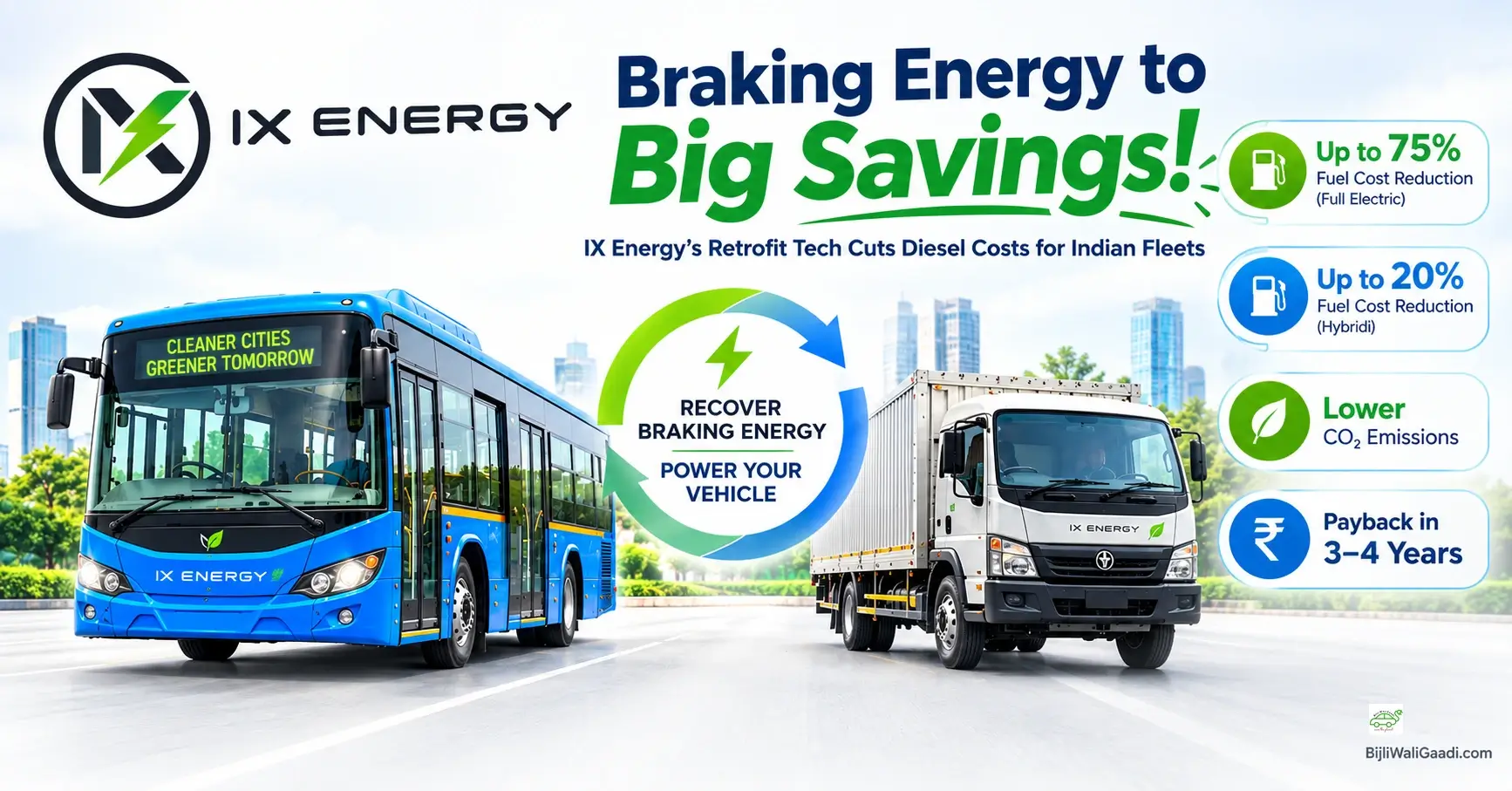
India’s city buses and delivery trucks stop, start and brake hundreds of times a day. Every stop wastes energy, and every kilometre burns diesel. Noida-based IX Energy says that stopping energy can be put to work. Its answer is not a new vehicle but a retrofit kit that turns an existing one into a hybrid or a full electric. All performance and cost figures in this article are claims made by IX Energy.
What Is IX Energy’s Retrofit Technology and Who Is It Built For?
IX Energy sells fuel-saving powertrain kits for fleet operators who want to keep the vehicles they already own. The range has two powertrain families and a set of supporting electronics:
- Electric Synergy Drive (ESD): a semi-electric (hybrid) powertrain
- Electric Energy Drive (EED): a full-electric powertrain
- Supporting hardware: a High Voltage Power Distribution Unit (HV-PDU), a display board and a telematics device
The company aims these products at intra-city bus fleets, last-mile delivery vehicles and warehouse-to-warehouse logistics vehicles.
How Does IX Energy Turn a Stopping Vehicle into a Power Source?
At the centre of the offering is in-house technology that uses the energy of a stopping vehicle to generate an electric charge. That charge then helps power the vehicle.
The approach pays off most where vehicles slow down often. IX Energy says its systems perform better on routes with frequent braking and acceleration, such as intra-city bus and cargo routes. That is why the company concentrates on these fleet types.
Electric Synergy Drive (ESD): The Hybrid Route for City Fleets
What it is: a semi-electric powertrain that IX Energy describes as a pocket-friendly fleet solution. It is designed to convert intra-city bus fleets into partial-electric vehicles.
What IX Energy claims:
- Up to 20% reduction in fuel costs compared with diesel
- Lower CO2 emissions
Where it appears in IX Energy’s project list: TSRTC, ASTC, Skyline Bus, Tata 1512 and Mahindra Comfio. The company also lists a Tata Hybrid Bus project in the USA.
Electric Energy Drive (EED): The Full-Electric Retrofit for Logistics Vehicles
What it is: a full-electric powertrain. IX Energy says it fits the vehicle perfectly and is designed to turn last-mile delivery and warehouse-to-warehouse logistics vehicles into full electric vehicles, without compromising performance.
What IX Energy claims:
- Up to 75% reduction in fuel cost compared with diesel
Where it appears in IX Energy’s project list: LPT Tata 407, Daimler Truck, Ambassador, Mahindra Supro and SFC Tata 407. A project titled “Adapting Retrofitting in E-Mobility” is also listed.
HV-PDU: The High Voltage Power Distribution Unit Behind the Conversion
An electric conversion needs a safe way to distribute high-voltage power. IX Energy’s HV-PDU is built for that role. Its listed features are:
- HVIL: engineered for safety
- Advanced EMI/EMC shielding
- A 3-in-1 distribution system: designed to optimise efficiency in a compact design
- A robust IP rating
IX Energy presents the unit as streamlined, secure and innovative electric power distribution.
Display Board and Telematics: Keeping Drivers and Fleet Managers Informed
Display board: IX Energy’s EV display board is positioned around sustainable, zero-emission driving.
Telematics device: the telematics range is designed to give real-time insight into:
- Battery performance
- Range estimation
- Charging status
IX Energy says the goal is to help users maximise efficiency and plan journeys with confidence. Its site navigation also lists a Vehicle Dashboard, an RS485/CAN/UART interconverter and other embedded solutions.
Is Retrofitting Cheaper Than Buying New? What IX Energy Says About Cost and Payback
IX Energy makes three economic claims:
1. Cost: retrofitting and reusing an old vehicle is less carbon intensive and costs half as much as buying a new vehicle.
2. Fuel savings: up to 75% for full electric and up to 20% for hybrid electric, compared with diesel.
3. Payback: the savings pay back the investment in 3-4 years.
The company also promotes a “Best ROI” on routes with frequent braking and acceleration, such as intra-city bus and cargo routes.
Hybrid vs Full-Electric Retrofit: ESD and EED Compared
| Parameter | ESD (Hybrid) | EED (Full Electric) |
| Powertrain | Semi-electric | Full-electric |
| Claimed fuel cost reduction vs diesel | Up to 20% | Up to 75% |
| Designed for | Intra-city bus fleets | Last-mile delivery and warehouse-to-warehouse logistics vehicles |
| Example projects | TSRTC, ASTC, Skyline Bus, Tata 1512, Mahindra Comfio | LPT Tata 407, Daimler Truck, Ambassador, Mahindra Supro, SFC Tata 407 |
Why Fleet Operators Choose IX Energy: Four Stated Reasons
- Sustainable and viable: reusing an existing vehicle is less carbon intensive.
- Big on fuel savings: up to 75% (full electric) and 20% (hybrid electric) versus diesel.
- In-house technology: the braking-energy system is developed by IX Energy itself.
- Best ROI: the company says returns are strongest on routes with frequent braking and acceleration.
Frequently Asked Questions About IX Energy’s Retrofit Kits
Stay connected via Google 'Electric Vehicle' News
Follow BijliWaliGaadi | India's Trusted EV Insights Portal
source on Google