The Secret Behind Hyundai’s 21,000 RPM EV Motor
Stay connected via Google 'Electric Vehicle' News
Follow BijliWaliGaadi | India's Trusted EV Insights Portal
source on Google
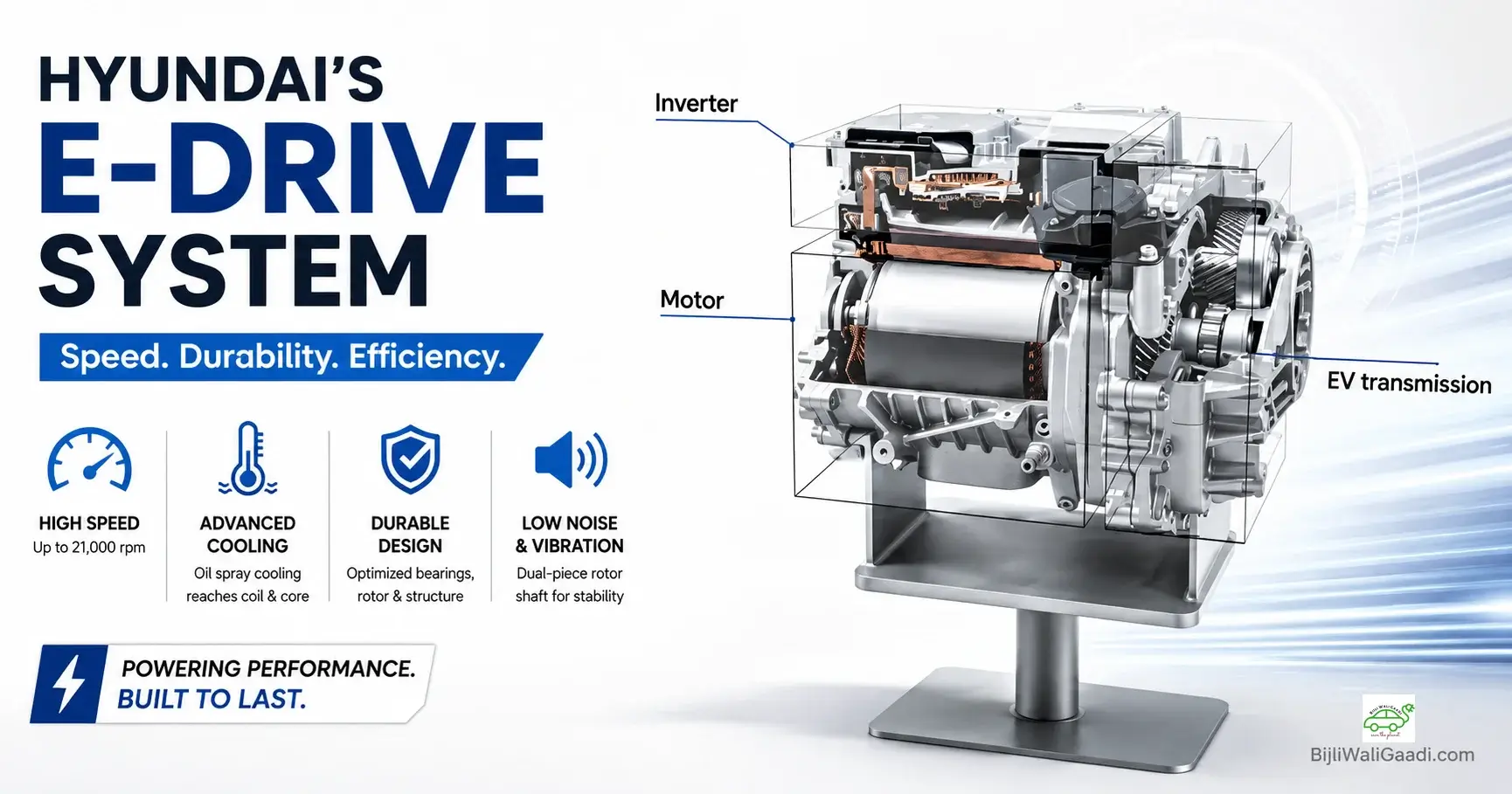
Raising an electric motor’s rotational speed can expand an EV’s performance envelope, but doing so creates a much harder engineering challenge: controlling heat, mechanical stress, noise and vibration. That trade-off, more than any single horsepower figure, is the real story behind Hyundai E-Drive system.
Hyundai’s dedicated electric vehicles, including the IONIQ 5 and EV6, have collected European Car of the Year and World Car of the Year honors while drawing consistent praise in road tests. According to Hyundai Motor Group, that competitiveness rests on a combination of technologies built into its E-GMP electric vehicle platform — from 800V ultra-fast charging to Vehicle-to-Load functionality — alongside a high-speed electric motor engineered to deliver strong performance while remaining durable, efficiently cooled and controlled for noise and vibration.
Pushing a motor to spin faster is not simply a matter of dialing up a setting — it creates cascading engineering problems in heat, mechanical stress and vibration. How Hyundai addressed those problems says more about the E-Drive system’s high-speed durability than any single peak-power figure.
What Hyundai E-Drive System Is
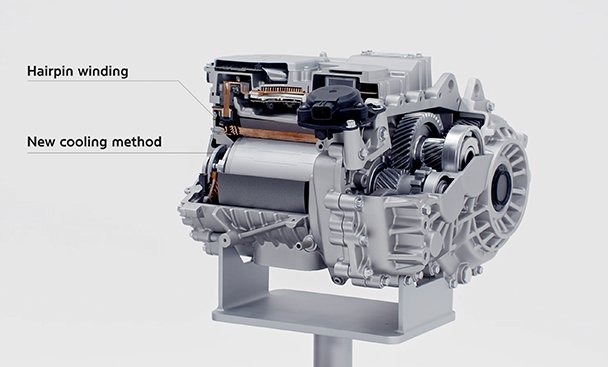
The architecture behind Hyundai E-Drive system is what Hyundai Motor Group describes as the PE, or Power Electric, system that drives its E-GMP-based EVs. Hyundai Motor Group explains that this system integrates a motor, a speed reducer, an inverter that converts direct current to alternating current, and a battery that stores electrical energy. The motor generates maximum torque the instant it begins turning, which is why EVs can outperform combustion vehicles from a standstill despite lacking a multi-speed transmission.
Hyundai Motor Group explains that this is also why EVs use a speed reducer rather than a conventional multi-stage transmission: combustion vehicles shift to a lower gear for more power and a higher gear for more speed, but an EV motor generates torque from the moment it starts rotating and can rev high enough that it does not need those separate gear ranges.
Wheel torque is proportional to motor torque multiplied by the reducer’s gear ratio, while wheel speed is proportional to motor speed divided by that same ratio. Raising the motor’s rotational ceiling therefore shifts the entire performance envelope — Hyundai Motor Group notes that the EV6 GT’s motor, spinning up to 21,000 rpm, can reach 0–260 km/h using only a single-stage reducer.
How Hyundai Builds Performance Into the E-Drive System
Hyundai Motor Group has pursued this approach deliberately. The IONIQ 5 and EV6 spin up to 15,000 rpm, which Hyundai describes as roughly a 33% increase over the automaker’s prior-generation motors. Genesis’ Electrified GV60 and GV70 push further, using a 19,000 rpm motor paired with a boost mode that briefly raises output — enough for the GV60 performance model to reach 490 horsepower and 0-60 mph in 4.0 seconds, according to Hyundai Motor Group.
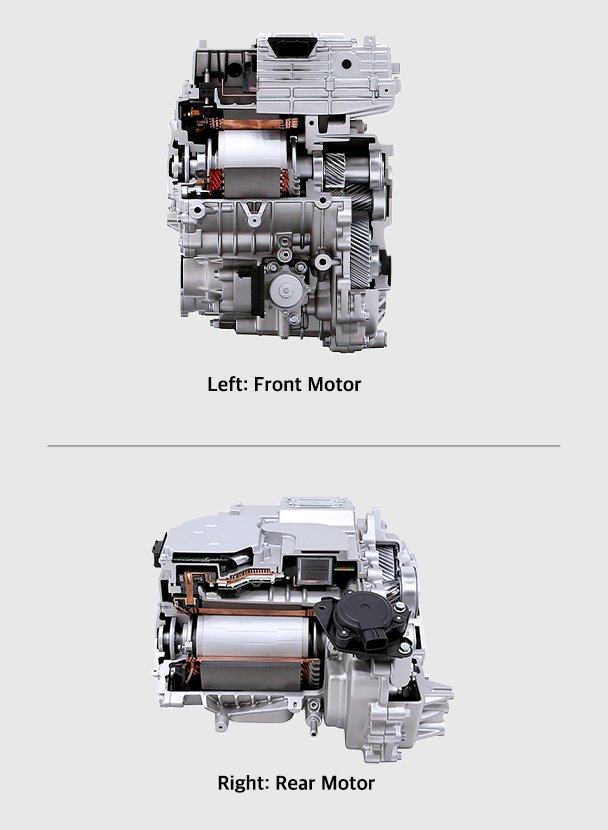
The clearest expression of this strategy is the EV6 GT. Hyundai Motor Group describes its front and rear motors, which turn up to 21,000 rpm, as boasting the highest rpm among current EVs, enabling a top speed of 260 km/h. Hyundai Motor Group also notes that the E-GMP motor’s maximum rotation speed rose by about 70% compared with the second-generation unit, while wheel torque and wheel speed improved by 20% and the motor itself was made smaller.
That last point matters. Hyundai’s account frames this as more than a speed increase alone: higher rotational speed, improved wheel torque and speed, and a smaller motor package are presented together, pointing to packaging and space benefits alongside the performance gain.
Why Thermal Management Is Critical to EV Motor Performance
Spinning a motor harder does not come free. Hyundai Motor Group acknowledges that raising motor speed introduces higher centrifugal force, greater heat loss, and increased noise and vibration — problems serious enough that, in Hyundai’s own account, other automakers cannot as easily deploy high-speed electric motors the way Hyundai Motor Group does.
Hyundai Motor Group frames its response to this challenge around three engineering priorities: durability, cooling, and noise and vibration control (NVH). Each of these had to be addressed for the motor to sustain 21,000 rpm operation reliably, and Hyundai’s own account treats them as inseparable from the performance gains themselves rather than secondary concerns.
How Cooling Helps Hyundai’s E-Drive Sustain Performance
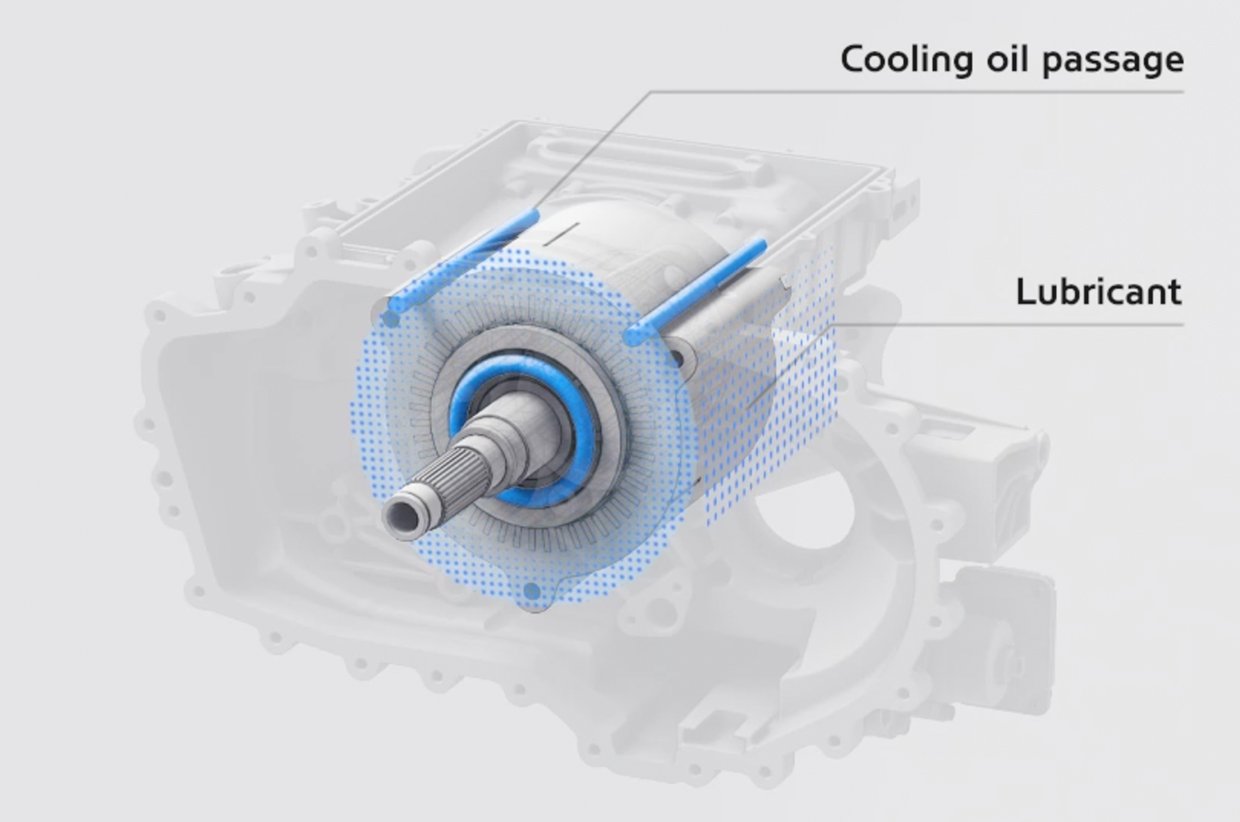
Hyundai Motor Group explains that its earlier water-cooling method could only cool the motor housing from the outside, because coolant flowed through the housing rather than reaching the coil — the hottest part of the motor. The E-GMP motor system instead sprays oil directly from an internal cooling pipe, which Hyundai Motor Group says allows the coolant to reach the coil and core more effectively than the previous method. The EV6 GT carries this further, with Hyundai Motor Group describing an enhanced cooling structure built specifically to keep the motor stable at 21,000 rpm.
Hyundai Motor Group also addressed the mechanical side of high-speed operation. Engineers improved stress distribution by optimizing the bearing cage, permanent magnet arrangement and rotor core formation, and used oil lubrication to cool the motor’s internal bearings — allowing them, according to Hyundai Motor Group, to respond to sustained operation at 21,000 rpm. To control the noise and vibration that come with higher rotational speeds, Hyundai Motor Group says it redesigned the rotor shaft using a dual-piece structure intended to minimize imbalance and reduce vibration and noise in the high-frequency range.
Performance Is More Than Peak Power
Hyundai Motor Group also points to hairpin winding technology, in which rectangular-section copper coils are wound more tightly than conventional round wire, reducing winding resistance and improving efficiency. Because hairpin windings can generate greater AC losses at high rotational speeds, Hyundai Motor Group says its engineers analyzed the loss mechanism specifically to minimize that penalty — improving efficiency, cooling performance, packaging and high-speed response together, rather than optimizing any single metric in isolation.
That balance is the clearest evidence that Hyundai’s E-Drive strategy is not built around a single peak-power headline. Hyundai Motor Group’s own account frames durability, efficiency and packaging as engineering targets pursued alongside motor speed, not afterthoughts addressed once the performance figures were set.
How Hyundai’s Approach Performs Under Real-World Driving
Hyundai Motor Group cites a test that put the EV6 GT’s high-speed motor to work outside a lab setting. During an EV6 GT media event in Germany, a YouTube creator tracked the motor’s rotation speed, battery output and temperature in real time on the unrestricted Autobahn. At a GPS-measured 263 km/h, the EV6 GT’s motor spun at 20,354 rpm. Hyundai Motor Group says the EV6 GT maintained a stable battery temperature — averaging 28°C — and a stable power state even while driving at more than 200 km/h.
What Hyundai’s E-Drive Engineering Means for Future EVs
Hyundai Motor Group frames the EV6 GT’s 21,000 rpm motor as proof that eco-friendliness and high performance are not necessarily in tension, and the automaker says its EV motor development is ongoing, with a next-generation dedicated motor planned for future models.
The broader lesson from Hyundai’s E-Drive system is that raw rotational speed depends on a combination of engineering choices working together: reducer optimization, cooling that reaches the coil and core, bearing durability, rotor design, vibration and noise control, and winding efficiency. Hyundai Motor Group’s own account treats these as inseparable from the motor-speed figures it publishes — sustained performance, in this telling, is a product of thermal management and mechanical stability as much as it is a product of rpm.
Note: Images used into this article are sourced from the official website of Hyundai Motors.
Stay connected via Google 'Electric Vehicle' News
Follow BijliWaliGaadi | India's Trusted EV Insights Portal
source on Google