Why Vayve Built AltRout: Unlocking Solar-Assisted Fleet Mobility for Private Campuses
Stay connected via Google 'Electric Vehicle' News
Follow BijliWaliGaadi | India's Trusted EV Insights Portal
source on Google
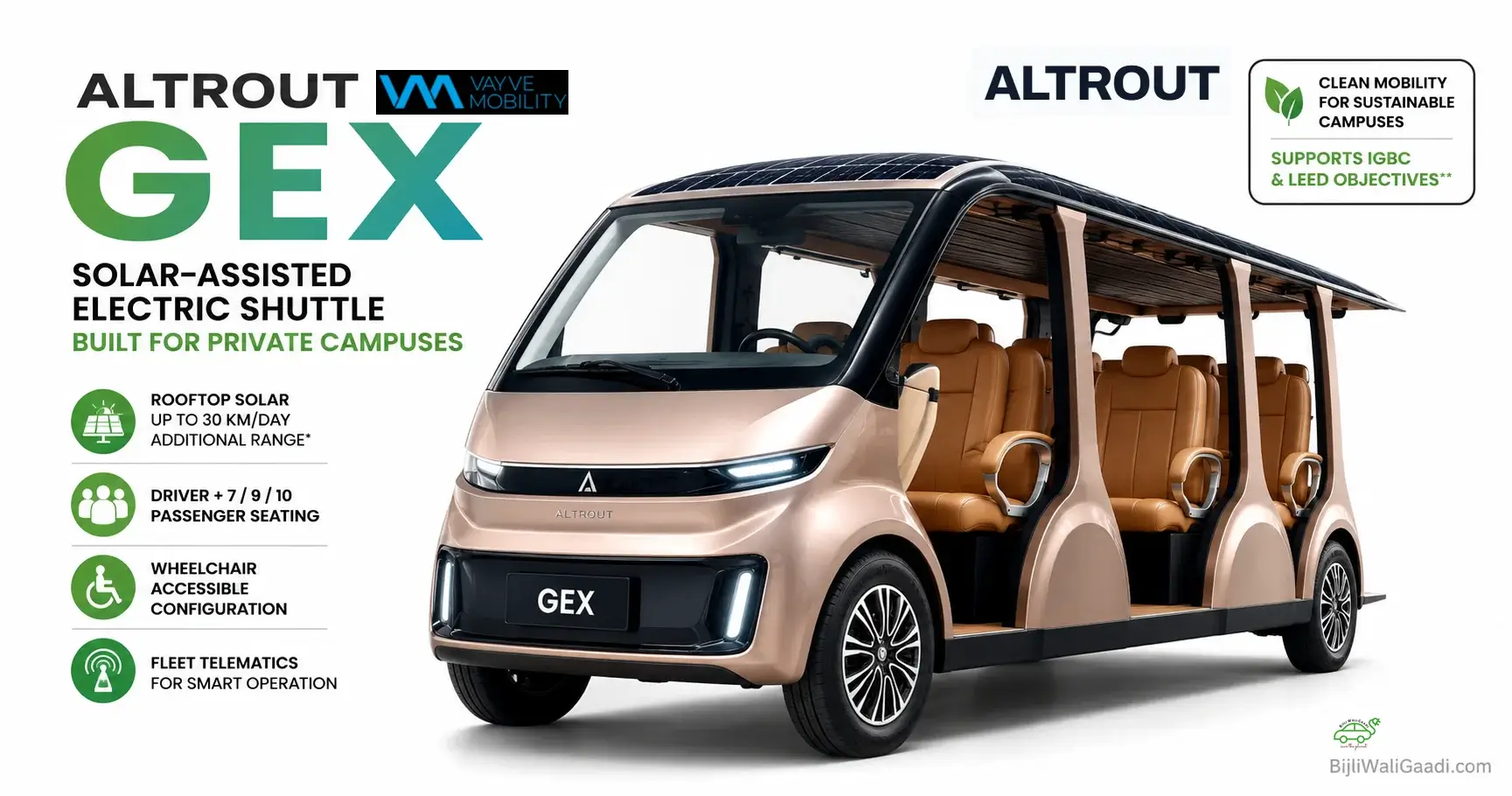
The AltRout GEX is a sub-5-metre, born-electric people mover developed primarily for private-campus operation — resorts, corporate parks, universities and similar controlled sites — with a rooftop solar array intended to add a solar-derived energy contribution while the vehicle works its daily duty cycle.
That combination — a purpose-built platform matched to a narrow, predictable operating environment, with solar generation layered on top — is what makes GEX worth examining, more than its size or seating count.
What Is the AltRout GEX?
GEX is the first product from AltRout, described as “a Vayve Commercial Mobility product” — positioning it within Vayve Mobility‘s wider electric vehicle portfolio. This vehicle comes into three different configurations: the GEX-P7, GEX-W9 (fitted with a wheelchair-accessible bay) and GEX-P10, seating a driver plus seven, nine or ten passengers respectively.
Vehicle size is given as 4,400mm or 4,800mm in length, with a 1,600mm width and 1,900mm height; the 4.8-metre figure is the relevant dimension behind AltRout’s “sub-5-metre” positioning. Wheelbase is 3,150mm, ground clearance 200mm, and the vehicle rides on 155 R13 tyres with independent front and rear suspension. Turning radius is under 6 metres — figures pointing toward manoeuvring within tight campus loops and drop-off bays rather than open-road cruising. Gross vehicle weight is 1,700kg, and gradeability is rated at 20%.
AltRout GEX Specifications at a Glance
The table below summarises the AltRout GEX’s official specifications:
| Specification | AltRout GEX |
| Configurations | GEX-P7, GEX-W9 (wheelchair-accessible), GEX-P10 |
| Seating Configuration | Driver + 7 / 9 / 10 |
| Vehicle Size (L x W x H) | 4,400 / 4,800 x 1,600 x 1,900 mm |
| Wheelbase | 3,150 mm |
| Ground Clearance | 200 mm |
| Turning Radius | Under 6,000 mm |
| Tyre Size | 155 R13 |
| Suspension | Independent, front and rear |
| Vehicle Gross Weight | 1,700 kg |
| Battery Capacity | 7 kWh / 10 kWh |
| Cell Chemistry | Lithium Iron Phosphate (LFP) |
| Range | 70 km / 100 km+ |
| Charging Time | 3–5 hours |
| Solar Output (Peak) | 400 Wp |
| Solar Range Contribution | Up to 30 km/day (company-stated) |
| Gradeability | 20% |
Solar output (400 Wp) is the peak electrical rating of the rooftop array; the up-to-30km/day figure is a separate, company-stated range contribution and depends on solar irradiance, weather, parking orientation and vehicle efficiency. Range figures are manufacturer-stated; no independent test methodology is specified.
How Vayve Mobility and AltRout Are Connected
Vayve Mobility is an India-based EV company headquartered in Pune, whose portfolio includes Eva, a compact solar-assisted city car aimed at personal urban mobility. AltRout extends Vayve Mobility’s purpose-built, born-electric vehicle strategy into a different application. Vayve Mobility co-founder and COO Vilas Deshpande describes AltRout as the company’s “private-road and off-road brand,” built around vehicles for “unserved and underserved” mobility applications rather than the conventional passenger-car segment. GEX is AltRout’s opening product under that strategy.
Rooftop Solar Gives GEX a Different Kind of EV Advantage
The GEX has a peak solar output of 400Wp from the rooftop array. Additionally, The AltRout cite a figure of up to 30km of additional range per day from the solar system. These are two different metrics and shouldn’t be conflated: 400Wp is the peak electrical output rating of the array, while “up to 30km per day” is a company-stated range/energy contribution under applicable conditions. Actual daily solar energy harvested will depend on irradiance, season, weather, parking orientation, shading and overall system and vehicle efficiency.
GEX should be understood as a solar-assisted electric vehicle, with rooftop solar assistance supplementing charging rather than a vehicle powered exclusively by solar energy.
Built for Campus Duty, Focused on Private-Road Operation
GEX’s specifications read less like a passenger car’s and more like a purpose-engineered utility platform’s. The turning radius of under 6 metres, 200mm ground clearance and independent suspension all point toward low-speed, high-frequency operation on private roads. Deshpande describes the platform as a rugged automotive architecture intended to address long-standing maintenance, repair and operations (MRO) challenges faced by campus and facilities fleet managers.
The GEX comes with two battery configurations — 7kWh and 10kWh, using lithium iron phosphate (LFP) cell chemistry — with 70km and 100km-plus range figures for the respective packs, and a charging time of three to five hours. The official online sources does not specify a test methodology or range standard behind these figures, so they should be read as manufacturer-stated ranges rather than an independently verified real-world benchmark.

Why a Smaller Battery Can Make Sense Here
GEX’s relatively modest battery capacities are one of the more interesting engineering choices. An EV does not necessarily need a large battery when its daily route is short, predictable and centrally managed. A smaller pack can reduce stored energy and potentially vehicle mass, while the rooftop solar system provides a supplementary energy contribution. Charging requirements, however, still depend on the vehicle’s duty cycle, energy consumption and charging strategy.
Comfort, Accessibility and Fleet Intelligence
The GEX has lounge-style bench seating with cushioned upholstery, ambient lighting, a digital instrument cluster showing speed, range and diagnostics, USB-C charging throughout the cabin, a reverse camera, and an ergonomic driver console. An optional fleet-telematics package is intended to give operators greater visibility into vehicle operation, diagnostics and fleet management.
The GEX-W9 variant adds a fold-out ramp and a dedicated wheelchair bay. The availability of this configuration makes accessibility part of the vehicle’s product planning rather than requiring every operator to engineer an external adaptation.
Why Predictable Routes Make Solar EVs More Interesting
Solar-assisted personal cars contend with irregular routes and unpredictable sun exposure. A campus shuttle’s operating pattern is potentially more favourable to solar generation: routes repeat within a defined geographic area, the vehicle may spend significant time parked outdoors, and generation can occur whenever the array has suitable irradiance. The resulting energy contribution can, in principle, reduce the amount of external electrical energy required over the vehicle’s duty cycle — though the scale of that reduction will vary with the conditions described above.
Vayve says the solar contribution can support IGBC and LEED credit objectives for campuses pursuing those sustainability frameworks; actual credit eligibility would depend on the applicable certification criteria and project documentation.
The Bigger Market for Private-Campus Electric Mobility
Corporate campuses, universities, hospitals, hotels and other large private sites represent potential use cases for internal passenger transport, creating an opening for purpose-built electric people movers designed for high-utilisation internal campus routes. As fleet electrification accelerates globally and sustainability certification frameworks gain influence in facilities planning, vehicles engineered specifically for these narrow, repeatable duty cycles could develop into a distinct category of purpose-built electric mobility.
What GEX Says About the Future of Purpose-Built EVs
GEX’s significance isn’t that rooftop solar can replace conventional charging — the company’s statements don’t claim that. Its significance is that Vayve Mobility is matching a relatively small electric platform, solar generation and fleet-management technology to a highly predictable operating environment.
Stay connected via Google 'Electric Vehicle' News
Follow BijliWaliGaadi | India's Trusted EV Insights Portal
source on Google