U.S. Hybrid Boom: 1 in 4 New Vehicles Are Now Electrified
Stay connected via Google 'Electric Vehicle' News
Follow BijliWaliGaadi | India's Trusted EV Insights Portal
source on Google
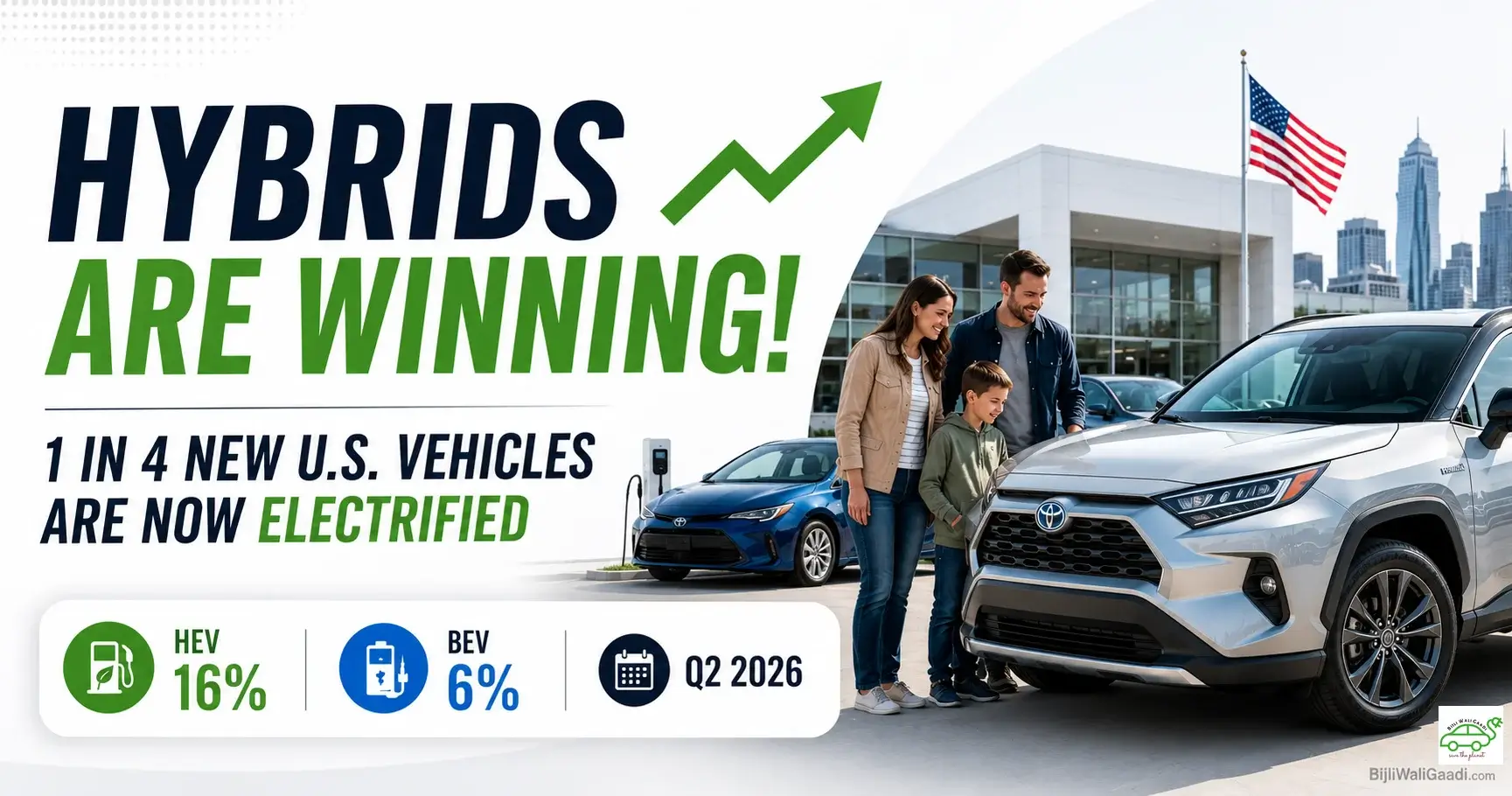
Walk onto any dealership lot in the U.S. this August, and you’ll notice a shift the sales brochures haven’t fully caught up with yet: hybrids, not pure EVs, are leading the electrification trend. According to fresh U.S. Energy Information Administration (EIA) data, electrified vehicles — hybrids, battery electric vehicles (BEVs), and plug-in hybrids combined — captured a record 24% of all new light-duty vehicle sales in the second quarter of 2026, up from 22% a year earlier. That’s nearly one in four new vehicles sold in America. But the more revealing story isn’t the 24% headline figure. It’s which powertrain is driving that number.
Hybrids Just Hit a Record 16% Market Share — Here’s Why That Number Matters More Than Any EV Milestone
Of that combined 24%, conventional “plug-less” hybrids alone accounted for a record 16% of light-duty vehicle sales in Q2 2026, according to EIA estimates. That’s up from roughly 13% a year ago — a stunning climb for a technology many assumed would be a bridge, not a destination. Cox Automotive’s Kelley Blue Book data backs this up on the ground: even as the overall new-vehicle market is projected to shrink by about 2.2% year-over-year, hybrid sales are forecast to rise by roughly 9%.
The growth is being driven by several overlapping factors rather than any single cause: fuel-price uncertainty, rising EV transaction prices, the removal of the federal EV purchase credit, lingering concerns about charging infrastructure, and a straightforward consumer preference for fuel savings without changing driving habits or refueling routines.
Product strategy is reinforcing the trend as well. Toyota’s redesigned Camry is now sold exclusively as a hybrid for the 2026 model year, and the redesigned RAV4 lineup has been rebuilt around Hybrid (HEV) and Plug-in Hybrid (PHEV) powertrains, with the conventional gasoline-only version eliminated. Stellantis has expanded electrified offerings across much of its Jeep SUV portfolio, with the brand continuing to prioritize 4xe hybrid technology and additional electrified crossover development. Eliminating gasoline-only variants naturally shifts sales toward hybrid models without requiring additional consumer incentives.
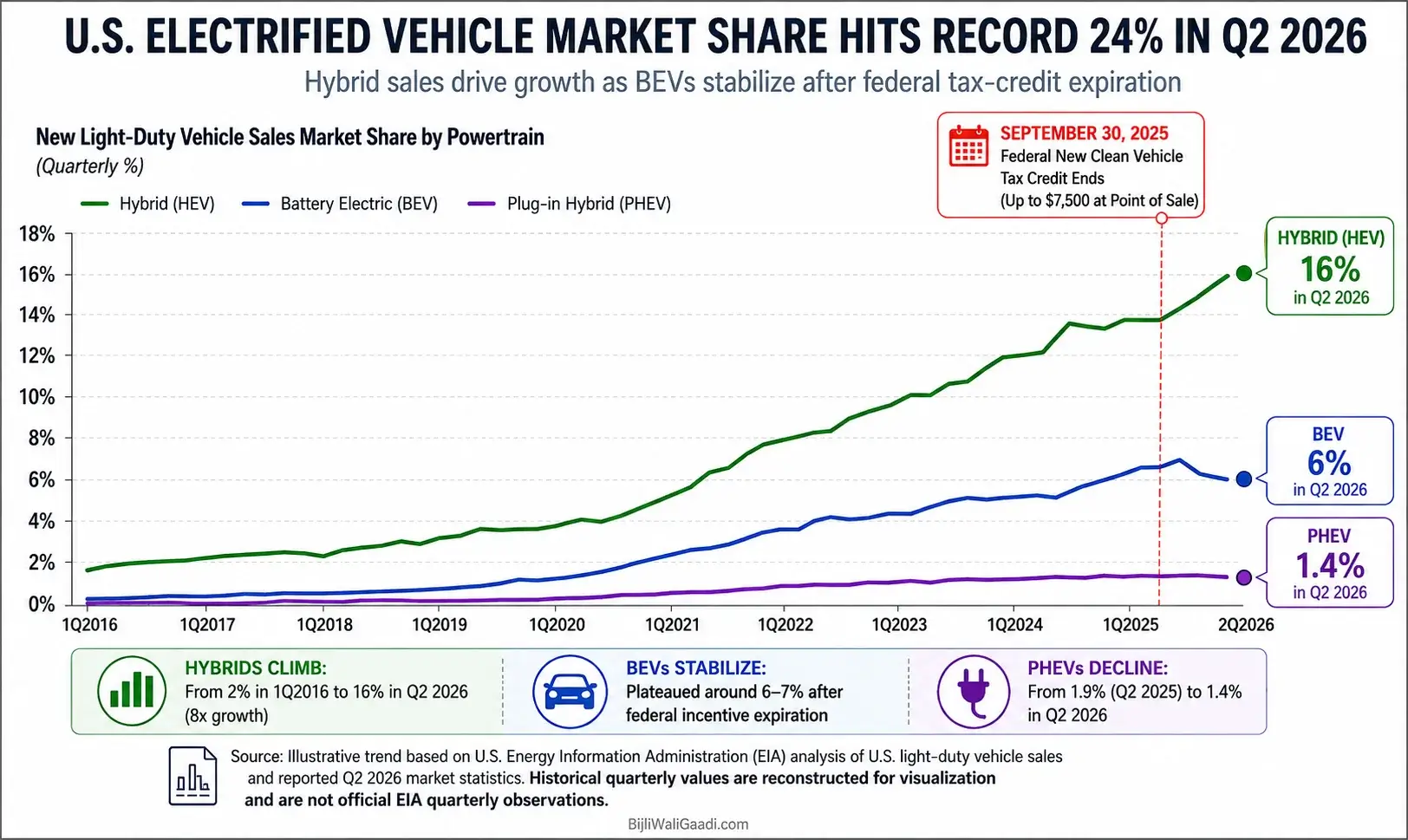
[Visual/Data-Callout Suggestion: Line chart plotting quarterly market share from 1Q2016–2Q2026, with separate lines for Hybrid, BEV, and PHEV. Include an annotated vertical marker at September 30, 2025 flagging the federal tax-credit expiration, with clear labels showing hybrids’ climb to 16% against BEVs’ plateau near 6–7%. Source: U.S. Energy Information Administration (EIA).]
Why BEV Sales Stabilized at 6% Instead of Collapsing After the $7,500 Tax Credit Disappeared
Here’s the number that should reset expectations for anyone assuming the EV transition has stalled entirely: BEV sales landed at 6% of new light-duty vehicle sales in Q2 2026, down from 7% a year earlier, but essentially flat compared to the first half of 2026. That reads as a stabilization following a significant policy-driven correction, rather than a broader collapse in EV demand.
The correction traces back to a specific federal policy change. The New Clean Vehicle Credit and the Qualified Commercial Clean Vehicle Credit — both worth up to $7,500 at the point of sale — expired on September 30, 2025, following federal legislative changes; state-level and manufacturer incentives in various markets were not affected. Buyers rushed to beat the deadline, pushing BEV share to a record 12% of light-duty sales that September alone. What followed was a market adjustment: 2025 became the first year BEV annual sales and market share actually declined, a trend that has carried into 2026. Plug-in hybrids saw a sharper proportional decline, sliding from 1.9% to just 1.4% of sales over the same year-over-year window.
Cox Automotive’s Q2 numbers offer a more encouraging signal, though. Kelley Blue Book estimates put EV sales at 247,226 units for the quarter — up 14.7% from a revised Q1 total. Sales remain roughly 20% below year-earlier levels, but that sequential recovery suggests the post-credit correction that began in late 2025 is stabilizing rather than deepening.
The Tesla Model Y Remains America’s Top-Selling EV
If you’re wondering whether EV buyers have moved away from Tesla amid the broader slowdown, the data suggests otherwise. The Tesla Model Y remains the best-selling electric vehicle in the country by a wide margin — more than one in three electric cars sold in Q2 2026 was a Model Y, according to Kelley Blue Book. Notably, while the Model 3 saw a 28.4% year-over-year sales drop, the Model Y’s decline was a comparatively modest 1.5%.
Tesla reported global deliveries of 480,126 vehicles for Q2 2026, a 25% year-over-year increase, even as the broader U.S. EV market contracted. The Model Y L expands Tesla’s highest-volume Model Y family with a longer-wheelbase, three-row configuration, broadening the brand’s appeal in the mainstream crossover segment — it does not replace the premium Model S or Model X, both of which remain in Tesla’s lineup. Localized U.S. production, regional factory incentives, and manufacturing efficiency have helped sustain Model Y demand even without the federal point-of-sale tax credit that once supported it.
Automakers Are Rewriting Their Production Lines Around Hybrids, Not EVs
This is where the story shifts from sales charts to boardroom decisions. Ford disclosed a $19.5 billion charge tied to redirecting EV investment and new-vehicle development toward hybrids — a figure that primarily reflects accounting write-downs and revised product-investment plans rather than a direct cash outlay — while still keeping a slate of smaller, profitable EVs in its lineup. General Motors has delayed or reprioritized several planned EV programs for 2026 while continuing to invest in select strategic EV platforms. Meanwhile, Toyota and Subaru are pushing in the opposite direction, launching multiple new hybrid and electrified models early in the year to capture the demand shift the EIA numbers describe.
Industry analysts tracking these production pivots point to a combination of factors: the elimination of federal EV purchase subsidies, new tariffs on vehicles and components, and rising labor costs tied to Big Three union contracts. Together, these pressures are nudging manufacturers toward internal combustion and hybrid platforms where margins are steadier and consumer demand is well-established.
For American car shoppers, this translates into a very practical reality: the hybrid aisle at your local dealership is about to get a lot bigger, and the “gas-only” aisle is shrinking fast. If you were planning to buy a RAV4 or Camry with a traditional engine, that option may simply not exist by the time you’re ready to sign.
What This Means for Your Next Car Purchase, Right Now
If you’re cross-shopping in 2026, here’s the consumer-level translation of all this market noise:
The Bigger Picture: Electrification Isn’t Slowing Down, It’s Just Changing Shape
It would be easy to read “BEV sales down” as bad news for electrification broadly. The EIA’s own framing suggests otherwise: combined electrified vehicle share hit a record 24% in Q2 2026, meaning the shift away from purely gasoline-powered cars is still advancing — it’s just hybrids, not pure EVs, doing the heavy lifting right now. Hybrids’ current edge largely comes down to lower ownership friction: mature supply chains keep production costs and pricing predictable, the driving experience feels familiar to gasoline-car owners, and buyers get real fuel savings without adapting to a new refueling routine. Cumulatively, though, BEVs still represent only about 2% of the entire registered light-duty vehicle fleet on U.S. roads, a reminder of just how early this transition remains, regardless of which powertrain wins each quarter.
For J.D. Power and Cox Automotive analysts tracking the rest of 2026, the question isn’t whether electrification continues — it clearly is. The question is whether federal policy, battery costs, and charging infrastructure investment can eventually pull BEVs out of their current holding pattern the way hybrids have already broken through.
Tell Us: Is Your Next Garage Addition Going to Be a Hybrid or a Pure EV?
America’s new-car buyers are voting with their wallets, and right now hybrids hold a clear lead. But Tesla’s Model Y shows pure EVs still have real pull when the product fits buyer needs. So where do you land? Are you leaning toward a hybrid to sidestep charging uncertainty and reduced tax incentives, or are you holding out for your next EV purchase despite the higher price tag? Drop your take in the comments — and tell us which model you’re cross-shopping right now.
Stay connected via Google 'Electric Vehicle' News
Follow BijliWaliGaadi | India's Trusted EV Insights Portal
source on Google