Why China’s New Sodium-Ion Battery Standard Matters
Stay connected via Google 'Electric Vehicle' News
Follow BijliWaliGaadi | India's Trusted EV Insights Portal
source on Google
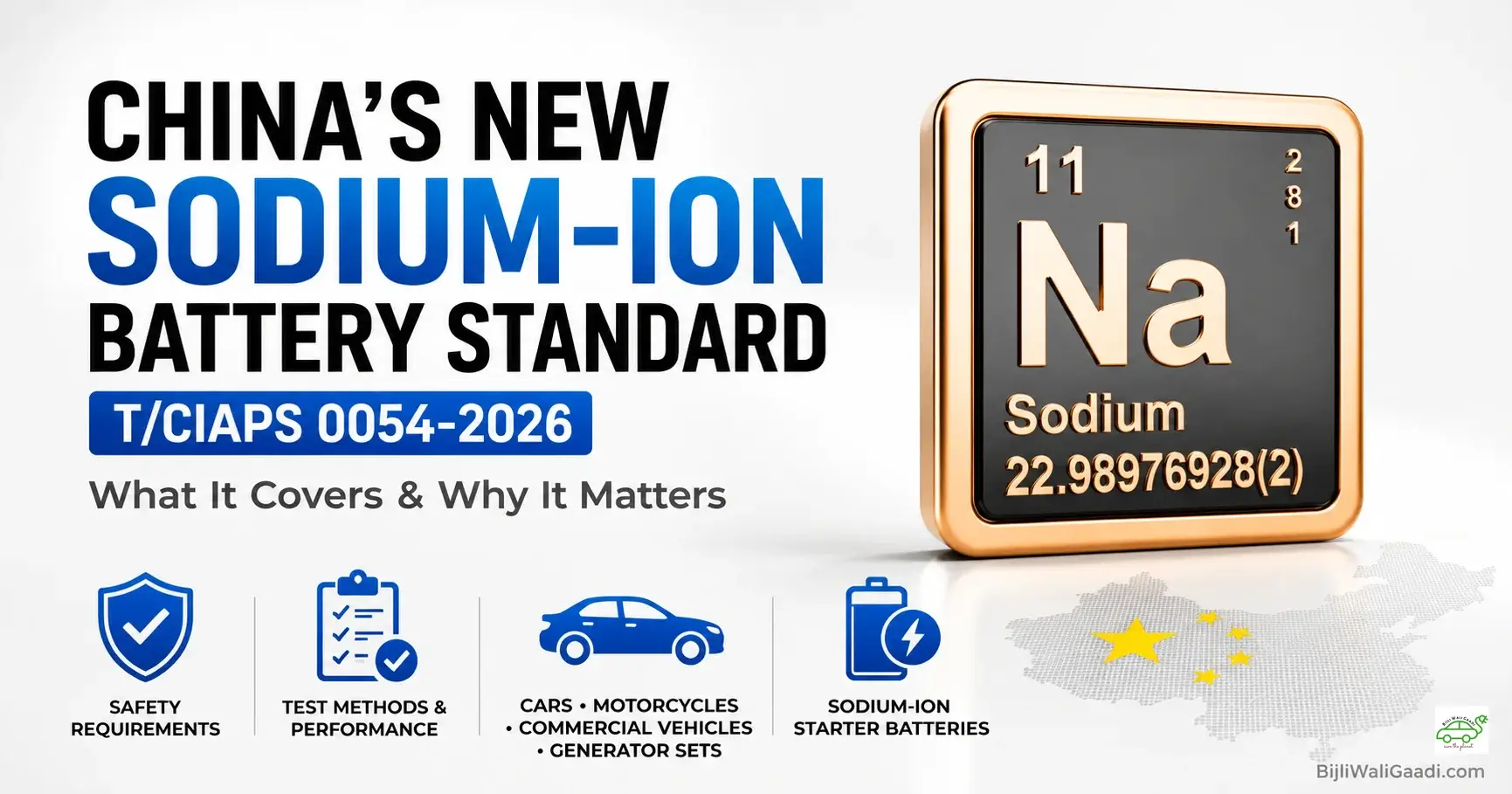
Quick Summary: ‘China’s T/CIAPS 0054—2026 standard, issued by the China Industrial Association of Power Sources, sets safety requirements and test methods for sodium-ion starter batteries used in motorcycles, passenger cars, commercial vehicles and generator sets. Rather than proving sodium-ion is ready to replace lead-acid everywhere, the standard gives the industry a common, validated basis for testing that claim application by application.’
Sodium-ion batteries have spent years being described as “promising.” China’s new safety standard for sodium-ion starter batteries is the first document that asks a harder question: promising according to whose test methods?
That distinction matters more than it sounds. A cell chemistry can perform impressively in a lab and still fail the specific demands of an automotive starting battery — short, high-power pulses, frequent charge-discharge cycling, harsh vibration, and reliable operation in cold weather. Until now, the market has lacked a common framework for evaluating sodium-ion cells specifically for starting applications. China’s new sodium-ion battery standard changes that.
What Is China’s T/CIAPS 0054—2026 Sodium-Ion Battery Standard?
T/CIAPS 0054—2026 is a sodium-ion battery safety standard issued by the China Industrial Association of Power Sources (CIAPS), released on July 26, 2026. It sets safety requirements and testing methods specifically for sodium-ion batteries designed for starting, lighting and ignition (SLI) applications — the category that includes starter batteries for motorcycles, passenger cars, commercial vehicles and generator sets.
A companion standard, T/CIAPS 0055-2026, covers performance requirements and test methods for the same sodium-ion starting-battery category. Industry reporting on August 12, 2026 confirmed that both standards had formally entered implementation, administered by the same association, applying to sodium-ion cells used in high-rate starting power sources for motorcycles and automobiles.
Why Sodium-Ion Starter Batteries Need Standardized Safety Testing
A starting battery is not an ordinary backup cell. It has to deliver short, high-power pulses reliably, often at low temperatures, while tolerating frequent charge-discharge events and harsh vibration or thermal conditions over years of service. A sodium-ion cell that performs well in a laboratory cycle test still needs application-level confirmation before it belongs in a starting-power pack for a vehicle or generator.
That is the practical gap T/CIAPS 0054—2026 is designed to close. The real question for a sodium-ion starter battery was never simply whether the chemistry works — it was whether a specific cell and pack design has been validated against the starting current, temperature range, charging profile, safety limits, communication requirements and mechanical environment of its intended application. A safety standard gives engineers and procurement teams a common reference point for asking exactly those questions.
What the New Standard Covers
T/CIAPS 0054—2026 establishes safety requirements and testing methods for SLI sodium-ion batteries across motorcycles, passenger cars, commercial vehicles and generator sets. Its companion standard, T/CIAPS 0055-2026, addresses performance requirements and test methods for the same application category. Together, the two standards create a shared vocabulary for evaluating high-rate discharge behavior, safety abuse testing, performance retention, labeling, packaging, transport and storage requirements for sodium-ion starting cells.
That shared vocabulary matters most once a supplier moves from cell selection into custom pack design, where a cell’s individual performance still has to be coordinated with a range of broader engineering considerations — things like battery-management-system thresholds, busbar design, enclosure structure, heat paths, cable sizing, fusing and charger compatibility. These are pack-level engineering decisions that sit alongside the standard rather than requirements the standard itself specifies, but a validated cell makes them easier to design around with confidence.
Why Sodium-Ion Batteries Are Being Considered for Vehicle Starting Systems
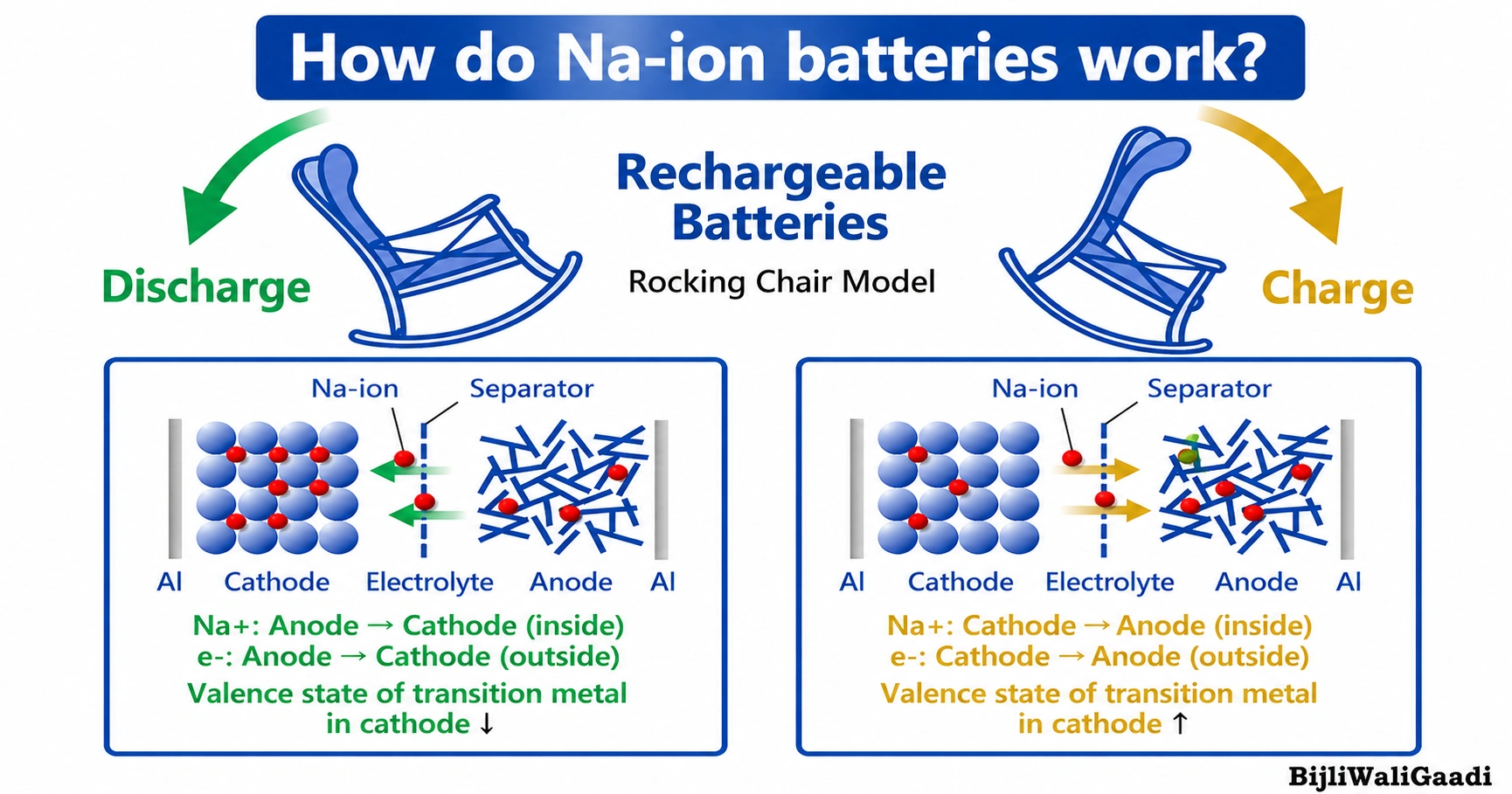
The appeal of sodium-ion chemistry for starting applications rests on a handful of potential advantages. Sodium-ion batteries are being considered partly because of their potential low-temperature performance and pulse-discharge capability — the supplied expert review cites a range of around −20°C to −30°C, though this figure describes reported chemistry-level potential rather than a universal specification for every sodium-ion cell.
That matters for a battery whose entire job is delivering a strong pulse on a cold morning. Sodium-ion cells are also associated with safety advantages compared with conventional lithium-ion batteries, including the ability to discharge to 0V without the dendrite-growth or swelling concerns that can affect other chemistries, and with potentially longer cycle life than conventional lead-acid starter batteries. Sodium’s resource abundance points toward potentially lower raw-material costs than lithium-based alternatives.
These are described as potential advantages rather than settled facts, and they are product-specific — a given sodium-ion cell design does not automatically outperform LFP or lead-acid on cold-start behavior, charging acceptance or abuse tolerance simply because it uses sodium-ion chemistry. That caveat is precisely why a standardized testing framework matters: it gives buyers a way to verify claims rather than take them on faith.
How Sodium-Ion Batteries Could Change Automotive Starter Batteries
If sodium-ion starter batteries prove out against the new standard’s test methods, the categories most likely to benefit first are the ones named directly in the standard’s scope — motorcycles, passenger cars, commercial vehicles and generator sets. These applications share a common profile: they need a battery that can deliver a reliable starting pulse across a wide temperature range and a long service life, without the premium placed on gram-for-gram energy density that dominates decisions for EV traction batteries. That is a very different set of priorities than the ones driving sodium-ion adoption in electric trucks or grid-scale storage, where different Chinese sodium-ion programs have been validating the chemistry on their own terms.
Why Standardization Matters for Automakers and Battery Suppliers
For automakers and battery suppliers, a published safety and performance standard does not guarantee commercial adoption, but it does lower a real barrier: the absence of a common testing language. Before evaluating a sodium-ion starter battery, a buyer needs to confirm the application profile — required starting current, pulse duration, minimum ambient temperature, charge source, duty cycle, enclosure size, vibration exposure, communication interface, certification route and shipping destination — and only then compare sodium-ion against LFP or lead-acid alternatives. A shared standard makes that comparison possible on consistent terms across suppliers, which is the kind of engineering-driven groundwork that typically precedes, rather than follows, wider commercialization.
What This Means for the Future of Sodium-Ion Batteries
T/CIAPS 0054—2026 arrives as sodium-ion chemistry is being validated across several distinct vehicle and storage applications in China, each on its own evidentiary basis. BijliWaliGaadi’s coverage of the sodium-ion battery market outlook has noted that starter batteries and telecom backup are considered early adoption targets as sodium-ion costs approach lead-acid levels — a development that could support that trajectory by giving the specific application category its own safety and testing framework.
Separately, BijliWaliGaadi’s reporting on China’s sodium-ion heavy-duty truck trials illustrates how the chemistry is being validated for propulsion in commercial vehicles — a different application from SLI starting batteries, but part of the same broader pattern of sodium-ion moving from laboratory promise toward application-specific, standardized validation across China’s vehicle and energy sectors.
None of this amounts to proof that sodium-ion starter batteries are ready to replace lead-acid batteries everywhere. What it does establish is that the industry now has a formal, published basis for testing that claim — application by application, rather than on chemistry alone. For an automotive starting-battery market that has run on lead-acid for over a century, and where lithium-ion has made only partial inroads, a validated safety standard is the unglamorous but necessary step that has to happen before broader adoption conversations can proceed.
Stay connected via Google 'Electric Vehicle' News
Follow BijliWaliGaadi | India's Trusted EV Insights Portal
source on Google