Beyond C-Rates: How Smart BMS and Passive Thermal Protection Can Help LFP Batteries Survive Indian Heat
Stay connected via Google 'Electric Vehicle' News
Follow BijliWaliGaadi | India's Trusted EV Insights Portal
source on Google
Quick Take-away
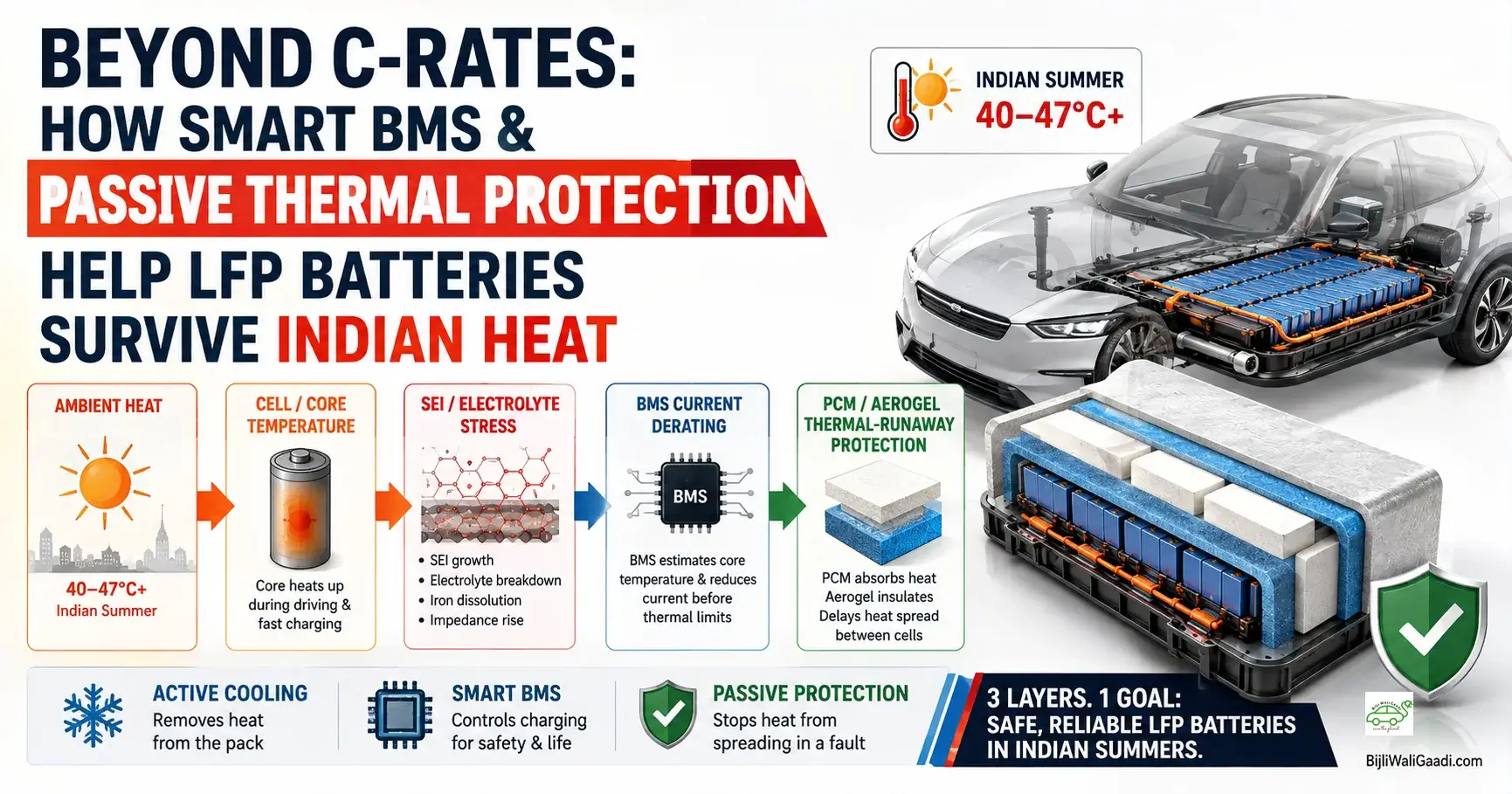
Indian summer heat above 40–45°C accelerates chemical aging in LFP cells and raises thermal stress during fast charging. No single fix solves this: cooling removes heat, PCM/aerogel barriers slow thermal-runaway propagation, and adaptive BMS software limits charging current before the cell core overheats.
Why 40–45°C Heat Accelerates LFP Battery Aging
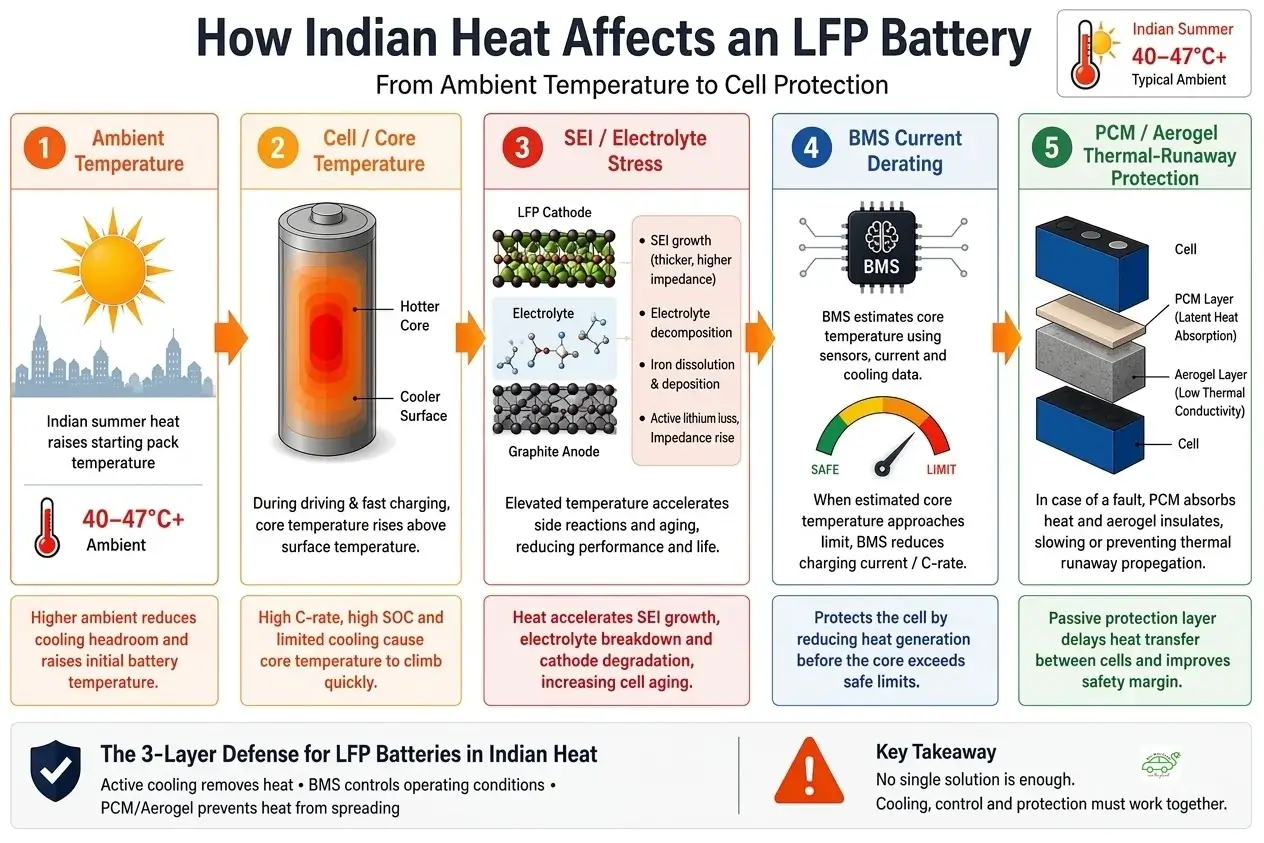
Heat speeds up the chemical side reactions that age every lithium-ion cell, including LFP. A ScienceDirect study on large-format graphite/LFP cells found that the degradation mechanism changes above roughly 45°C, with cathode-side thermal stress and electrolyte decomposition becoming more significant, while SEI-related active-lithium loss remains an important contributor.
Under that study’s cycling conditions, cell lifetime at 55°C worked out to roughly one-seventh of lifetime at 25°C — a laboratory result from one test protocol, not a warranty prediction for every pack, since real-world lifetime also depends on pack design, cooling, and charging habits.
High-temperature degradation isn’t one mechanism. Documented contributors include SEI film growth at the graphite anode, iron dissolving from the cathode onto the anode, electrolyte breakdown, and impedance growth — often together rather than one dominating every cell. This differs from a related failure mode covered in our Lithium plating vs SEI layer growth explainer: lithium plating is strongly associated with low cell temperature, high charging current, and conditions that limit lithium-ion intercalation.
Why C-Rate Alone Cannot Predict Summer Charging Stress
C-rate alone doesn’t tell you how much stress a charging session places on a cell. What matters is C-rate combined with cell temperature, state of charge, charge duration, and how effectively the pack rejects heat.
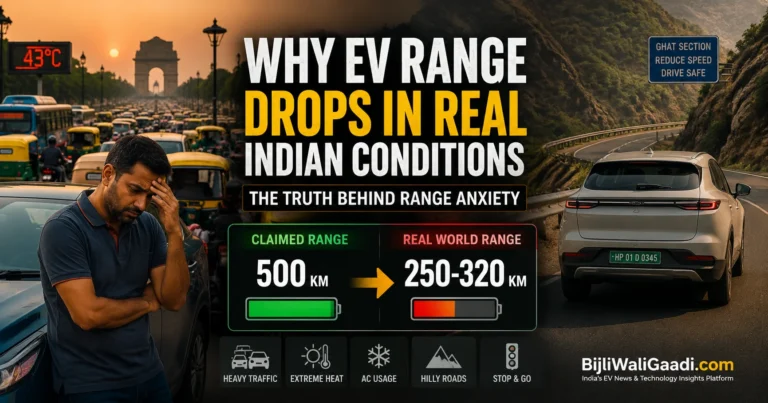
A 2C charge at a moderate temperature is not thermally equivalent to the same 2C charge when the pack is already hot after a highway drive on a 42°C day in Delhi or Nagpur — the starting cell temperature narrows the margin before the cell enters a stressful zone, even though the C-rate figure looks identical either way.
This is why EV charging curves are rarely fixed; they’re shaped in real time by thermal conditions, not C-rate alone. See our complete guide to EV batteries in India for pack-design background.
What Active Liquid Cooling Can and Cannot Do
Active liquid cooling removes heat from the pack via a coolant loop, often assisted by a chiller or refrigerant circuit. Effectiveness depends on coolant temperature, chiller capacity, flow rate, heat-transfer area, cell heat generation, and control strategy.
Higher ambient temperature reduces the thermal headroom available to reject heat, particularly when cooling ultimately relies on ambient conditions or a constrained chiller. The actual limit depends on those same factors — there is no single universal ambient ceiling at which liquid cooling stops working.
Parasitic energy consumption from pumps, fans, and compressors is a real design consideration, best described qualitatively rather than with one percentage figure, since published values vary with drive cycle, climate, and system design.
How PCM and Aerogel Barriers Slow Thermal Runaway Propagation
PCM and aerogel felt serve a different purpose than active cooling: they absorb heat through latent-heat phase transitions and insulate against its spread, mainly to slow or block thermal-runaway propagation between cells if a fault occurs. For everyday summer degradation, heat rejection and charging control matter more; PCM/aerogel becomes most valuable when the design goal shifts from temperature control to preventing a cell failure from propagating.
In an experimental module using NMC cells, a paraffin/SiC-nanowire/aerogel composite reported thermal conductivity as low as 0.042 W/(m·K) at 600°C and surface temperature differences below 1.82°C between cells. These figures describe that specific material system, using a different cell chemistry — not a demonstrated LFP-pack result or a universal PCM/aerogel benchmark.
A separate wrapping-material study found aerogel felt delayed thermal-runaway onset by about 97 seconds and thermal-conductive gel by about 99 seconds, versus unwrapped cells. These numbers come from one experimental configuration; they demonstrate the protective principle rather than guaranteeing an identical delay in a full automotive pack. None of this shows PCM or aerogel slows ordinary SEI growth or extends calendar life — their documented role is safety-focused, not a fix for everyday capacity fade.
How an Advanced BMS Can React Before the Cell Core Gets Too Hot
During high-current operation, the hottest region inside a cell can be warmer than the surface, while surface sensors may respond with some delay. Advanced BMS and charging-control systems can estimate this internal state from measurable inputs — surface temperature, current, coolant temperature, and other thermal data — rather than measuring the core directly. Core-temperature estimation is largely an emerging, research-level capability; production implementations vary across manufacturers.
A 2026 research framework using a Kolmogorov-Arnold Network estimates core temperature from surface temperature, coolant temperature, coolant power, and charging current, and incorporates that estimate into safety-constrained fast-charging control. This is not yet a standard capability across production EVs.
The value is earlier intervention: if estimated core temperature approaches a safety limit, the system can cut charging current before that limit is reached at the surface — trading some charge time for a lower thermal peak, though the trade-off’s exact size is vehicle-specific.
Active Cooling vs PCM/Aerogel vs Adaptive BMS
| Technology | Main Function | Strength | Limitation | Role in Indian Heat |
| Active Liquid Cooling | Removes heat from the pack via coolant/refrigerant circuit | Handles sustained, high heat loads during driving and fast charging | Effectiveness depends on system design; consumes auxiliary power; headroom narrows in high ambient heat | Primary bulk heat-rejection layer, especially during summer fast charging |
| PCM/Aerogel Thermal Barriers | Absorbs and blocks heat transfer between cells; delays thermal-runaway propagation | Passive, draws no auxiliary power; improves safety margin | Does not reject bulk heat from the pack; does not slow ordinary SEI-driven aging | Safety backstop against fault propagation, not a cooling replacement |
| Adaptive BMS | Estimates cell-core temperature and controls charging current/SoC window | Enables earlier intervention than surface-only monitoring | Cannot physically cool the battery; effectiveness depends on model accuracy | Reduces risk of thermal overshoot during hot-weather fast charging |
What This Means for LFP EVs in India’s Summer
For owners and fleet operators, the takeaway isn’t that hot-weather charging is dangerous by default, but that it carries a different risk profile than moderate-climate charging. Not every Indian city sees identical peak temperatures — Delhi, Nagpur, and similar high-heat regions demand more from thermal-management systems than cooler coastal or hill regions.
Temporary charging-speed reduction in extreme heat is usually a protective, reversible BMS response, not permanent damage. Permanent electrochemical degradation, by contrast, accumulates gradually from repeated exposure to high temperature and high SoC over months and years. These are different phenomena and shouldn’t be conflated.
Final Verdict
No single technology — active cooling, PCM/aerogel barriers, or adaptive BMS software — replaces the other two. Cooling rejects heat, passive barriers contain a fault, and BMS software manages operating conditions from the best available estimate. For LFP packs built for repeated Indian summers, the strongest thermal-safety architecture combines active heat rejection, intelligent operating control, and passive protection where pack design requires it.
Stay connected via Google 'Electric Vehicle' News
Follow BijliWaliGaadi | India's Trusted EV Insights Portal
source on Google