Petrol Lost the Lead in India’s Car Market—But Not How You Think
Stay connected via Google 'Electric Vehicle' News
Follow BijliWaliGaadi | India's Trusted EV Insights Portal
source on Google
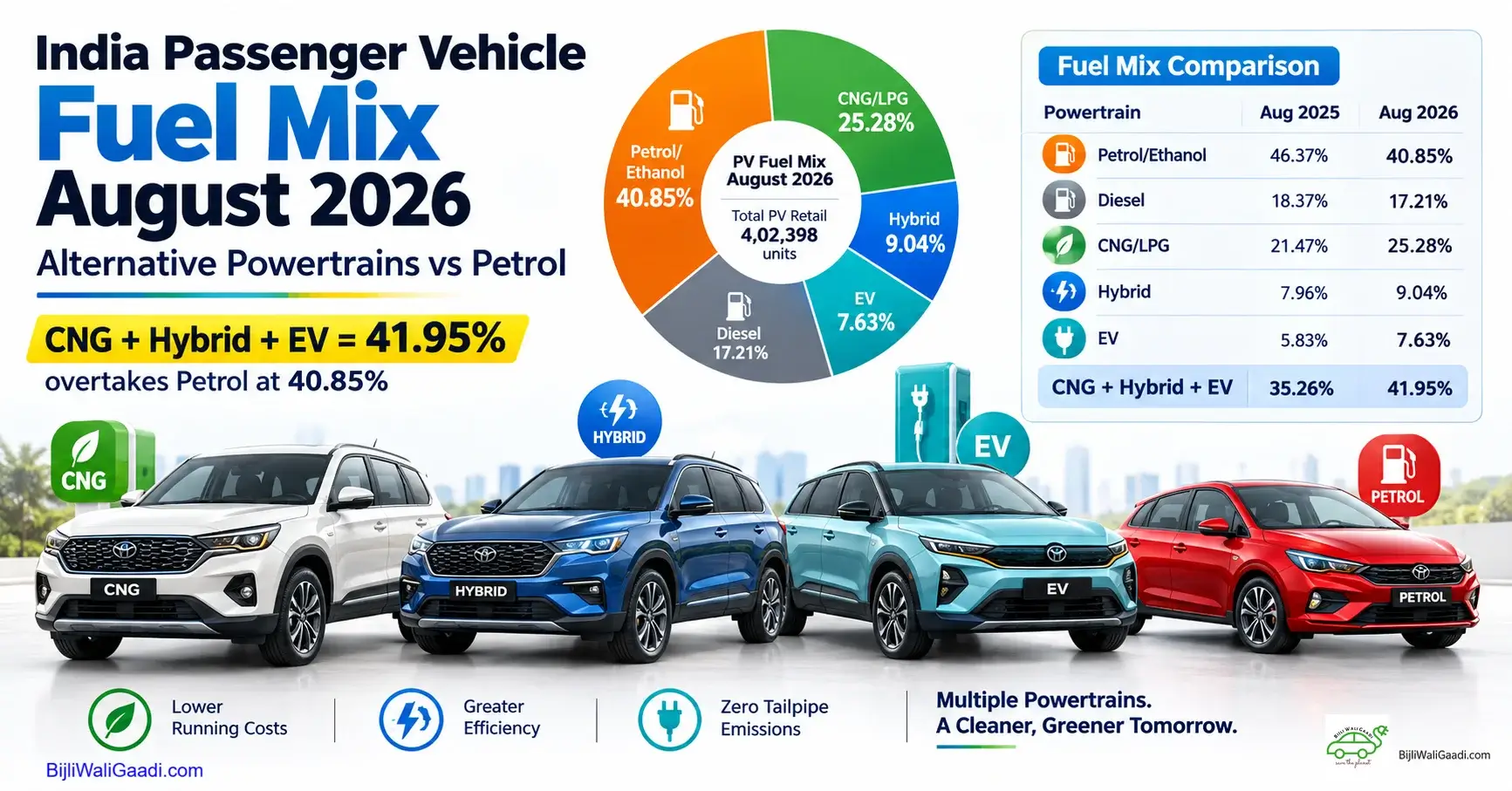
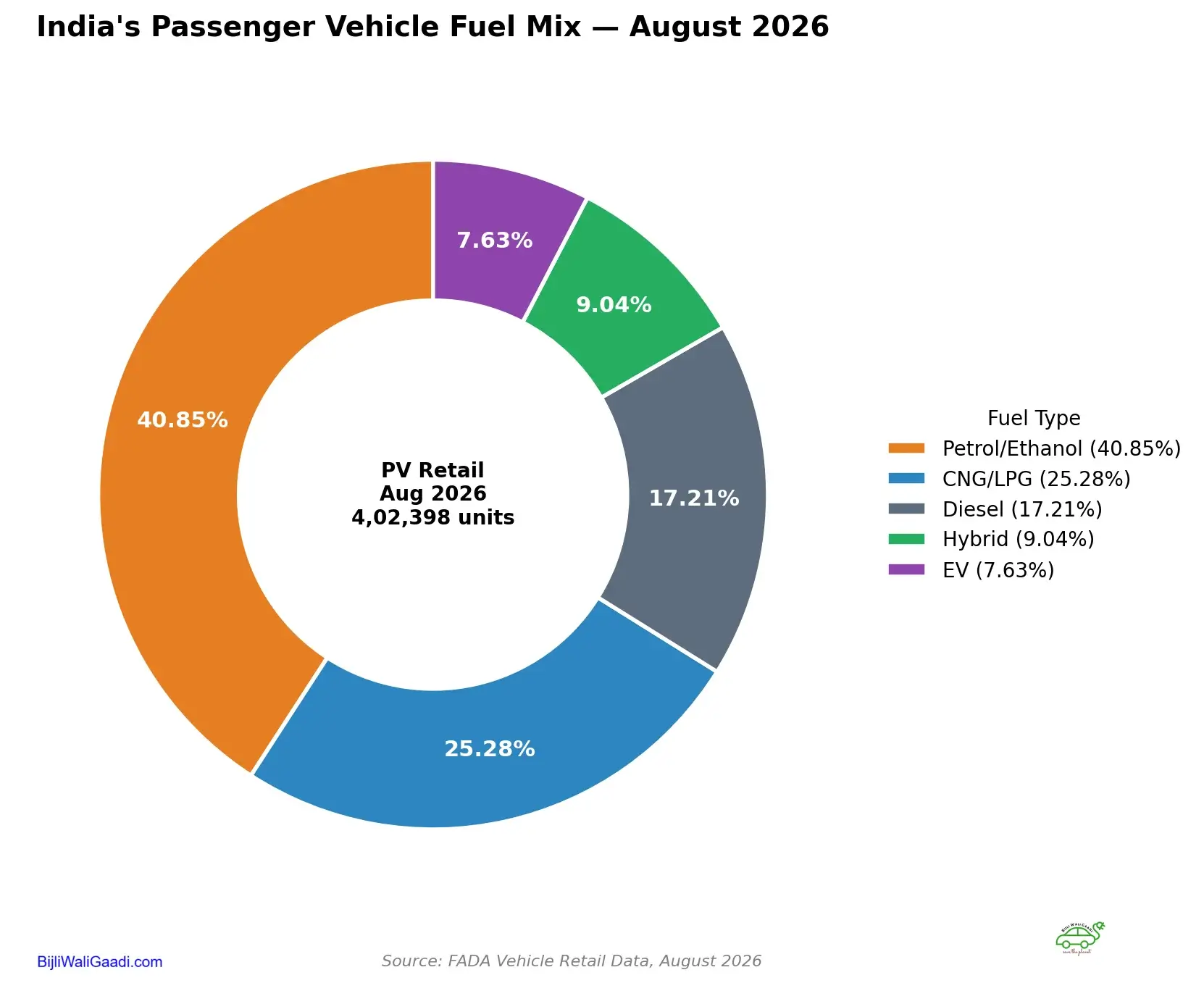
India’s passenger-vehicle retail market crossed a milestone in August 2026. According to FADA (Federation of Automobile Dealers Associations) data collated on 4 September 2026 from 1,467 of India’s 1,469 RTOs, combined retail registrations of CNG, hybrid and electric passenger vehicles reached 41.95 percent of the passenger vehicle (PV) market, edging past petrol/ethanol’s 40.85 percent. FADA describes this as the first time this crossover has occurred in the passenger-vehicle segment. Total PV retail for the month stood at 4,02,398 units, up 16.14 percent year-on-year and the first August in which PV retail crossed the 4-lakh mark, even as volumes eased 3.40 percent from July’s 4,16,555 units.
What Actually Overtook Petrol
It is important to be precise about what this milestone does and does not mean. Electric vehicles alone did not overtake petrol. EVs held just 7.63 percent of PV retail in August 2026, far behind petrol’s 40.85 percent. What crossed the line was the combined share of three distinct alternative powertrains — CNG, hybrid and EV — grouped together at 41.95 percent. These are not interchangeable technologies. CNG is primarily a running-cost proposition for buyers prioritising lower fuel spend. Hybrids offer efficiency gains without requiring external charging. EVs represent full battery-electric propulsion with zero tailpipe emissions. Their combined overtaking of petrol reflects three separate consumer trends advancing at once, not a single unified shift.
EV-Specific Performance: 30,696 Units, +51.89% YoY
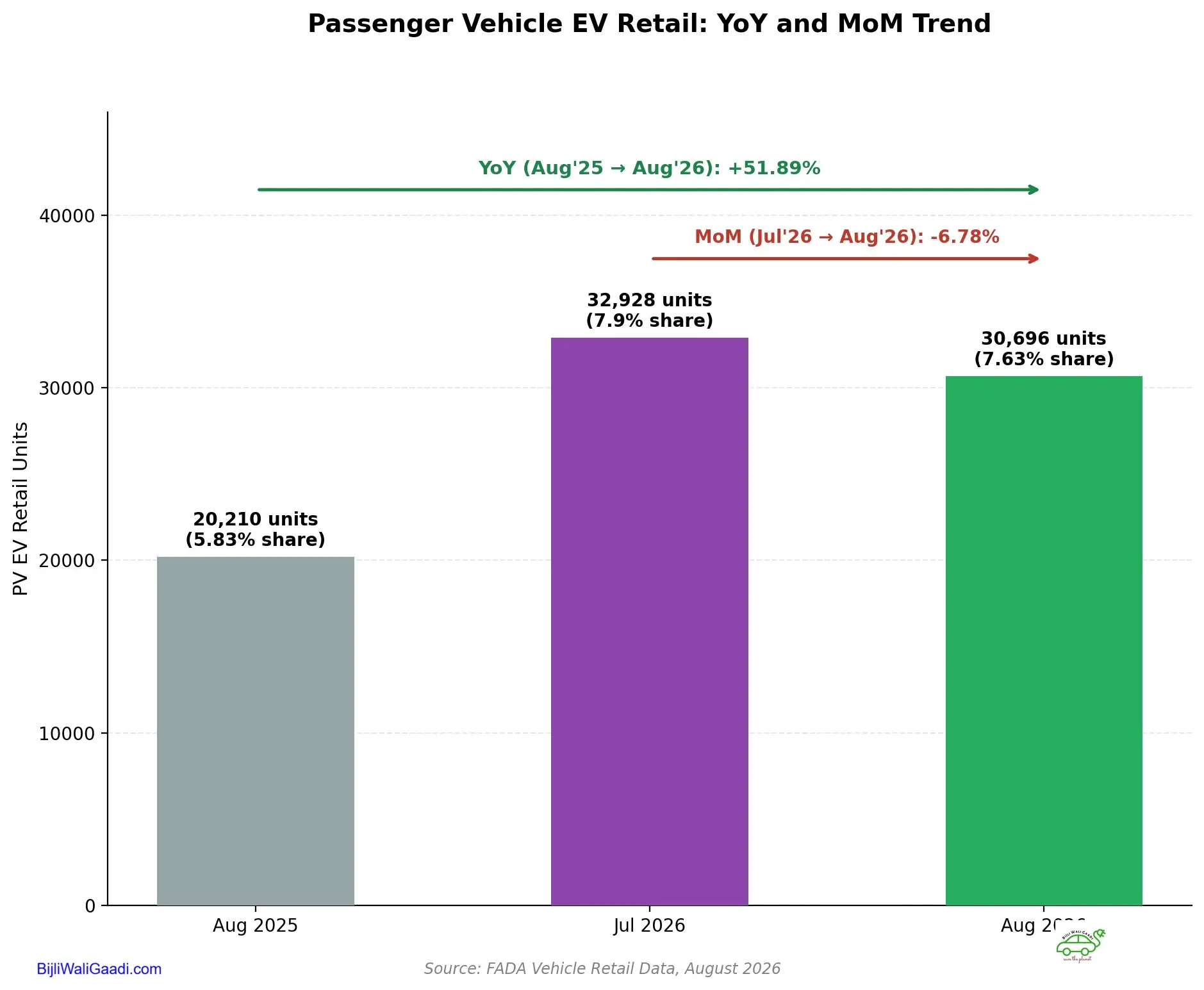
Passenger vehicle EV retail totalled 30,696 units in August 2026, translating to a 7.63 percent share of PV retail. This is up from 20,210 units and a 5.83 percent share in August 2025 — year-on-year growth of 51.89 percent, approximately 52 percent. However, the picture is not one of uninterrupted acceleration: EV retail fell 6.78 percent month-on-month from July 2026’s 32,928 units (7.9 percent share). That sequential dip is worth noting alongside the year-on-year strength, since it tempers any narrative of unbroken monthly momentum.
OEM Leaderboard and Concentration
Tata Motors Passenger Vehicles led PV EV retail with 13,158 units, up 63.17 percent year-on-year. Mahindra & Mahindra followed with 6,464 units (+56.17 percent YoY), and JSW MG Motor India retailed 4,622 units, down 17.77 percent YoY. Together, Tata and Mahindra accounted for roughly 64 percent of August’s PV EV retail, underlining how concentrated the category still is among a handful of players.
VinFast Auto India recorded 2,199 units, with no comparable August 2025 retail base in the FADA data, while Maruti Suzuki India recorded 1,412 EV retail units in August 2026, reflecting the growing presence of its EV offering. Hyundai (803 units, +17.06 percent), Kia (645 units, +28.74 percent), BYD (543 units, -6.54 percent) and BMW (274 units, -35.07 percent) rounded out the rest of a field still led decisively by domestic manufacturers.
| Electric Passenger Vehicle Retail Data | |||||
| PV OEM | Aug’26 | Jul’26 | Aug’25 | MoM% | YoY% |
| TATA MOTORS PASSENGER VEHICLES LTD | 13,158 | 13,678 | 8,064 | -3.80% | 63.17% |
| MAHINDRA & MAHINDRA LIMITED | 6,464 | 7,742 | 4,139 | -16.51% | 56.17% |
| JSW MG MOTOR INDIA PVT LTD | 4,622 | 5,689 | 5,621 | -18.76% | -17.77% |
| VINFAST AUTO INDIA PVT LTD | 2,199 | 1,482 | – | 48.38% | 0.00% |
| MARUTI SUZUKI INDIA LTD | 1,412 | 1,600 | – | -11.75% | 0.00% |
| HYUNDAI MOTOR INDIA LTD | 803 | 566 | 686 | 41.87% | 17.06% |
| KIA INDIA PRIVATE LIMITED | 645 | 470 | 501 | 37.23% | 28.74% |
| BYD INDIA PRIVATE LIMITED | 543 | 749 | 581 | -27.50% | -6.54% |
| BMW INDIA PVT LTD | 274 | 369 | 422 | -25.75% | -35.07% |
| TOYOTA KIRLOSKAR MOTOR PVT LTD | 161 | 123 | – | 30.89% | 0.00% |
| MERCEDES-BENZ AG | 114 | 165 | 110 | -30.91% | 3.64% |
| TESLA INDIA MOTORS AND ENERGY PVT LTD | 116 | 115 | – | 0.87% | 0.00% |
| STELLANTIS AUTOMOBILES INDIA PVT LTD | 44 | 51 | 36 | -13.73% | 22.22% |
| VOLVO AUTO INDIA PVT LTD | 33 | 49 | 21 | -32.65% | 57.14% |
| Others | 108 | 80 | 29 | 35.00% | 272.41% |
| Total | 30,696 | 32,928 | 20,210 | -6.78% | 51.89% |
CNG and Hybrid Contribution to the Crossover
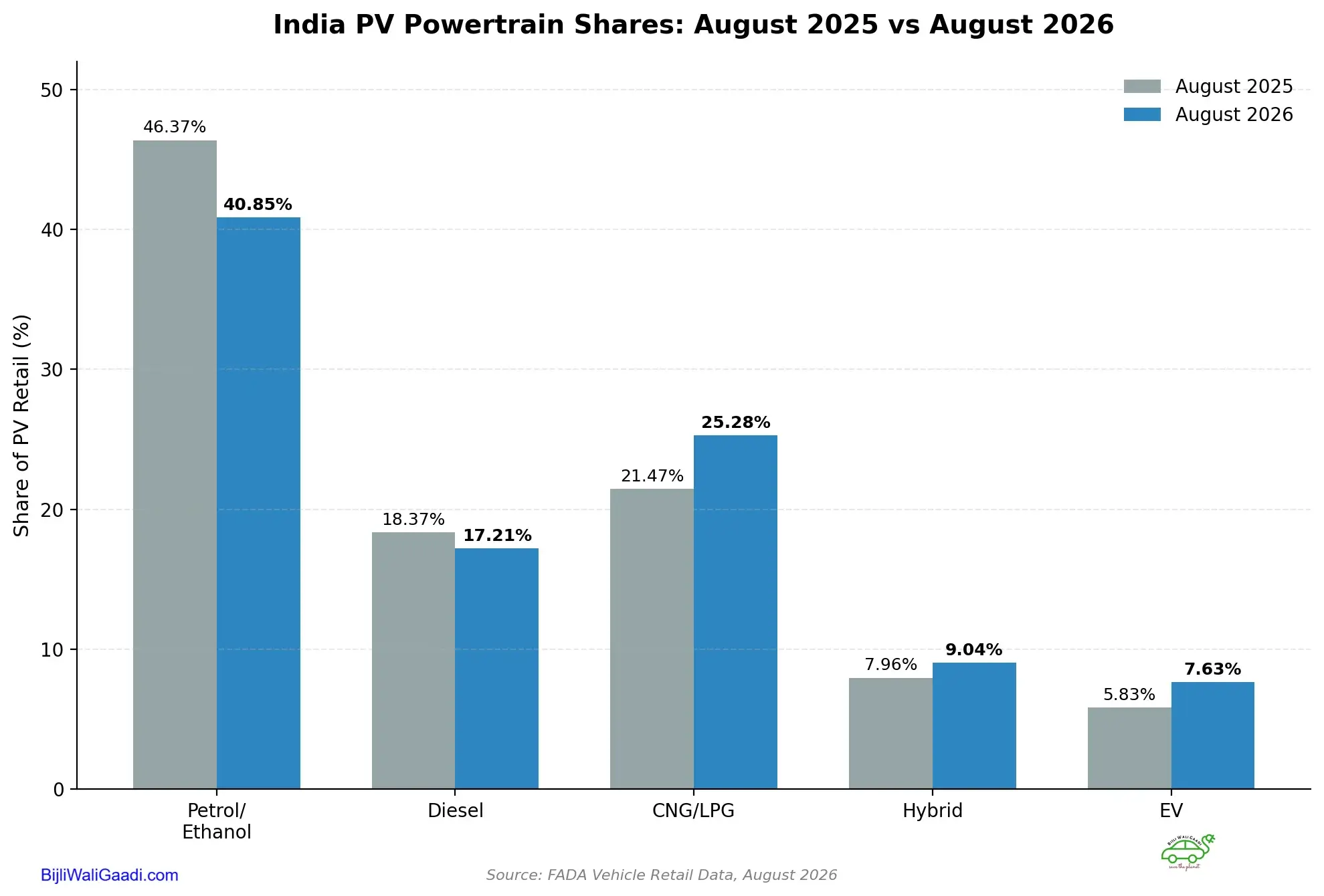
CNG/LPG remained the largest single component of the alternative-powertrain bloc at 25.28 percent of PV retail, up from 21.47 percent in August 2025 — a gain of 3.81 percentage points and more than three times the EV share. Hybrids rose to 9.04 percent from 7.96 percent, a gain of 1.08 percentage points. FADA and dealer commentary have linked part of this shift to running-cost economics and continuing consumer hesitation around the E20 ethanol-blended petrol transition, though these remain qualitative observations rather than independently quantified drivers.
Petrol and Diesel Share Decline
Petrol/ethanol’s share fell from 46.37 percent in August 2025 to 40.85 percent in August 2026, a decline of 5.52 percentage points. Diesel eased from 18.37 percent to 17.21 percent, down 1.16 percentage points. Petrol remains the single largest individual fuel type in the PV market; it has only been overtaken when CNG, hybrid and EV retail are grouped together as one category.
| Powertrain | Aug 2025 | Aug 2026 | Change |
| Petrol/Ethanol | 46.37% | 40.85% | -5.52 pp |
| Diesel | 18.37% | 17.21% | -1.16 pp |
| CNG/LPG | 21.47% | 25.28% | +3.81 pp |
| Hybrid | 7.96% | 9.04% | +1.08 pp |
| EV | 5.83% | 7.63% | +1.80 pp |
| CNG + Hybrid + EV | 35.26% | 41.95% | +6.69 pp |
What the Milestone Means — and What It Does Not
The 41.95 percent versus 40.85 percent crossover is a genuine structural signal: three alternative powertrains together are now more popular than petrol for the first time in FADA’s reporting. It does not mean EVs are near a tipping point on their own, nor that petrol demand has collapsed — petrol remains the largest single fuel by a wide margin over any individual alternative. The more accurate reading is that India’s PV market is moving toward a multi-powertrain structure, with CNG doing the heaviest lifting on volume, hybrids growing steadily, and EVs posting the fastest percentage growth from a smaller base.
FADA’s Caution on Base Effects and Inventory
FADA has urged reading the year-on-year strength “with discipline,” noting that part of it reflects a soft August 2025 base, when buyers deferred purchases ahead of the GST 2.0 rate cut. Dealers also reported, per FADA’s commentary, that festive-season bookings underperformed their own expectations, and PV inventory stood at 38–40 days against FADA’s recommended 21-day benchmark. These factors suggest some caution is warranted before treating a single month’s crossover as a settled trend.
A Multi-Powertrain Market, Not an EV-Only Story
August 2026 marks a real inflection in how India’s car buyers are splitting their choices, but the underlying story is plural: CNG, hybrid and EV retail are each growing for different reasons, and together — not individually — they have edged past petrol. Whether this crossover holds through the festive months of September to November, when inventory and demand will be tested most directly, is the metric worth watching next.
Key Takeaways:
- CNG, hybrid and EV passenger vehicles combined reached 41.95% of PV retail in August 2026, overtaking petrol’s 40.85% — a crossover FADA describes as the first of its kind.
- EVs alone held only 7.63% of PV retail; the crossover reflects three distinct powertrains growing together, not EVs beating petrol individually.
- PV EV retail rose 51.89% YoY to 30,696 units, but fell 6.78% month-on-month from July’s 32,928 units.
- Tata Motors (13,158 units) and Mahindra (6,464 units) together accounted for about 64% of August’s PV EV retail.
- FADA cautions that part of the YoY strength stems from a soft August 2025 base and that festive-season conversion through November remains the real test.
FAQs:
Stay connected via Google 'Electric Vehicle' News
Follow BijliWaliGaadi | India's Trusted EV Insights Portal
source on Google