Toyota and Scania Put Hydrogen to the Test: Can 300 kW Fuel Cells Crack Europe’s Heavy-Truck Challenge?
Stay connected via Google 'Electric Vehicle' News
Follow BijliWaliGaadi | India's Trusted EV Insights Portal
source on Google
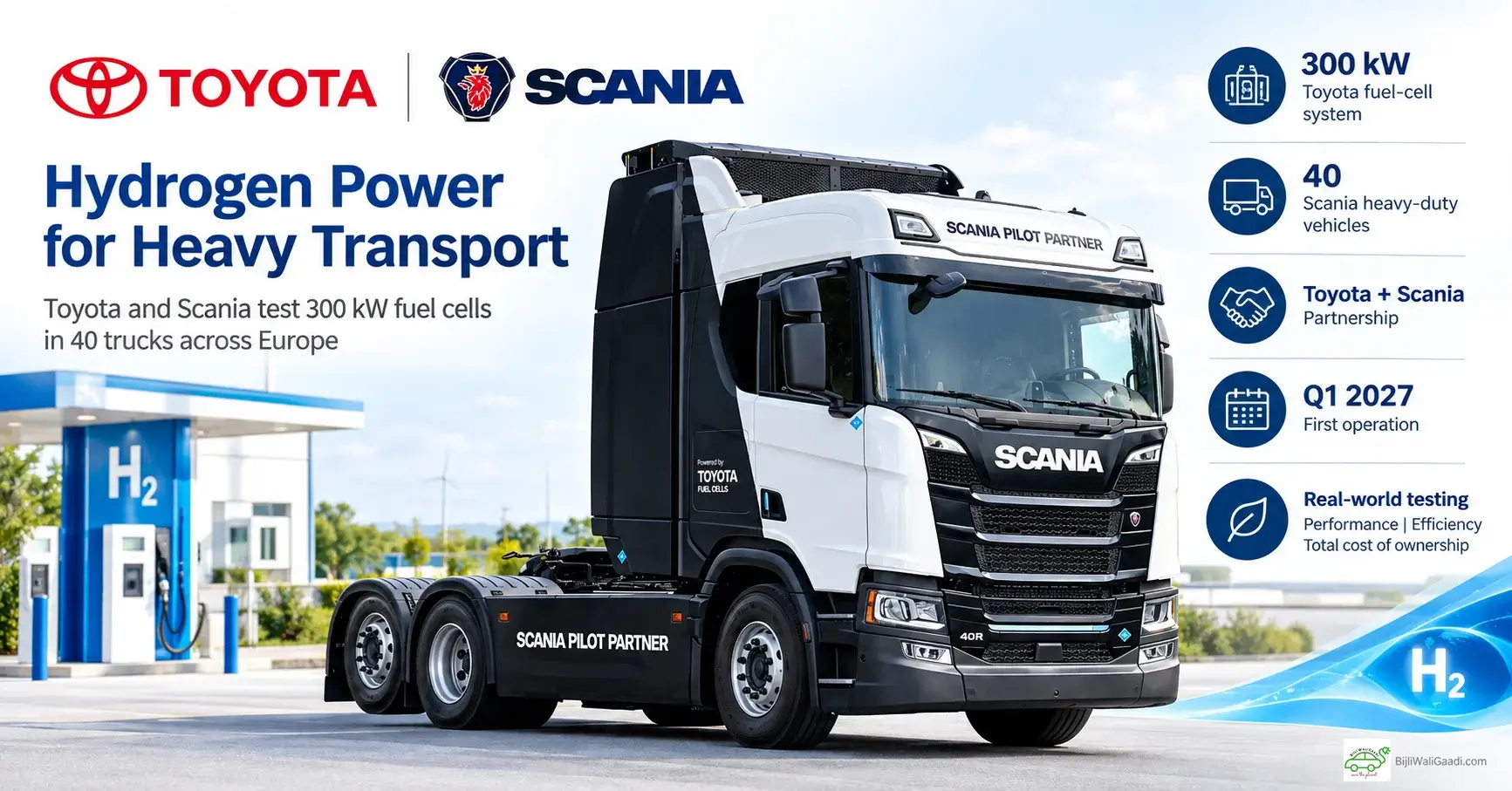
Toyota is putting its latest fuel-cell technology to work in 40 Scania heavy-duty trucks. The bigger question is whether hydrogen can prove technically effective, operationally practical and economically competitive in everyday freight.
The two companies announced their collaboration on 7 September 2026, at a pivotal moment for zero-emission trucking in Europe. Battery-electric trucks are scaling fast on depot-based routes, but long-haul, high-utilisation freight remains a harder problem to solve.
This isn’t a concept reveal or a motor-show demonstrator. It’s a real-world pilot involving selected customers and genuine operating conditions, with a clear timeline and clear evaluation criteria — which is what makes it worth paying attention to.
Toyota and Scania’s 40-Truck Hydrogen Test
Under the agreement, Toyota will supply fuel-cell systems for 40 Scania heavy-duty vehicles. These trucks will run within Scania’s Pilot Partner programme, a framework the Swedish manufacturer uses to test emerging technologies with selected customers under genuine operating conditions rather than in a lab.
Toyota and Scania say the trial will evaluate three things: technical performance, operational efficiency, and total cost of ownership. That combination matters. Fuel-cell trucks have been demonstrated before; what’s harder to prove is whether they can be run profitably, day after day, on real routes with real payloads and real schedules.
The first Scania hydrogen fuel-cell electric trucks are expected to begin operating during Q1 2027, giving both companies a defined window in which to gather field data before drawing conclusions.
Toyota’s 300 kW Gen 3 Fuel-Cell System
The trucks will run on Toyota’s third-generation fuel-cell system, which the company says delivers 300 kW of power in a notably compact package designed for heavy-duty applications and other demanding use cases.
It’s worth being precise here: the 300 kW figure describes the output of Toyota’s fuel-cell system, not the total traction power of the Scania truck itself. Scania has not disclosed the vehicle’s full drivetrain specifications for this programme, and it would be a mistake to conflate the two.
What Toyota is emphasising is the system’s highly compact design, an important consideration in heavy-duty vehicles where packaging, weight and available chassis space directly affect vehicle engineering and payload. This generation represents Toyota’s latest attempt to make fuel-cell technology commercially credible at scale, not just technically impressive.
Why Scania Wants Real-World Data
Laboratory results and demonstration fleets can only tell you so much. Hydrogen refuelling behaviour, cold-weather performance, fuel-cell durability and driver experience all look different once a truck is doing actual logistics work for an actual customer.
That’s the premise of Scania’s Pilot Partner programme: put the technology in the hands of real operators, on real routes, and see what the numbers actually say about running costs. For a company the size of Scania, credibility with fleet customers depends on data, not marketing claims.
Hydrogen vs Battery-Electric Trucks
This is not a story about hydrogen beating batteries. Battery-electric trucks already work well for many duty cycles, particularly where depot charging is available and routes are predictable enough to plan around charging windows.
Hydrogen fuel cells attract continued interest in a different set of scenarios: long operating hours, high vehicle utilisation, longer-distance routes, and operations where minimising charging downtime matters more than minimising upfront vehicle cost. Rapid refuelling is one of hydrogen’s potential operational advantages for fleets that cannot afford long charging downtime.
But hydrogen carries real disadvantages too. Producing hydrogen efficiently and affordably remains difficult, the well-to-wheel energy efficiency of fuel cells trails battery-electric systems, and refuelling infrastructure across Europe is still thin. Vehicle costs remain higher, and the availability of low-carbon hydrogen varies significantly by region.
The more useful framing is that different duty cycles may favour different zero-emission powertrains. This trial exists precisely to find out where hydrogen fits.
Scania is not presenting hydrogen as a replacement for battery-electric trucks across the board. The company considers battery-electric technology a key pathway for sustainable heavy transport, while hydrogen fuel-cell vehicles could complement BEVs in applications where charging infrastructure or duty cycles make battery-electric operation more difficult.
What the 40 Trucks Will Actually Prove
Toyota and Scania have not yet disclosed hydrogen tank capacity, storage pressure, driving range, refuelling time, payload, or total cost of ownership figures for these specific trucks. Nor have they named the exact truck model, operating countries, routes, or hydrogen source.
What the programme is designed to produce is comparative operational evidence: how the fuel cell performs under sustained heavy-duty use, and whether the economics — fuel cost, uptime, maintenance — can compete with alternatives once real fleet data is in hand.
It’s a pilot, not proof of commercial viability. Forty trucks make it a meaningful real-world test, but it is still a pilot programme rather than a market-wide commercial verdict.
Why This Matters for Europe — and India
In Europe, this trial adds concrete data to a policy environment increasingly focused on zero-emission freight mandates. European fleets are actively evaluating multiple zero-emission powertrain options, and a trial like this helps clarify which technology suits which duty cycle rather than assuming one answer fits every route.
For India, the relevance is strategic rather than immediate. India’s heavy commercial vehicle sector is large and growing, and long-haul freight is genuinely difficult to electrify with a single powertrain solution. Hydrogen already features in India’s broader clean-transport planning — the National Green Hydrogen Mission includes hydrogen mobility pilots — and heavy trucks could eventually become an important hydrogen demand centre if infrastructure and economics develop in step. Toyota and Scania have not indicated any Indian deployment under this programme; its value for Indian readers lies in the international real-world evidence it will generate.
What Happens Next?
Toyota says it will share further details at its IAA Transportation press conference on 14 September 2026, which should clarify more about the technology and possibly the trial’s scope. Beyond that, the next concrete milestone is Q1 2027, when the first hydrogen-powered Scania trucks are expected to enter operation.
Final Verdict
Toyota’s latest 300 kW third-generation fuel-cell system gives this programme significant technical interest, and pairing it with Scania’s Pilot Partner programme gives it the kind of real-world testing ground that hydrogen trucking needs to move past demonstration projects. But its real commercial significance will depend entirely on the operational data generated from 2027 onward — not on this announcement.
Toyota-Scania Hydrogen Truck Pilot: Key Facts
| Parameter | Confirmed Detail |
| Partnership | Toyota + Scania |
| Vehicles | 40 Scania heavy-duty vehicles |
| Fuel-cell technology | Toyota third-generation fuel-cell system |
| Fuel-cell output | 300 kW |
| Test framework | Scania Pilot Partner programme |
| Testing environment | Real-world logistics operations with selected customers |
| Evaluation | Technical performance, operational efficiency and total cost of ownership |
| First operation | Q1 2027 |
| Next information milestone | Toyota IAA Transportation press conference, 14 September 2026 |
Stay connected via Google 'Electric Vehicle' News
Follow BijliWaliGaadi | India's Trusted EV Insights Portal
source on Google