MG Comet EV Real-World Review & Global Comparison (Wuling Air EV Platforms)
Stay connected via Google 'Electric Vehicle' News
Follow BijliWaliGaadi | India's Trusted EV Insights Portal
source on Google
Why this ultra-compact 4-seater can make more sense than an SUV in Indian city traffic
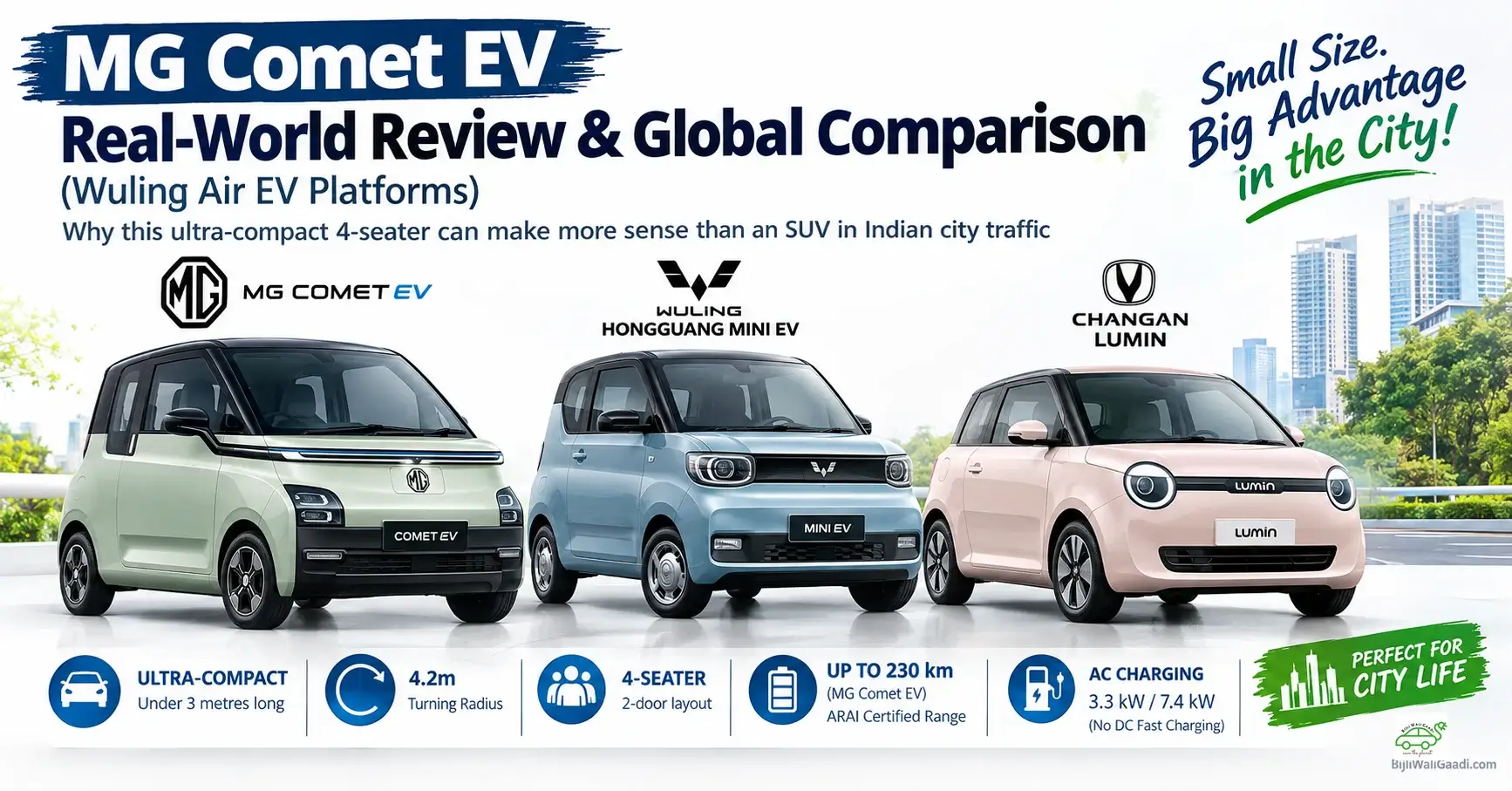
Extended city use shows why the MG Comet EV can make more sense than a larger SUV for dense urban traffic. At just under 3 metres long, its 4.2-metre turning radius makes tight U-turns and narrow-city manoeuvres substantially easier than in a conventional SUV, and it fits into parking spaces that larger cars often have to approach more cautiously. In Bengaluru- or Mumbai-style stop-start traffic, that manoeuvrability matters more day-to-day than raw capability, which is exactly the case the Comet is built to make.
Quick Summary
- MG Comet EV: ₹7.80–10.07 lakh ex-showroom, depending on variant; prices can change with offers. 17.3 kWh battery (standard variants) or 17.4 kWh (FC variants), 230 km ARAI-certified range, 101 km/h top speed, 4.2m turning radius, 4-seater.
- Wuling Hongguang Mini EV: overseas-market pricing (~$4,200–7,500); not sold at this price in India. Up to 13.8 kWh depending on version, up to 170 km claimed, 100 km/h.
- Changan Lumin: overseas-market pricing; not sold at this price in India. Up to 28.1 kWh depending on version, up to 301 km CLTC, 101 km/h, built on Changan’s EPA0 platform.
What Is the MG Comet EV?
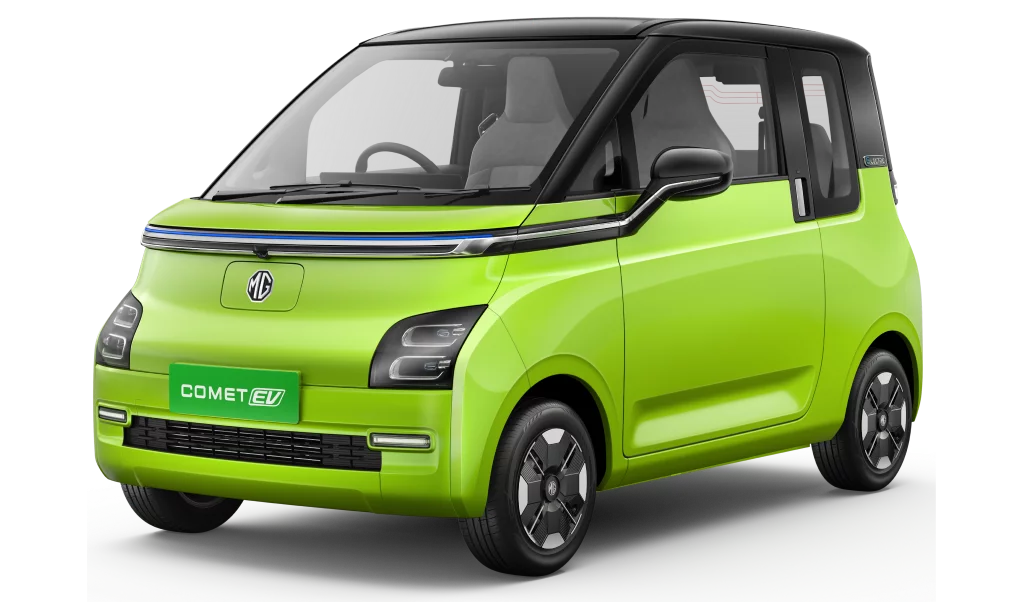
The MG Comet EV is an ultra-compact 4-seater electric car featuring a 17.3–17.4 kWh battery, 230 km ARAI-certified range, and a 4.2-meter turning radius designed for urban driving. The Comet is based on SAIC-GM-Wuling’s Global Small Electric Vehicle (GSEV) architecture and is closely related to the Wuling Air EV sold in other markets, with a floating twin-display setup on higher variants. It’s one of three electric cars in MG’s current India lineup, positioned as the compact city-only option alongside the larger Windsor EV and ZS EV.
The GSEV Platform: One Skeleton, Three Global Faces
The Wuling Hongguang Mini EV helped make SAIC-GM-Wuling one of the world’s leading high-volume micro-EV manufacturers, and sits closely related within the same SAIC-GM-Wuling small-EV family as the Comet, though not necessarily an identical platform implementation. The Changan Lumin isn’t on the same platform, it’s Changan’s EPA0 electric platform, but competes squarely in the same 4-seat, sub-3.3-metre segment.
What differs between them is calibration for their home markets. MG’s Indian version gets suspension tuning for Indian road conditions and safety equipment (dual airbags, ABS) positioned for Indian regulatory requirements, while safety equipment and specifications vary significantly by Mini EV generation, trim and market. The Lumin, meanwhile, offers a considerably larger battery on its higher-range configuration, up to 28.1 kWh depending on version.
Real-World Usability: Heat, Charging, and Daily Practicality
Battery chemistry and Indian summers: The Comet uses a lithium-ion prismatic-cell battery, 17.3 kWh on standard variants and 17.4 kWh on FC variants, as detailed in our MG Comet EV battery replacement cost guide. Battery performance and durability in hot climates depend on cell chemistry, thermal management, charging behaviour, ambient temperature and operating conditions. In cities such as Delhi and Nagpur, high temperatures can also increase air-conditioning loads and affect energy consumption.
Charging realities: The Comet EV charges at 3.3 kW AC as standard, taking roughly 7 hours for a full charge, with a 7.4 kW AC fast-charging option bringing that down to approximately 3.5 hours for a 0–100% charge on compatible variants. The Comet is an AC-charging-focused city EV and does not support DC fast charging. Some Changan Lumin versions offer DC fast charging, unlike the India-spec Comet, and charging hardware varies across Wuling Mini EV and Changan Lumin versions and markets, so those models shouldn’t be treated as having one universal charging specification.
Tech-focused interior: Higher Comet variants use twin 10.25-inch displays for the instrument cluster and infotainment system, a setup that feels disproportionately premium for a car this size, and MG’s rotary gear selector adds a genuine “tech-forward” impression that budget hatchbacks in the same price band don’t match.
2-door vs 4-seat reality check: The Comet EV seats four but uses a 2-door layout, rear passengers climb in by folding the front seats forward. This is a real practicality trade-off: it’s excellent as a solo or two-person daily driver, workable for occasional four-person short hops, and genuinely limiting if you regularly need to load four adults quickly.
Technical Comparison Table
| Model | Platform | Battery Capacity | Claimed/Test-Cycle Range | Top Speed | Turning Radius | Price |
| MG Comet EV | SAIC-GM-Wuling GSEV | 17.3–17.4 kWh | 230 km ARAI | 101 km/h | 4.2 m | ₹7.8–10.1 lakh, India ex-showroom |
| Wuling Hongguang Mini EV | SAIC-GM-Wuling small-EV family | Up to 13.8 kWh, depending on version | Up to 170 km claimed | 100 km/h | Not listed | Overseas-market pricing; not India |
| Changan Lumin | Changan EPA0 | Up to 28.1 kWh, depending on version | Up to 301 km CLTC | 101 km/h | Not listed | Overseas-market pricing; not India |
For how these ultra-compact 4-seaters compare against India’s quadricycle segment, see our full guide. For a broader look at China’s sub-$10,000 EV ecosystem, including the Wuling Mini EV and Changan Lumin in more depth. And for how the Comet stacks up against its closest domestic rival, see our MG Comet EV vs Tata Tiago EV comparison.
Final Verdict
The case for the ultra-compact 4-seater EV segment is straightforward: in Indian metro traffic, size and manoeuvrability matter more than horsepower or highway capability. The MG Comet EV’s tight turning radius and dual-screen interior justify its premium over the Wuling Hongguang Mini EV’s overseas pricing, while the Changan Lumin shows what’s possible on range when a manufacturer fits a larger pack into a similar footprint, on the international configurations where that pack is offered.
Frequently Asked Questions
Stay connected via Google 'Electric Vehicle' News
Follow BijliWaliGaadi | India's Trusted EV Insights Portal
source on Google