Australia’s Sub-$40k EV Market: Chinese Brands Challenge Petrol Cars
Stay connected via Google 'Electric Vehicle' News
Follow BijliWaliGaadi | India's Trusted EV Insights Portal
source on Google
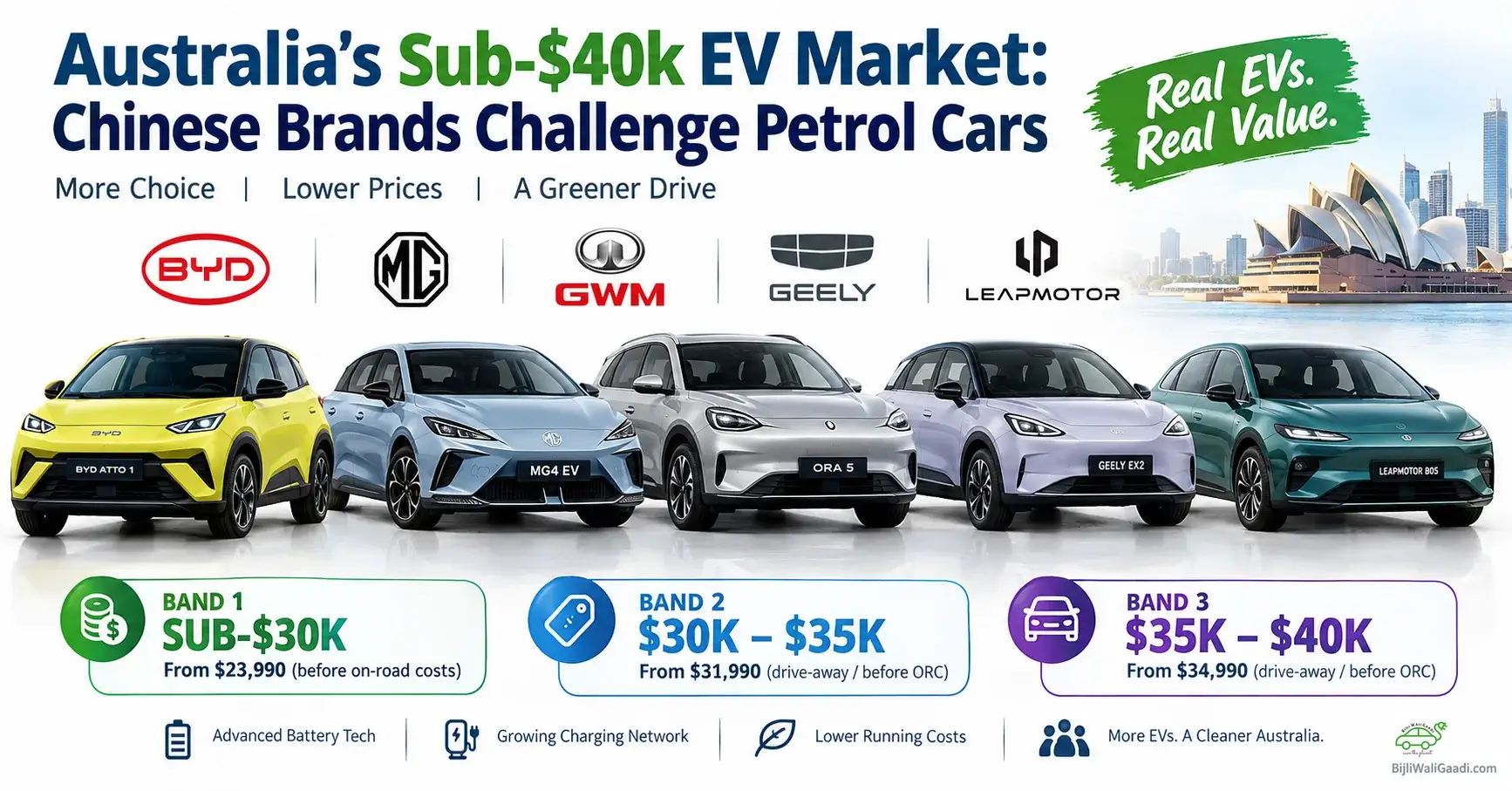
BYD, MG, GWM, Geely and Leapmotor are pushing new EV prices into the sub-$40,000 range, with some models now starting below $30,000 before on-road costs. As of September 2026, this is bringing EV pricing much closer to mainstream petrol and hybrid cars in the small-car and small-SUV segments — though not every model in this bracket shares the same pricing basis, and buyers need to read the fine print on what’s included.
The Sub-$40k EV Segment Has Split Into Three Price Bands
SUB-$40K AUSTRALIAN EV MARKET (SEPTEMBER 2026)
Prices and promotional drive-away offers are correct at the time of publication and may vary by state, stock availability, vehicle colour and campaign period.
BYD’s Atto 1 and Atto 2 Widen the Entry-Level Field
BYD’s Atto 1, built on e-Platform 3.0 with Blade Battery technology, is Australia’s lowest-priced new EV. The front-wheel-drive Essential produces 65kW for up to 220km WLTP range, while the Premium steps up to 115kW and 310km WLTP. At $23,990 before on-road costs, the Atto 1 Essential starts $6,000 below the $29,990 Dolphin Essential. The Atto 2 small SUV, priced from $31,990 (Dynamic) to $35,990 (Premium) before on-road costs, offers up to 345km WLTP range across both variants.
MG4 EV Urban: A Deliberately Cost-Focused Sibling
The MG4 EV Urban is a distinct model from MG’s established rear-wheel-drive MG4, built instead on SAIC’s E3 platform with front-wheel drive and a torsion-beam rear suspension — a layout that prioritises packaging and cost efficiency. The Essence 43 (43kWh LFP, up to 316km WLTP) and Essence 54 (54kWh LFP, up to 405km WLTP) are available from $31,990 and $34,990 drive-away as September 2026 promotional offers running through 30 September 2026, subject to stock and campaign terms, with up to 150kW DC charging available. MG’s standard RWD MG4, built on its Modular Scalable Platform, sits above the $40,000 threshold covered here.
GWM Ora 5 and the Second Wave: Geely EX2 and Leapmotor B05
GWM’s Ora 5 small SUV uses a 58.3kWh LFP battery and a 150kW front-mounted motor for a claimed 430km on the WLTC cycle — not WLTP — with DC charging up to 120kW. It’s priced from $33,990 (Lux) and $36,990 (Ultra) drive-away.
Geely‘s EX2 undercuts most rivals at $26,490 before on-road costs for the Complete (35.3kWh LFP, 60kW motor, up to 252km WLTP) and $30,990 for the Inspire (47.1kWh LFP, 85kW motor, up to 345km WLTP), both rear-wheel drive.
Leapmotor’s B05 rounds out the field: the rear-wheel-drive Style (56.2kWh LFP, 160kW, up to 401km WLTP) is $35,990 drive-away, while the Design LR (67.1kWh LFP, 160kW, up to 482km WLTP) is available at $38,990 drive-away as a limited introductory offer through 30 September 2026, subject to campaign terms; the Design LR is claimed to reach 100km/h in 6.7 seconds. These newer entrants reflect a combination of manufacturing scale, battery supply chains, platform reuse, vertical integration in some manufacturers, and intense competition within China’s domestic EV market.
Comparison Table: Sub-$40k Electric Vehicles in Australia
| Model | Variant | Price basis | Battery | Range | Key point |
| BYD Atto 1 | Essential | $23,990 before ORC | Blade Battery | 220km WLTP | Australia’s lowest-priced new EV |
| Geely EX2 | Complete | $26,490 before ORC | 35.3kWh LFP | 252km WLTP | Rear-wheel drive at entry price |
| BYD Dolphin | Essential | $29,990 before ORC | Blade Battery | 340km WLTP | Sub-$30,000 five-seat hatch |
| MG4 EV Urban | Essence 43 | $31,990 drive-away (Sept 2026 offer) | 43kWh LFP | 316km WLTP | Front-drive, drive-away simplicity |
| GWM Ora 5 | Lux | $33,990 drive-away | 58.3kWh LFP | 430km claimed WLTC range | Longest claimed range in its band |
| Leapmotor B05 | Style | $35,990 drive-away (Sept 2026 offer) | 56.2kWh LFP | 401km WLTP | Rear-wheel-drive electric hatch |
New Vehicle Efficiency Standard: A Growing Strategic Factor
Australia’s New Vehicle Efficiency Standard applies to regulated vehicle suppliers, measuring fleet emissions against annual targets. Suppliers below target generate NVES units, which may be banked or traded; those above target accrue a liability eventually offset through unit purchases or a penalty. Selling more EVs helps a manufacturer’s fleet-average position, but the precise commercial benefit depends on its whole model range and existing compliance standing — it doesn’t translate automatically into subsidised retail pricing. For predominantly electric brands, NVES compliance is a growing strategic consideration rather than the deciding factor behind pricing.
Running Costs: An Illustrative Comparison
The following is an illustrative calculation, not a universal Australian average. Over 15,000km a year, a small EV using 15–16kWh/100km would consume about 2,250–2,400kWh. At 20–25 cents/kWh, that’s roughly $450–$600 in annual home-charging electricity. A petrol hatchback using 6.5–7.5L/100km would consume about 975–1,125 litres; at an assumed $2.05/L, that’s roughly $2,000–$2,300. The gap can favour the EV meaningfully, but actual savings depend on electricity tariffs, petrol prices, charging location and real-world efficiency.
FBT and Novated Leases: A Benefit That’s Being Wound Back
Eligible EVs currently receive a full Fringe Benefits Tax exemption under the electric-car discount rules, continuing until 31 March 2027. From 1 April 2027 to 31 March 2029, eligible EVs valued at $75,000 or less continue to receive the full exemption, while those priced above $75,000 but below the fuel-efficient LCT threshold receive a 25 percent discount on otherwise payable FBT. From 1 April 2029, all eligible EVs below the LCT threshold move to the 25 percent discount rather than the full exemption. Existing eligible leases have transitional treatment where applicable. Every model in this article sits well under $75,000, so current buyers retain access to the full exemption under today’s rules — though the actual saving still depends on income, vehicle price and lease structure.
Can Legacy Brands Respond?
The sub-$40,000 segment is becoming considerably more competitive, and Toyota, Hyundai and Mazda face increasing pressure to bring affordable EVs to market rather than relying on hybrid strategies alone. Whether they do so before Chinese brands further entrench themselves in this bracket will shape the next phase of Australia’s shift to electric passenger cars.
Stay connected via Google 'Electric Vehicle' News
Follow BijliWaliGaadi | India's Trusted EV Insights Portal
source on Google