From Twizy to Mobilize Duo: How Renault Refined — Then Abandoned — the Tandem Urban EV
Stay connected via Google 'Electric Vehicle' News
Follow BijliWaliGaadi | India's Trusted EV Insights Portal
source on Google
“Renault Twizy vs Mobilize Duo“
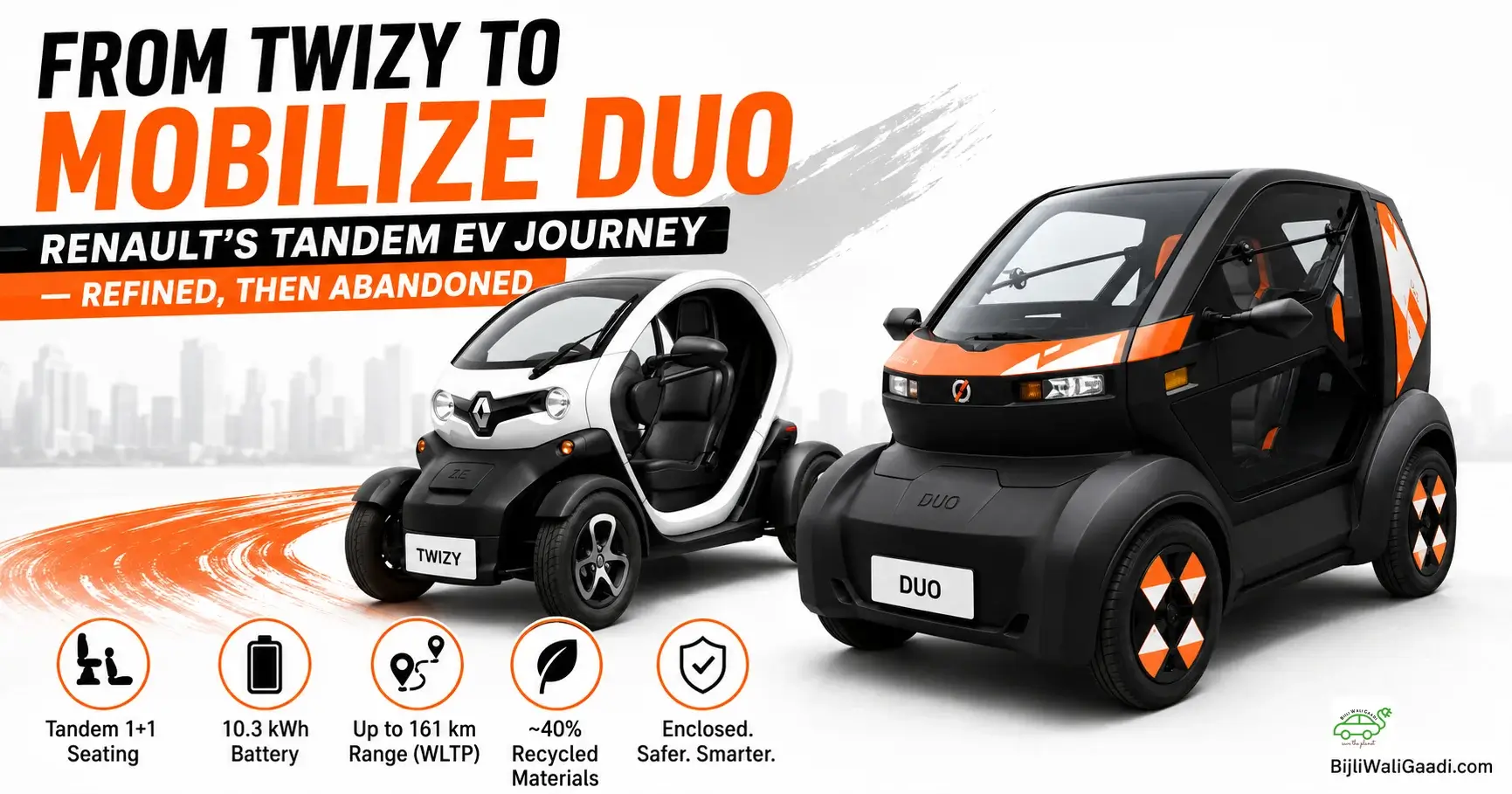
From the open-air Twizy to the enclosed Duo, Renault spent years refining the tandem micro-EV formula, but commercial reality ultimately stopped the experiment.
In 2012, Renault dropped a plastic-and-aluminum go-kart with a windshield onto European streets and called it the future of city driving. The Twizy had doors that barely sealed, no proper heater, and a firm, featherweight chassis that made every roundabout feel like a stunt, and people loved it anyway. Renault kept it in production until 2023. Its true successor, Mobilize’s Duo, arrived in October 2024: fully enclosed, built with a significant share of recycled materials, and engineered to fix nearly everything owners complained about. Then, in December 2025, Renault ended the programme, citing limited profitability. This is how a stubborn open-air experiment became a genuinely better urban EV, and why being better wasn’t enough to survive.
Quick Summary
- Renault Twizy E-Tech 80 (BWG-EV-005): Discontinued pioneer, produced 2011–2023, historically priced around €12,000, 6.1 kWh battery, 80 km/h top speed, approx. 474 kg.
- Mobilize Duo (BWG-EV-006): Discontinued successor, commercialised from October 2024, production ended after Renault’s December 2025 restructuring. Sold as Duo 45 Neo (L6e) and Duo 80 Evo (L7e), both sharing a 10.3 kWh battery.
- Both use the same tandem 1+1 seating layout: driver up front, passenger directly behind.
Tandem 1+1 Seating: Renault’s Signature Bet
Most microcars, like the Citroën Ami or Fiat Topolino, seat two people side by side, forcing the whole car to be wide. Renault took the opposite approach with the Twizy: stack the seats front-to-back, motorcycle-style, so the car only needs to be as wide as one person. That’s why the Twizy measures just 1237 mm wide, narrower than most cars, while still carrying two adults.
The trade-off shows up the moment you look for cargo space: the rear passenger gets less personal space and a different view than the driver. But for gridlock and parking nose-in to a spot no hatchback could touch, the format is genuinely clever, and Mobilize kept it in the Duo because it stayed central to the car’s footprint.
AEO Snippet: How Does the Mobilize Duo Compare to the Original Renault Twizy?
The Mobilize Duo was Renault Group’s successor to the Twizy, retaining its tandem 1+1 layout while adding an enclosed cabin, a larger 10.3 kWh battery, and up to 161 km of WLTP-rated range. Renault discontinued the programme in December 2025, citing limited profitability prospects, after roughly a year on sale in Europe.
What Went Right (and Wrong) With the Original Twizy
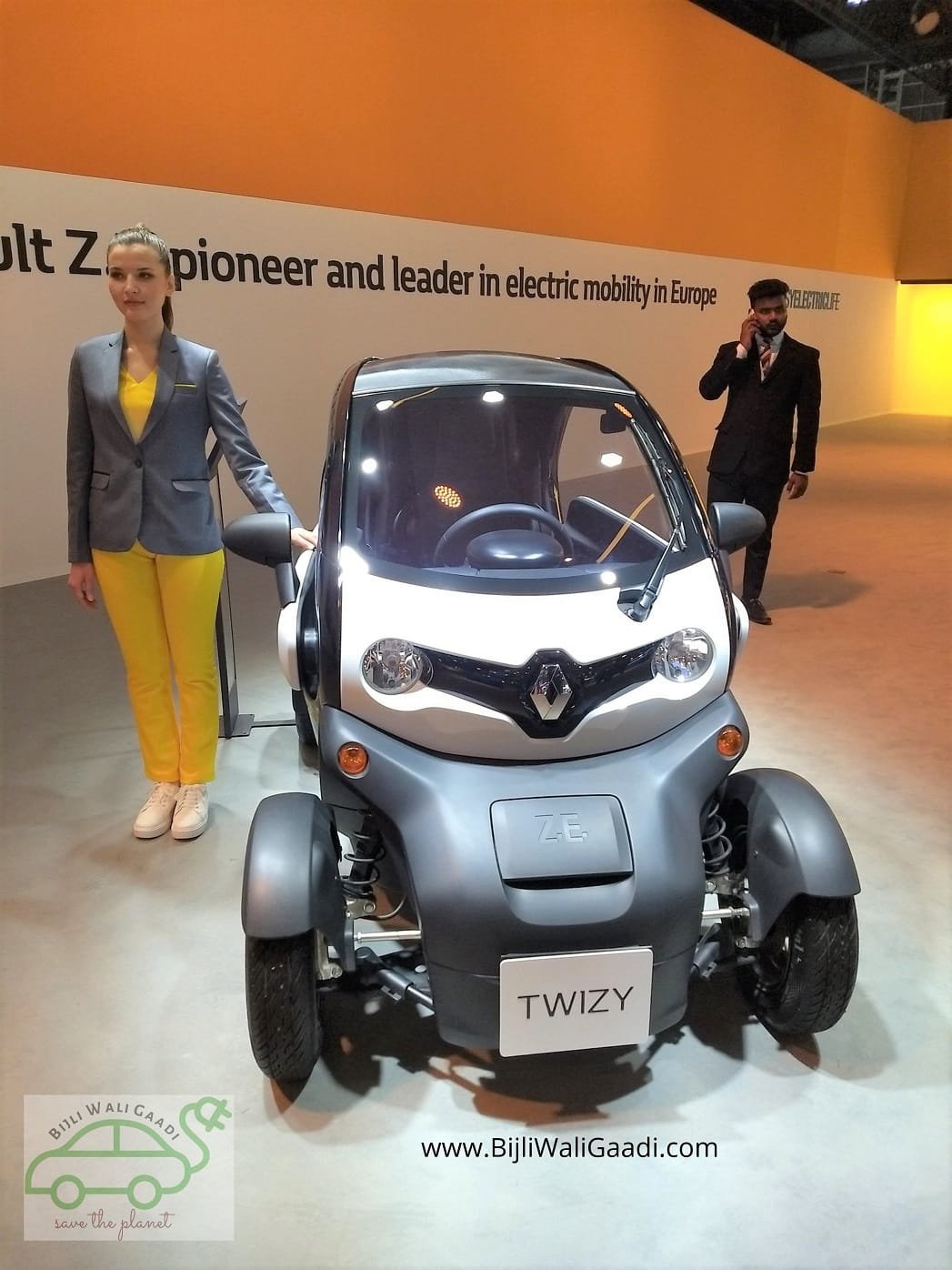
The Twizy earned cult status for reasons that had nothing to do with comfort. Its firm suspension and low 474 kg kerb weight gave it a go-kart-like driving character praised by reviewers. Optional scissor-style doors on some trims turned heads at stoplights, and with a 13 kW motor and 80 km/h top speed, it needed only a light-vehicle licence in most of Europe under the L7e category. Historic pricing around €12,000 undercut many “proper” small EVs of its era.
But Renault’s decision to replace rather than facelift the Twizy points to real shortcomings. Many trims shipped with only partial weather protection, with sealed windows and doors offered as options rather than standard. The firm, low-mass chassis that made it fun on smooth tarmac could feel harsh on broken roads. Its modest 6.1 kWh battery delivered usable range that varied considerably with conditions and driving style, and the open cabin exposed occupants and some components to a harsher environment than an enclosed car.
How the Mobilize Duo Addressed the Twizy’s Shortcomings
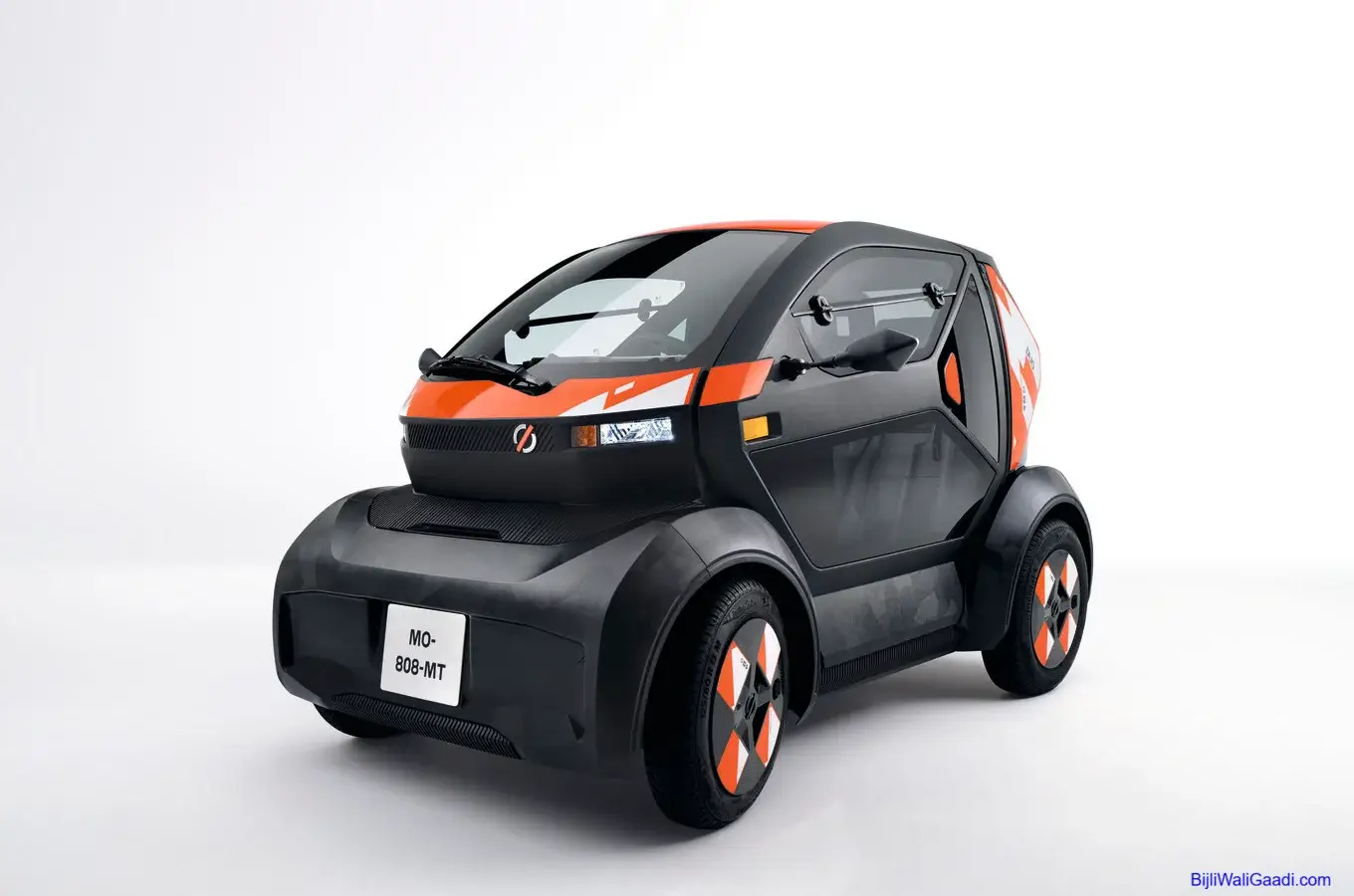
Mobilize, Renault’s mobility brand, didn’t reinvent the format; it re-engineered the execution. The Duo kept the tandem seating and distinctive upward-opening “elytra” doors, but paired them with a properly glazed, largely enclosed cabin and heated windscreen — a significant step up from the Twizy, though not fully equivalent to a conventional sealed car: windows could still open, and air conditioning was optional rather than standard.
Both Duo versions shared a 10.3 kWh battery, nearly 70% larger than the Twizy’s, rated at up to 161 km on the WLTP cycle (Mobilize suggested real-world usage would typically exceed 100 km, including in winter). Mobilize also pursued an eco-design strategy: later communications describe production vehicles as using around 40% recycled materials, including the battery, with a target of roughly 95% recyclability — a more modest figure than the “over 50%” target floated during earlier development. Ownership combined purchase with leasing, subscription, and fleet or car-sharing programmes.
Technical Comparison Table
| Specification | Renault Twizy E-Tech 80 | Mobilize Duo 45 Neo | Mobilize Duo 80 Evo |
| Status | Discontinued (2011–2023) | Discontinued (Dec 2025) | Discontinued (Dec 2025) |
| EU Category | L7e (Heavy Quadricycle) | L6e (Light Quadricycle) | L7e (Heavy Quadricycle) |
| Length | 2338 mm | 2430 mm | 2430 mm |
| Width | 1237 mm | 1300 mm | 1300 mm |
| Height | 1454 mm | 1460 mm | 1460 mm |
| Wheelbase | 1686 mm | 1680 mm | 1680 mm |
| Seating | 2 (Tandem 1+1) | 2 (Tandem 1+1) | 2 (Tandem 1+1) |
| Power Output | 13 kW (17 hp) | approx. 5.6 kW (8 hp) | approx. 7.4 kW (10 hp) |
| Battery Capacity | 6.1 kWh (Lithium-ion) | 10.3 kWh (Lithium-ion) | 10.3 kWh (Lithium-ion) |
| Range (WLTP) | Varied by conditions/trim | 161 km | 160 km |
| Top Speed | 80 km/h | 45 km/h | 80 km/h |
| Approx. Kerb Weight | approx. 474 kg | approx. 495 kg | approx. 500–510 kg |
| Charging (household socket, 10–95%) | approx. 3.5 hrs | approx. 5.5 hrs Schuko; approx. 5 hrs with optional Type 2 | approx. 5.5 hrs Schuko; approx. 5 hrs with optional Type 2 |
| Historical European Starting Price | approx. €12,000 (varied by market) | From €9,990 | From €11,600 in France |
INR figures are omitted here as approximate currency conversions would be misleading; neither vehicle was ever officially launched or priced for the Indian market.
Could a Tandem-Seater Microcar Work in Congested Indian Traffic?
Urban mobility planners keep returning to this question, and the honest answer is: possibly, in narrow use cases, but with real caveats. At 1237–1300 mm wide, both the Twizy and the Duo are narrower than most compact cars and many auto-rickshaws, which typically run closer to 1.3–1.4 m wide. That footprint could improve manoeuvrability, parking efficiency, and access to constrained streets, without positioning the vehicle as a substitute for two-wheelers in moving traffic. India’s monsoon and 40°C-plus summers are exactly the conditions where an enclosed, glazed cabin like the Duo’s would matter more than the Twizy’s open-air charm.
Barriers remain, though: tandem seating means limited cargo space and no way to carry a third passenger; quadricycles occupy an unusual regulatory position relative to full cars; Indian buyers here are intensely price-sensitive; and a tandem microcar would compete against electric two-wheelers and affordable small EVs. Neither vehicle was ever officially launched in India, and the Duo was discontinued globally before any India programme emerged.
Final Verdict
The Twizy proved in 2012 that a narrow, tandem-seat electric microcar could be genuinely engaging to drive and useful in dense cities, even while being weather-exposed and unsuited for daily all-condition use. The Duo answered nearly every one of those complaints with an enclosed cabin, meaningfully more range, and a documented eco-design push. But engineering improvement didn’t translate into commercial success: Renault confirmed in December 2025 that the programme would end, citing limited profitability prospects.
The Duo is best understood not as a successful production formula, but as an urban-mobility experiment that solved many of the Twizy’s usability problems while running into the harder problem of making a tiny two-seat quadricycle profitable at scale.
Frequently Asked Questions
Stay connected via Google 'Electric Vehicle' News
Follow BijliWaliGaadi | India's Trusted EV Insights Portal
source on Google