The Rise of License-Free EVs: Citroën Ami vs Opel Rocks vs Aixam vs Ligier Myli
Stay connected via Google 'Electric Vehicle' News
Follow BijliWaliGaadi | India's Trusted EV Insights Portal
source on Google
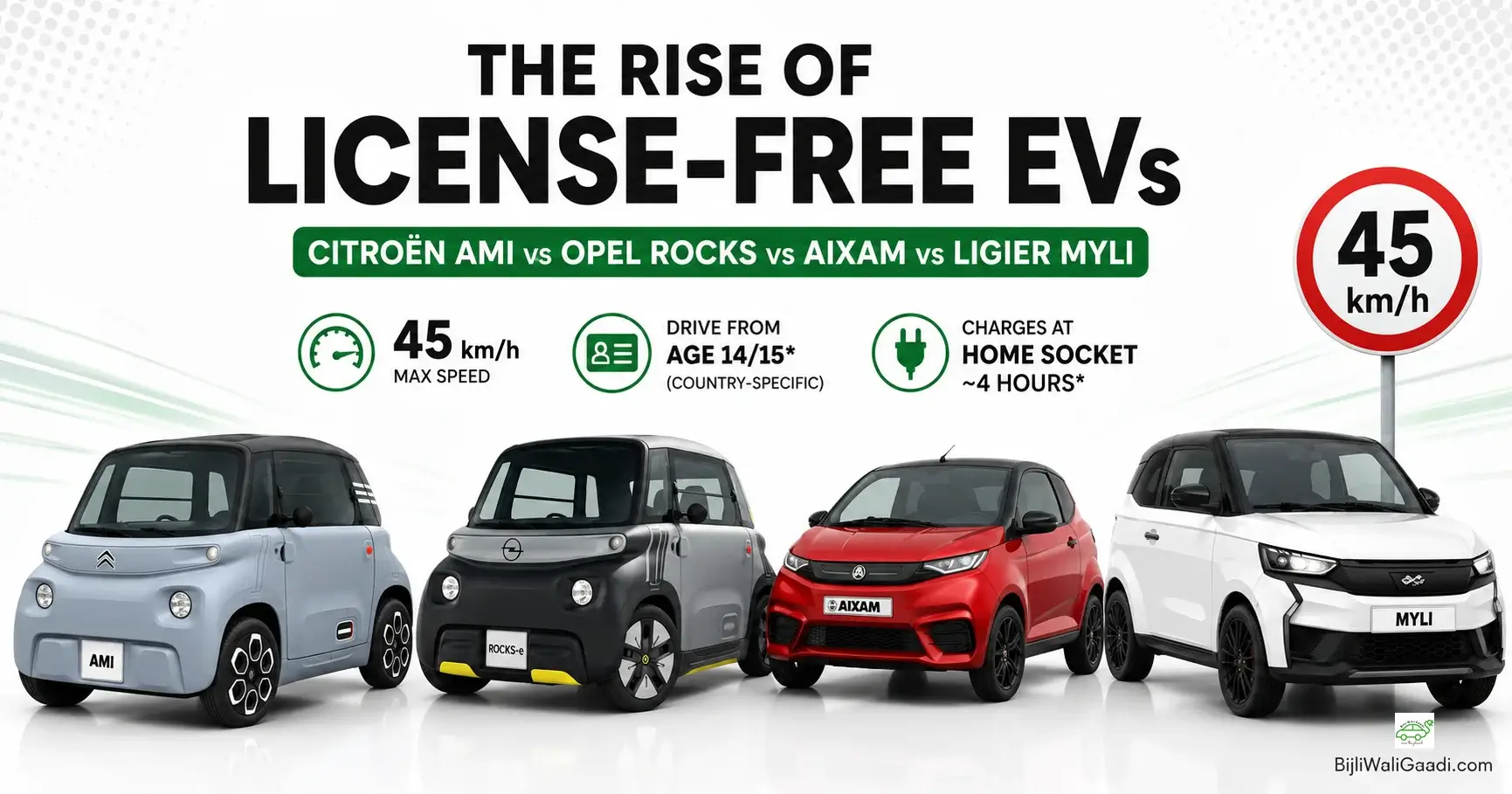
A license-free electric car in Europe refers to L6e light quadricycles limited to 45 km/h and 6 kW power, drivable from age 14-16 without a full driving license.
Quick Summary Box
| Category covered | EU L6e Light Quadricycles (“license-free” electric cars) |
| Vehicles compared | Citroën Ami, Opel Rocks Electric, Aixam City Sport Electric, Ligier Myli EV (L6e configuration) |
| Max design speed | 45 km/h for all L6e configurations discussed here |
| Price range | From roughly €7,990 to €16,799 depending on model and market — prices and specifications vary by market |
| Who can drive one | Nationally determined; France permits qualifying L6e quadricycles from age 14 with the AM entitlement/training framework, Germany’s AM minimum age is 15 — rules are not identical across the EU |
| Best for | Dense European city cores, youth mobility where nationally permitted, and second-vehicle urban commuting |
Note: All INR figures in this article are approximate conversions at the exchange rate used at the time of writing and are not Indian retail prices, since none of these models is currently sold in India.
The Teenager Behind the Wheel — And It’s Completely Legal
Picture a suburban street outside Lyon at 8 a.m. A teenager who is years away from being eligible for a conventional car licence is pulling out of the driveway in a boxy little electric car, no adult supervision required.
This isn’t a loophole — it’s illustrative of a real, deliberate EU regulatory pathway. It’s a decades-old European regulatory category called L6e, and it has become one of the more talked-about mobility stories on the continent in recent years. A cluster of manufacturers — Stellantis brands Citroën and Opel, alongside heritage French microcar houses like Aixam and Ligier — has turned what was historically a niche “sans permis” microcar segment into a genuine electric urban and youth mobility category.
These are homologated road vehicles, but their safety and type-approval requirements are different from those applied to full-size M1 passenger cars — a distinction worth understanding before assuming these are simply “small cars.” They are capped at a 45 km/h maximum design speed, generally priced under €17,000, and in some EU countries can be driven by younger teenagers on an AM (moped-class) entitlement instead of a full car license — though exactly who can drive one, and from what age, depends entirely on the country. For anyone tracking the future of “license-free” personal electric mobility — and whether that idea could ever translate to Indian streets — this segment is worth understanding in detail.
What Is an L6e Light Quadricycle?
L6e is an EU L-category classification for light quadricycles with a maximum design speed of 45 km/h. Under Regulation (EU) No 168/2013, L6e vehicles have a maximum mass in running order of 425 kg, and the enclosed L6e-B sub-category can have up to 6 kW of continuous rated power — not every L6e vehicle is limited identically.
Here, “license-free” is a common market term for these microcars; it does not mean that every L6e vehicle can be driven without a licence, training or an age requirement.
Manufacturers’ published kerb or operating weights are not always the same figure as the “mass in running order” used for EU homologation, particularly for electric versions where battery treatment can affect the calculation — so the table below presents manufacturer-stated figures, not a claim that every car is homologated at an identical regulatory weight.
Deep Dive: Four License-Free Electric Cars Reshaping Urban Mobility
1. Citroën Ami — The Model That Put L6e EVs on the Map
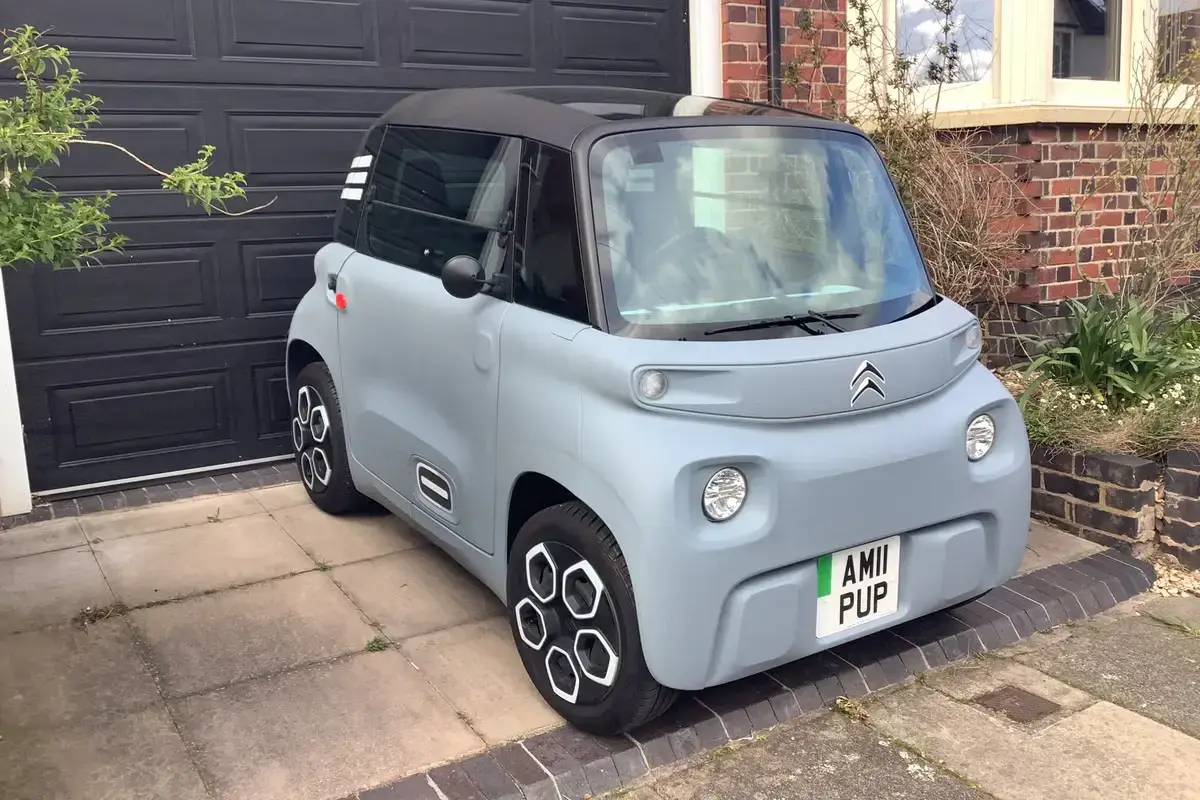
The Citroën Ami is arguably the vehicle that did the most to bring modern L6e mobility into the mainstream conversation. Built by Stellantis in France, current German/Austrian market pricing lists it from €7,990 (~₹7.2 Lakh, approximate conversion) and it seats two.
Technical & Battery Specs
- Battery pack: 5.5 kWh lithium-ion
- Motor: 6 kW, front-wheel drive
- Official range: up to 75 km, depending on market/test specification
- Charging time: approximately 4 hours on a standard 230V household socket, per current manufacturer specification — no wallbox or public charger needed
- Max design speed: 45 km/h
Design & Urban Maneuverability Citroën deliberately simplified the Ami’s body architecture and used shared/symmetrical components in several areas, helping reduce manufacturing complexity and tooling requirements — a big part of how the car is kept close to the €8,000 mark. At around 2.41–2.46 metres long and 1.39 metres wide, depending on version, the Ami is barely bigger than two mopeds parked side by side, and its compact footprint gives it a noticeably tight turning circle well suited to narrow European city streets. Dimensions and published weights can vary slightly by model year, market and version.
Why it matters: No other vehicle better captures the “license-free” pitch for European markets — it’s the benchmark every rival in this article is measured against, even though the exact age/licensing rules it can be driven under vary by country.
2. Opel Rocks Electric (Rocks-e) — A Stellantis Platform Derivative for Germany
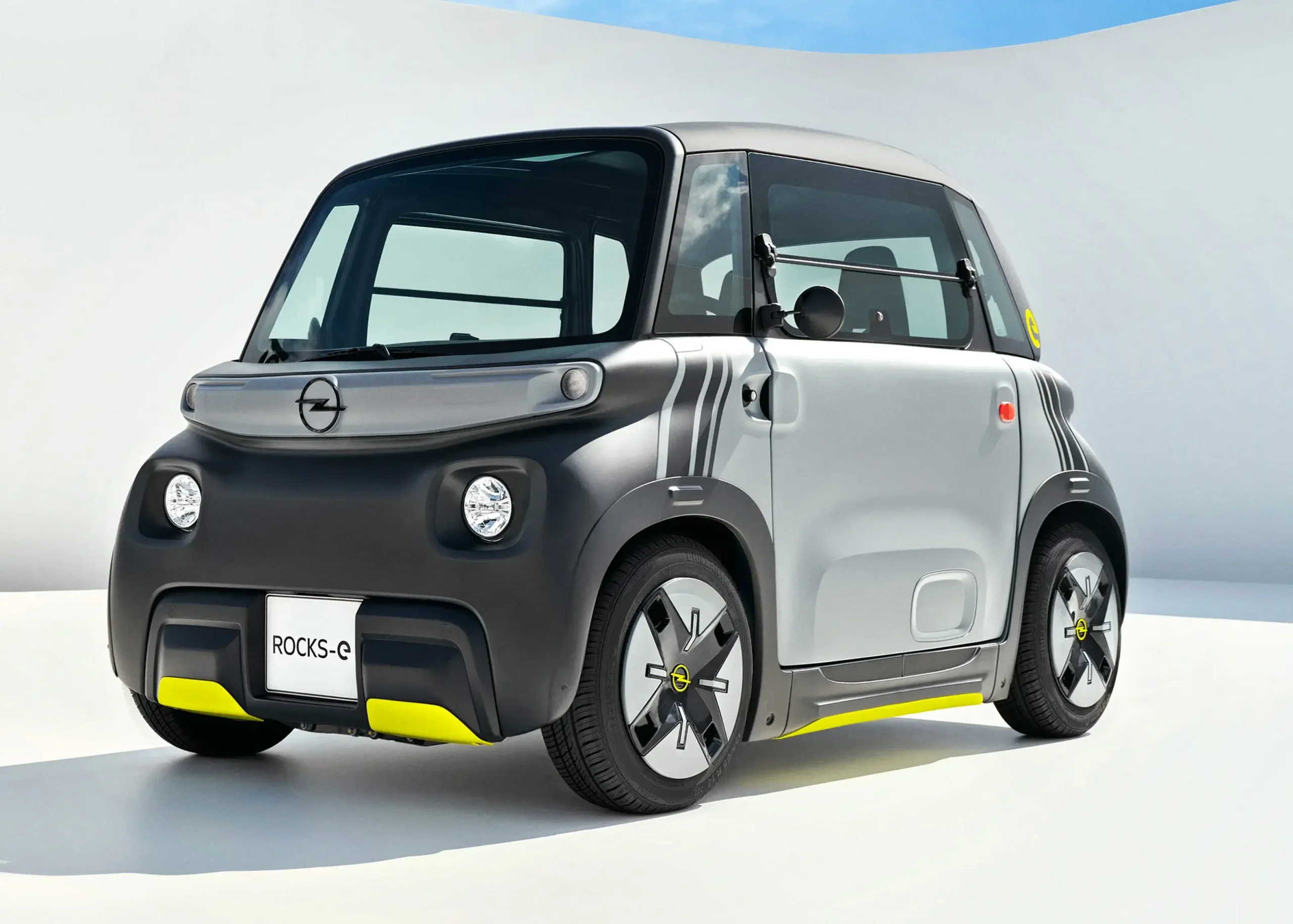
The Opel Rocks Electric shares its underlying Stellantis L6e architecture with the Citroën Ami — it isn’t a separately engineered German solution, but a platform derivative with Opel styling and market positioning. Current pricing lists it from €7,990 (~₹7.2 Lakh, approximate conversion).
Technical & Battery Specs
- Battery pack: 5.5 kWh lithium-ion
- Motor: 6 kW, front-wheel drive
- Official range: up to 75 km, depending on market/test specification
- Charging time: approximately 4 hours on a 230V household socket
- Manufacturer-stated operating weight: 471 kg (this is the published figure, not necessarily the EU homologation “mass in running order” used for L6e classification)
Design & Urban Maneuverability The Rocks-e wears Opel’s “Vizor” front fascia, giving it more mature styling cues than the Ami, aimed at appealing to parents as much as teenage drivers. In Germany, the minimum age for the AM licence is 15, and Opel has positioned the Rocks-e as a weatherproof step up from a 45 km/h moped for that market. Dimensionally it’s near-identical to the Ami (2,410 mm long, 1,390 mm wide), so it shares a similarly tight urban turning circle and the same home-socket charging convenience.
Why it matters: It shows the L6e formula scaling across a shared Stellantis platform, localized country by country to fit differing national licensing rules rather than one single EU-wide standard.
3. Aixam City Sport Electric — The Heritage “Sans Permis” Goes Electric
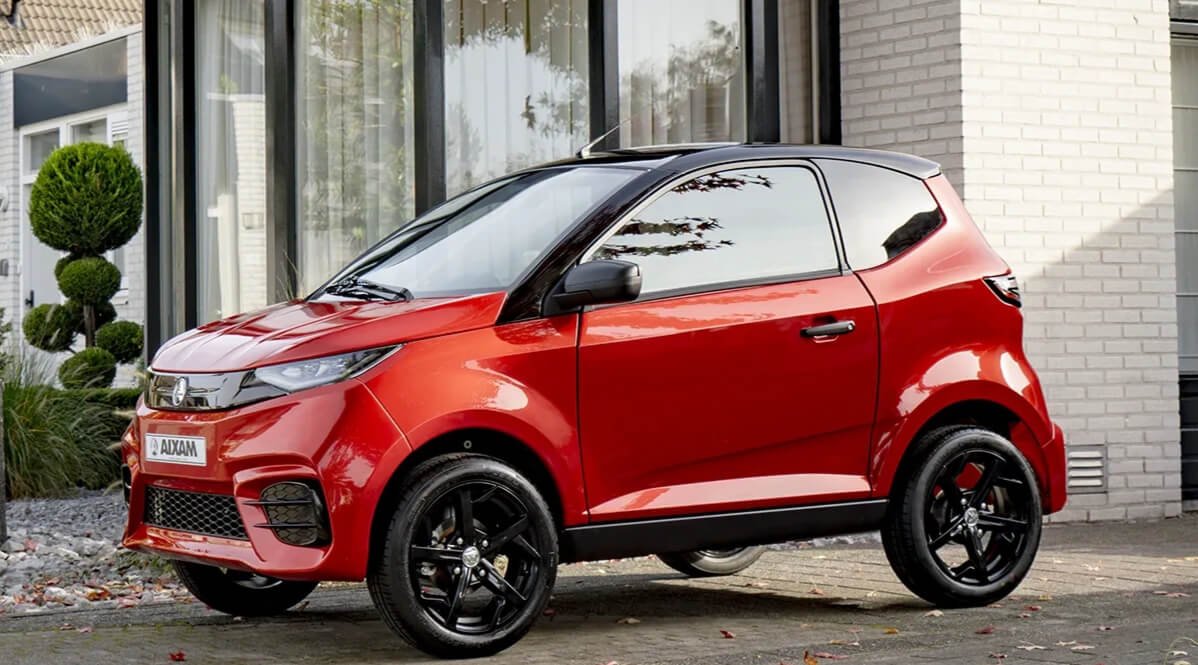
Aixam has been building “sans permis” microcars in France since long before Citroën entered the segment. The current City Sport Electric is priced from €16,799 (~₹15.1 Lakh, approximate conversion) — a market-specific listed price, and pricing/specification can vary by country.
Technical & Battery Specs
- Battery pack: 7.50 kWh, LFP (lithium iron phosphate) chemistry
- Motor: 6 kW maximum power, front-wheel drive
- Range: up to 113 km according to the WMTC test cycle
- Manufacturer-stated operating/unladen weight: 415 kg
- Max design speed: 45 km/h
Design & Urban Maneuverability At approximately 2,789 mm long and 1,500 mm wide, with a 1,795 mm wheelbase, the City Sport Electric is noticeably larger than the Ami/Rocks-e twins, trading a fraction of tight-alley agility for a longer wheelbase and steadier low-speed ride quality. ABS+EBD is offered as an option on the current model, and the car is positioned around comfort and acoustic refinement rather than outright agility.
Why it matters: It shows the L6e category isn’t only about the cheapest possible entry point — there’s a genuine premium tier here, and note that the City Sport Electric’s LFP battery, WMTC-rated range, and pricing are meaningfully different from earlier-generation Aixam electric specifications, so buyers should always check the current model year.
4. Ligier Myli EV — The Range-Focused Configuration of the Class
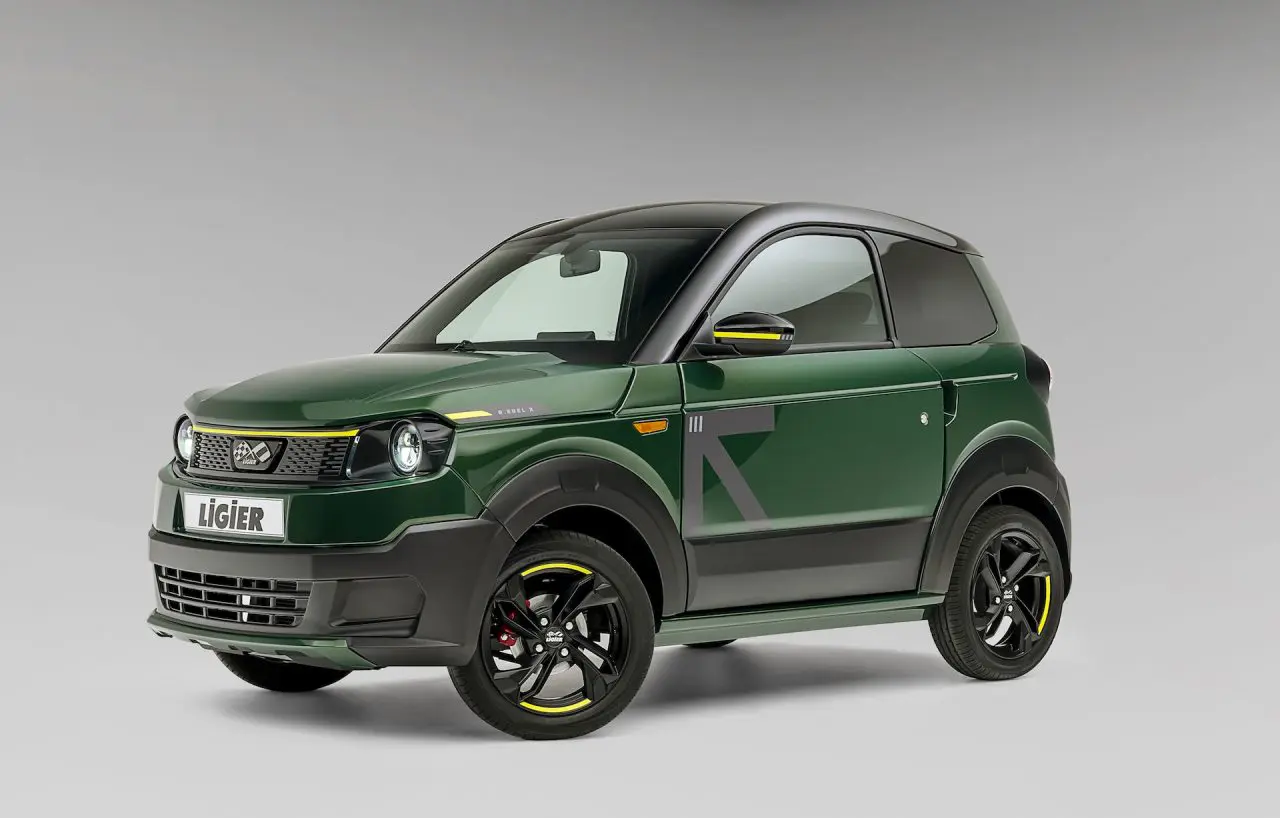
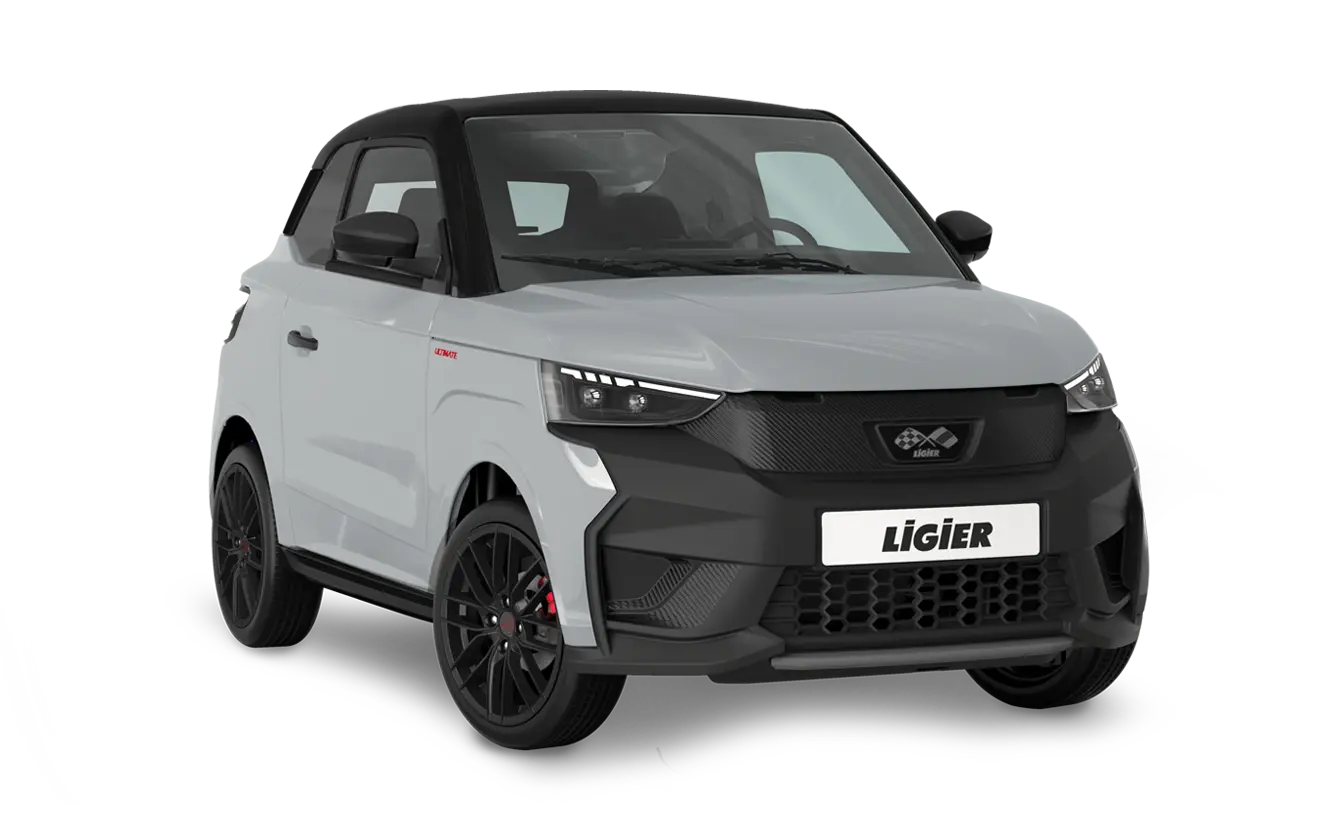
Note: The gray color shown car above is LiGiEr JS50 which usages the EV platform of LiGiER Myli EV only. Its has an ultra-efficient electric engine with an unrivalled autonomy of up to 192 km thanks to its HIGH-PERFORMANCE battery pack.
Ligier, another storied French microcar manufacturer, offers the Myli EV across multiple battery and homologation configurations depending on market, so it’s important not to treat “the Myli” as a single spec sheet. One current market listing places the L6e Long Range configuration at around €12,499 (~₹11.2 Lakh, approximate conversion), although prices and equipment vary by market.
Technical & Battery Specs
- Battery pack: 8.2 kWh or 12.42 kWh on the current Myli range; earlier or market-specific versions have also been listed with a 4.14 kWh battery
- Motor: approximately 5.6 kW
- Range (Long Range configuration): up to 192 km (WMTC)
- Charging time: approximately 2h30, 4h15 or 6h15 depending on the 4.14, 8.28/8.2 or 12.42 kWh battery configuration
Important category note: Ligier also offers Myli variants homologated as L7e, a distinctly different quadricycle category from L6e. L7e allows higher power and mass limits and, depending on sub-category, meaningfully higher speeds. It is subject to different national licensing requirements and is not the same AM-eligible L6e category, and is not a “license-free” 45 km/h vehicle in the way the L6e version is. Don’t assume every Myli you see is interchangeable with the L6e model discussed elsewhere in this article.
Design & Urban Maneuverability The Myli is the largest car in this line-up at roughly 2,958 mm long, 1,499 mm wide, giving it potentially more planted ride characteristics on urban and suburban roads, at the cost of a slightly wider turning circle than the compact Citroën/Opel twins.
Why it matters: For anyone who assumed L6e cars were strictly short-range city toys, the top-spec Myli configuration is a useful reminder that the category can be built out for meaningfully longer range — provided you’re clear on which exact variant and homologation category you’re looking at.
Comparison Table
| Specification | Citroën Ami | Opel Rocks Electric | Aixam City Sport Electric | Ligier Myli EV (L6e, Long Range) |
| EU category | L6e | L6e | L6e | L6e (L7e also offered separately) |
| Price (market-specific) | From €7,990 | From €7,990 | From €16,799 | From ~€13,599 |
| Battery | 5.5 kWh | 5.5 kWh | 7.50 kWh (LFP) | 8.2 / 12.42 kWh current; 4.14 kWh on some earlier/market-specific versions |
| Motor power | 6 kW | 6 kW | 6 kW | ~5.6 kW |
| Drive | FWD | FWD | FWD | Not consistently published |
| Official range/test cycle | Up to 75 km (official cycle; market specification) | Up to 75 km (official cycle; market specification) | Up to 113 km (WMTC) | Up to 192 km (WMTC) |
| Charging (230V home socket) | ~4 hrs | ~4 hrs | Not consistently published | ~2h30 / ~4h15 / ~6h15, depending on battery |
| Max design speed | 45 km/h | 45 km/h | 45 km/h | 45 km/h (L6e version only) |
| Length x Width (seating capacity) | 2410 x 1390 mm (2 Seats) | 2410 x 1390 mm (2 Seats) | ~2789 x 1500 mm (2 Seats) | ~2958 x 1499 mm (2 Seats) |
| Wheelbase | 1730 mm | 1730 mm | 1795 mm | Not consistently published |
| Published vehicle weight* | 483 kg with battery | 471 kg | 415 kg | Not consistently published |
Published vehicle weights can include the propulsion battery, whereas EU L-category “mass in running order” excludes the propulsion battery for pure-electric vehicles. They therefore should not be compared directly with the 425-kg L6e classification threshold.
Could an L6e-Style Light Quadricycle Work in Urban India?
This is the question every Indian EV buyer and policymaker should be asking as European city cores make room for these cars. The honest answer: the underlying engineering logic is promising, but the current European execution needs significant rework for Indian regulatory and market conditions.
Where the L6e logic makes sense for India:
- Narrow footprint, tight turning: At around 1,390–1,500 mm width, a car this size would slot through Indian bottlenecks — think Chandni Chowk in Delhi or Bengaluru’s Malleswaram by-lanes — more easily than a typical hatchback.
- Household charging: Several of these vehicles charge on a standard 230V wall socket in a few hours, which lines up reasonably well with India’s widely available domestic power points, though real-world compatibility with Indian 15A sockets and local grid conditions would need separate validation.
- Youth/second-vehicle mobility: India has a large market of college students and short-hop urban commuters currently on two-wheelers who could, in principle, be a natural audience for an enclosed, weatherproof alternative — provided regulations allowed it.
Where friction shows up:
Verdict on India fit: The engineering philosophy — a tiny footprint, home-socket charging, and simplified low-cost body architecture — is a reasonable direction for Indian urban mobility to explore. But the regulatory hook (youth driving on an AM-style entitlement) and the 45 km/h speed cap are Europe-specific constraints that would need to be substantially reworked under India’s own quadricycle taxonomy before any of these four cars could be sold here as-is.
Summary
The license-free EV segment is a genuine, scaling category with real manufacturing backing (Stellantis) and legacy microcar houses (Aixam, Ligier) both investing further in it.
- Best entry-price proposition: Citroën Ami — the cheapest, most recognisable, and the model that helped define the modern electric microcar category.
- Most distinctive market positioning: Opel Rocks Electric — same underlying platform, styled and marketed for a different national audience.
- Most comfort-oriented: Aixam City Sport Electric — LFP battery, longer wheelbase, and an optional ABS+EBD package.
- Most range-focused configuration: Ligier Myli EV (Long Range) — its top-spec battery pack pushes the category into genuinely longer-distance territory, though buyers must be careful to select the correct L6e (not L7e) variant.
Frequently Asked Questions
Stay connected via Google 'Electric Vehicle' News
Follow BijliWaliGaadi | India's Trusted EV Insights Portal
source on Google