UltraTech’s 600+ Electric Truck Expansion Could Become the Demand Catalyst India’s Heavy-Duty EV Sector Needs
Stay connected via Google 'Electric Vehicle' News
Follow BijliWaliGaadi | India's Trusted EV Insights Portal
source on Google
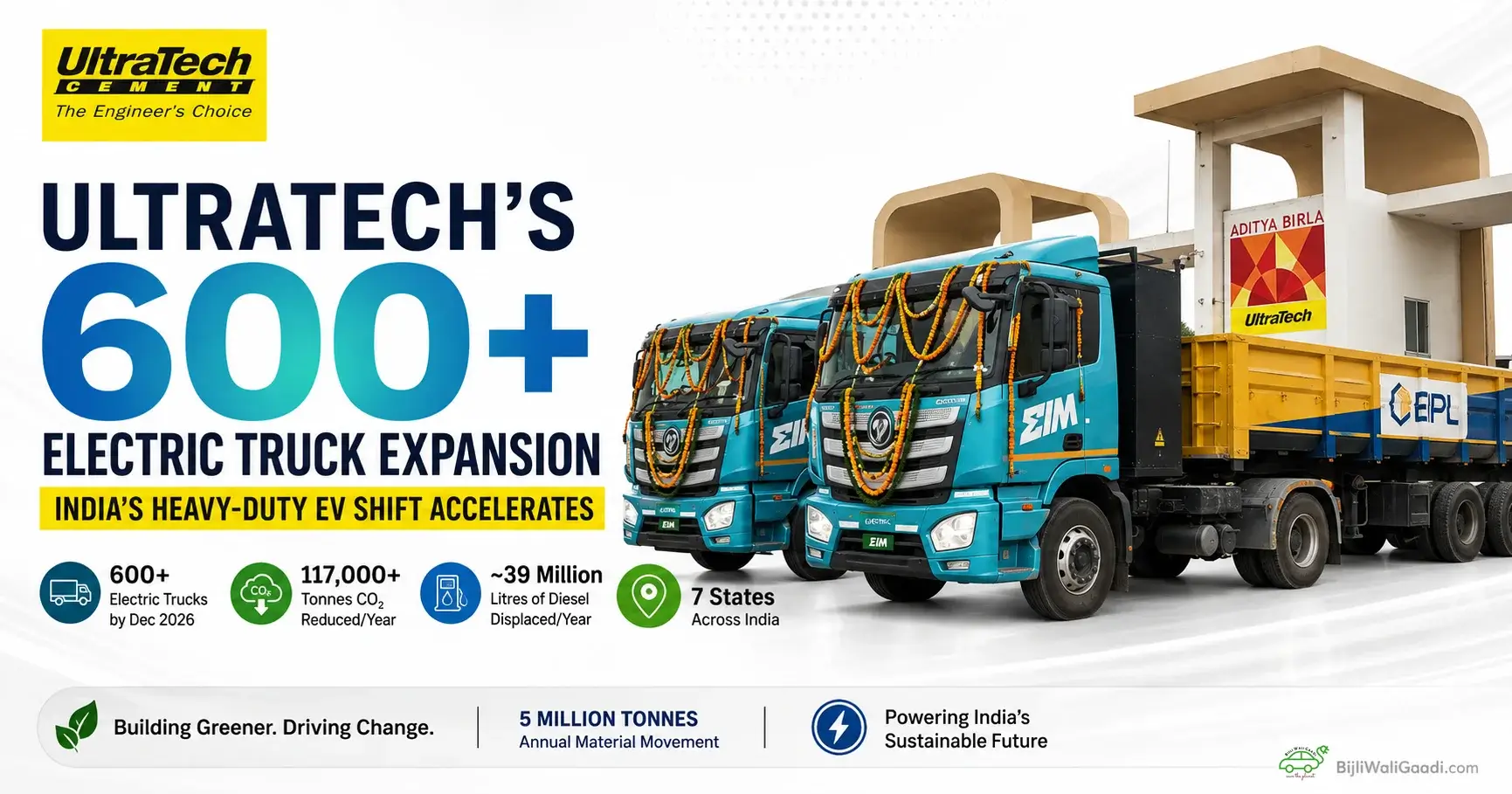
UltraTech Cement has confirmed one of the largest corporate commitments yet to electric heavy-duty trucking in India. On September 2, 2026, the company announced it will scale its electric truck fleet to more than 600 vehicles by December 2026, deploying them to move roughly five million tonnes of clinker and other materials a year across seven states.
Heavy-duty trucks remain the most electrification-resistant segment of India’s commercial vehicle fleet, so a single fleet operator committing to this scale matters well beyond the cement industry. It offers a concrete test of whether large, predictable corporate freight demand can do what open-market economics alone has not: give India’s electric truck manufacturers and their suppliers a reason to build at scale.
What UltraTech Has Confirmed About Its Electric Truck Expansion
According to UltraTech’s official statement, the company has signed service contracts with several EV prime-mover manufacturers — including Tata Motors, Ashok Leyland, IPLTech, Energy In Motion and Sany, along with their subsidiaries and third-party logistics providers — to operate the expanded fleet. UltraTech has not disclosed how the 600+ trucks are split among these partners, so any specific manufacturer allocation remains unconfirmed.
The trucks will transport clinker and other key materials across Gujarat, Uttar Pradesh, Madhya Pradesh, Rajasthan, Chhattisgarh, Maharashtra and Odisha. UltraTech projects that once fully operational, the fleet will cut net annual CO₂ emissions by more than 117,000 tonnes, equivalent to displacing 39 million litres of diesel a year.
This builds on a June 2026 deployment in which UltraTech and partner Energy In Motion put 45 electric trucks — each rated at 55 tonnes capacity — into service hauling clinker 250 kilometres from its Kotputli plant in Rajasthan to grinding units in the Delhi-NCR region. As of FY26, UltraTech’s green logistics fleet comprised 638 CNG trucks, 32 LNG trucks and 89 electric trucks. The new expansion plan represents close to a sevenfold increase in electric trucks within roughly six months.
Why Fixed Industrial Routes Are the Logical Starting Point for Electric Heavy Trucks
Captive industrial logistics — moving materials between a company’s own plants along the same corridor every day — sidesteps several of the barriers that make general long-haul trucking hard to electrify. Because the same trucks run the same lanes repeatedly, a fleet operator can plan depot or corridor charging around known stopping points rather than needing to solve charging availability across an entire national highway network.
Utilisation is high and predictable too, which matters because electric trucks typically cost more upfront but less to run — an equation that favours vehicles doing consistent daily mileage over idle time. And because one company controls both the vehicles and the routes, it can absorb early-stage technology risk and negotiate multi-manufacturer service contracts in a way that thousands of independent truck owners cannot.
This is consistent with what’s happening globally: the first commercially successful electric truck deployments worldwide have concentrated in port operations, mining, depot-based logistics and other high-utilisation industrial corridors — not unrestricted long-haul freight. India’s opportunity isn’t simply to copy Europe’s or China’s electric trucking playbook; its dense network of captive industrial logistics, running cement, steel and mining materials along fixed corridors, could create a distinct adoption pathway of its own.
India’s Electric Truck Segment Remains Small — Which Is Why This Expansion Stands Out
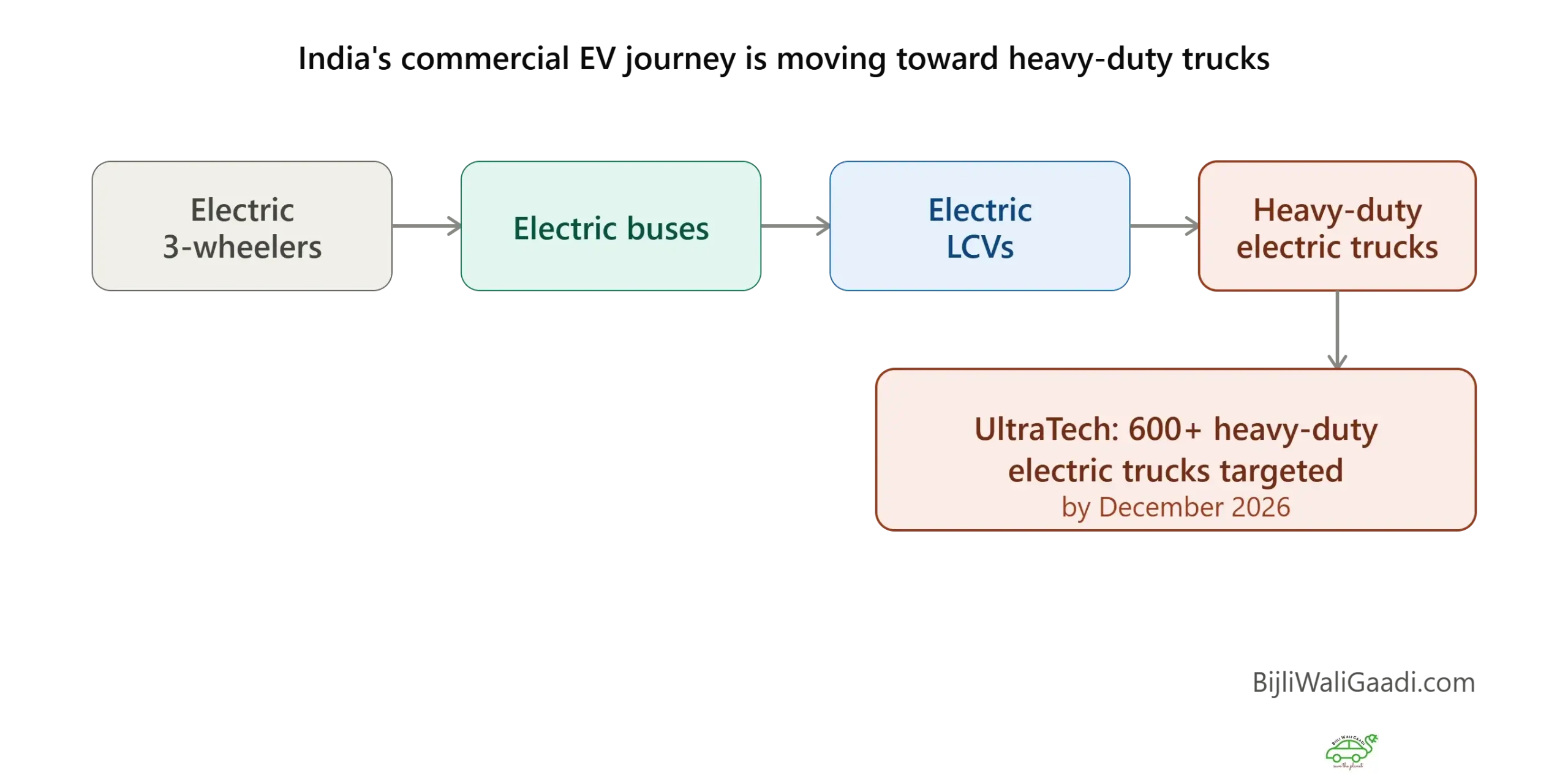
Electric heavy trucks are still a very small part of India’s overall EV market. Of the roughly 2.34 million EVs sold in India in 2025, only 573 were trucks, according to JMK Research & Analytics — a small fraction of total EV sales, even after growing 155.8% year-on-year from 224 units in 2024. That low base is precisely why a single corporate commitment involving 600+ vehicles is strategically significant: it represents a multiple of the entire segment’s recent annual volumes concentrated in one operator’s fleet.
Officials have also acknowledged the scale of the challenge directly. Speaking at the India Clean Transportation Summit on September 1, 2026, Dr Hanif Qureshi, Additional Secretary at India’s Ministry of Heavy Industries, said plainly that “if anybody is under the impression that there will be 100 per cent electrification, then that is not going to happen, at least not in the near future.”
A Proposed Government Scheme Could Reinforce Corporate Momentum
Dr Qureshi also indicated, at the same event, that his ministry is considering a new scheme to support heavy-duty EVs — potentially covering up to 100,000 vehicles, split roughly between electric buses and trucks, over the next five years, with a proposed outlay in the region of ₹98.52 billion. This proposal remains under discussion and has not been formally approved; specifics including financing structure and implementation timeline are subject to policy approval. If it does proceed, it would signal that corporate fleet commitments and public policy are moving toward the same segment simultaneously — though neither should be read as guaranteeing the other’s success.
Manufacturing Opportunities Split Along Different Lines for Indian and Chinese Players
Growing fleet-scale demand is unlikely to benefit every manufacturer equally, and the opportunities differ by capability. Indian manufacturers such as Tata Motors and Ashok Leyland bring domestic production scale, localised chassis and drivetrain manufacturing, established fleet service networks, and existing financing relationships with Indian operators — advantages that are hard to replicate quickly.
Chinese manufacturers and technology suppliers, including Sany, bring a different set of strengths: years of experience scaling battery-electric heavy trucks, mature electric drivetrain ecosystems, and deep battery supply-chain expertise. Their opportunity in India is more likely to come through component partnerships, technology licensing, or joint local manufacturing arrangements than through direct import dominance, given India’s stated localisation priorities and its established domestic commercial vehicle industry. The more realistic outcome is a competitive market — domestic OEM strength meeting global technology and supply-chain expertise — rather than one dominated by any single country’s manufacturers.
What This Means Going Forward
UltraTech’s expansion won’t shift India’s overall trucking fleet away from diesel in the near term, and charging infrastructure, financing costs and vehicle economics remain real constraints for most operators outside captive industrial settings. But a fixed-route, high-utilisation deployment of this size gives India’s electric heavy-truck ecosystem a rare thing: a real demand signal at a scale manufacturers and suppliers can plan around, rather than another pilot project.
UltraTech Electric Logistics Development
| Metric | UltraTech Electric Logistics Development |
| Existing electric fleet (FY26) | 89 electric trucks, alongside 638 CNG and 32 LNG trucks (850+ total green logistics fleet) |
| 2026 expansion target | 600+ heavy-duty electric trucks by December 2026 |
| Primary logistics application | Clinker and key materials transport |
| Annual freight movement | Approximately 5 million tonnes per year |
| Geographic deployment | Gujarat, Uttar Pradesh, Madhya Pradesh, Rajasthan, Chhattisgarh, Maharashtra, Odisha |
| Key ecosystem partners | Tata Motors, Ashok Leyland, IPLTech, Energy In Motion, Sany, and their subsidiaries/logistics partners |
| Expected environmental impact | 117,000+ tonnes annual CO₂ reduction; ~39 million litres of diesel displaced per year |
| Strategic objective | Electrification of the mine-to-plant and inter-plant supply chain |
Quick Answers
Stay connected via Google 'Electric Vehicle' News
Follow BijliWaliGaadi | India's Trusted EV Insights Portal
source on Google