No Fast Charger Needed: How Silence S04 & XEV Yoyo Solve Micro-EV Range Anxiety
Stay connected via Google 'Electric Vehicle' News
Follow BijliWaliGaadi | India's Trusted EV Insights Portal
source on Google
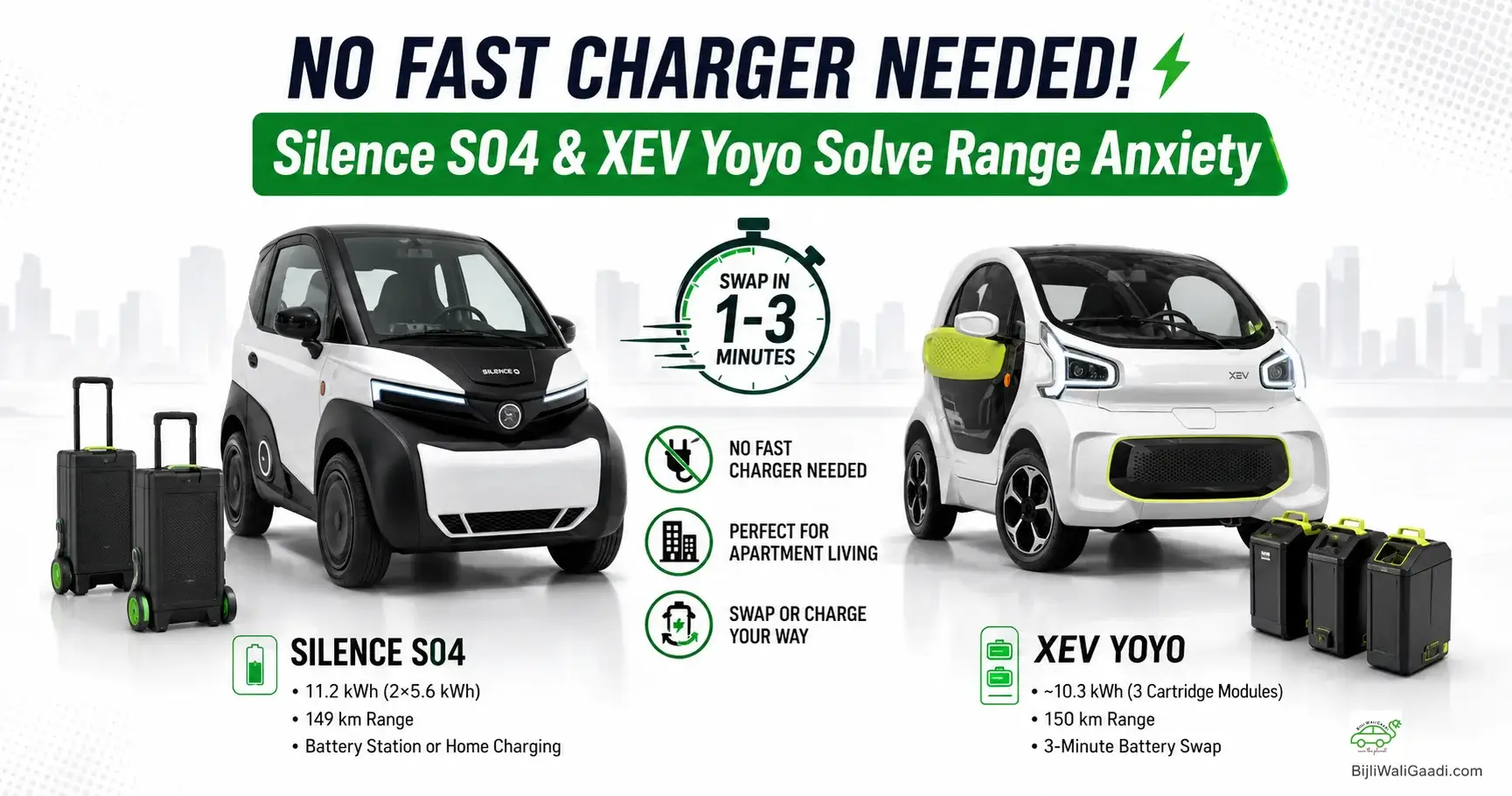
Batteries with wheels — and one robotic swap network: how two European microcars tackle range anxiety.
Forget hunting for a public DC fast charger or running an extension cord across the pavement. Spain’s Silence S04 lets you pull its battery out like airport luggage and roll it to any wall socket in your apartment, or exchange it at a Silence Battery Station. Italy’s XEV Yoyo goes further: drive up to a swap point, and its cartridge-style battery modules are exchanged in around three minutes, no cable required. For urban commuters without a driveway or a dedicated charger, this is a real fix for range anxiety, not simply a bigger battery, but a battery you can replace or charge away from the car.
Quick Summary Box
- Silence S04 Nanocar: Spain, 11.2 kWh (2× 5.6 kWh lithium-ion), 149 km range, 85 km/h top speed, €10,180 (historical launch/reference price, including batteries; ~₹9.1 Lakh).
- XEV Yoyo: Italy/China, approx. 10.3 kWh LiFePO4 across three cartridge modules, 150 km claimed range, 90 km/h top speed (current manufacturer specification; some earlier/market-specific versions are listed at 80 km/h), €16,990 (~₹15.3 Lakh) as a referenced European starting price.
- Both are EU L7e heavy quadricycles with removable, swappable battery systems, built on two very different swap philosophies.
What Is a Swappable Battery Electric Microcar?
Battery swapping in microcars allows drivers to replace depleted batteries with pre-charged packs in roughly a minute to around three minutes, depending on the system, or wheel removable batteries indoors like luggage for household charging, instead of plugging the whole vehicle into a charger. It removes dependence on public fast-charging infrastructure, letting apartment dwellers and fleet operators recharge power packs anywhere with a standard socket or a compatible swap station.
How the Silence S04’s “Trolley System” Works
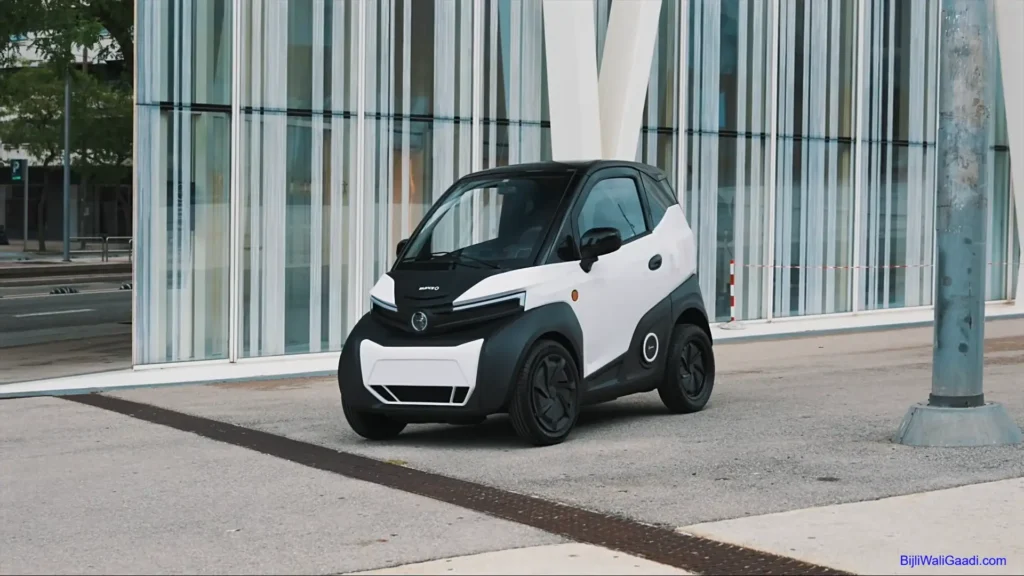
The S04 splits its 11.2 kWh pack into two 5.6 kWh modules, each fitted with built-in wheels and a telescopic handle, essentially a battery designed to look and behave like carry-on luggage. Pop one out from under the seat, wheel it through your building lobby, into a lift, and plug it into any household socket. By cable, a full recharge takes around 7–9 hours per module.
Crucially, the trolley design isn’t the only option. Silence also operates a network of Battery Stations, where subscribed users can swap depleted packs for charged ones in about a minute, echoing the swap infrastructure Silence already runs for its electric scooters. Buyers can even purchase the S04 without batteries and subscribe to this exchange service instead, cutting the upfront cost noticeably. The L7e version discussed here uses two 5.6 kWh modules for its full 149-km WMTC range. The trolley system’s real advantage is flexibility: charge indoors, charge outdoors, or swap at a station.
How the XEV Yoyo’s Battery Swap System Works
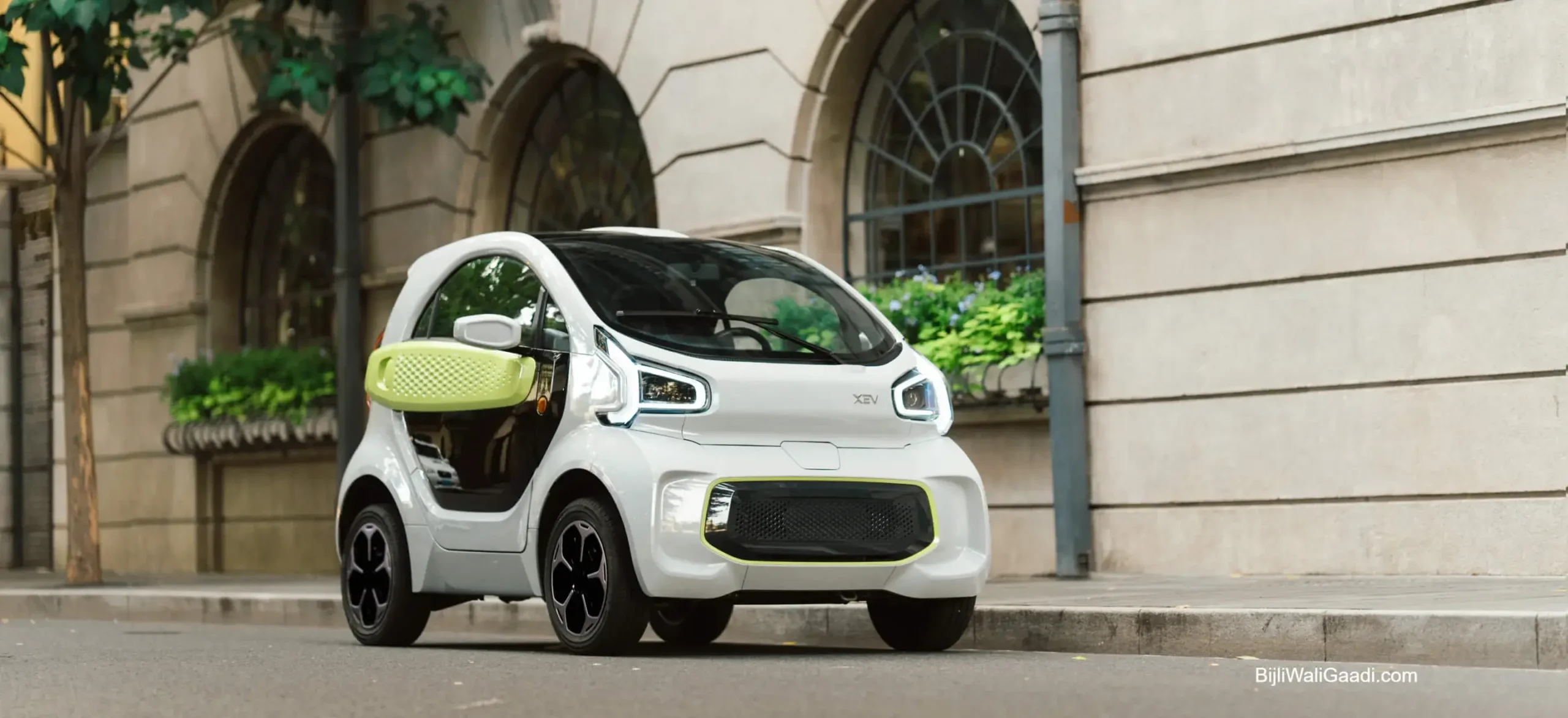
The Yoyo takes a more centralized approach. Its roughly 10.3 kWh LiFePO4 battery is split into three lightweight cartridge modules, stored in the rear compartment. At a compatible swap point, all three cartridges are exchanged for charged ones in about three minutes, a system XEV has trialled with energy partner Eni across five Italian cities, including Rome, Milan, Turin, Florence, and Bologna. A front-mounted charging port also allows conventional home or Type 2 AC charging as a secondary, slower option.
The Yoyo pairs this with 3D-printed, modular exterior body panels (built from just 57 components), meaning damaged bumpers or trim pieces can be reprinted and replaced rather than repainted or repaired, a genuinely novel manufacturing angle for a low-volume microcar.
Technical Comparison Table
| Specification | Silence S04 Nanocar | XEV Yoyo |
| Country | Spain | Italy / China |
| Battery Size & Chemistry | 11.2 kWh (2 × 5.6 kWh), lithium-ion | approx. 10.3 kWh, LiFePO4 (three cartridge modules) |
| Swapping Mechanism | Trolley (removable, wheeled modules) + Battery Station network | Centralized swap-point exchange of three cartridges |
| Swap/Charge Time | 7–9 hrs cable charging; approx. 60 sec at a Battery Station | approx. 3 min at a swap point; approx. 3–5 hrs AC/cable charging, depending on version/source |
| Range | 149 km (WMTC) | 150 km (claimed) |
| Top Speed | 85 km/h | 90 km/h (current manufacturer specification; some earlier/market versions cited at 80 km/h) |
| Motor Power | 14 kW (22 kW peak) | up to 15 kW |
| Weight | 435 kg without batteries (+ 82 kg for 2 × 41 kg batteries) | 522 kg (published vehicle weight) |
| Price | €10,180 (historical launch/reference price, including batteries; ~₹10 Lakh) | €16,990 (~₹17 Lakh), referenced European starting price |
For the full regulatory context behind both vehicles’ L7e classification, see our L7e Heavy Quadricycles Guide.
Charging vs Swapping: Which Actually Saves You Time?
For a driver with no home charger and no garage, both systems beat waiting at a public DC fast charger. The S04 offers the most flexibility: charge a module indoors over several hours, or use a Battery Station for a near-instant exchange. The Yoyo prioritizes speed, its swap is faster per visit, but only works where XEV has built stations, making it closer to a Battery-as-a-Service (BaaS) subscription than a universal fix. Fleets tend to prefer the Yoyo’s turnaround; commuters may prefer the S04’s flexibility.
Could Battery Swapping Work in Indian Cities?
India is arguably a promising market for swappable microcars. Dense apartment living without dedicated parking is the norm in cities like Mumbai and Bengaluru, a use case the S04’s trolley system is particularly well suited to. India already has significant experience with battery swapping for two-wheelers, three-wheelers, and last-mile commercial vehicles, but those systems aren’t automatically compatible with four-wheel microcars; a swappable four-wheeler would need its own hardware, safety standards, software, and swap infrastructure built essentially from scratch.
India’s ambient heat matters too. Frequent battery cycling in 40°C+ conditions increases the importance of robust thermal management to control heat-related degradation, a bigger demand than in temperate Spain or Italy. Pricing is a further hurdle: at ₹9–15 Lakh, both vehicles sit well above India’s compact urban EV/passenger-car market (see our review of the MG Comet EV, which starts closer to ₹7 Lakh with four seats). Indian companies have explored compact EVs and swapping business models broadly, but a mass-market four-wheel swappable microcar ecosystem doesn’t yet exist here.
Final Verdict
Both cars prove “swappable” doesn’t mean one thing. The S04 is the flexible, hybrid answer, removable trolley batteries for home charging, backed by a Battery Station network. The Yoyo is the infrastructure-dependent answer, its three-cartridge system is faster per swap but tied to station coverage, and priced well above the S04.
Frequently Asked Questions
Stay connected via Google 'Electric Vehicle' News
Follow BijliWaliGaadi | India's Trusted EV Insights Portal
source on Google