Critical Materials Innovation Challenge: $100,000 Prize to Secure U.S. Automotive and EV Supply Chains
Stay connected via Google 'Electric Vehicle' News
Follow BijliWaliGaadi | India's Trusted EV Insights Portal
source on Google
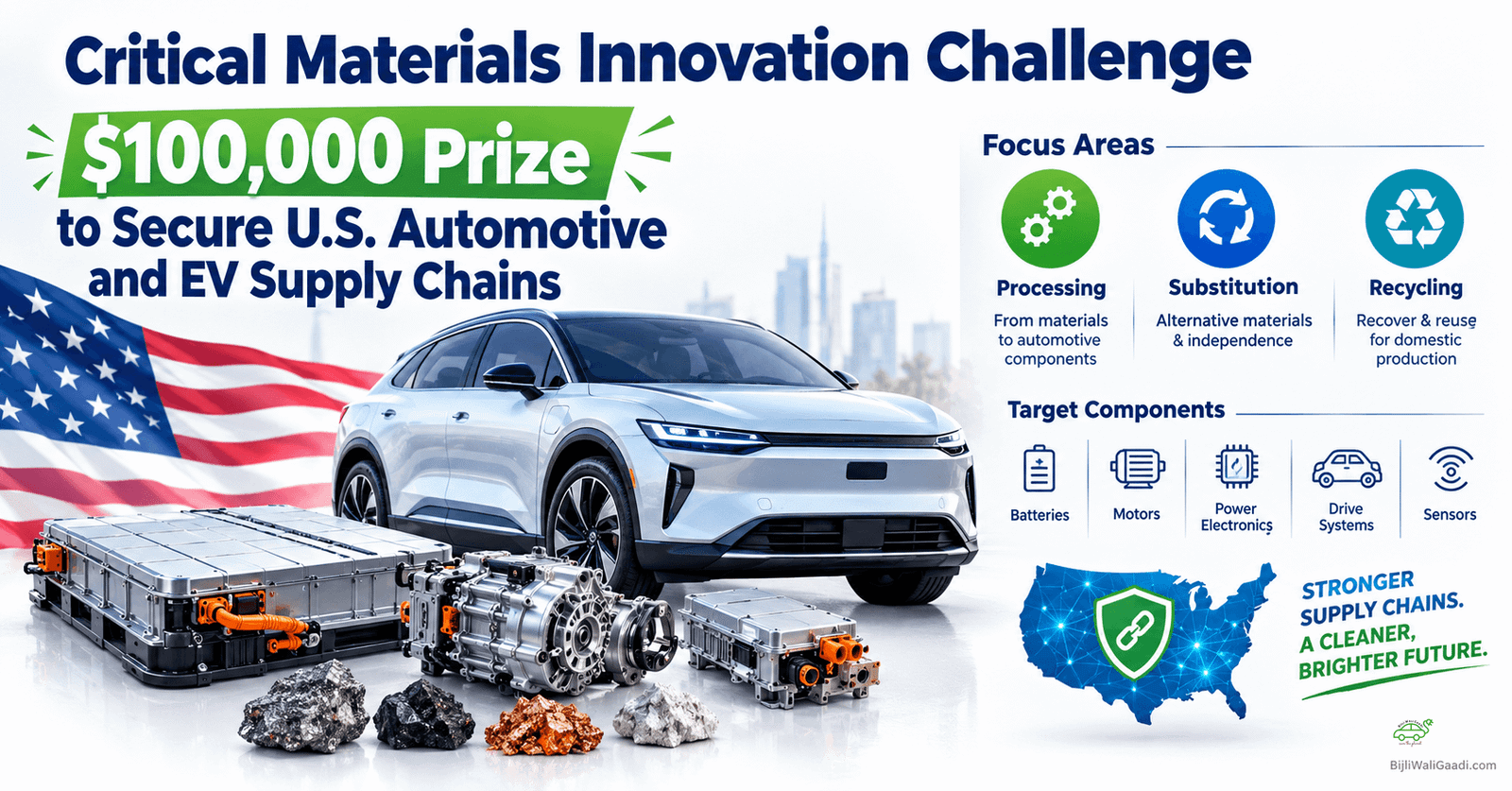
Centrepolis Accelerator at Lawrence Technological University (LTU) has launched the Critical Materials Manufacturing Technology Accelerator (CMMTA), built around a global Innovation Challenge. Announced on October 6, 2026, in Southfield, Michigan, the challenge offers a $100,000 grand prize for technologies that reduce U.S. dependence on foreign critical materials. Because it names batteries, motors and power electronics among its target components, it matters directly to electric vehicles. This guide covers the programme, its focus areas, deadlines and how to apply, followed by a brief note on MP Materials and its magnet agreement with GM.
What Is the Critical Materials Manufacturing Technology Innovation Challenge?
The Critical Materials Manufacturing Technology Innovation Challenge is a global technology-scouting effort. It seeks the most promising technologies that can reduce U.S. dependence on foreign sources of critical materials.
The challenge favours technologies that can move quickly from laboratory to commercial production. The aim is to help establish new domestic manufacturing capabilities and supply chains for the automotive, aerospace, energy, electronics and defense industries.
Who Is Behind the Critical Materials Manufacturing Technology Accelerator?
Centrepolis Accelerator at LTU developed the CMMTA in partnership with the United States Council for Automotive Research (USCAR). USCAR was founded in 1992 and is the collaborative automotive technology company of Ford Motor Company, General Motors and Stellantis.
Centrepolis Accelerator is a product development and business accelerator in Southfield, Michigan. It helps hardware and advanced manufacturing companies bring products to market through expert-in-residence support, prototyping resources and strategic partnerships.
Why Do Critical Materials Matter for Electric Vehicles?
USCAR’s Executive Director, Dr. Steven Przesmitzki, said critical materials appear throughout modern vehicles. He named advanced batteries, next-generation electric motors, and electronics such as displays and lighting.
The programme’s target components reinforce the EV link. They include drive systems, batteries, motors, power electronics and sensors. The initiative is expected to support domestically produced advanced batteries, electric motors, power electronics, and autonomous controls and sensors.
What Are the Three Focus Areas of the Innovation Challenge?
The challenge is organised around three areas:
- Processing: advancements in critical materials and rare earth processing into automotive components.
- Substitution: alternative domestic material substitution and material independence.
- Recycling: end-of-life recovery and recycling of critical materials for domestic production processes.
Together, these cover making materials, replacing them, and recovering them from used products.
Which Technologies Does the Innovation Challenge Not Support?
The programme does not support technologies focused on mineral exploration, mining or primary ore extraction. It looks for innovations that can be processed into automotive components, so the focus is on manufacturing and materials technology, not on the mine.
Which Automotive Components Could Benefit From the Challenge?
The announcement lists the following components:
- Drive systems
- Batteries
- Motors
- Electronics and power electronics
- Sensors
- Structural and non-structural components
It also says the initiative should support domestic production of materials and components deemed essential for both commercial and military products. That is why defense contractors are named among the manufacturers that selected companies can be connected to.
What Do Companies Selected Through the Challenge Receive?
Selected companies become eligible for a $100,000 grand prize and a range of commercialization support, including:
- Pilot and demonstration projects
- Product engineering and design-for-manufacturability support
- Connections to automotive, defense and industrial customers
- Strategic partnerships with automotive original equipment manufacturers (OEMs), tier suppliers and U.S. military commands
- Funding strategy, proposal development and investor introductions
The announcement says the Accelerator is meant to strengthen U.S. industrial competitiveness and supply chain resilience. It aims to do this by reducing dependence on foreign materials, enabling recovery of strategic materials from end-of-life products, and advancing next-generation material substitution technologies.
Critical Materials Innovation Challenge Deadlines and Application Details
| Materials Innovation Challenge Milestone | Date |
| Programme announced | October 6, 2026 |
| Informational webinar | October 28 |
| Priority application deadline | November 23, 2026, 11:59 PM |
| Final application deadline | January 11, 2027, 11:59 PM |
| Evaluation for $100,000 grand prize | After the final deadline |
Applicants are encouraged to meet the priority deadline. That allows more time to begin engaging and building relationships with USCAR and its member companies. Eligibility requirements and submission details are on the Centrepolis Accelerator programme page. Centrepolis Accelerator and USCAR will host the webinar to explain the challenge, eligibility, the application process and opportunities to engage with USCAR.
What Did Centrepolis Accelerator and USCAR Leaders Say About the Challenge?
Dan Radomski, CEO of Centrepolis Accelerator, said the initiative is about strengthening U.S. domestic manufacturing capabilities and building a more resilient supply chain. He said the goal is to find the best technologies in critical material processing, substitution and recycling. These would then be connected to USCAR’s member companies and other U.S. manufacturers, including defense contractors.
Dr. Przesmitzki said USCAR was founded to strengthen the domestic auto industry’s technology base through pre-competitive, collaborative research. He said the partnership lets USCAR look beyond its member companies to the wider innovation ecosystem for technologies that can secure domestic supply of the materials the industry depends on.
Frequently Asked Questions About the Critical Materials Innovation Challenge
Stay connected via Google 'Electric Vehicle' News
Follow BijliWaliGaadi | India's Trusted EV Insights Portal
source on Google