Delhi Proposes 2.5 Lakh E-Rickshaw Cap and Mandatory ECC: Everything in the 2026 Draft Scheme
Stay connected via Google 'Electric Vehicle' News
Follow BijliWaliGaadi | India's Trusted EV Insights Portal
source on Google
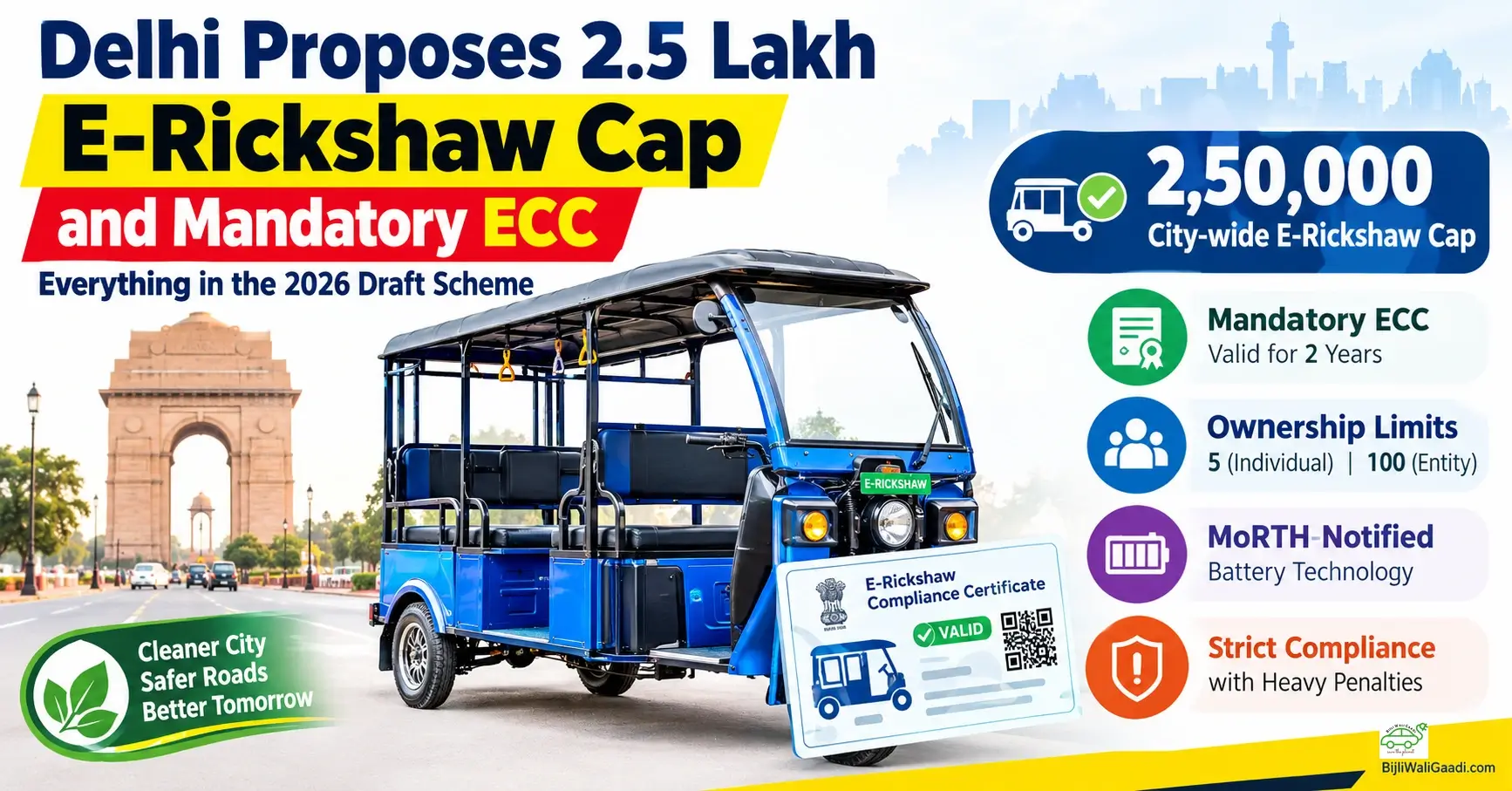
Delhi’s e-rickshaws carry lakhs of commuters every day, and the capital now wants a firm hand on the wheel. The Transport Department, GNCTD, has uploaded the draft Delhi E-Rickshaw (Registration and Operation) Scheme, 2026 for public comment. It proposes a city-wide ceiling of 2,50,000 e-rickshaws, a mandatory digital E-Rickshaw Compliance Certificate (ECC), ownership limits, MoRTH-notified battery technology and an uncompromising impounding regime. Here is what the document says, section by section.
Delhi E-Rickshaw Scheme 2026 at a Glance: Key Numbers
| Provision | What the draft says |
| Fleet cap | 2,50,000 e-rickshaws/ECCs city-wide |
| ECC validity | 2 years from issue |
| ECC deadline for existing vehicles (Categories B and C) | 90 days from notification, or an extended period set by the Transport Department |
| Individual ownership limit | Up to 5 e-rickshaws |
| Entity ownership limit | Up to 100 e-rickshaws |
| Aggregator licence trigger for Entities | On reaching 25 e-rickshaws, within one month of registering the 25th |
| Registration series | DL-1ER, DL-2ER, DL-3ER and so on, without a fare meter |
| Scheme duration | Initial 5 years from notification |
| Public feedback window | 30 days from publication |
What Is the Delhi E-Rickshaw (Registration and Operation) Scheme, 2026?
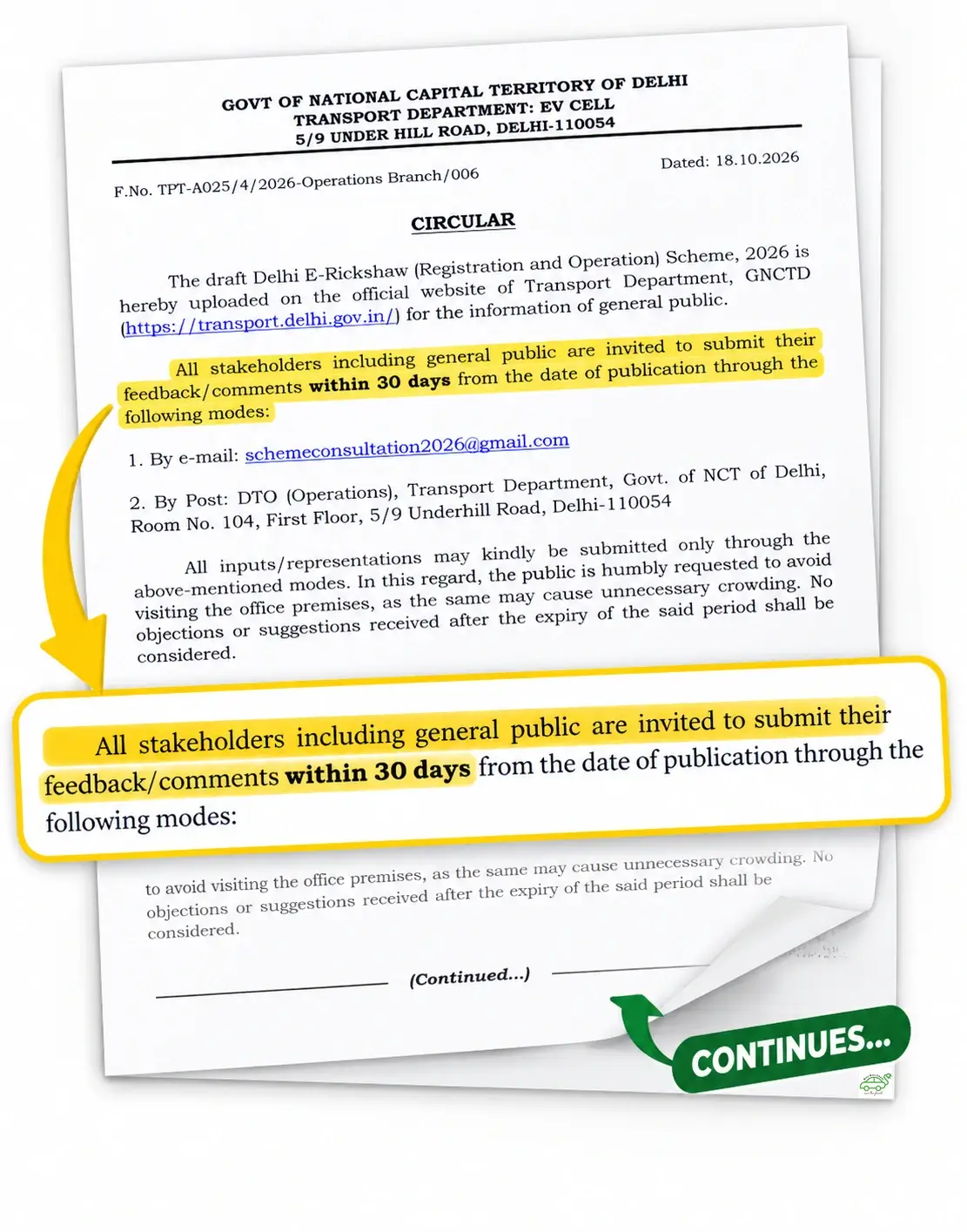
The Scheme is a draft regulatory framework covering registration, compliance, safety standards and operation of e-rickshaws in the National Capital Territory. The circular uploading it is dated 18.10.2026 (F.No. TPT-A025/4/2026-Operations Branch/006). It is issued under Section 67(3) of the Motor Vehicles Act, 1988, in line with the Central Motor Vehicles Rules, 1989.
The preamble recognises e-rickshaws as an affordable, accessible last-mile mode that also supports the livelihoods of many owners and drivers. It also names the problems the government wants to fix: traffic congestion, road safety risks, unsafe vehicle operations, non-compliant battery technologies and obstruction on certain road stretches. The absence of a uniform compliance framework, it says, has made enforcement, monitoring and accountability difficult.
Once notified in the Official Gazette, the Scheme applies to all e-rickshaws operating or proposed to operate in Delhi and remains in force for an initial five years, unless modified, extended or withdrawn earlier.
How to Send Feedback on the Draft E-Rickshaw Scheme
The draft is hosted on the Transport Department website (transport.delhi.gov.in). All stakeholders, including the general public, can submit comments within 30 days from the date of publication, through two modes only:
- Email: schemeconsultation2026@gmail.com
- Post: DTO (Operations), Transport Department, Govt. of NCT of Delhi, Room No. 104, First Floor, 5/9 Underhill Road, Delhi-110054
The department asks people not to visit the office to avoid crowding, and states that objections or suggestions received after the period expires will not be considered.
What Counts as an E-Rickshaw: The Technical Definition Used in the Draft
The Scheme adopts the definition in Rule 2(cb) of the Central Motor Vehicles Rules, 1989. An e-rickshaw is a special purpose battery-operated, three-wheeled vehicle meant for last-mile passenger transport for hire or reward, provided it meets all of the following:
- Constructed or adapted to carry not more than four passengers, excluding the driver, and not more than 40 kg of luggage in total
- Net motor power not exceeding 2000 W
- Maximum speed not exceeding 25 km/h
Operating rules in the draft repeat the same limits: four passengers excluding the driver and 40 kg of luggage.
E-Rickshaw Compliance Certificate (ECC): The Core of Delhi’s New Framework
The ECC is a unique digital certificate issued by the Transport Department. It confirms that the vehicle, its registered owner or Entity, and the driver comply with the Scheme’s requirements on registration, fitness, battery compliance and eligibility.
- Mandatory: No e-rickshaw may operate in Delhi unless it is registered under Section 39 of the Act and holds a valid ECC.
- Validity: Two years from the date of issue, unless suspended or cancelled earlier.
- Not a permit: The draft states the ECC is a compliance authorisation under Section 67(3) and shall not be construed as a permit under Section 66.
- One vehicle, one driver: Each ECC is linked to one e-rickshaw and one driver with a valid e-rickshaw driving licence. The same licence cannot be linked to more than one valid ECC at a time.
- Contents: Registration Certificate details, owner or Entity and driver details (including driving licence and PSV Badge numbers), battery compliance status, and fitness and insurance validity, plus any other particulars specified later.
- On demand: The ECC must be available for inspection by an enforcement authority.
Delhi E-Rickshaw Fleet Cap: Why the Limit Is 2,50,000
Citing traffic congestion, road safety hazards, air and noise pollution and what it calls the excessive and unregulated proliferation of e-rickshaws, the government proposes a city-wide cap of 2,50,000 e-rickshaws/ECCs. No registration or ECC will be issued beyond the limit unless the cap is revised.
Every e-rickshaw with a valid ECC is counted individually, whether registered to an individual or an Entity. The government may review the cap from time to time. The cap becomes operational only after the 90-day ECC compliance window (or any extended period) ends, giving existing Category B and C vehicles time to regularise before the restriction on new ECCs takes effect.
Category A, B and C E-Rickshaws: Who Needs What
The draft divides vehicles into three groups:
- Category A: E-rickshaws seeking registration after the Scheme is notified.
- Category B: Already registered, with a valid fitness certificate, valid insurance, and a driver holding a valid e-rickshaw driving licence and PSV Badge.
- Category C: Already registered, but without a valid fitness certificate or valid insurance, or whose driver lacks a valid e-rickshaw driving licence with PSV Badge.
Category B and C owners must obtain an ECC within 90 days of notification, or within a longer period set by the Transport Department through an order. After that, operating without an ECC invites enforcement action.
Ownership Rules: 5 E-Rickshaws for Individuals, 100 for Entities
Individual owners must, unless GNCTD permits otherwise, be individuals resident in NCT Delhi with valid address proof, and cannot own more than five e-rickshaws under the Scheme. An owner who drives personally must hold a valid e-rickshaw driving licence and a PSV Badge issued under Rule 6 of the Delhi Motor Vehicle Rules, 1993, must not be disqualified, and cannot ply any other e-rickshaw in Delhi. An owner who hires a driver must give the driver’s details to the Registering Authority and update them on every change.
Entities (a company, firm, NGO, co-operative society, driving school or other permitted body) can own up to 100 e-rickshaws. They must submit the individual driver’s details for each vehicle, keep the driver list updated, ensure each driver holds a valid licence and PSV Badge, and arrange adequate charging or battery swapping. When an Entity’s fleet reaches 25 e-rickshaws, it must obtain an Aggregator licence under the Delhi Motor Vehicle Aggregator and Delivery Service Provider Scheme, 2023, within one month of registering the 25th vehicle.
New E-Rickshaw Registration in Delhi: DL-1ER Series and Type Approval
New e-rickshaws will be registered as transport vehicles in the DL-1ER, DL-2ER, DL-3ER (and so on) series at the zonal Registering Authority matching the dealer’s area, without a fare meter. A model must be type-approved under Rule 126 of the Central Motor Vehicles Rules, 1989, with a valid type-approval certificate endorsed by the Transport Department, before any registration or ECC is issued.
Category A applicants follow two steps. First, registration, with Forms 20, 21 and 22, a valid insurance certificate, address proof and Form 34 if the vehicle is hypothecated. Second, the ECC, with the RC, the driver’s e-rickshaw licence and PSV Badge, battery compliance proof, a fitness certificate and a valid Special Inspection Report. Entities must add incorporation documents and, where applicable, the Aggregator licence.
Special Inspection Report: How Vehicle and Driver Details Will Be Verified
The Transport Department may inspect a vehicle before issuing an ECC or at specified intervals. The findings go into a Special Inspection Report (Annexure 2). Inspectors verify details against the Vahan record, including the vehicle number, owner name, chassis and motor numbers, registered mobile number, the laser codes on the front and rear number plates and the vehicle colour.
At inspection, the Aadhaar number of the owner (or the Entity’s registration details), the driver’s Aadhaar, licence number, PSV Badge number and phone number, a chassis image, and the battery type (lead acid or lithium ion) are recorded.
Battery Rules for Delhi E-Rickshaws: MoRTH-Notified Technology and Authorised Recycling
Every e-rickshaw seeking registration and an ECC must use battery technology as notified by the Ministry of Road Transport and Highways from time to time. Proof can be an OEM or dealer invoice, or a self-declaration supported by physical verification. The draft does not name a specific chemistry; it ties compliance to whatever MoRTH notifies.
Used batteries must be disposed of only through authorised recyclers, in line with the Battery Waste Management Rules, 2022 and CPCB guidelines. A non-compliant or unsafe battery can get a vehicle impounded pending rectification.
Impounding, Crushing and Penalties Under the Delhi E-Rickshaw Scheme
Enforcement is the sharpest part of the draft:
- Unregistered e-rickshaws: Impounded immediately after notification and never released. The vehicle is crushed and auctioned by GNCTD under prescribed guidelines. The battery, whether owned or leased from a third party, is also not released and is auctioned to a registered recycler.
- Registered but non-compliant e-rickshaws: After the 90-day window, those without a valid ECC are impounded and released only after a valid ECC is obtained and all penalties are paid. If no ECC is obtained within 15 days of impounding, the Competent Authority may begin disposal proceedings.
- Safety breaches: Vehicles with a bull bar or a non-compliant or unsafe battery are impounded pending rectification.
Penalties can arise under the Motor Vehicles Act, 1988, its rules, the Scheme and other applicable law, including ECC cancellation. Anyone aggrieved by an ECC suspension or cancellation can appeal within 30 days of receiving the order to the Special Commissioner (Transport), GNCTD, or another notified authority.
Replacement and Transfer Rules: Scrapped, Total-Loss and Stolen E-Rickshaws
An e-rickshaw can be transferred to another eligible individual or Entity. If a vehicle is beyond repair or declared a total loss by the insurer, the owner may replace it against a scrapping certificate from an authorised scrapper or a total-loss letter from the insurance company. If a vehicle is stolen, it must first be transferred in the insurer’s name, after which the owner may apply to register a replacement, subject to the Scheme’s requirements.
Safety, Display and Driver Conduct Rules for Delhi’s E-Rickshaws
On the vehicle:
- Name, address and phone number of the owner or Entity painted on the left side
- Registration particulars displayed as prescribed
- Yellow reflective strip on the rear
- High Security Registration Plate (HSRP)
- No bull bar, frontal crash guard, ramming bar or similar structure
- Parking at a proper place without obstructing traffic or pedestrians
- A first-aid box, fire extinguisher and other safety equipment as specified
For drivers:
- No more than four passengers (excluding the driver) or 40 kg of luggage
- No passenger on the driver’s seat and none travelling standing
- No driving under the influence of alcohol, narcotics or psychotropic substances
- No audio played in a distracting manner during duty hours
- Courteous behaviour, with help for senior citizens and differently-abled passengers
- Immediate police reporting, and taking the victim to the nearest police station, PCR van or post, in any incident of indecent behaviour, molestation or eve-teasing involving a woman passenger
- No hazardous chemicals, explosives or inflammable materials
- A clean vehicle, with a valid licence, PSV Badge and ECC at all times
E-rickshaws also cannot ply on roads notified as prohibited for them, which the Transport Department can update. Driver training must meet Rule 8A of the Central Motor Vehicles Rules, 1989 and the Transport Department’s circular dated 25.05.2026.
Frequently Asked Questions About the Delhi E-Rickshaw Scheme 2026
Source: Transport Department, GNCTD circular F.No. TPT-A025/4/2026-Operations Branch/006 dated 18.10.2026 and the draft Delhi E-Rickshaw (Registration and Operation) Scheme, 2026.
Stay connected via Google 'Electric Vehicle' News
Follow BijliWaliGaadi | India's Trusted EV Insights Portal
source on Google