Honda’s Wireless Charging Road Targets Trucks First: What Is Proven and What Comes Next
Stay connected via Google 'Electric Vehicle' News
Follow BijliWaliGaadi | India's Trusted EV Insights Portal
source on Google
Quick Answer: What Did Honda Announce on October 5, 2026?
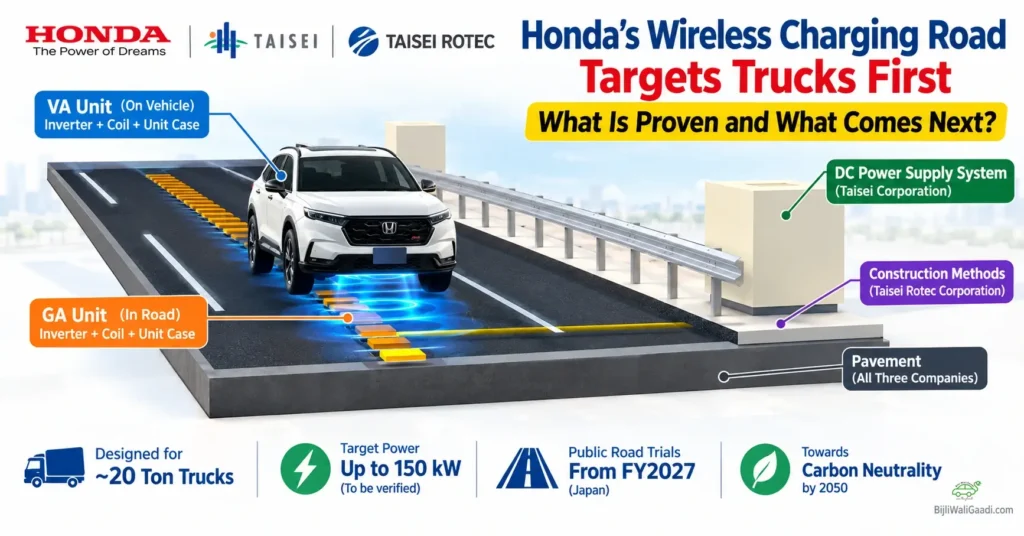
Honda R&D Co., Ltd. has developed, jointly with Taisei Corporation and Taisei Rotec Corporation, the underlying technology for a magnetic coupling wireless power transfer (WPT) road system. The system is meant to charge EVs wirelessly while they are in motion, from passenger cars to large commercial vehicles. The three companies plan public-road demonstration testing from the Japanese 2027 fiscal year, which starts on April 1, 2027.
The wording matters. This is underlying technology plus a test programme. It is not an operating charging highway, and Honda has not published delivered-power results for the system.
Key Takeaways
- Partners: Honda R&D (Honda Motor’s R&D subsidiary), Taisei Corporation and Taisei Rotec Corporation.
- Headline claim: Honda says its road-embedded unit is the first to integrate the inverter and coil into a single DWPT unit. Honda’s own research dates this to the end of September 2026.
- Design target: Units and pavement that withstand large vehicles of about 20 tons gross weight.
- Power goal: Performance to be verified at up to 150 kW for potential large commercial vehicle use.
- Next milestone: Public-road demonstrations from Japanese FY2027, including NEXCO East’s Tateyama Project in Chiba.
Who Is Behind the Project? Honda R&D, Honda Motor and the Taisei Group
The announcement comes from Honda R&D Co., Ltd., the R&D subsidiary of Honda Motor Co., Ltd. Two companies from the Taisei Group are partners:
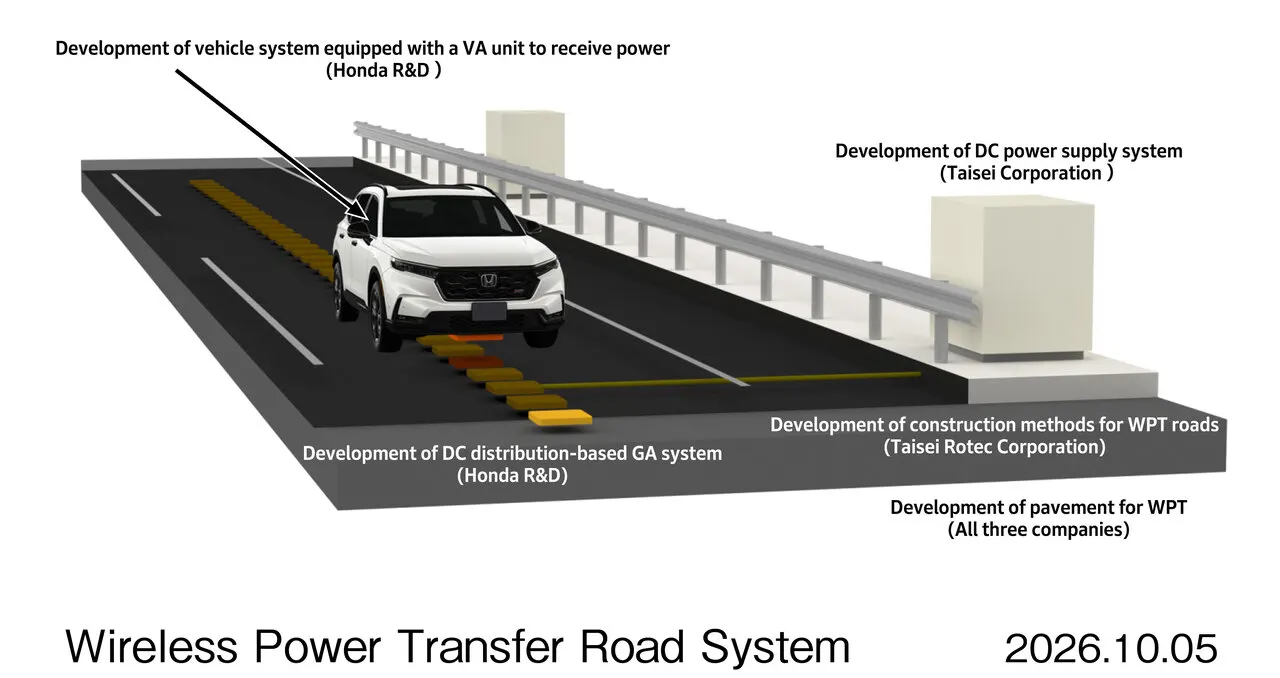
- Taisei Corporation develops the DC power supply system.
- Taisei Rotec Corporation develops the construction methods for WPT roads.
Honda says it is striving for carbon neutrality by 2050. Alongside this research, it has launched Honda Charge, an EV charging network service in Japan, as part of efforts to improve the convenience of EV use. Honda has worked on dynamic wireless power transfer (DWPT) since 2021. The joint research with Taisei and Taisei Rotec on the magnetic coupling WPT road system began in 2025.
What Is In-Motion Wireless Charging (DWPT) and Why Start With Logistics?
Dynamic wireless power transfer supplies power to a vehicle while it is moving. Honda expects this to reduce how often vehicles need to charge at home or at charging stations.
Honda plans to put the technology to practical use first in the logistics and transportation sectors, where it expects DWPT to deliver significant benefits. For background on the wider field, see our explainer on dynamic wireless charging roads (DWPT) tested worldwide.
How Honda’s Wireless Charging Road System Works: GA Units, VA Unit and DC Distribution
Honda’s DWPT system has three key components:
- A DC power supply system on the ground, developed by Taisei.
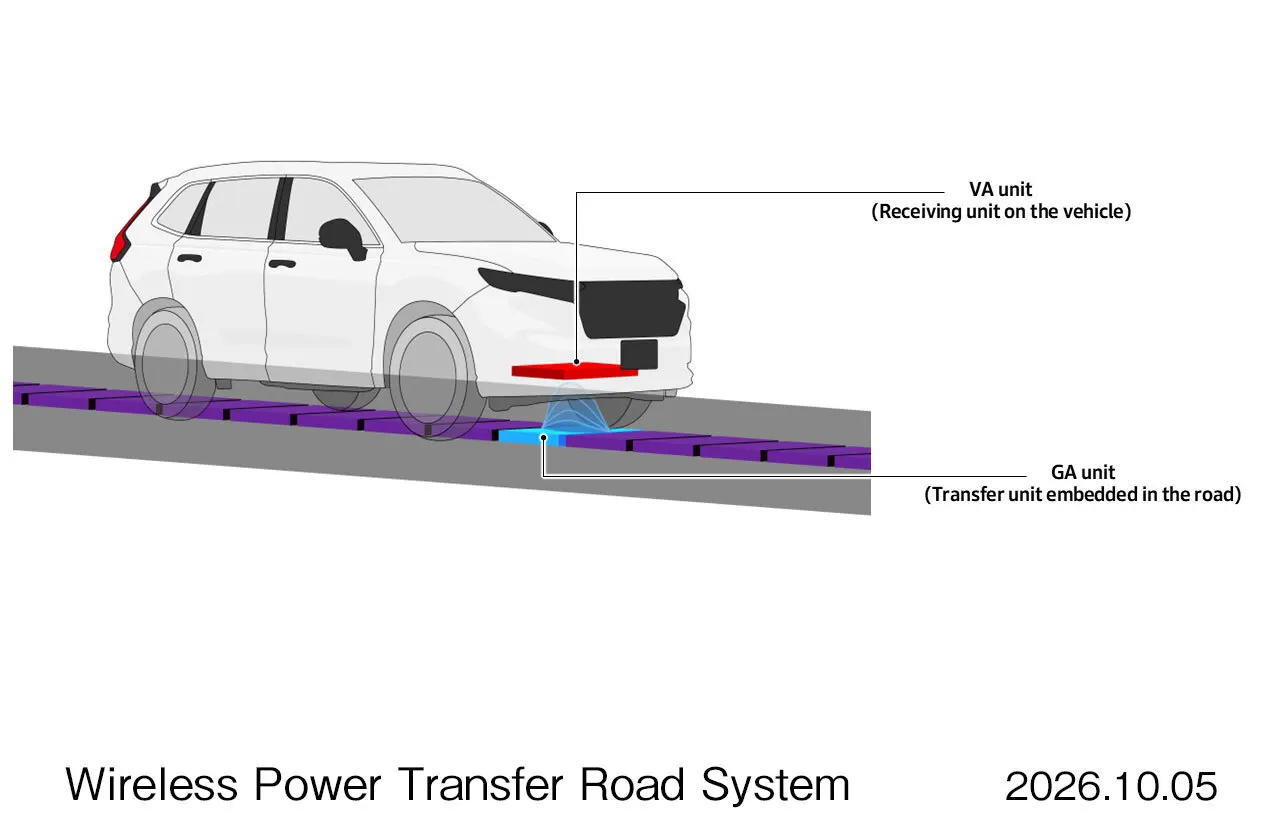
- A DC distribution-based ground assembly (GA) system. Multiple GA units, which are the power transmitters, are embedded in the road and connected by a DC link.
- A vehicle assembly (VA) unit, the power receiver installed on the vehicle.
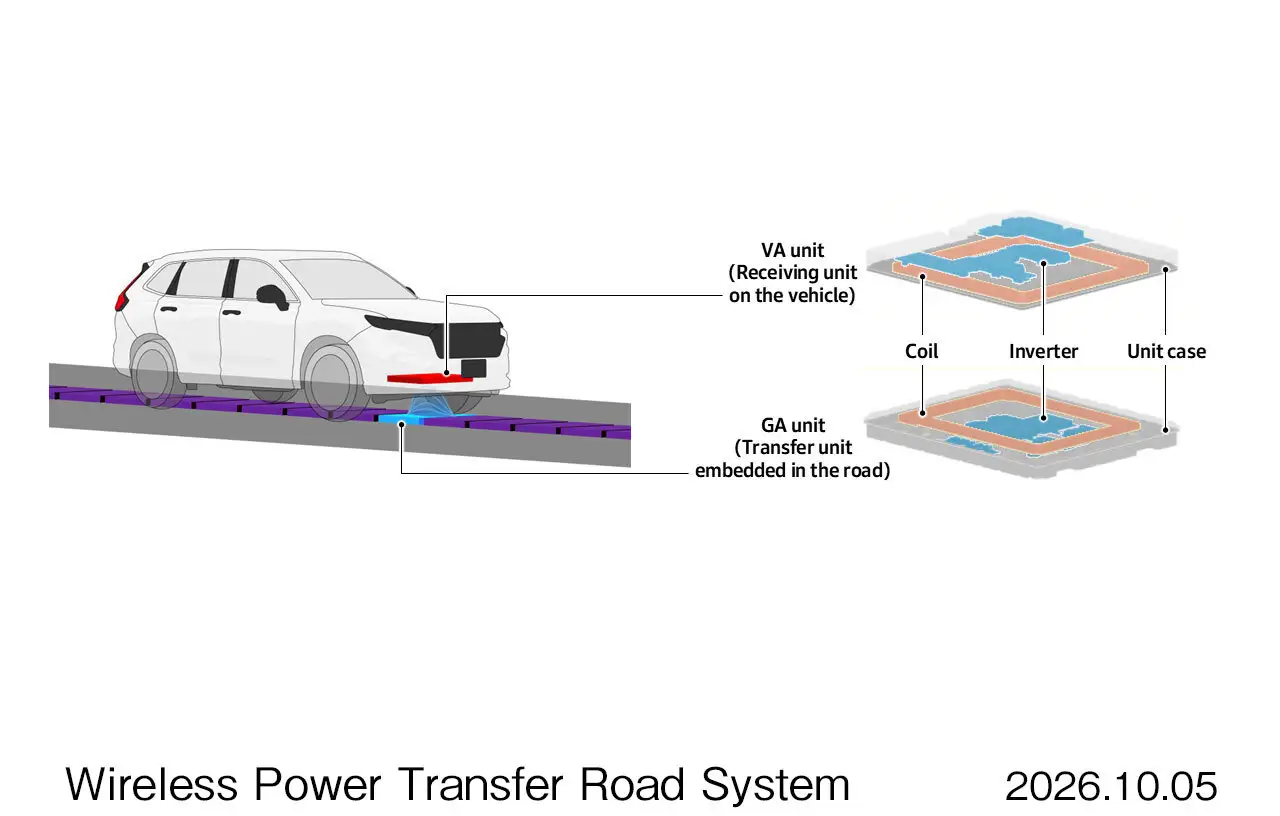
In Honda’s infographic, each unit has three parts: a coil, an inverter and a unit case. The VA unit sits under the vehicle and the GA unit sits in the road surface. The receiver units are described as compatible with high power density. They are meant to suit a wide range of mobility products, from passenger EVs to large commercial EVs, and to deliver a high power output even to small EVs.
To understand the physics behind coil-to-coil transfer, read our guide to how inductive wireless EV charging works.
Why Putting the Inverter and Coil in One Road Unit Is Honda’s Biggest Claim
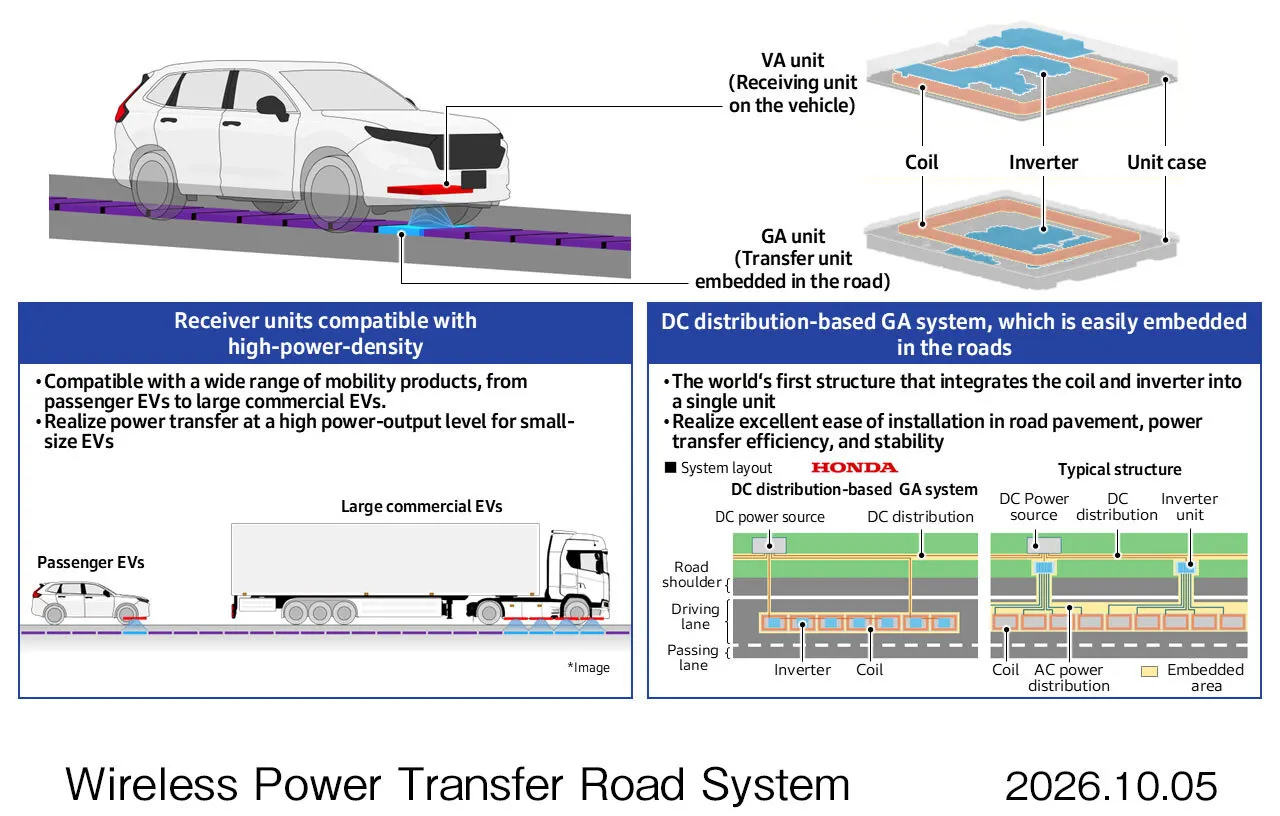
Honda says its road-embedded GA system integrates the inverter and coil into a single DWPT unit “for the first time in the world.” Honda qualifies this: it is the first such unit publicly disclosed as of the end of September 2026, based on Honda’s own research.
Honda’s diagram compares its layout with a typical structure. The typical layout uses a separate inverter unit and AC power distribution to the coils. Honda’s layout distributes DC power instead. According to Honda, the DC structure:
- simplifies wiring in the embedded sections
- reduces the number of components and the amount of installation work
- enables highly responsive and stable high-power transfer when paired with the DC power supply system on the ground
Can a Charging Road Survive 20-Ton Trucks? The Three Challenges Honda Tested
The three companies ran experiments on a test roadway at the Future Technology Field for Taisei Group/Satte (T-FIELD/SATTE). They focused on three challenges:
| Challenge | What had to be shown |
| Strength | GA units and pavement must withstand traffic of large vehicles with a gross weight of about 20 tons |
| Power supply | The DC power supply must feed high-power electricity to the GA system with high responsiveness and stability |
| Installation | GA units must be practical to install and able to be upgraded in future |
Honda says it optimized the internal structure of the GA units to give the pavement, including the embedded units, sufficient strength and durability for long-term use under heavy-load traffic.
How Honda Plans to Embed Wireless Charging in Existing Roads
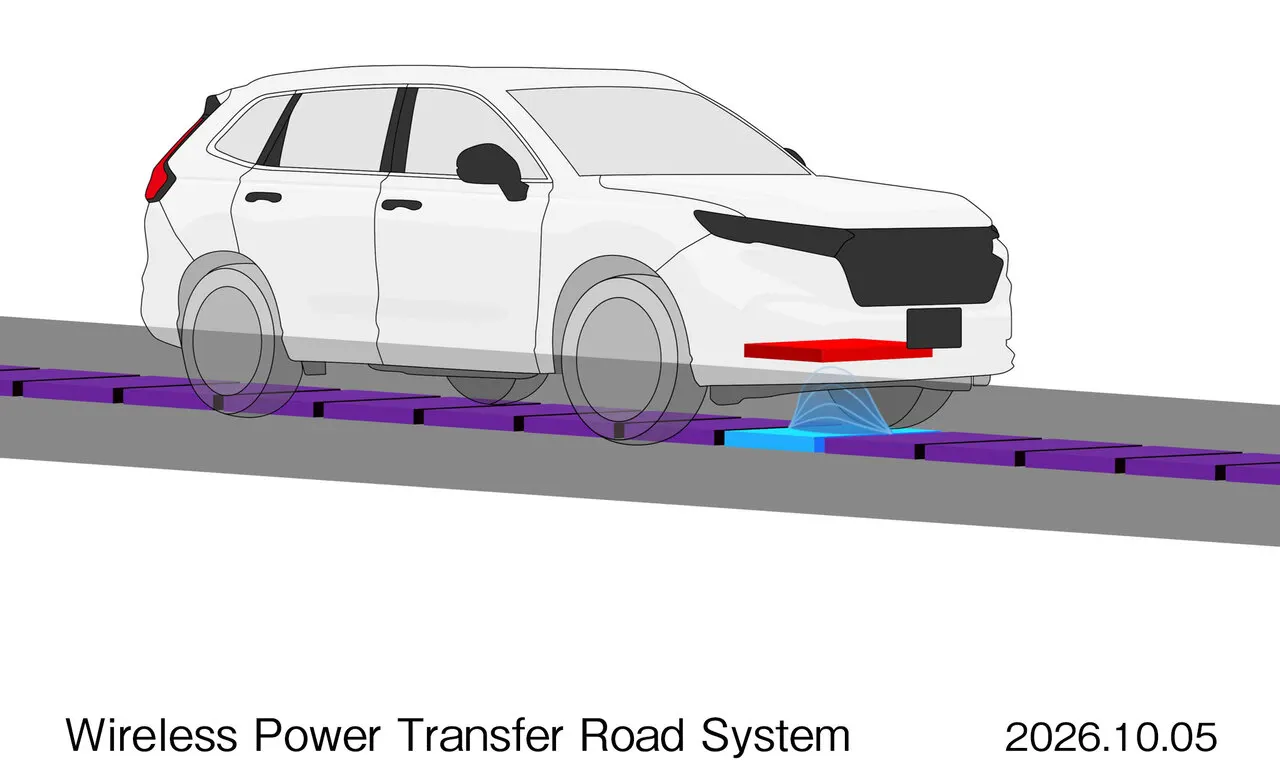
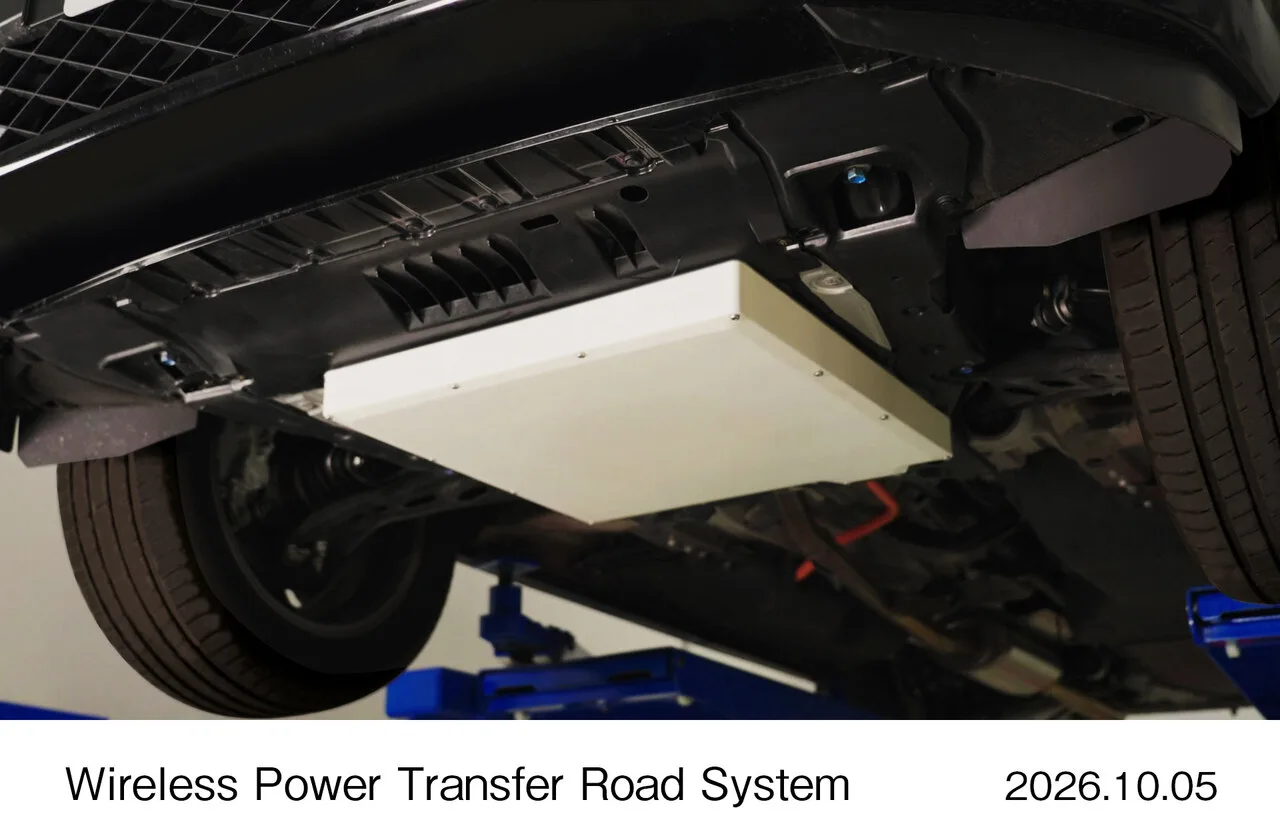
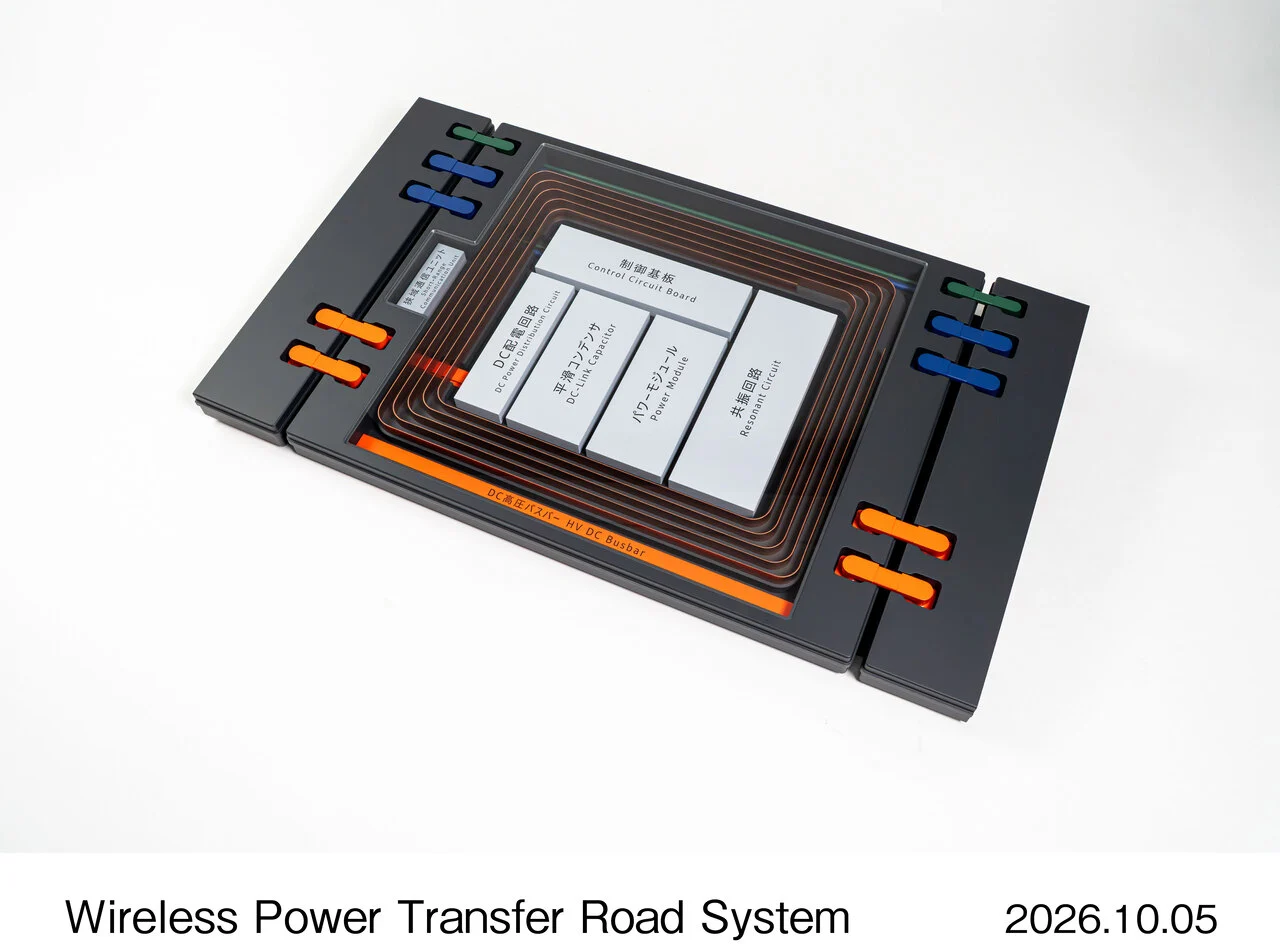
Honda designed the GA unit with existing pavement in mind. Its structure supports milling and embedding installation, with measures for the uneven surfaces that milling can leave. The DC distribution structure simplifies wiring in the embedded sections. Honda says this makes embedding easier in existing pavement and during future pavement renewal work. The design also allows for later upgrades to the road and its equipment.
What Happens Next: Test Roadway, 1-Million-Wheel-Load Trial and the Tateyama Project
Honda’s announced timeline:
- From late 2026: A test roadway will be built at the Future Technology Field for Taisei Group/Tamura (T-FIELD/TAMRA).
- Tests on that roadway:
- A long-term durability evaluation using actual vehicles, with a loading test equivalent to 1 million wheel loads at 49 kN per wheel
- DWPT performance tests
- Tests of measures against electromagnetic field leakage
- After that: Verification of performance at up to 150 kW for potential use with large commercial vehicles, and of WPT reliability for vehicles at high speed.
- From Japanese FY2027: Participation in the Tateyama Project, a DWPT demonstration by East Nippon Expressway Company Limited (NEXCO East) on the Tateyama Expressway in Chiba.
Honda also planned to showcase its DWPT work at Japan Mobility Show Bizweek (October 13–16, 2026, Makuhari Messe) and at ITS World Congress 2026 (October 19–23, Gangneung Olympic Park, South Korea).
Honda’s Plan Versus Wireless Roads Already Tested Elsewhere
The projects below are at different stages, so the figures are not like-for-like. Honda’s 150 kW is a verification target, while the others are reported field results or outcomes.
| Project | Status | Power | Evidence status |
| Honda / Taisei / Taisei Rotec WPT road, Japan | Underlying technology developed; public-road trials from FY2027 | Up to 150 kW to be verified | Planned |
| US 52/231, Indiana | Operational testbed | 190 kW to a Class 8 truck at 65 mph | Demonstrated |
| A10 highway, France | Live open highway | 200+ kW average, 300+ kW peak | Independently measured |
| Smartroad Gotland, Sweden | Completed September 2023 | About 70 kW average, 40-tonne truck at up to 80 km/h | Measured |
| E20 corridor, Sweden | Cancelled February 2025 | N/A | Never built |
Two lessons from those projects frame Honda’s work. Sweden’s E20 shows that a working demonstration and a fundable permanent corridor are separate problems. And a 2026 University of Texas at El Paso lab study found that rigid housings embedded in asphalt can concentrate stress and drive rutting, with no field data yet from a public DWPT highway. That is why Honda’s pavement-durability and loading tests are central to its programme.
What Honda’s Wireless Road Could Mean for India
Honda has announced no India plans. Still, its logistics-first approach echoes the case for India: smaller batteries and less charging downtime for high-utilization trucks on fixed freight corridors.
Any Indian programme would need its own validation. Extreme summer heat could worsen the thermal softening of asphalt that lab studies describe. Monsoon exposure raises the stakes for waterproofing at the interface. Heavy, sometimes overloaded axle traffic would stress embedded hardware harder than controlled test tracks do. These are validation requirements, not evidence that the technology cannot work here.
Verdict: A Credible Engineering Step, Not Yet a Charging Highway
Honda’s announcement is notable for the problems it targets: durability under about 20-ton traffic, a simpler DC-based design and installation in existing roads. Those are the issues that separate a lab success from a road-ready system. The decisive evidence will come from the 1-million-wheel-load test, the electromagnetic leakage tests and the 2027 public-road trials. Until those results arrive, this is a promising foundation rather than a proven charging road.
FAQs: Honda’s In-Motion Wireless EV Charging Road
Stay connected via Google 'Electric Vehicle' News
Follow BijliWaliGaadi | India's Trusted EV Insights Portal
source on Google