ID. Buzz Drove 99,767 km Around the World: Here’s What the Battery Looked Like Afterwards
Stay connected via Google 'Electric Vehicle' News
Follow BijliWaliGaadi | India's Trusted EV Insights Portal
source on Google
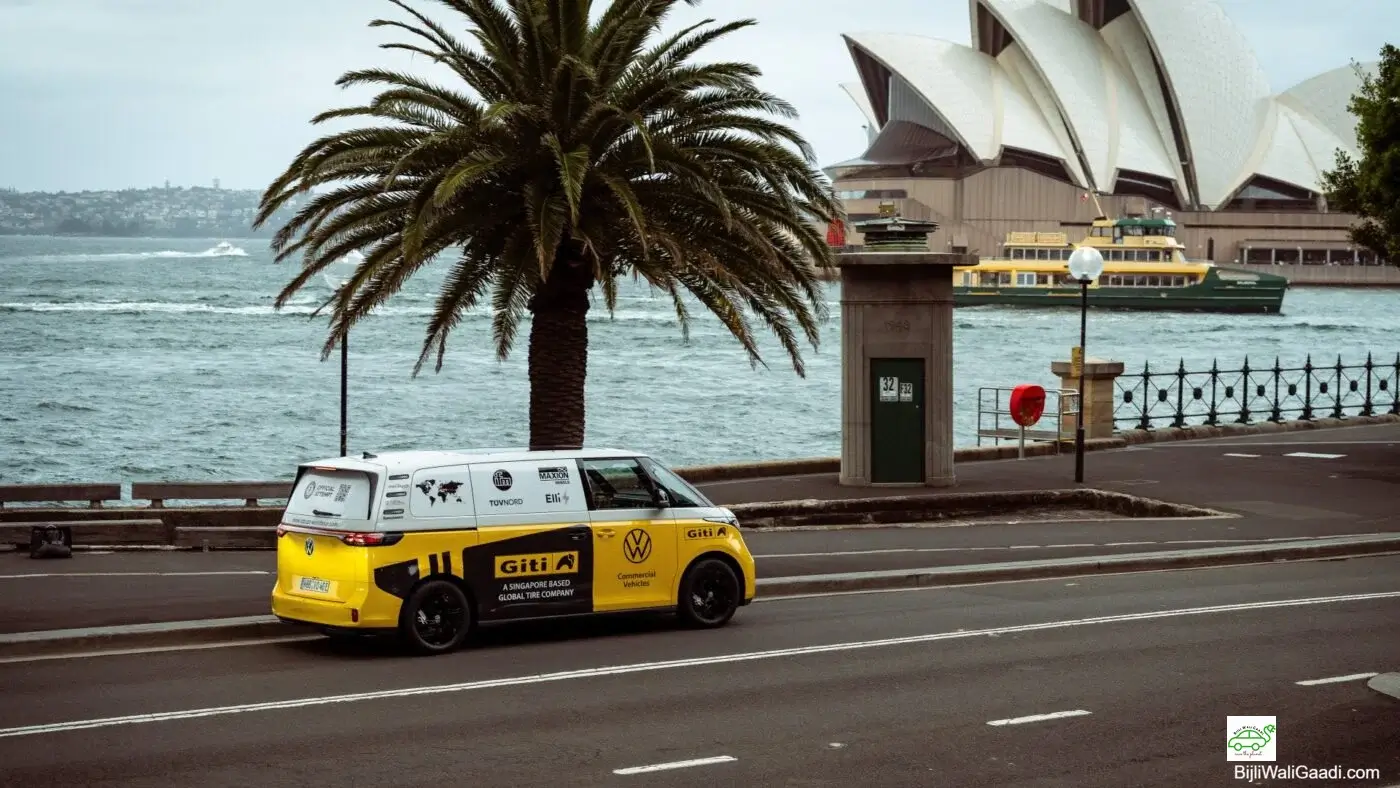
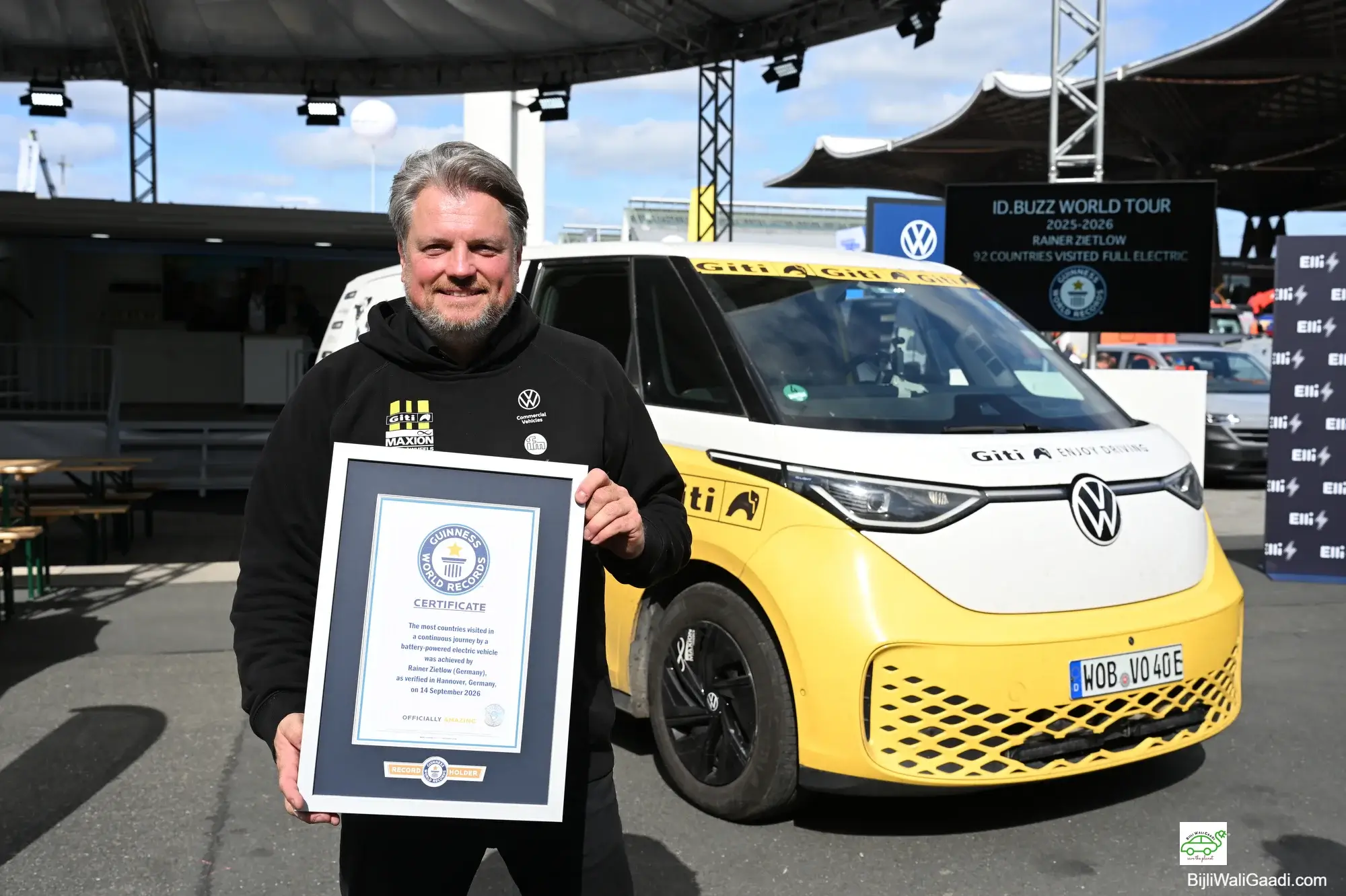
Quick Answer: Volkswagen Commercial Vehicles reports that Rainer Zietlow drove an ID. Buzz Pro LWB through 92 countries on six continents in 445 days, covering 99,767 km and earning a Guinness World Record™. TÜV Nord certified the battery at 95.75% state of health afterwards. Volkswagen also reports more than 300 charging cycles and zero technical breakdowns.
Key Takeaways
- The record: most countries visited in a continuous journey by a battery-powered electric vehicle.
- The data point: 95.75% battery state of health after 99,767 km, certified by TÜV Nord.
- The caveat: one expedition vehicle’s result, not a guarantee for every ID. Buzz.
- The lesson: Zietlow says to check charging availability in advance.
What Is the ID. Buzz World Record?
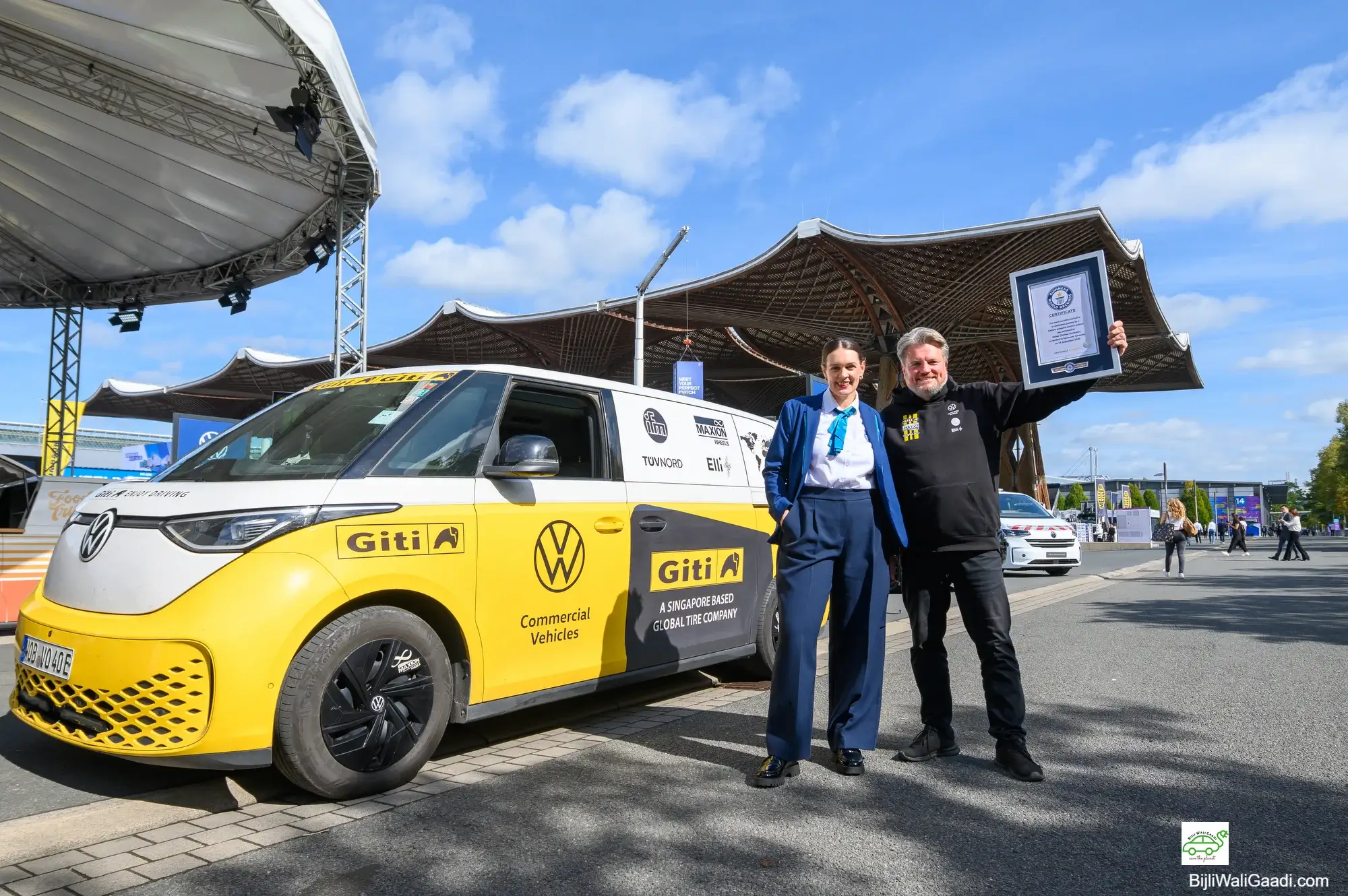
Guinness World Records™ recognized the category “Most countries visited in a continuous journey by a battery powered electric vehicle.” Representative Lena Kuhlmann presented the certificate at IAA Transportation 2026 in Hanover.
Zietlow left Hanover in summer 2025, crossing deserts, mountains and major cities on standard-production Giti tyres.
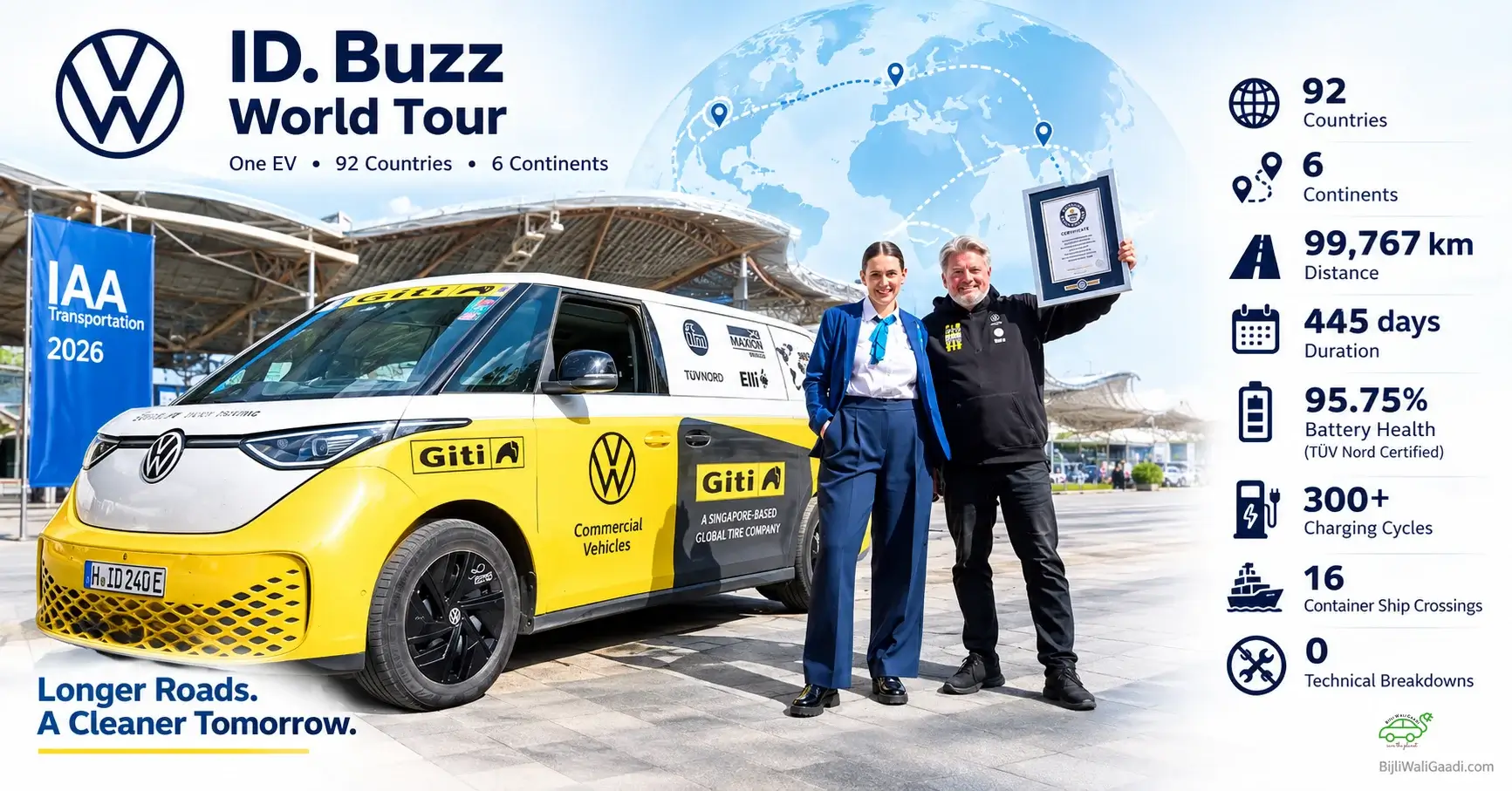
ID. Buzz World Tour by the Numbers
| Metric | Result |
| Driver | Rainer Zietlow |
| Vehicle | Volkswagen ID. Buzz Pro LWB |
| Countries | 92 |
| Continents | 6 |
| Distance | 99,767 km |
| Duration | 445 days |
| Charging cycles | 300+ |
| Container-ship crossings | 16 |
| Reported technical breakdowns | 0 |
| Battery state of health (TÜV Nord) | 95.75% |
| Finish | IAA Transportation 2026, Hanover |
Source: Volkswagen Commercial Vehicles press release.
What Happened to the Battery After 99,767 km?
TÜV Nord certified the high-voltage battery’s state of health at 95.75% after the journey. That is a measured result for this specific expedition vehicle, and it is a real-world long-distance data point, not a universal battery-degradation guarantee.
Volkswagen’s release does not describe TÜV Nord’s testing method, so none is assumed.
The no-breakdown claim comes from Volkswagen and Zietlow. “I had no technical problems,” he said, adding that TÜV Nord’s before-and-after inspection confirmed it. The release publishes only the battery result.
How the ID. Buzz Electric Powertrain Works
The ID. Buzz is a battery-electric vehicle (BEV), not a hybrid. Volkswagen Commercial Vehicles UK describes a lithium-ion high-voltage battery in the floor, mains charging and zero emissions while driving.
Life and Style versions use a rear-mounted electric motor. The GTX has two motors, front and rear. Placing the battery low in the “sandwich floor” lowers the centre of gravity, which Volkswagen says makes the ID. Buzz very agile.
The record vehicle is an ID. Buzz Pro LWB. The press release gives no motor layout and does not call it a GTX, so this table covers the current UK range.
| Powertrain detail | ID. Buzz (current UK range) |
| Vehicle type | Battery-electric (BEV) |
| Life and Style layout | Rear-mounted electric motor |
| Life and Style output | Up to 210 kW / 286 PS |
| GTX layout | Dual motor, front + rear |
| GTX output | 250 kW / 340 PS |
| Maximum torque | 560 Nm (quoted in Volkswagen’s GTX section) |
| Battery position | Floor-mounted “sandwich floor” |
ID. Buzz Technical Specifications
Official WLTP range varies by configuration, so each table names its source.
| Specification | Record vehicle (press release) |
| Vehicle | ID. Buzz Pro LWB |
| Net battery | 86 kWh |
| WLTP range quoted | Approx. 483–498 km, depending on model and equipment |
| DC charging | Up to 200 kW; 10–80% in under 30 minutes |
| Condition | Series production |
| Specification | Volkswagen Commercial Vehicles UK |
| Net battery | 79 kWh (84 kWh gross); 86 kWh for Life and Style 7-seat |
| Official WLTP range | 251–300 miles, depending on trim (300: Life 6-seat LWB; 251: GTX 5-seat SWB) |
| Maximum DC charging | 185 kW (5-seat); 200 kW (7-seat) |
| Charging time | About 30 minutes for 5–80%, under specified conditions |
| Length | 4,712 mm (5-seat); 4,962 mm (7-seat) |
| Wheelbase | 2,989 mm (5-seat); 3,239 mm (7-seat) |
| Boot capacity | 1,121 litres (5-seat); 306 litres (7-seat, third row up) |
| Trailer load | Up to 1,800 kg with optional towing device |
| Battery warranty | 8 years/100,000 miles |
What Did the World Tour Reveal About EV Charging?
Zietlow called the global picture “very mixed”. His account is one driver’s experience, not a survey.
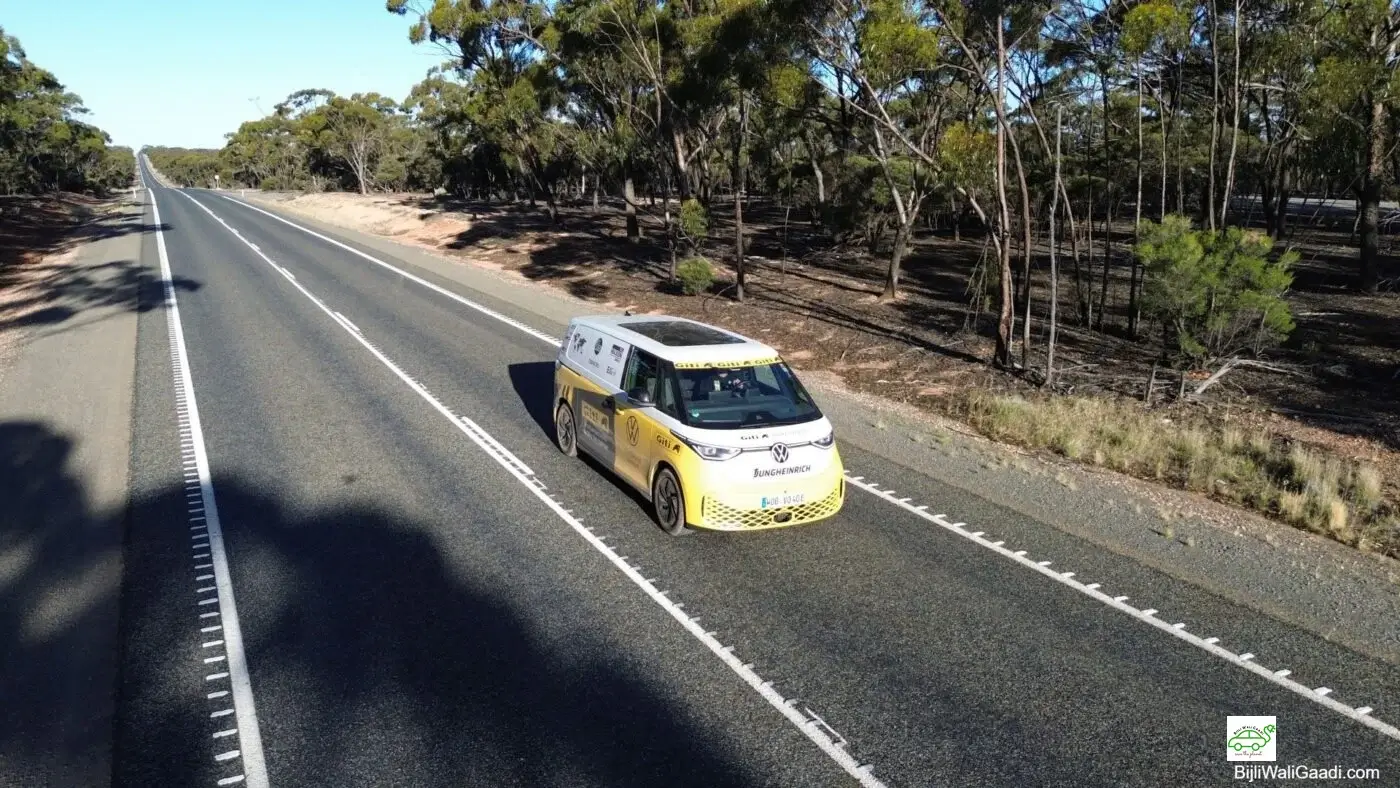
In Zambia and Tanzania, he said, nothing was available, so he charged at national substations under supervision. He said South Africa, Morocco and Rwanda already work well, cited fast progress in Saudi Arabia, Brazil and Chile, and called China “in a league of its own.”
Zietlow said he preferred the EV because some markets can present diesel-fuel quality challenges, while the ID. Buzz avoided oil changes and engine-overheating risk.
What Does This Mean for EV Buyers?
Zietlow’s message was that the record was driven in a series-production ID. Buzz. Weigh that against the limits: one vehicle, one driver, results reported by Volkswagen.
Volkswagen’s UK page adds that battery capacity reduces over time with use and charging, and cites an 8-year/100,000-mile battery warranty.
ID. Buzz World Record FAQs
–
Stay connected via Google 'Electric Vehicle' News
Follow BijliWaliGaadi | India's Trusted EV Insights Portal
source on Google