xEVs- Difference between Battery Electric Vehicle (BEVs), Plug-in Hybrid (PHEVs) and Hybrid Vehicle (HEVs)
Stay connected via Google 'Electric Vehicle' News
Follow BijliWaliGaadi | India's Trusted EV Insights Portal
source on Google
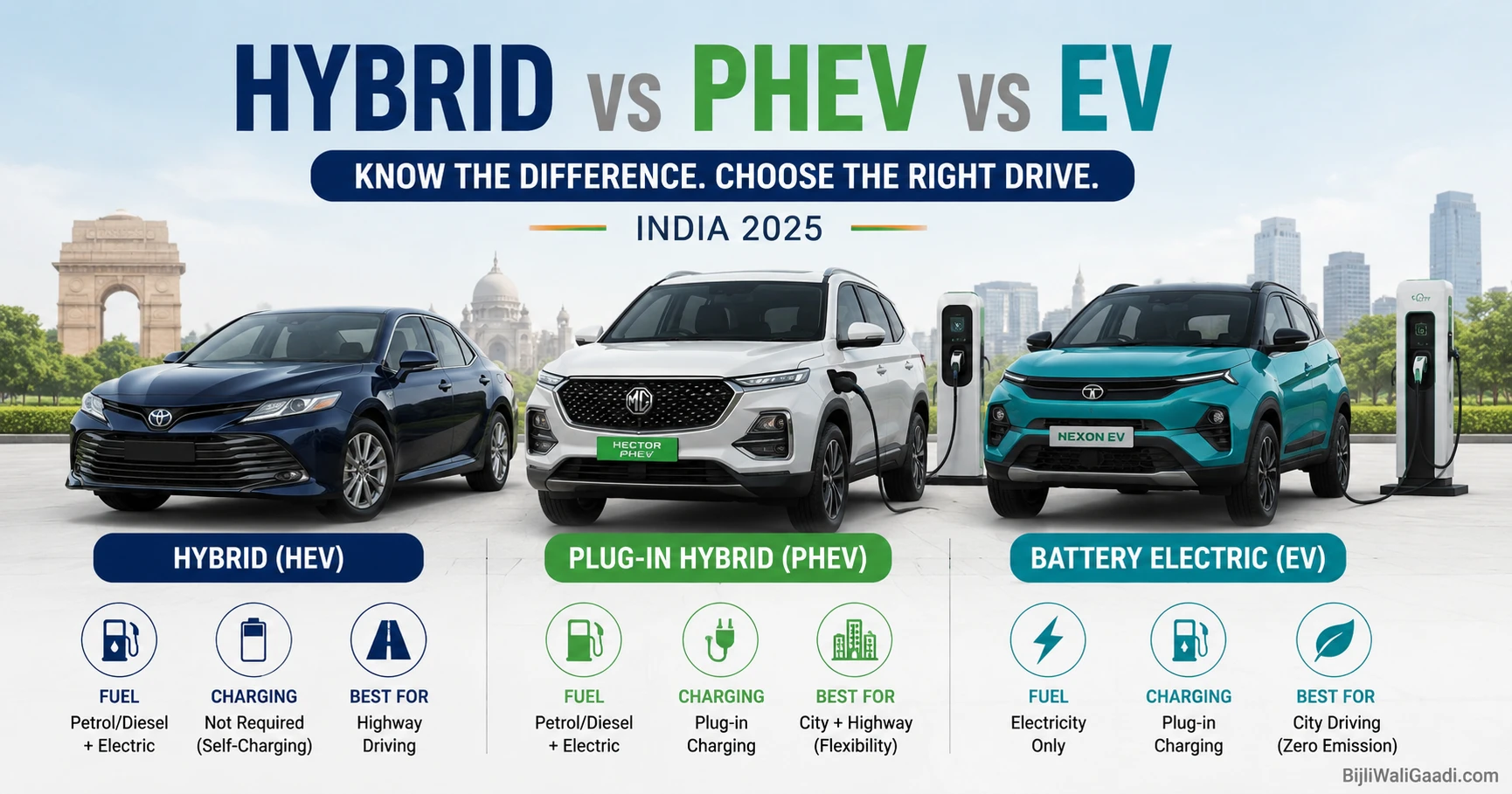
Comparing Electric Vehicles (EVs):
HEVs vs. BEVs vs. PHEVs vs. FCEV
Should you buy a pure electric car, a hybrid, or a plug-in hybrid in India? With brands like Tata, Toyota, Mahindra, BYD, Hyundai and Maruti promoting different technologies, many buyers are confused about what BEV, HEV and PHEV actually mean. This guide explains everything in simple language with practical Indian examples, running costs, charging needs and real-world usability.
EVs:Electric Vehicles
HEVs: Hybrid Electric Vehicles
BEVs:Battery Electric Vehicles
PHEVs: Plug-in Hybrid Electric Vehicles
FCEVs: Fuel Cell Electric Vehicles
 |
| Smart Hybrid Vehicle by Suzuki |
| Technology | Needs Charging? | Uses Petrol? | Pure Electric Driving | Best For |
| BEV | Yes | No | Full-time | City + Highway EV users |
| HEV | No External Charging | Yes | Limited | Mileage-focused buyers |
| PHEV | Yes | Yes | Moderate | Mixed usage buyers |
Why it is important to understand these HEVs, BEVs, PHEVs, and FCEVs:


How these xEVs are different than Petrol/Diesel Vehicles:
Conventional Vehicle:
Petrol or Diesel is stored into fuel tank of the vehicles and from there it goes to the internal combustion engine. Internal combustion engine generate the power which goes through the flywheel- Clutch- Gearbox- Propeller shaft- Differential to wheels of the car.
There are some advantages of conventional car like-
– Fast Refueling
– Long range
– No electric power

Hybrid Electric Vehicles (HEVs):
Battery range: 0 km
Power generated : 0.5kW-3kW
Voltage: 12 Volt
Example: Maruti Suzuki SHVS technology is a hybrid system which now comes nearly all the high variant models of company car.
other cars are – Toyota Prius, Ford C-Max.
Plug-in Hybrid Vehicle (PHEVs):
Battery range: >20 kms
Power: >20 kW
Voltage: 130V – 400V
There may be different layout of Engine,Battery,Inverter and Motor inside any PHEVs and those pattern/layout need to understand. Here I will try to explain the different types of Hybrid vehicles-
a) Parallel Hybrid
b) Serial Hybrid
c) Serial/Parallel Hybrid (Power Split)

Parallel Hybrid:
In this design, the internal combustion engine and an electric propulsion system are connected directly to the vehicle's wheels. The vehicle uses the primary engine for highway driving and the electric motor provides additional power for acceleration, Hill climbing and other on on demand activity. In above picture it can be seen that vehicle's front wheel is connected with the engine while rear wheels take drive from the battery and motor. This arrangement can be such a way that both engine and e-motors are connected to the drive-train of front or rear wheels and power output from either of unit would be as per choice. So, this is on demand and we also can drive purely at electric for more than 20 kms. Our conventional IC engine car can easily convert into this type of parallel hybrid electric vehicle by putting very little effort. Battery is charged from the regenerative braking system and with external charging station.
Serial Hybrid:
In serial hybrid vehicle either front or rear wheels are connected with conventional engine and electric motor/battery. There is no mechanical connection between road wheel and combustion engine directly. Combustion engine runs the generator and it fills the battery and battery power operate the e-motor to drive the wheels. In above image the vehicle’s front wheels are taking drive from the electric motor/battery as well as from the internal combustion engine. Inverter is placed between e-motor and battery which has a specific purpose. Inverter takes DC current from the battery and convert is into 3-phase AC current to operate the motor. Inverter also do the charging work for the battery when it get’s energy from the re-generative braking system or from the engine (optional). On board battery pack can be charge from external charging stations. The serial hybrid comes with a special technical tag line- Battery electric vehicle with range extender.
Advantage: Internal combustion engine can be run on maximum efficiency point to minimize the fuel expenses.
 |
| Chevy Volt Power-train cut section. Image Credit: Wikipedia- Mario Roberto Duran Ortiz |
Serial/Parallel Hybrid (Power Split):
This is simply combination of 1st and 2nd type of hybrid explained above. Electric motor and internal combustion engines drives either front wheels or rear. Planetary gearbox works here to split the power between e-motor and internal combustion engine
First Hybrid Car Toyota Prius 1991 was the serial/parallel hybrid. Maximum hybrid vehicles running on the road are serial/parallel hybrid because it has advantage to run either e-motor and engine or both at their optimum efficiency range. It’s completely choice based. It also offer the facility to charge the battery from the engine.
Battery Electrical Vehicles (BEVs):
Battery electric vehicles run exclusively on the on-board battery power. There is no other power source or power generator like internal combustion engine is used. Now there are many BEVs in the market. Tesla exclusively produces electric car and Tesla Model 3 is one of the most selling electric car in the world. Other companies like BYD, SAIC, BMW, Nissan, BAIC, Geely, Volkswagen, Hyundai, Mitsubishi, Toyota, Renault, Volve and Chevrolet are the major player worldwide in battery electrical vehicle market.
So, in future also the BEVs will dominate the automobile market and expected to reach upto 45% of the total vehicle sell in the world by 2040.
|
Manufacturer
|
Vehicle
|
Drive Range (KMs)
|
|
Mahindra Electric
|
e2o+
|
140
|
|
Audi
|
e-tron
|
328
|
|
BMW
|
i3 & i3s
|
246
|
|
Chevrolet
|
Bolt EV
|
383
|
|
Fiat
|
500e
|
135
|
|
Honda
|
Clarity Electric
|
143
|
|
Hyundai
|
IONIQ Electric
|
199
|
|
Hyundai
|
Kona Electric
|
415
|
|
Jaguar
|
I-Pace
|
376
|
|
Kia
|
Niro EV
|
384
|
|
Nissan
|
Leaf
|
241 to 345
|
|
Tesla
|
Model 3
|
354 to 498
|
|
Model S
|
555 to 595
|
|
|
Model X
|
490 to 523
|
Fuel Cell Electric Vehicles (FCEVs):

 |
| Hyundai_ix35_hydrogen_fuel_cell_car |
FAQs
-
What is the difference between HEV and PHEV?
The simplest way to think about it: an HEV is a smarter petrol car, while a PHEV is closer to a real electric car with a backup engine. An HEV charges its tiny 12V battery on its own — through the engine and regenerative braking — and never needs a plug. A PHEV carries a much larger battery (130V–400V), plugs into a charger, and can cover 20+ km on pure electricity before the engine ever wakes up.
-
Is the MG Windsor EV BaaS option worth it in 2026?
It’s a great move if you want to keep your initial cheque under ₹10L or if you don’t have home charging. At ₹3.9–₹4.5/km, it’s perfect for moderate city use. However, if you’re a high-mileage driver doing over 1,200 km a month, you’re better off buying the battery outright to save money in the long run.
-
What is the difference between BEV, PHEV, HEV, and FCEV?
MeThese are the four flavours of electrified vehicles — each one using electricity differently:
• HEV — a petrol car with a small self-charging battery that never needs a plug.
• PHEV — a petrol-electric car with a rechargeable battery good for 20+ km of electric-only driving.
• BEV — a fully electric car powered entirely by a battery you charge externally. No engine at all.
• FCEV — generates its own electricity from hydrogen on board, emitting nothing but water vapour. -
Does a hybrid car need charging?
If you own a regular hybrid (HEV), you never need to worry about charging — it quietly handles that itself while you drive, using the engine and regenerative braking. A plug-in hybrid (PHEV), however, genuinely benefits from being plugged in regularly. Leave it uncharged and it still runs, but you’d essentially be driving a heavier petrol car and missing out entirely on the affordable electric kilometres it was designed to deliver.
-
Is PHEV available in India?
Yes, PHEVs are available in India, but the market is currently split between high-end luxury imports like the Porsche Cayenne S E-Hybrid (₹1.44 Cr+) and a new wave of localized “affordable” options.
While long-standing models like the BMW X5 45e and Volvo XC90 Recharge have largely transitioned to mild-hybrids or full EVs in India, mass-market disruption is arriving this year via JSW-MG and Jetour, with SUVs like the Jetour T2 PHEV launching by Diwali 2026 in the ₹25–30 lakh bracket.
-
Which EV technology gives the lowest running cost in India?
Nothing beats a BEV when it comes to running costs in India. At roughly ₹1–1.5 per kilometre, it costs a fraction of the ₹6–8 per km you’d spend in a petrol car. A PHEV comes close — but only if you’re disciplined about keeping it charged and doing most of your daily driving on electricity. An HEV does save fuel compared to a conventional car, but since petrol is always in the equation, its per-kilometre cost is the highest of the three.
-
Which is better in India — a Hybrid or a BEV?
Honestly, the technology isn’t the deciding factor — your charging access is. If you can charge at home or at work, a BEV is the smarter, cheaper, and more future-ready choice. But if you’re frequently on long highway drives, live in a city where public chargers are still sparse, or stay in an apartment with no charging point, a hybrid gives you genuine peace of mind that a BEV simply cannot yet match everywhere in India.
-
Are hybrids future-proof in India?
For the next several years, yes — hybrids still make a lot of sense in India, especially outside the major metros. The charging network is growing fast, but it hasn’t reached the kind of density that makes a BEV stress-free for every Indian buyer yet. In that window, a hybrid is a cleaner, more practical step forward from a petrol car. Long-term though, as charging infrastructure catches up, the road in India leads clearly toward BEVs.
-
Is a BEV good for long-distance driving in India?
A BEV handles long-distance driving well on popular highway corridors — think Delhi–Jaipur, Mumbai–Pune, or Bengaluru–Mysuru — where fast chargers are increasingly available. With most modern BEVs offering 250–500 km of real-world range, the distances are rarely the problem. The challenge is less-travelled routes, where charging infrastructure is still catching up. For now, long-distance BEV travel in India rewards those who plan ahead.
-
What are the three types of hybrid drivetrain layouts?
Not all hybrids work the same way under the bonnet — the architecture matters:
• Parallel Hybrid — the engine and electric motor both drive the wheels, together or independently. Maruti’s SHVS is a familiar example.
• Serial Hybrid — the engine never touches the wheels; it runs a generator to charge the battery, which then powers the motor.
• Power Split (Serial/Parallel) — the clever combination of both, using a planetary gearbox to always pick the most efficient mode. The Toyota Prius pioneered this, and it remains the most fuel-efficient hybrid layout on the road today. -
What is an FCEV and how is it different from a BEV?
A Fuel Cell Electric Vehicle (FCEV) makes its own electricity on board by combining hydrogen and oxygen — and the only thing coming out of the tailpipe is water vapour. Unlike a BEV, you don’t plug it in; you refuel it with hydrogen in roughly the same time it takes to fill a petrol tank. The Hyundai Nexo is the most notable example globally. For India, FCEVs remain a technology of the future — hydrogen refuelling stations simply don’t exist here yet.
-
What does xEV mean?
xEV is the auto industry’s shorthand for every kind of electrified vehicle, where the “x” stands in for whichever type of electrification is involved — H for Hybrid, P for Plug-in, B for Battery, or F for Fuel Cell. It’s a clean, collective term that separates all electrically-assisted vehicles from the conventional petrol and diesel world. With global forecasts projecting xEVs to account for 57% of all new passenger vehicle sales by 2040, it’s a term worth knowing well
Stay connected via Google 'Electric Vehicle' News
Follow BijliWaliGaadi | India's Trusted EV Insights Portal
source on Google