BYD Atto 3 Battery Replacement Cost in India
Stay connected via Google 'Electric Vehicle' News
Follow BijliWaliGaadi | India's Trusted EV Insights Portal
source on Google
BYD Atto 3 battery replacement cost | BYD Atto 3 battery cost | BYD Atto 3 49.92 kWh battery cost | BYD Atto 3 61.48 kWh battery cost | BYD Atto 3 battery replacement cost in India
Quick Summary:
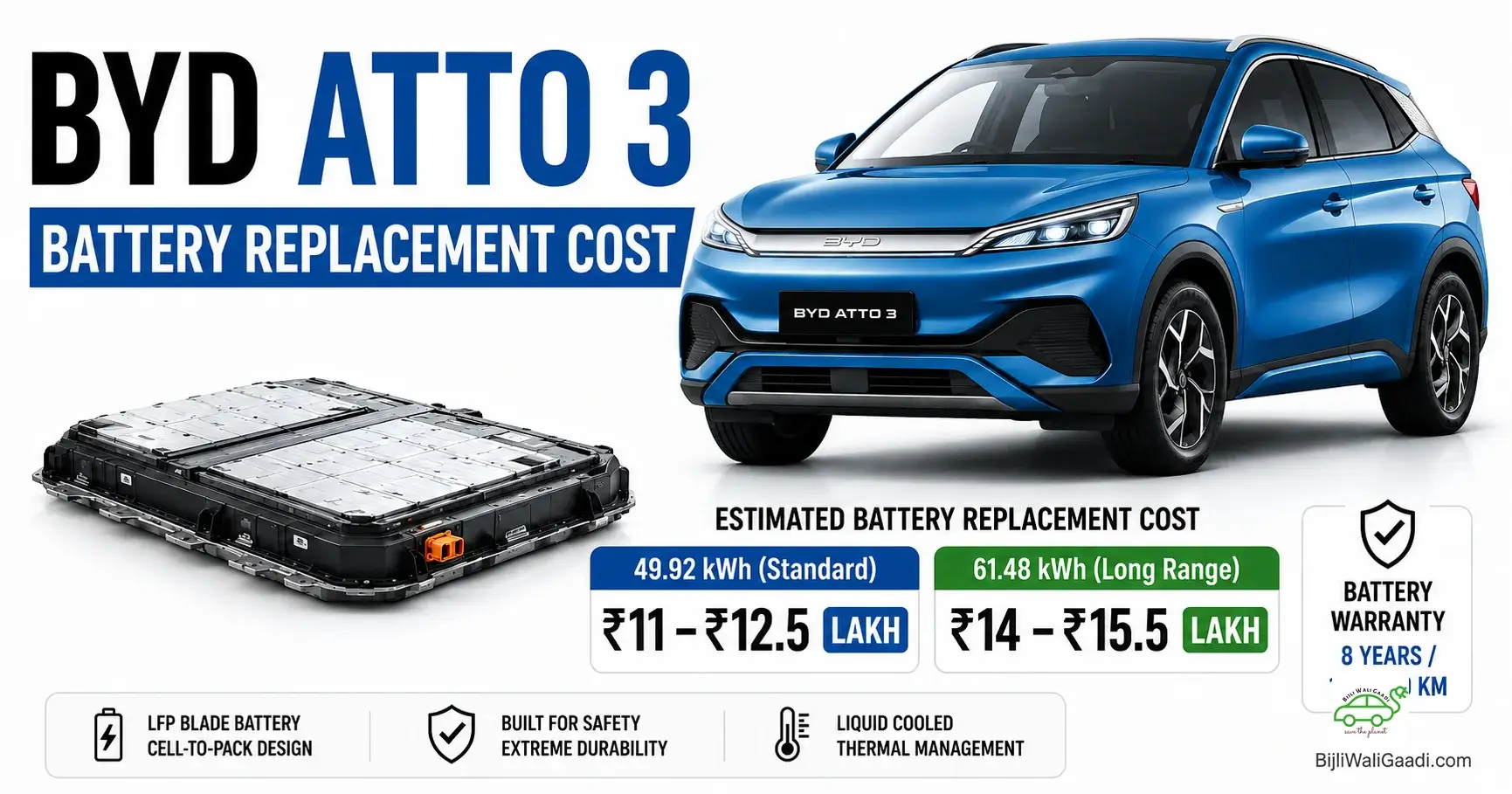
The BYD Atto 3 battery replacement cost is estimated at ₹11 lakh–₹15.5 lakh for its LFP Blade Battery, depending on pack size — roughly ₹11 lakh–₹12.5 lakh for the 49.92 kWh pack, and ₹14 lakh–₹15.5 lakh for the 61.48 kWh pack. Both are covered by an 8-year/1,60,000 km warranty in India. Note: BYD’s newer 8-year/250,000 km Blade Battery warranty extension, announced in January 2026, currently applies only to Europe — not India.
Battery replacement anxiety around the Atto 3 comes with an unusual twist: BYD markets the Blade Battery as one of the safest, most abuse-resistant packs on sale — nail penetration tests, a 46-tonne truck rolling over it, the works. What BYD’s own India brochure doesn’t advertise quite as loudly is that this same structural design, where the cells themselves form part of the pack’s load-bearing frame, makes casual cell-by-cell repair far less realistic than it sounds. Here’s what that actually means for your wallet.
Key Specification & Battery Cost at a Glance
| Parameter | Technical Specification |
| Vehicle Model | BYD Atto 3 (Dynamic / Premium / Superior) |
| Battery Pack Capacity | 49.92 kWh (Dynamic) or 61.48 kWh (Premium / Superior) |
| Cell Chemistry / Tech | LFP (Lithium Iron Phosphate), BYD Blade Battery, cell-to-pack design |
| Battery Architecture | Cell-to-Pack (CTP) Blade Battery |
| Factory Warranty | 8 Years / 1,60,000 km (traction battery) |
| Est. Replacement Cost (Part + GST + Labour) | ₹11 lakh – ₹15.5 lakh |
| Estimated Cost per kWh | ≈ ₹22,000 – ₹25,200/kWh |
| Thermal Management | Liquid-cooled (BYD e-Platform 3.0) |
A note on the cost estimate: BYD India has never published an official battery replacement price list, so treat ₹11 lakh–₹15.5 lakh as a planning estimate rather than a confirmed BYD figure. Independent reporting on the Atto 3 varies enormously as a result — from as low as ₹6 lakh–₹8 lakh at the optimistic end, to ₹15 lakh–₹18 lakh at the pessimistic end. A 2025 dealer-pricing scandal in Nepal (a separate market from India, but instructive) saw showrooms quoting anywhere from ₹7 lakh to ₹21.95 lakh for the same job. Get a written quote from an authorised BYD India service centre before budgeting.
Detailed Battery Replacement Cost Breakdown for the BYD Atto 3
Component-level costing. A replacement bill bundles the Blade Battery pack itself (LFP cells + BMS + structural housing + liquid-cooling hardware), GST on spare parts, diagnostic checks, and fitment labour. BYD’s brochure confirms the pack’s engineering (cell-to-pack integration, 8-in-1 electric powertrain via e-Platform 3.0) but includes no pricing information.
Two packs, two price bands. The Dynamic variant’s smaller 49.92 kWh pack runs an estimated ₹11 lakh–₹12.5 lakh to replace; the Premium and Superior variants’ larger 61.48 kWh pack runs ₹14 lakh–₹15.5 lakh. The larger pack has approximately 23% more nominal energy capacity, which contributes to its higher replacement estimate. However, the final price is not determined by kWh alone; pack hardware, electronics, structural components, diagnostics, labour, logistics and service pricing can also influence the invoice.
Cost-per-kWh reality check. Based on the planning ranges used in this article, the implied replacement cost is approximately ₹22,000–₹25,200 per kWh. This should not be interpreted as the battery’s manufacturing cost or as a direct market benchmark, because replacement pricing also includes the pack assembly, electronics, diagnostics, labour, logistics and applicable taxes. The premium here likely reflects the Blade Battery’s structural cell-to-pack construction (no separate modules to swap) combined with BYD’s still-developing parts and service logistics in India, rather than the LFP chemistry itself.
Why “cell-level repair” is more theoretical than practical here. BYD’s Blade Battery packs individual prismatic LFP cells directly into the pack housing, skipping the module stage entirely — a genuine safety and packaging advantage, but one that works against easy piecemeal repair. Some Nepal dealer quotes circulated a figure of ~₹6,000 per cell across roughly 105 cells (implying a ~₹6.3 lakh full-pack estimate), but authorised centres in practice default to full-pack replacement for any major fault, since the structural cell-to-pack design isn’t built for routine individual cell swaps the way older modular EV batteries are.
BYD Atto 3 vs Other EVs: How Does the Battery Cost Compare?
| Vehicle | Estimated Battery Replacement Cost |
| BYD Atto 3 | ₹11–15.5 lakh |
| Tata Nexon EV | Planning estimate |
| Hyundai Creta Electric | Planning estimate |
| Mahindra BE 6 | Planning estimate |
All figures above are planning estimates pending official OEM pricing — none of these manufacturers publish a fixed nationwide battery replacement price.
OEM Warranty Terms vs Out-of-Warranty Reality
Coverage scope. BYD’s warranty structure for the Atto 3 in India:
- Traction battery: 8 years / 1,60,000 km, whichever comes first
- Motor & motor controller: 8 years / 1,50,000 km
- DC-DC assembly, HV electric control, OBC: 6 years / 1,50,000 km
- General vehicle warranty: 3 years / 1,25,000 km
- 12V auxiliary battery, tyres: 1 year / 20,000 km
The Europe-only warranty extension — don’t get confused by this. In January 2026, BYD globally announced an extension of the Blade Battery warranty to 8 years / 2,50,000 km with a guaranteed minimum 70% State of Health, up from 1,50,000–2,00,000 km previously. Every official BYD source confirms this applies specifically to European customers, retroactively covering existing owners there — it has not been extended to India as of this writing. If you see this news cited in relation to an Indian Atto 3, treat it with caution; India’s standard remains 8 years/1,60,000 km.
State of Health (SOH) threshold. BYD’s warranty coverage includes protection against degradation beyond specific thresholds — global BYD documentation ties this to a guaranteed minimum 70% SOH during the warranty period, though BYD India’s consumer-facing material doesn’t spell this out in plain language. Confirm the exact clause with your dealer.
Warranty void traps. The exclusions that actually cost owners money: damage from flooding, extreme external impacts (including rodent bites, per BYD’s own guidance), and accident damage are explicitly excluded from HV battery warranty coverage. A July 2025 case in Noida saw a BYD Seal owner billed ₹18.35 lakh for flood damage precisely because their insurance lacked a “Battery Protect Plus” add-on — a useful reminder that standard zero-depreciation motor insurance typically does not cover battery short-circuits from water ingress. Check that your policy includes an Electrical & Electronic Breakdown rider.
Indian Tropical Climate & Battery Longevity Factors
Thermal stress in Indian summers. LFP chemistry — the Blade Battery’s foundation — is inherently well-suited to India’s 40°C+ summer ambient temperatures, with a higher thermal-runaway threshold and slower calendar-aging than NMC packs. This is one of the genuine advantages of BYD’s chemistry choice for the Indian market.
Thermal management efficiency. The Atto 3 uses a liquid-cooled battery pack as part of BYD’s e-Platform 3.0, with a heat pump system BYD claims can improve thermal efficiency by up to 20% and operate across a -30°C to 60°C range — relevant mainly for extreme cold, but the same active thermal regulation helps during Indian summer fast-charging sessions too.
Real-world degradation expectations. BYD’s own India brochure states the Blade Battery is rated for “more than 1,000” charge cycles — a notably more conservative figure than BYD’s global marketing claims of 3,000+ cycles quoted in other markets. Available real-world evidence suggests that battery degradation does not automatically mean a full-pack replacement is required, but individual battery health varies with usage, climate, charging behaviour and operating conditions. Given the gap between BYD India’s printed cycle-life figure and its own global marketing claims, treat “1,000+ cycles” as the more conservative, locally-documented baseline.
Module-Level Repair vs Full Pack Replacement: What Owners Need to Know
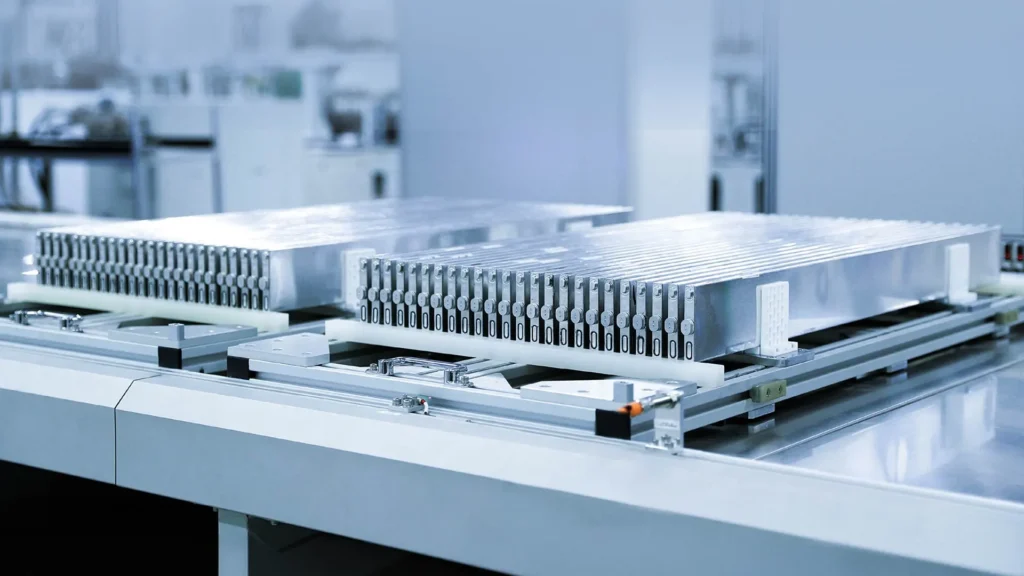
Cell/module swap capability. This is the Atto 3’s key nuance: because the Blade Battery’s cell-to-pack design eliminates the module layer entirely, isolated faults that would be module-repairable on a conventional EV battery often can’t be addressed the same way here. In practice, most major faults on the Atto 3 result in full pack replacement rather than a cheaper partial fix — a meaningful difference from vehicles using traditional modular battery architecture.
Third-party repair ecosystem. India’s independent EV battery-repair sector remains limited, and BYD’s structural pack design makes third-party intervention even less practical than on modular packs. Going outside BYD’s authorised network also voids any remaining warranty regardless.
Salvage and recycling credit. Degraded LFP packs retain meaningful value in India’s growing second-life energy storage (ESS) market, given LFP’s stability advantages for stationary storage applications. Exact trade-in terms for Atto 3 packs aren’t well-standardised yet — confirm the current offer with your BYD dealer.
Conclusion: Should This Change How You Own an Atto 3?
Not really — and that’s the point worth ending on. The 8-year/1,60,000 km battery warranty covers the vast majority of ownership scenarios most Atto 3 buyers will actually encounter; a genuine out-of-warranty replacement is an edge case, not a routine expense.
Where the real risk sits is elsewhere: uninsured or under-insured battery damage from flooding or accidents, which warranty explicitly doesn’t cover. Make sure your motor insurance includes an Electrical & Electronic Breakdown or “Battery Protect”-style rider — the Noida flood-damage case earlier in this article is exactly the scenario that add-on exists for.
If you ever do need a replacement, don’t work from any published estimate — including this one. Get a written, VIN-specific quotation from an authorised BYD service centre first, confirm what’s covered under warranty, and budget from that number rather than a general planning range.
Frequently Asked Questions (FAQs)
Stay connected via Google 'Electric Vehicle' News
Follow BijliWaliGaadi | India's Trusted EV Insights Portal
source on Google