E-Rickshaw Price in India 2026: 20+ Models, Battery Cost, Subsidy Details
Stay connected via Google 'Electric Vehicle' News
Follow BijliWaliGaadi | India's Trusted EV Insights Portal
source on Google
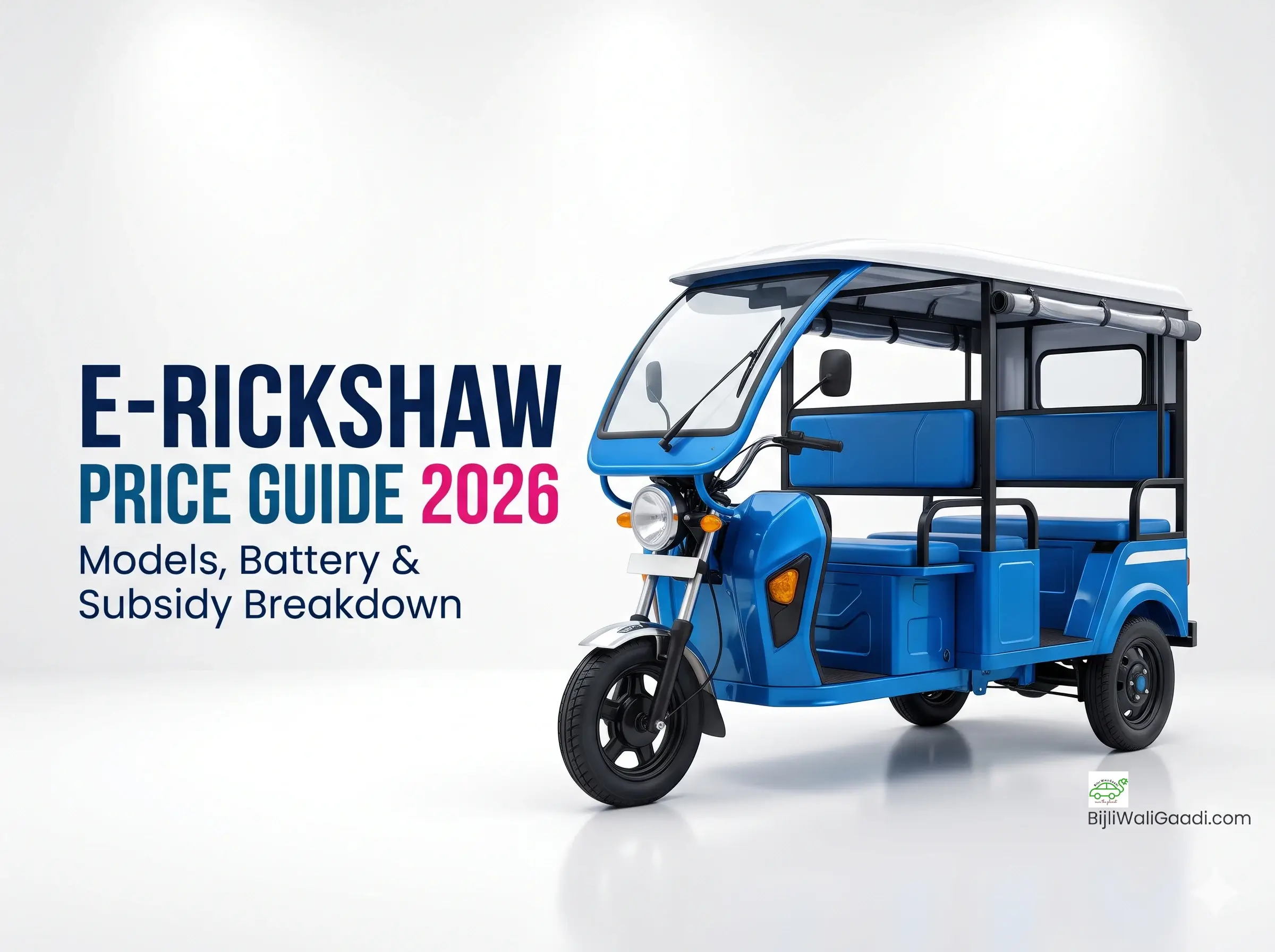
India’s three-wheeler market is splitting in two. At the bottom, low-speed e-rickshaws capped near 25 km/h remain the cheapest entry into commercial mobility. Above them, a newer tier of L5 electric autos from Bajaj, Mahindra, TVS, Euler and Montra competes on certified range, battery warranty and speed, at prices that reach about ₹4.5 lakh. Policy is reinforcing the split. Central PM E-DRIVE support for L5 vehicles closed on 26 December 2025, and Delhi’s 2026 EV policy will allow only electric L5 three-wheelers to be newly registered from 1 January 2027.
For a driver or fleet owner, sticker price tells only part of the story. A vehicle chosen on price alone can be slow to charge, hard to service or ineligible for an incentive. This guide separates conventional e-rickshaws from L5 electric autos, prices each model on a stated basis, and works through battery, charging, subsidy and running-cost arithmetic.
What Is the Price of an E-Rickshaw in India in 2026?
Listed e-rickshaw prices in India run from about ₹0.65 lakh to ₹4.5 lakh ex-showroom in 2026. Conventional passenger models checked on manufacturer pages cost ₹1.85–₹2.04 lakh, while L5 electric autos cost roughly ₹3.10–₹4.50 lakh, depending on battery, variant and city.
Prices vary with vehicle classification (L3 low-speed or L5 high-speed), battery chemistry (lead-acid or lithium-ion), passenger capacity and state incentives. The table sets out each category and the basis of its price.
| Vehicle category | Speed and battery specification | Typical price range (ex-showroom) | Pricing and data basis |
| Conventional passenger e-rickshaw (L3 low-speed) | Up to 25 km/h; lead-acid or 4–5.4 kWh lithium-ion | ₹1.85–₹2.04 lakh | Verified on manufacturer pages for Bajaj Riki P4005 and Mahindra Treo Yaari. Unverified market references: ₹0.65–₹2.2 lakh from dealer listings |
| L5 passenger electric auto (high-speed commercial) | 45–60 km/h top speed; 9–18 kWh LFP or lithium-ion | ₹3.10–₹4.50 lakh | Delhi ex-showroom launch and listed prices (for example Bajaj WEGO, Mahindra UDO) |
| Electric cargo three-wheeler or e-cart | Heavy-duty cargo hauling; 9–12.1 kWh battery | ₹3.87 lakh onwards | Ex-showroom Delhi launch figure for Bajaj WEGO C9009 at ₹3,87,371 |
Note for buyers: these are benchmark reference prices. The final on-road price depends on battery pack size, dealer location, RTO registration charges, state EV policy benefits and insurance.
What Is the Difference Between L3 E-Rickshaws, L5 Electric Autos and Cargo E-Carts?
L3 e-rickshaws are low-speed, low-power passenger vehicles capped near 25 km/h under Section 2A of the Motor Vehicles Act, while L5 electric autos are faster, more powerful commercial three-wheelers. PM E-DRIVE and Delhi’s policy treat them separately, so classification affects licence, permit and incentive eligibility.
“E-rickshaw” is used loosely in the market, but the vehicles differ in law, performance and subsidy treatment.
Classification decides the driving licence and permit rules, the speed limit, passenger capacity, insurance category and which incentive can apply. Check the category printed on the RC and type-approval papers before you pay, and do not compare an L5 auto with a low-speed e-rickshaw on price alone.
How Much Does a Conventional Passenger E-Rickshaw Cost in India?
Conventional passenger e-rickshaws checked on manufacturer pages cost ₹1.85–₹2.04 lakh ex-showroom: the Bajaj Riki P4005 is listed at ₹1,85,000–₹1,90,890 and the Mahindra Treo Yaari at ₹1.96–₹2.04 lakh. Dealer listings run from about ₹0.63 lakh, but those figures are unverified.
Which Conventional E-Rickshaw Prices Are Confirmed on Manufacturer Pages?
Two well known conventional models could be checked against manufacturer pages: the Bajaj Riki P4005 at ₹1,85,000–₹1,90,890 (ex-showroom New Delhi) and the Mahindra Treo Yaari Passenger at ₹1.96–₹2.04 lakh. Both are low-speed passenger vehicles with top speeds of 24.5–25 km/h.
| Model | Price (basis) | Battery and key specification |
| Bajaj Riki P4005 | ₹1,85,000 in the page body; ₹1,90,890 in page metadata (ex-showroom New Delhi) | 5.4 kWh (chemistry not stated), 149 km certified, 25 km/h, 5 seats including driver, 3 years/60,000 km warranty |
| Mahindra Treo Yaari Passenger | ₹1.96–₹2.04 lakh (manufacturer page, undated) | Lithium-ion 48 V, about 85 km typical real-world range, 24.5 km/h, D+4, 3 years or 40,000 km warranty |
What Are the Indicative Reference Prices for Other E-Rickshaw Models in India?
| Model | Indicative reference price (Not exact) |
| YC Electric Yatri Super | ₹1.73 lakh onwards |
| Kinetic Safar Smart | ₹1.53–₹2.18 lakh |
| Atul Elite Plus | ₹1.12–₹1.15 lakh |
| Saarthi DLX | ₹1.00 lakh onwards |
| Bahubali E-Rickshaw | ₹1.10–₹1.40 lakh |
| JSA E-Rickshaw | ₹1.15 lakh onwards |
| Thukral Electric ER 1 | ₹1.15–₹1.40 lakh |
| City Life Standard | ₹1.30 lakh onwards |
| Mayuri Deluxe | ₹1.30–₹1.50 lakh |
| Jezza Super J1000 | ₹1.39 lakh onwards |
| Mini Metro E-Rickshaw | ₹1.55 lakh onwards |
| Lohia Comfort | ₹1.55–₹1.75 lakh |
| E-Ashwa E-Rickshaw | ₹1.60 lakh onwards |
| Evex India Ranger | ₹0.68–₹0.70 lakh |
| SN Solar Energy Passenger | ₹0.65–₹0.70 lakh |
| Gkon Butterfly | ₹0.63–₹0.67 lakh |
These are historical or indicative reference figures. For models priced below about ₹1 lakh, ask the dealer for the type-approval certificate, battery chemistry and warranty in writing before paying.
How Much Do L5 Electric Autos Cost? Bajaj WEGO, Euler NEO, TVS King EV Max, Montra Super Auto and Mahindra UDO
L5 electric autos in this comparison start at ₹3,11,908 (Bajaj WEGO P5009 at launch) and reach about ₹4.5 lakh (WEGO P9018 at launch ₹4,48,303), with certified ranges from 155 km to 296 km. Prices are ex-showroom Delhi or listed, and Bajaj’s own pages disagree.
This is where OEM competition is sharpest. Bajaj has built the broadest ladder, with seven WEGO variants announced on 14 April 2026 across passenger and cargo use. Euler offers three NEO HiRANGE variants, TVS a single King EV Max, Mahindra the UDO with a six-year warranty claim, and Montra the Super Auto with two battery options. Rivals compete on certified range, battery size and warranty rather than price alone, and these vehicles are sold mostly on certified range rather than typical range.
| Model | Price (basis) | Battery | Certified range | Top speed |
| Bajaj WEGO P5009 | ₹3,11,908 (launch, ex-showroom Delhi, 14 April 2026) | 9.2 kWh | 213 km | 45 km/h |
| Bajaj WEGO P5012 | ₹3,69,301 (ex-showroom New Delhi) | 12.1 kWh | 272 km | 50 km/h |
| Bajaj WEGO P7009 / P7012 | Launch ₹3,23,001 / ₹3,63,062; the P70 page now shows “starting from” ₹3,74,299 | 9.2 / 12.1 kWh LFP | 182 / 259 km | 45 / 50 km/h |
| Bajaj WEGO P9018 | ₹4,41,247 (product page); launch ₹4,48,303 | 17.7 kWh LFP | 296 km | 45 km/h |
| Euler NEO HiRANGE | ₹3,09,999 / ₹3,59,999 / ₹4,07,999 (reported at launch by EVreporter); current price unconfirmed | 9.6 / 11.56 / 13.44 kWh (reported) | 171 / 204–205 / 261 km | 54–60 km/h (reported) |
| TVS King EV Max | Launched at ₹2.95 lakh in January 2025; a dealer listing shows ₹3.28 lakh (ex-showroom New Delhi) | 9.2 kWh LFP (TVS page; some reports say 9.7 kWh) | 179 km | 60 km/h |
| Montra Electric Super Auto | ₹3,79,500 at launch, stated as ex-showroom post-subsidy; listings show ₹3.77–₹3.80 lakh | 7.66 or 10.24 kWh (reported); listings differ | 155 or 203 km | Not verified |
| Mahindra UDO | ₹3,84,299 standard; ₹3,58,999 introductory at the February 2026 launch for a limited period | 11.7 kWh lithium-ion, IP67 | 265 km ARAI; 200 km claimed real-world | 55 km/h (Race mode) |
What Affects the On-Road Price of an E-Rickshaw?
On-road price equals ex-showroom price plus registration, insurance, taxes and dealer charges, and it differs by state and city. Compare quotations only on the same basis, and remember a low purchase price does not guarantee a low ownership cost.
A cheap vehicle with a short battery warranty and few service centres can cost more over three or four years.
Is There a Subsidy on E-Rickshaws in India in 2026?
PM E-DRIVE supports eligible commercially registered e-rickshaws and e-carts until 31 March 2028 while funds last, but L5 support closed on 26 December 2025. Delhi’s 2026 policy offers ₹50,000 in year one for eligible L5M e-autos, with conditions.
Eligibility depends on vehicle category, purchase date, registration and model approval. None of it is guaranteed. The policy direction is a tilt away from the low-speed segment at the central level and toward electric L5 autos in Delhi, which is why the category printed on your RC matters.
What Does PM E-DRIVE Offer E-Rickshaw Buyers in 2026?
The 27 March 2026 notification lists ₹5,000 and ₹2,500 per kWh rates for e-rickshaws and e-carts, capped at ₹25,000 and ₹12,500, with a ₹2.5 lakh ex-factory price limit. L5 autos such as WEGO and UDO should not be assumed to receive central support.
The 27 March 2026 notification extends the e-rickshaw and e-cart component to 31 March 2028 and confirms the L5 component closed on 26 December 2025. The 10 August 2026 amendment did not change the e-rickshaw row.
What Does the Delhi EV Policy 2026 Offer E-Rickshaw and E-Auto Buyers?
Delhi’s EV Policy 2026, in force from 1 July 2026 to 31 March 2030, offers L5M e-autos ₹50,000, ₹40,000 and ₹30,000 in years one to three. It lists no separate purchase incentive for conventional e-rickshaws, and the older ₹30,000 figure no longer applies.
The Delhi EV Policy 2026 took effect on 1 July 2026 and runs to 31 March 2030.
Stay connected via Google 'Electric Vehicle' News
Follow BijliWaliGaadi | India's Trusted EV Insights Portal
source on Google