Toyota Develops Next-Gen 1.5L Hybrid for Multi-Pathway Platforms, Targets 15%+ Better Fuel Economy
Stay connected via Google 'Electric Vehicle' News
Follow BijliWaliGaadi | India's Trusted EV Insights Portal
source on Google
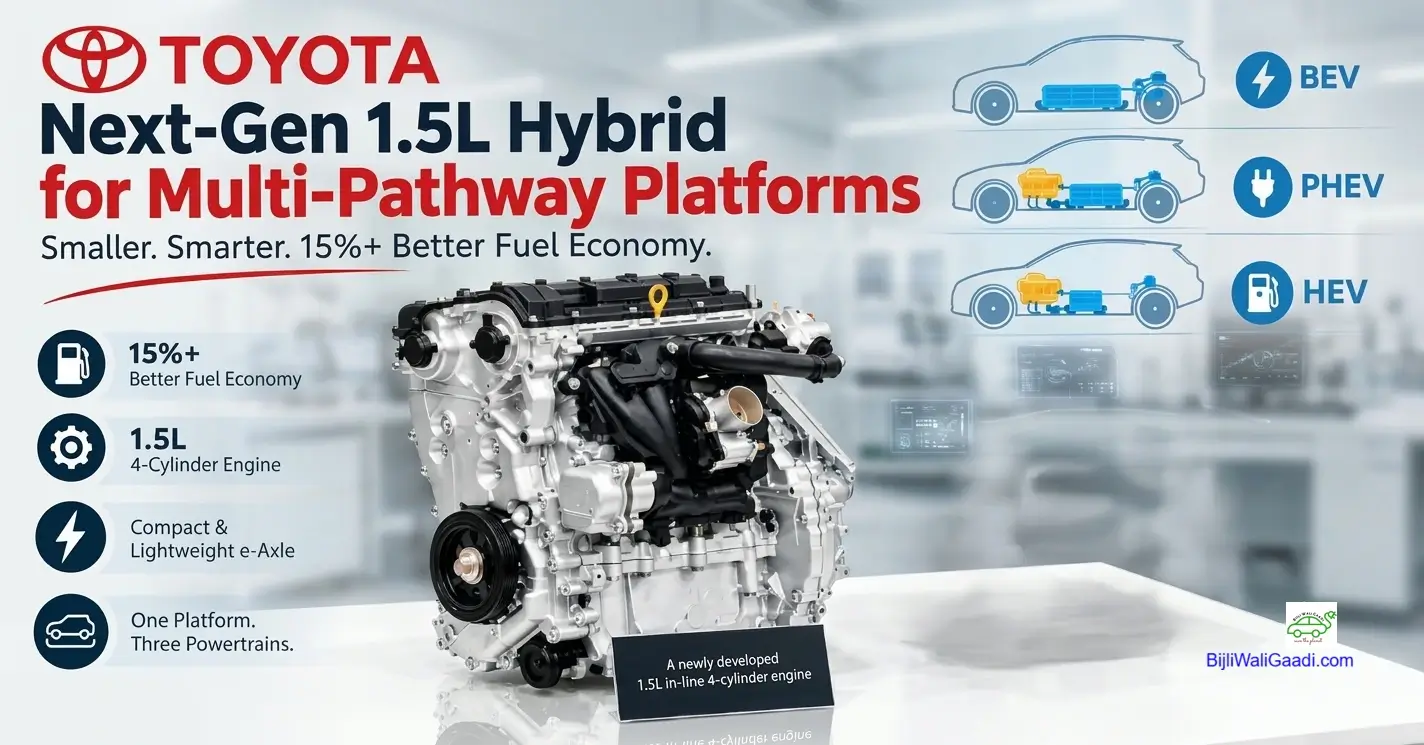
Toyota announced on 28 October 2026 that it is developing a next-generation hybrid powertrain for its future multi-pathway vehicle platforms. The system pairs a new family of 1.5-litre four-cylinder engines, in naturally aspirated and turbocharged form, with lighter, more compact electric motors, power control units and inverters. Toyota is targeting more than 15% better fuel economy.
Quick answer: Toyota’s next-generation hybrid is an integrated powertrain built around a new 1.5-litre four-cylinder engine family. It is much smaller than previous Toyota hybrid systems, so it can share a platform designed first for battery-electric vehicles with plug-in hybrid and hybrid versions.
Toyota’s Next-Generation Hybrid at a Glance
| Item | What Toyota says |
| Announced | 28 October 2026 |
| Engine | New modular 1.5-litre four-cylinder, naturally aspirated and turbocharged, designed for electrification |
| Electrification hardware | Lighter, more compact electric motors, power control units and inverters |
| Efficiency target | More than 15% better fuel economy |
| Platform | New multi-pathway platform shared by battery-electric, plug-in hybrid and hybrid vehicles |
| Fuels | Being developed to run on renewable and carbon-neutral fuels |
Why Toyota Is Building a Hybrid for an EV-First Platform
Toyota says energy circumstances differ by region and country, as do customer needs and preferences. Its multi-pathway approach responds by offering a range of electrified powertrains and adjusting the mix to market demand.
Because the new hybrid is much smaller than before, it can be packaged within platforms designed first for battery-electric vehicles.
New 1.5-Litre Four-Cylinder Engine: Naturally Aspirated and Turbocharged
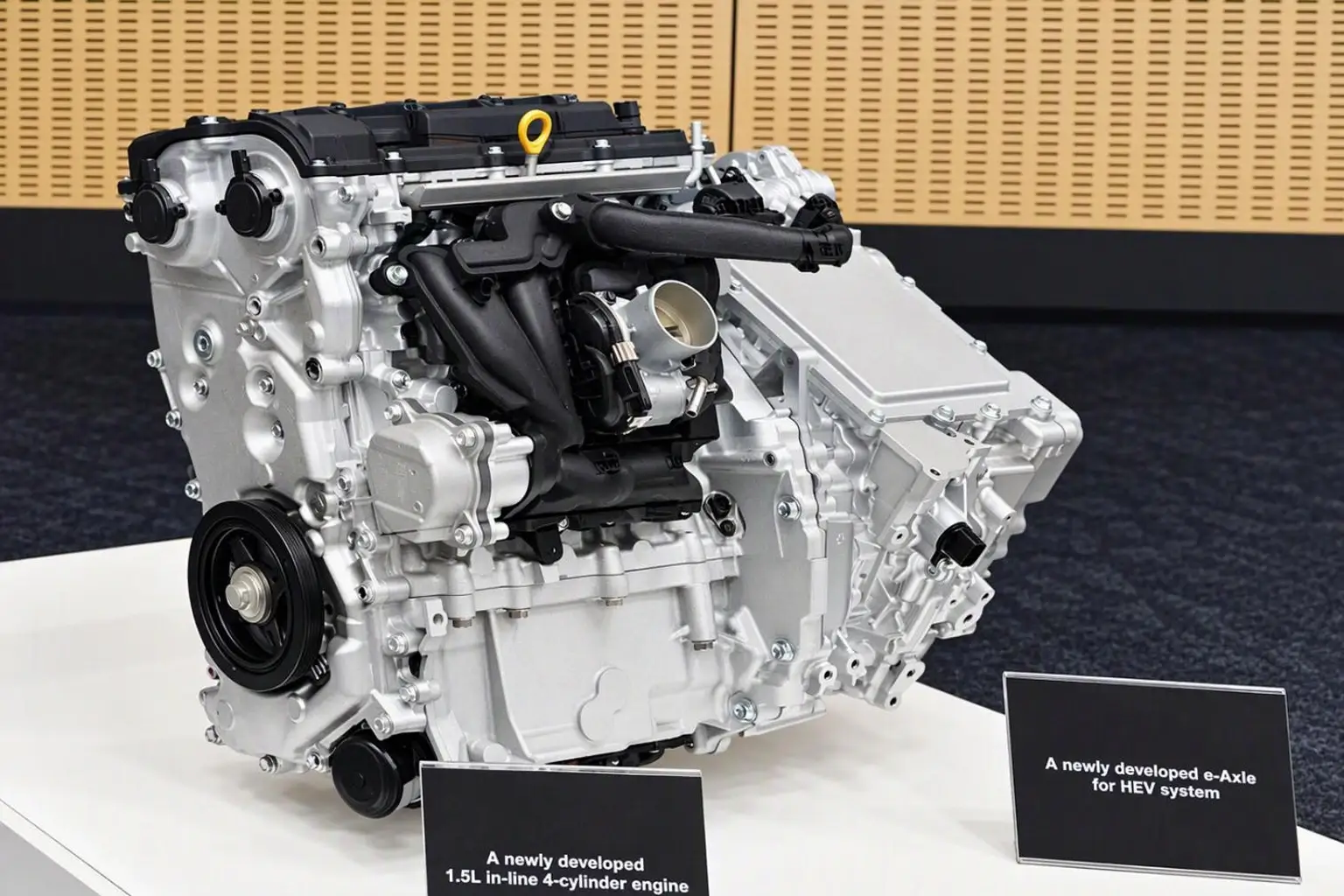
Toyota says it did not adapt an existing engine for electrified use. The engine, hybrid system and power electronics were developed together as a single integrated powertrain.
The new 1.5-litre engines were designed for electrification from the start and are smaller and more efficient than their predecessors. The naturally aspirated version is designed to cover the performance range now served by Toyota’s 1.8-litre engine and its current 1.5-litre three-cylinder engine. The family is modular, with a turbocharged variant alongside it.
Silicon Carbide Power Electronics and Lighter Motors Reduce System Losses
The engines are paired with lighter, more compact electric motors and power control units. According to Toyota’s UK release, these include Toyota-developed silicon carbide (SiC) power electronics. Toyota says integrating these components more closely is intended to reduce losses across the whole system.
A display unit shown beside the engine carries a placard reading “A newly developed e-Axle for HEV system”. Neither release gives specifications for it.
How Toyota Aims for More Than 15% Better Fuel Economy
Toyota expects the gain to come from four areas: lower mechanical friction, improved thermal management, reduced electrical losses and lower aerodynamic drag (a lower Cd value).
Two caveats are worth noting. First, this is a target, not a certified figure, and Toyota has not named a baseline model or test cycle. Second, aerodynamic drag is a vehicle-level factor, so part of the 15% depends on how the car is shaped, not on the engine and motors alone.
What Is Toyota’s Multi-Pathway Platform?
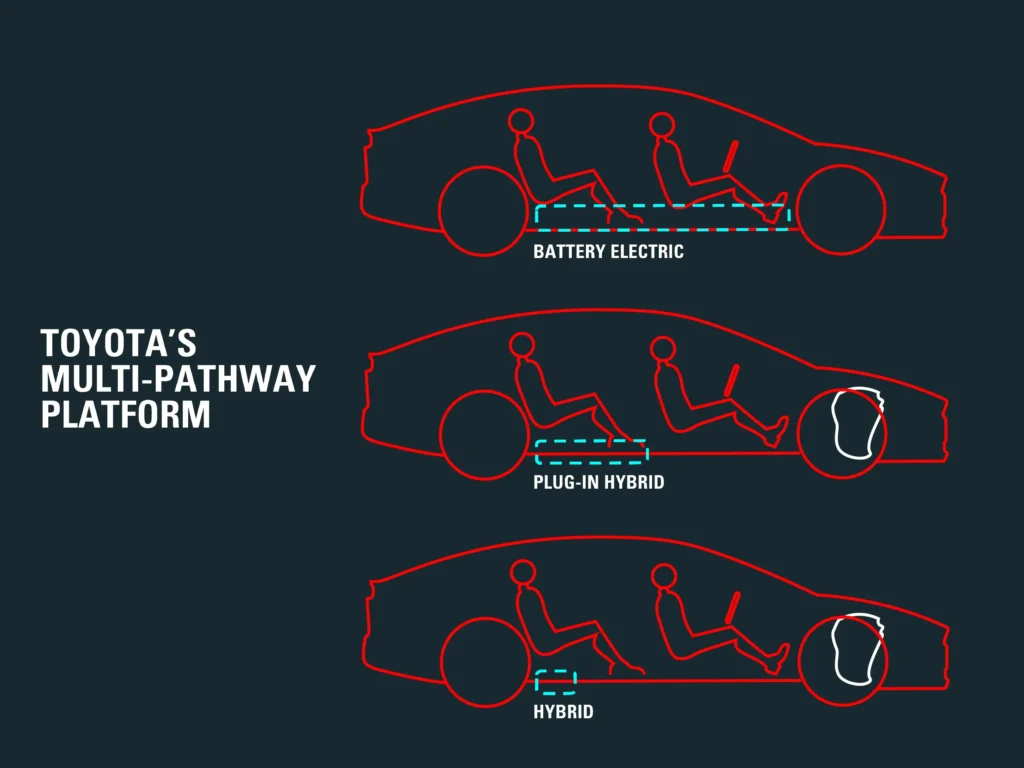
Toyota is developing the multi-pathway platform to deliver uncompromised performance and product appeal as a battery-electric vehicle. The compact new hybrid system can be integrated into the same platform. Hybrid and plug-in hybrid powertrains fit the same basic architecture without affecting the vehicle’s silhouette, interior space or capability.
Toyota’s platform graphic illustrates the idea. The body and seating layout are the same for the battery-electric, plug-in hybrid and hybrid versions. The underfloor battery space is largest in the battery-electric version, smaller in the plug-in hybrid and smallest in the hybrid, and a combustion engine appears only in the latter two.
Lower Bonnets and Freer Styling: What a Smaller Hybrid Means for Design
The lower-profile engine and hybrid package allow lower bonnet heights and more dynamic vehicle proportions. Designers can style the shape of the vehicle with fewer constraints.
Common Architecture: Economies of Scale and Manufacturing Flexibility
Battery-electric, plug-in hybrid and hybrid vehicles will share a common architecture, so Toyota can spread development and production investment across higher combined volumes. The result, Toyota says, is greater financial and engineering economies of scale, without compromising any variant. The architecture is also intended to let manufacturing adjust the powertrain mix to match customer demand.
Renewable Fuels and Carbon Neutrality: Hybrid’s Continuing Role
Toyota describes highly efficient hybrid technology as a continuing part of its multi-pathway approach to carbon neutrality. It plans to increase external sales of its new engine and hybrid technologies in the coming years.
The system is also being developed to run on renewable and carbon-neutral fuels. Toyota says this extends the contribution combustion-based electrified vehicles can make to reducing emissions while battery-electric and fuel cell electric technologies continue to expand.
About Toyota Motor Europe and the Toyota Group
The announcement was issued by Toyota Motor Europe NV/SA (TME), Toyota’s European organisation, which sits within the global Toyota group headed by Toyota Motor Corporation of Japan. TME oversees wholesale sales and marketing of Toyota, GR (Gazoo Racing) and Lexus vehicles and parts and accessories, as well as Toyota’s European manufacturing and engineering operations.
According to Toyota:
- It directly employs over 26,000 people in Europe and has invested over EUR 12 billion there since 1990.
- Its eight European manufacturing plants are in Portugal, the UK, France, Poland, the Czech Republic and Turkey.
- It sold 1,229,000 vehicles in Europe in 2025, a 7.2% market share.
- It aims to achieve carbon neutrality across its entire European business by 2040.
What Toyota Has Not Yet Confirmed
- Launch dates, model names or a market rollout plan
- Power, torque or engine codes for the 1.5-litre units
- Battery capacity, electric range or e-Axle specifications
- The baseline and test cycle behind the 15% target
- Availability in India or any other specific market
Analysis: What This Means for Hybrid and EV Buyers
For buyers, this is a statement of direction rather than a product launch. Toyota is engineering its next hybrids to share an EV-first platform. For Indian readers, neither release names India or any specific market for the new hardware, so local availability remains unannounced.
Bottom Line
Toyota is betting that one flexible architecture and a smaller four-cylinder hybrid can serve very different markets. Watch for the first production models, confirmed specifications and the baseline behind the fuel economy claim.
Sources: Toyota Europe Newsroom and Toyota UK Media Site,
Frequently Asked Questions
Stay connected via Google 'Electric Vehicle' News
Follow BijliWaliGaadi | India's Trusted EV Insights Portal
source on Google