Hyundai’s Game-Changing 2-Stage Motor: The 12-Switch Tech Ending the EV Range vs. Performance Debate

Hyundai 2-Stage Motor System | EV Inverter Technology | Dual Inverter | Hyundai Advance Technology for EV

The 2-stage motor technology : Hyundai Motor Group’s award-winning dual-inverter architecture boosts motor voltage by 70 percent, delivering supercar acceleration and commuter-grade efficiency from a single, compact unit — now powering the IONIQ 5 N, IONIQ 6 N, IONIQ 9, Kia EV6 GT, EV9, and EV9 GT.
Table of Contents
One Motor, Two Personalities: How Hyundai Solved the EV Efficiency Puzzle (simply explained)

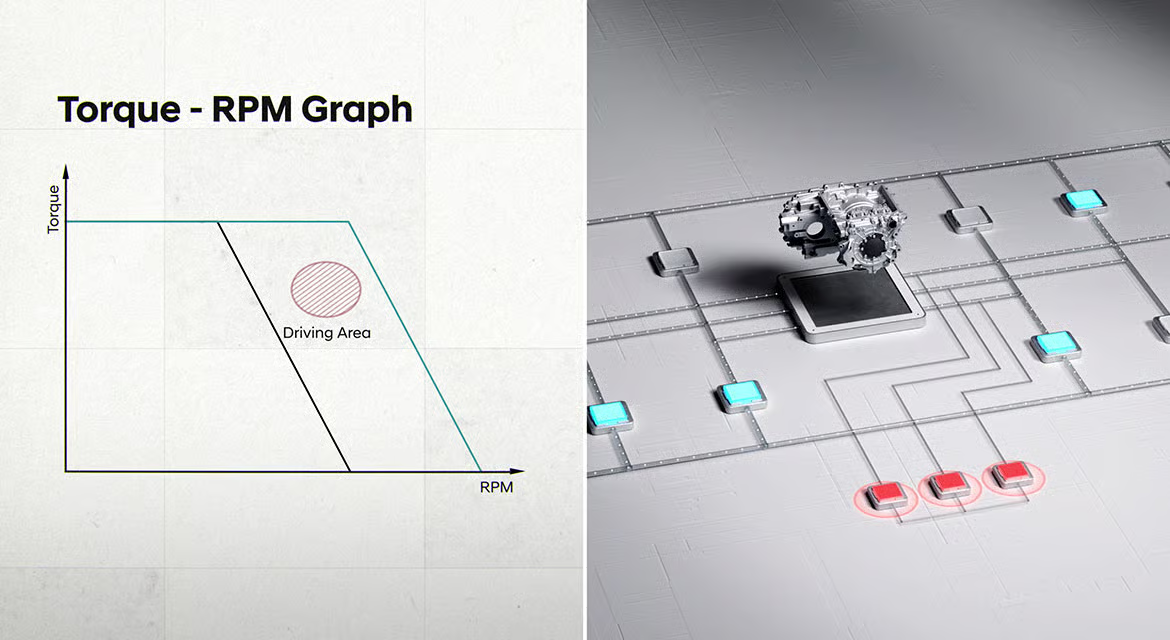
Hyundai’s 2‑Stage Motor transforms the E‑Axle (Inverter, Motor, Reducer) into a system that no longer forces a compromise between range and performance. In daily driving, the Inverter operates the Motor in a highly efficient mode—ideal for city traffic and steady cruising—helping maximize range without changing your driving style.
But the real breakthrough comes when you demand power. During 0–100 km/h acceleration or quick highway overtakes, the same Inverter instantly unlocks a second stage, delivering higher voltage to the Motor. This keeps the pull strong and continuous, instead of tapering off at higher speeds.
The result is an E‑Axle that feels refined in the city, yet noticeably more responsive and powerful when pushed. Overtakes become quicker, high-speed driving feels more effortless, and acceleration remains consistent across the speed range.
In simple terms, Hyundai’s 12‑switch Inverter allows one E‑Axle to behave like two—efficient when you need range, and powerful when you want performance—finally resolving the long-standing EV trade-off.
The EV Dilemma: Why High Performance Usually Kills Driving Range
Every electric vehicle relies on three interdependent subsystems: the motor, the reducer, and the inverter. The motor generates torque; the reducer transmits it to the wheels; the inverter converts the battery’s direct current into the alternating current the motor needs, while precisely governing how and when that power is delivered.
Increasing an EV’s peak power traditionally meant raising the motor’s current. That approach works — but it carries a penalty. Higher current demands larger, heavier hardware, makes thermal management exponentially more difficult, and — critically — degrades efficiency during the low-load, variable-speed conditions of everyday urban driving. A motor tuned for a drag-strip launch is a compromised tool in stop-start traffic.
The inverter is the logical place to intervene. While it cannot independently raise battery voltage, the precision with which it applies and sequences that voltage has a profound effect on the power available to the motor. This is the insight that drove Hyundai Motor Group’s engineers to rebuild their inverter architecture from first principles.
Key Engineering Tension: Motor systems optimised for maximum power output routinely sacrifice efficiency at partial load — the operating condition that dominates real-world driving. Solving both simultaneously, within a production-feasible package, was the central challenge.
Inside the ‘6+6’ Dual Inverter: How Hyundai Doubled the Tech to Boost Efficiency
The ‘6 Plus 6’ Dual Inverter Structure

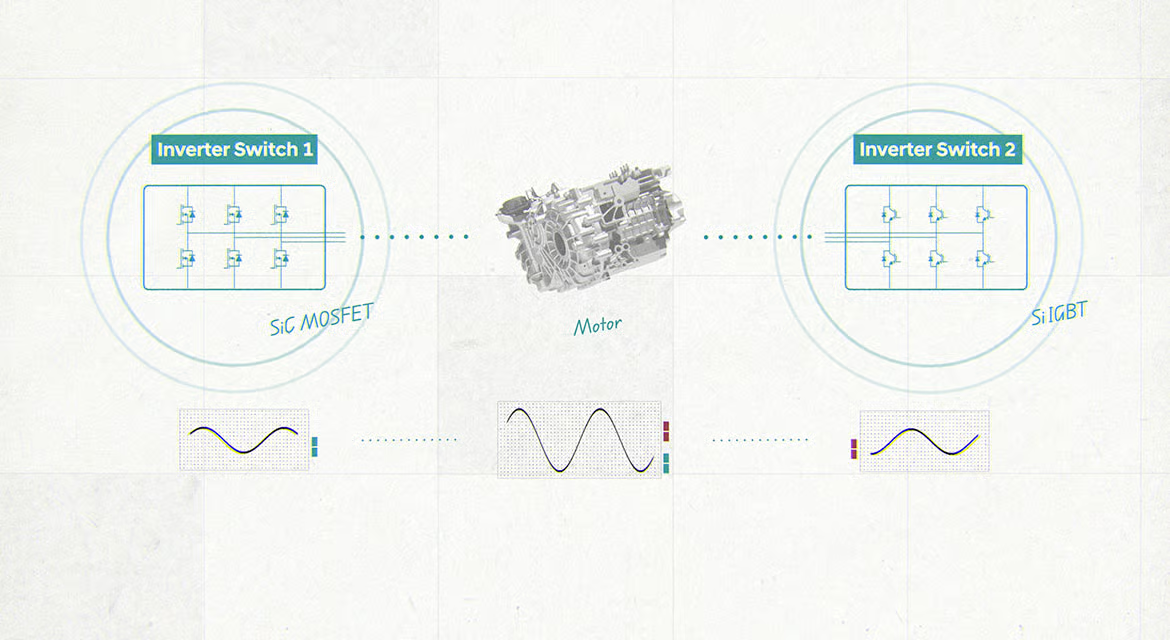
A conventional inverter uses six semiconductor switches — typically Silicon Carbide (SiC) devices, chosen for high efficiency but at significant cost. Hyundai Motor Group’s 2-Stage Motor System doubles that count to twelve, arranged in a ‘6 plus 6’ configuration: one bank of six SiC switches for high-efficiency operation, and a second bank of six Silicon (Si) switches for high-power conditions.
This is not a simple hardware addition. Doubling the switch count fundamentally transforms the control architecture. A conventional six-switch inverter divides into upper and lower sets across three phases, producing eight possible switching combinations. With twelve switches, those combinations multiply eightfold — to 64 — demanding an entirely new level of coordination and control precision.
Beyond Hexagons: How 64 Switching Combinations Deliver Supercar Smoothness
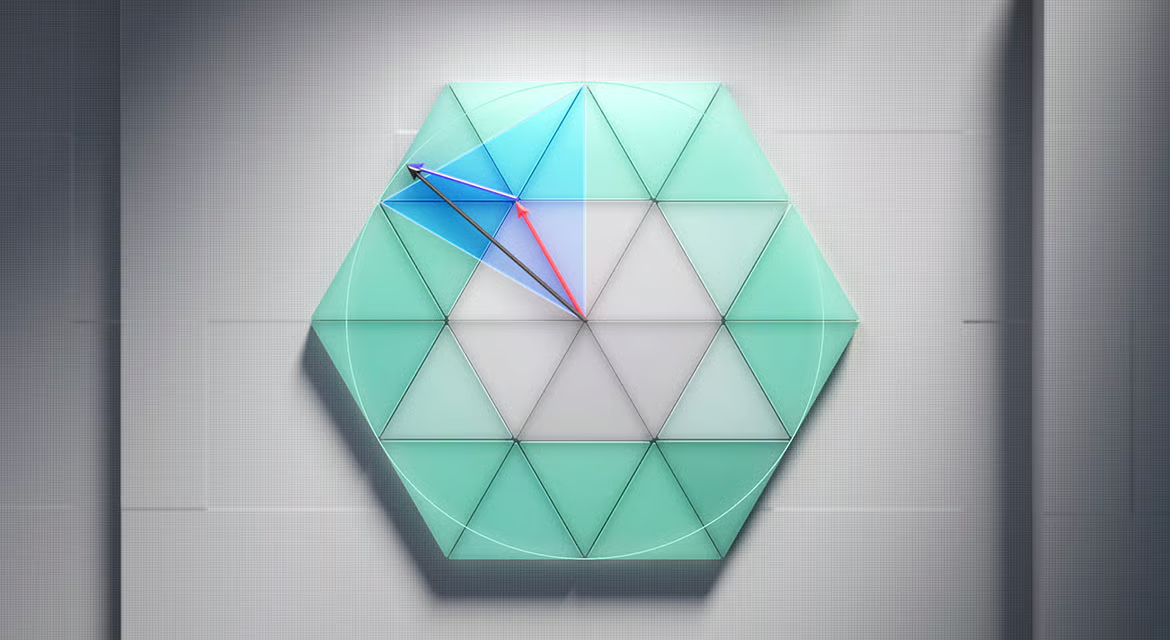
The 2-stage motor technology: The output of an inverter can be visualised as a voltage space vector moving within a defined boundary. In a standard six-switch system, that boundary is a hexagon; the maximum voltage applicable to the motor equals the length of one side. When the vector moves in discrete steps — as a coarser control strategy produces — the driver feels the result as jerk or stutter.
Hyundai’s system expands this voltage space. One module holds six switches in a fixed six-step pattern; the second module controls the remaining six across all 64 combinations. A proprietary transfer switch manages the boundary between these two voltage spaces, selecting the optimal configuration in real time based on driving conditions. The outcome is smooth, continuous voltage vector transitions regardless of load or speed.
Efficiency for the City, Power for the Highway: Dual-Mode Smart Control Explained
The system’s intelligence is expressed through two distinct operating modes:
- City / Efficiency Mode — only the SiC switch bank is active. SiC semiconductors run at lower switching losses, minimising energy consumption during the partial-load, variable-speed conditions typical of urban and highway cruising.
- Performance Mode — both switch banks operate simultaneously. Combined, they raise the effective voltage applied to the motor by approximately 70 percent versus a conventional single-bank inverter, unlocking the full torque and power the motor is capable of delivering.
The transition between modes is managed by Hyundai’s proprietary algorithms. Seamless handoff — with no torque interruption perceptible to the driver — required a complete re-engineering of the control system’s coordination logic, not merely a firmware adjustment.
Comparison: Hyundai 2-Stage vs. Standard EV Inverters
| Parameter | Conventional Inverter | Hyundai 2-Stage System |
| Semiconductor switches | 6 (SiC only) | 12 (6 SiC + 6 Si) |
| Switch combinations | 8 | 64 (×8 increase) |
| Voltage utilisation gain | Baseline | +70% |
| Power modules | 9 discrete | 3 integrated |
| Cooling method | Single-sided | Double-sided |
| City-drive efficiency | Moderate | Optimised (SiC-only stage) |
| Peak power output | Limited by voltage | Maximised (both stages) |
Table 1: Conventional 6-switch inverter vs. Hyundai 2-Stage Motor System. Source: Hyundai Motor Group Newsroom.
The Engineering Secret: How Hyundai Shrank 9 Modules into 3 Without Overheating
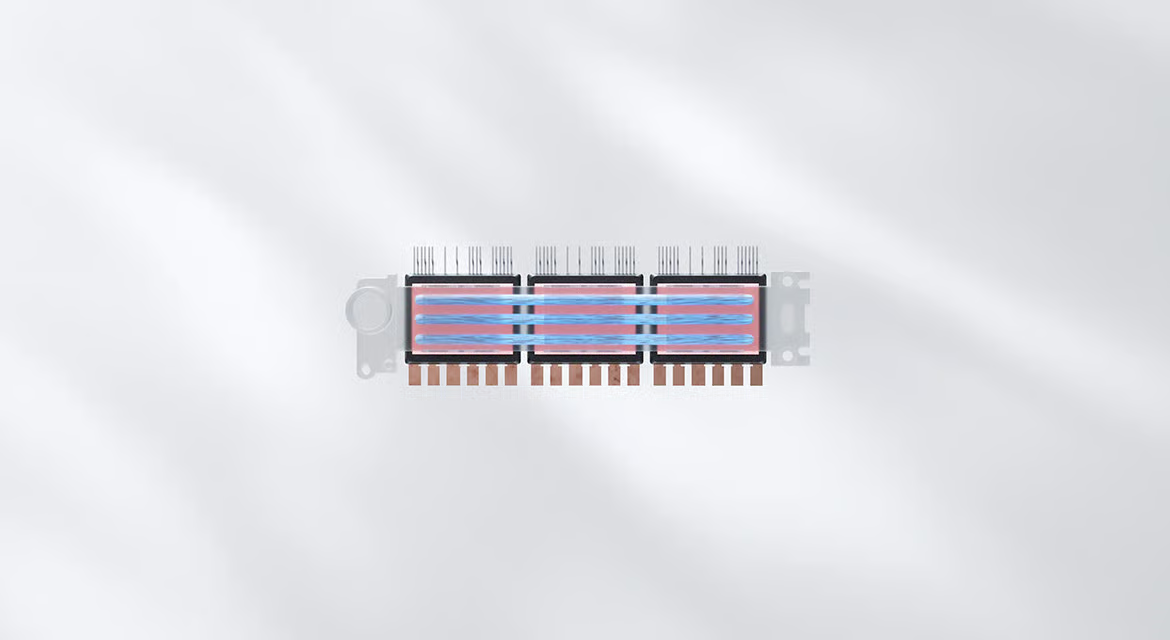
Adding six switches and a transfer switch to an inverter would ordinarily increase package volume and mass — unacceptable for a production vehicle. Hyundai Motor Group resolved this through a purpose-designed in-house power module.
The inverter’s physical dimensions are governed by its semiconductor power modules — the packaged units that house the switches and manage heat dissipation and electrical insulation. Conventional designs use nine discrete modules. Hyundai’s engineers consolidated these into three integrated modules, reducing the overall component count threefold and simplifying the assembly structure.
Simultaneously, the cooling architecture was upgraded from single-sided to double-sided, significantly improving heat dissipation per unit volume. The result: a higher power density within a smaller, lighter envelope that meets the thermal demands of sustained high-performance operation — making the system viable for mass production without dimensional compromise.
Electric Vehicles Equipped with the 2-Stage Motor System
The technology is currently deployed across Hyundai Motor Group’s high-performance and flagship electric vehicle lineup:
- Hyundai IONIQ 5 N
- Hyundai IONIQ 6 N (global debut model for this system)
- Hyundai IONIQ 9
- Hyundai NEXO FCEV (all-new model)
- Kia EV6 GT
- Kia EV9
- Kia EV9 GT
Hyundai Motor Group has confirmed the technology will expand across additional vehicle platforms. As an indication of the real-world performance envelope this enables: the IONIQ 5 N produces outputs up to 600 horsepower and 740 Nm of torque, while still offering a driving range of approximately 448 km on a full charge.
Industry Recognition The 2-Stage Motor System received the Presidential Award at the 2024 Korea Technology Awards — the nation’s highest honour for technological excellence. It is currently the only dual-inverter architecture in production that achieves high performance and high efficiency simultaneously.
The New Gold Standard: What Hyundai’s 2-Stage Motor Tech Means for Indian EV Buyers

The 2-Stage Motor System represents a structural departure from the prevailing approach to EV powertrain development. Rather than accepting an efficiency penalty as the price of performance — or constraining performance to preserve efficiency — it creates a single hardware platform that optimises for both conditions through software-defined operating modes.
The significance extends beyond the immediate performance figures. By demonstrating that a 12-switch dual-inverter can be packaged competitively, integrated with production-grade thermal management, and controlled with sufficient precision to be invisible to the driver, Hyundai Motor Group has established a viable architectural template for the broader EV industry.
For Indian EV buyers evaluating Hyundai models, the practical upshot is clear: the same powertrain that delivers brisk urban commuting efficiency is capable of sustained high-power output when demanded — without mode-selection inputs from the driver, and without dimensional or weight penalties relative to outgoing single-stage systems.
Note: Images used in this article are sourced from Hyundai official website.
FAQs: Hyundai 2-Stage Motor System
-
What is a voltage space vector in an EV inverter?
A voltage space vector is a mathematical representation of the voltage being applied to the motor at any instant. Smooth, continuous movement of this vector produces seamless torque delivery. Coarse or stepped control produces noticeable jerk. Hyundai’s 12-switch system, with 64 possible switching combinations, allows far finer vector control than a conventional 8-combination system.
-
Which Hyundai and Kia cars have the 2-Stage Motor System?
The IONIQ 5 N, IONIQ 6 N, IONIQ 9, and new NEXO FCEV from Hyundai, and the EV6 GT, EV9, and EV9 GT from Kia. The IONIQ 6 N was the system’s global production debut.
-
Does the Hyundai 12-switch inverter make the system heavier?
No. Hyundai’s in-house power module design consolidates nine modules into three, and upgrades cooling from single-sided to double-sided. The result is a more compact, lighter inverter with higher power density — making the system production-feasible without size or weight penalties.
-
Has the 2-Stage Motor System won any awards?
Yes. The technology received the Presidential Award at the 2024 Korea Technology Awards, South Korea’s highest honour for technological excellence, recognising its significance as the only dual-inverter EV architecture in production achieving both high performance and high efficiency simultaneously.
-
What is Silicon Carbide (SiC) and why is it used in EV inverters?
Silicon Carbide is a wide-bandgap semiconductor that switches faster and generates less heat than conventional silicon at high voltages. This translates directly to lower inverter losses and higher efficiency. Its cost premium over silicon is the reason Hyundai’s system uses SiC only in the efficiency-critical six-switch bank, pairing it with lower-cost silicon switches for the power-augmentation bank.
-
What is a transfer switch in the context of Hyundai’s motor system?
The transfer switch is a proprietary control element that mediates between the two six-switch voltage spaces in real time. It determines which switch bank — or combination — is active based on current driving conditions, ensuring optimal mode selection without driver intervention and without torque interruption during transitions.
-
How does the 2-Stage Motor System improve EV efficiency?
In city or cruising conditions, only the high-efficiency SiC switch bank is active. SiC semiconductors produce lower switching losses than silicon, minimising energy waste at partial load. The second switch bank remains dormant, contributing no additional losses until high power is required.
-
What is Hyundai’s 2-Stage Motor System?
It is a dual-inverter architecture that uses 12 semiconductor switches (six Silicon Carbide for efficiency, six Silicon for power) in place of the conventional six. The system increases effective motor voltage by up to 70 percent and uses a transfer switch to shift between an efficiency-optimised mode for everyday driving and a full-power mode for performance demands.
-
Why did Hyundai use 12 switches instead of 6?
Doubling the switches allows the inverter to apply higher voltage levels to the motor than a single six-switch bank could achieve — delivering a 70 percent increase in usable voltage range. The SiC bank handles efficiency-critical conditions; the combined 12-switch configuration unlocks maximum power output.