BYD Da Han: 1,008 km Range and 5-Minute Charging for a New Luxury EV Flagship
Stay connected via Google 'Electric Vehicle' News
Follow BijliWaliGaadi | India's Trusted EV Insights Portal
source on Google
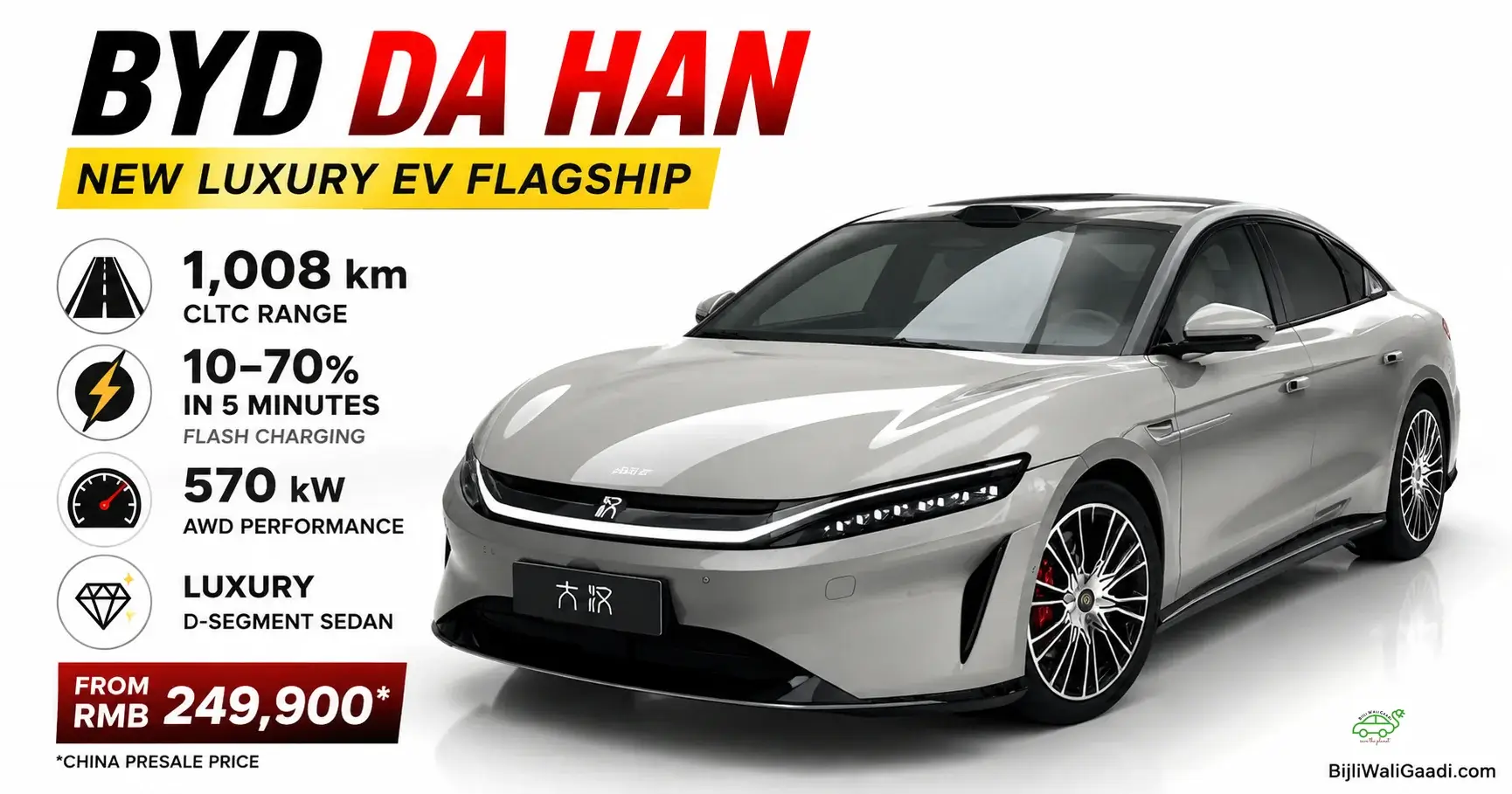
BYD has opened presales for the Da Han, a full-size electric sedan claiming up to 1,008 km of range on China’s CLTC cycle and a headline charging figure that can restore roughly 60% of its battery capacity in around five minutes. Revealed at the Chengdu Auto Show, the car — also referred to as the Great Han in some international reporting — is BYD’s clearest attempt yet to build a genuine luxury flagship rather than another value-priced EV.
BYD Da Han Debuts as a New Luxury EV Flagship
The Da Han is not a facelift of the existing BYD Han that already sells in Europe, Australia and other markets. It’s a distinct, larger model built as the first D-segment sedan in BYD’s Dynasty range, positioned above the Han rather than replacing it. At 5,256 mm long, 1,999 mm wide and 1,510 mm tall, on a 3,130 mm wheelbase, it is roughly 66 mm longer than a standard-wheelbase Mercedes-Benz S-Class — a comparison BYD has been happy to draw, though size alone doesn’t settle a luxury argument on its own.
China presales opened on 21 August 2026 across three trims: an entry RWD Premium at RMB 249,900 (roughly $37,170), a mid-tier RWD Flagship at RMB 269,900, and a range-topping AWD Flagship at RMB 299,900. All figures are China-market presale prices; no international pricing has been announced.
The Da Han’s 1,008-km CLTC Range Comes With an Important Catch
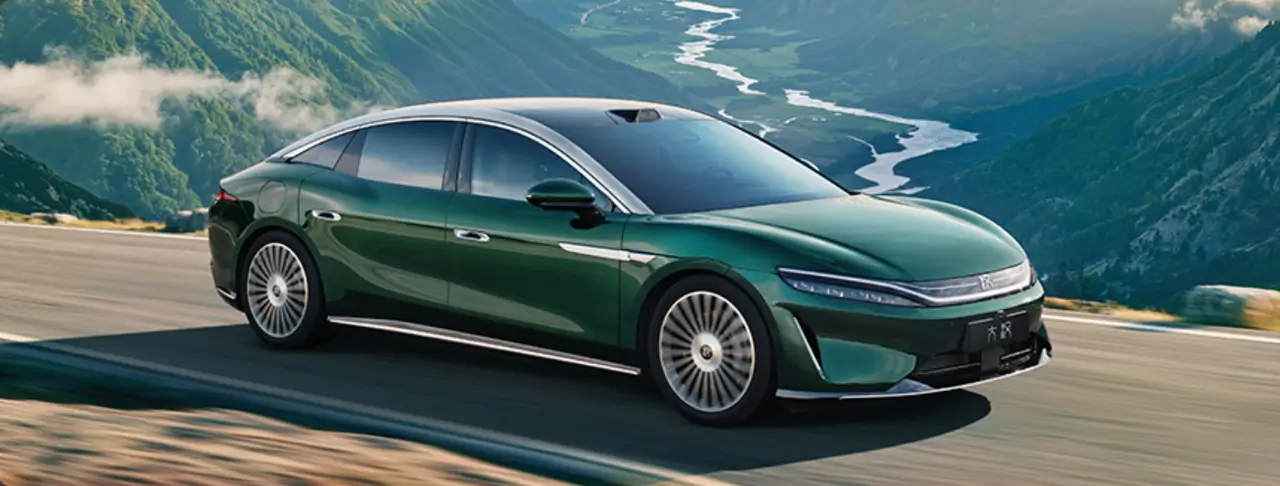
BYD rates the rear-wheel-drive variants at up to 1,008 km under China’s CLTC test cycle, drawn from a 102.3 kWh second-generation Blade Battery pack using LFP chemistry. The heavier, more powerful AWD Flagship is rated lower, at 880 km CLTC.
That number needs context. CLTC is a Chinese testing standard that consistently produces higher figures than Europe’s WLTP or the US EPA cycle, largely because of its low-speed-weighted drive profile. BYD has not published an official WLTP or EPA-equivalent figure for the Da Han, so there is no verified international-cycle range to report yet — and any such figure floating online should be treated as unofficial until BYD confirms it for a specific market.
Five-Minute Charging Could Be the Bigger Breakthrough
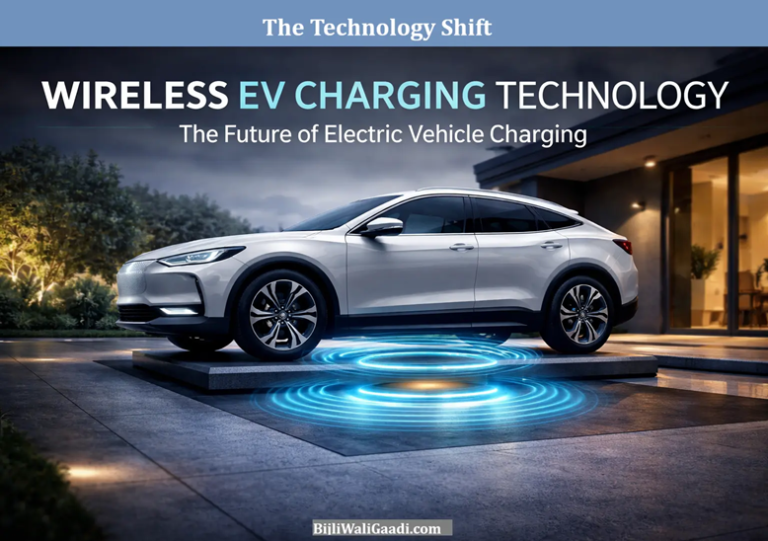
The range number generates headlines, but the charging claim is the more consequential engineering story. BYD says the Da Han’s Flash Charging system can take the battery from 10% to 70% in around five minutes, and from 10% to 97% in about nine minutes.
Two clarifications matter here. First, the five-minute figure applies to a 10–70% top-up, not a full charge from empty. Second, the 1,500 kW figure attached to BYD’s compatible Flash Charging infrastructure is the peak capability of the charging system, not a constant rate the battery receives throughout the session — charging power tapers as the battery fills, as it does on any DC fast-charging system. Reaching these speeds also depends on access to BYD’s high-power charging stations, part of a Flash Charging network the company has been expanding through 2026 to support its newer Dynasty and Denza models.
Even accounting for that nuance, a production sedan adding hundreds of kilometres of range in the time it takes to queue for coffee is a genuine shift in what charging speed can offer over simply fitting a bigger battery.
570 kW Gives the Da Han Serious Performance Credentials
Power output splits by drivetrain. The RWD versions use a single 370 kW motor, while the AWD Flagship adds a 200 kW front motor for 570 kW combined — about 764 hp. BYD quotes a 0–100 km/h time of 3.3 seconds for the AWD variant, with a 270 km/h top speed.
Chassis technology backs up the numbers on paper. Standard rear-wheel steering brings the turning radius down to 4.95 m — BYD says this matches its compact Seagull city car — despite the Da Han’s size. A DiSus-A dual-chamber air suspension offers around 100 mm of ride-height adjustment and can vary stiffness between comfort and sport settings. The top AWD Flagship adds a roof-mounted LiDAR sensor paired with BYD‘s DiPilot 5.0 assisted-driving system. It’s worth being precise here: this is an advanced driver-assistance suite, not a confirmed autonomous-driving system, and no source establishes a specific legal automation level for international markets.
Why BYD Is Positioning the Da Han as a Luxury Flagship
The Da Han sits alongside BYD’s broader push to move beyond its reputation as a value-focused EV maker. Positioning a Dynasty-series flagship above the existing Han, with premium cabin materials, advanced chassis hardware and flagship-grade performance, gives BYD a genuine halo model to sit next to premium sub-brands like Denza and Yangwang as the company builds international credibility.
That strategic logic doesn’t rely on disputed sales statistics to make sense — the argument is straightforward: a manufacturer that wants to be taken seriously in the luxury segment needs a car that can compete on specification with the segment leaders, and the Da Han is BYD’s attempt to build one.
Can the Da Han Really Challenge Established Luxury EVs?
On specification alone, the Da Han’s range, charging speed, power output and dimensions put it in the same conversation as the Mercedes-Benz EQS and BMW i7, and its footprint exceeds the standard S-Class. Its charging proposition is particularly unusual among large luxury EVs, where charging times remain substantially longer.
But a spec sheet isn’t the whole story. Established luxury brands compete on decades of dealer and service infrastructure, resale value, software maturity and brand cachet — none of which transfer automatically from a strong reveal event. The Da Han is a serious technical proposition rather than a settled disruptor, and how it’s judged internationally will depend heavily on real-world charging access, after-sales support and whether the car actually reaches showrooms outside China.
When Will the BYD Da Han Reach International Markets?
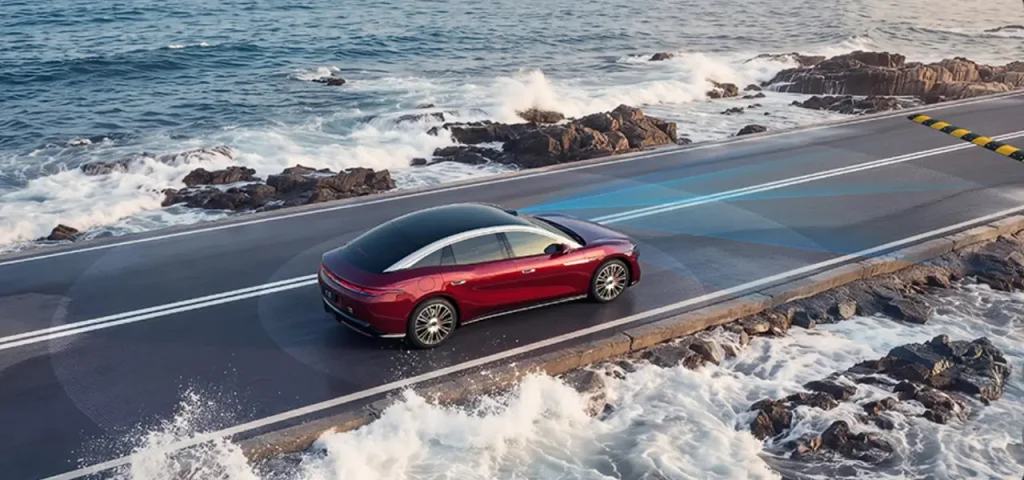
BYD has not announced an international launch timetable, pricing or availability for the Da Han. The existing BYD Han already sells in Europe, Australia and several other markets, which suggests an eventual international rollout of the Da Han is plausible given BYD’s expanding export network — but as of its Chengdu debut, that remains unconfirmed. Readers outside China should treat any specific market or date currently circulating as speculation rather than fact.
Why the BYD Da Han Matters Beyond China
Regardless of when it reaches international buyers, the Da Han is a useful marker of where EV engineering stands in 2026. It shows that four-digit-kilometre CLTC range, sub-ten-minute top-up charging, 764-hp performance and full-size luxury dimensions can now be packaged into a single production sedan — priced, in China, well below what comparably specified Western luxury EVs cost. Whether that combination translates into sustained international credibility, rather than an impressive spec sheet, is the question the next twelve months of BYD’s global expansion should start to answer.
Stay connected via Google 'Electric Vehicle' News
Follow BijliWaliGaadi | India's Trusted EV Insights Portal
source on Google