Ola S1 Z: How an Indigenous LFP Cell Reaches India’s Mass-Market Scooter Segment
Stay connected via Google 'Electric Vehicle' News
Follow BijliWaliGaadi | India's Trusted EV Insights Portal
source on Google
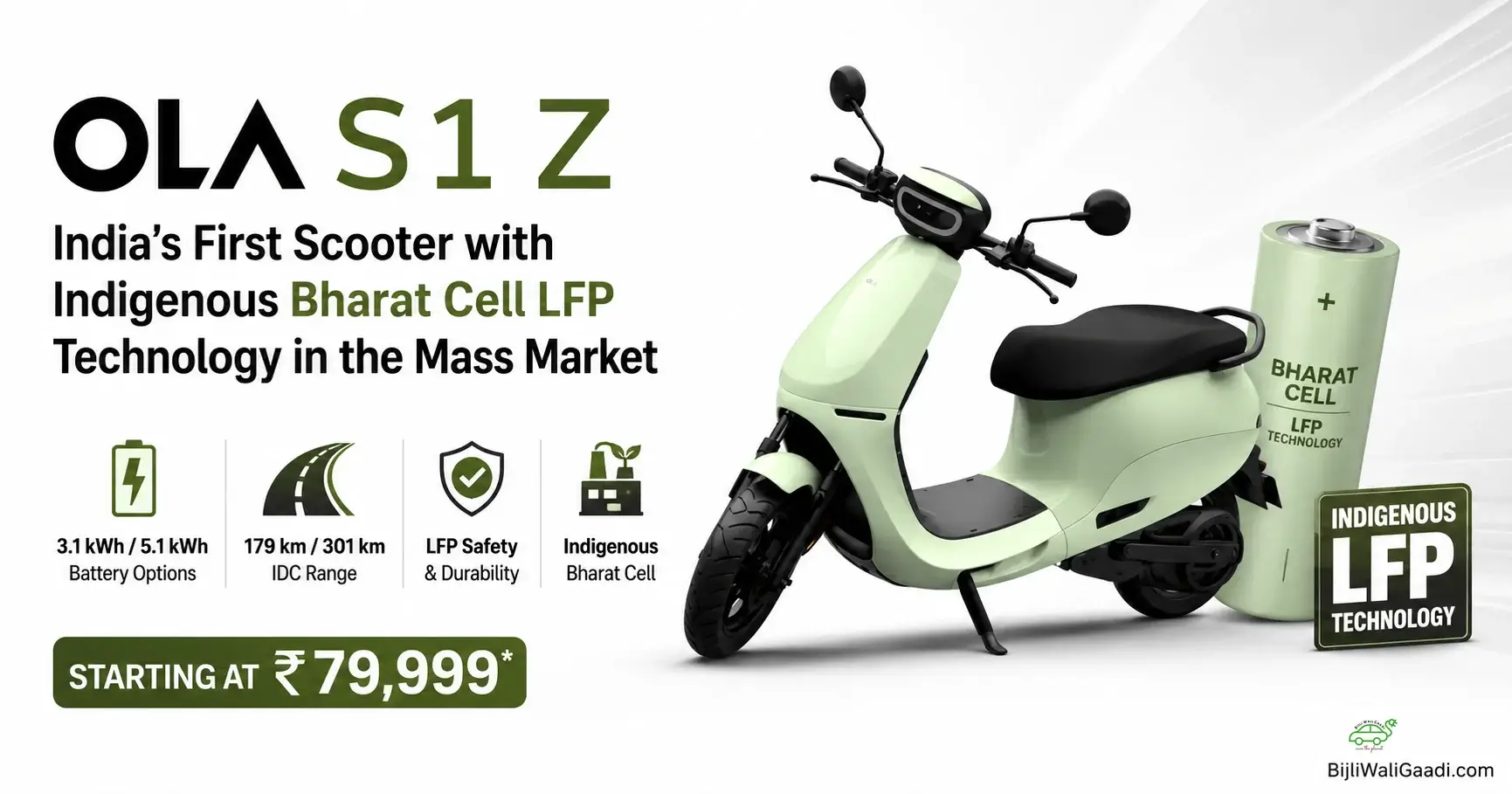
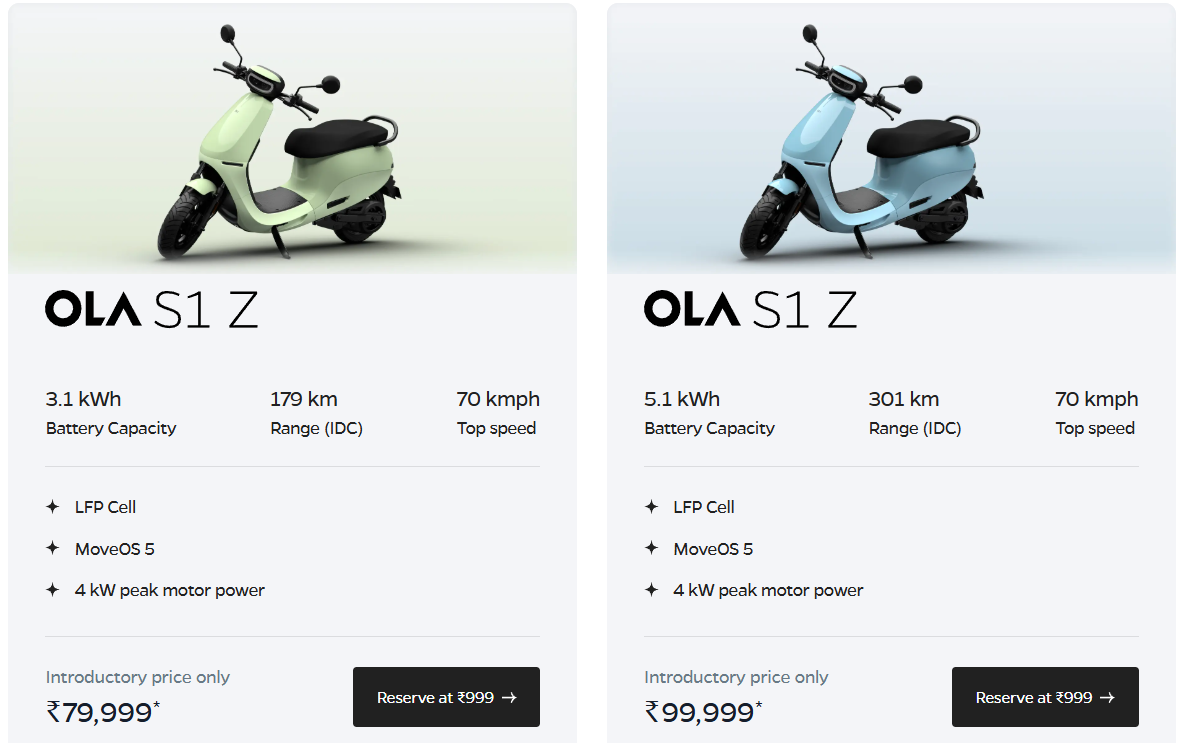
Ola Electric has spent years building battery cells in-house. This week, that investment reached the segment where it matters most for the company’s business: the sub-₹1-lakh price bracket, where India’s overall two-wheeler volume is heavily concentrated. The new OLa S1 Z, priced from an introductory ₹79,999 for its 3.1 kWh variant and ₹99,999 for the 5.1 kWh version, is the first Ola scooter range built around the company’s own Bharat Cell lithium iron phosphate (LFP) technology.
“The true measure of innovation… is how quickly it reaches everyday Indians,” said Ola Electric chairman and managing director Bhavish Aggarwal at the launch. It isn’t a flagship; it’s a value commuter, and what makes it noteworthy is what sits beneath the seat — a cell chemistry Ola designed and manufactures itself, deployed exactly where cost pressure is highest.
What Makes the Ola S1 Z Technically Significant?
NMC has historically been widely used in electric two-wheelers because it offers higher energy density for a given package, while LFP has increasingly become an important alternative where cost, durability and thermal stability carry greater weight. Ola’s move with the S1 Z inverts the usual pattern for this price bracket: it puts a locally developed, locally manufactured LFP cell into its cheapest scooter range, rather than reserving indigenous technology for premium models.
Ola Electric describes the S1 Z as the first scooter range in India to use its indigenous 46-series LFP cell platform — a statement about where its battery strategy is headed, not just a new product. It’s also the first Ola range to go to market through dealer-operated stores rather than the company’s own retail network, a distribution shift running alongside the technology one.
Bharat Cell LFP Technology Moves Into the Mass Market
“Bharat Cell” is Ola Electric’s name for the LFP cell platform developed at its Battery Innovation Centre in Bengaluru, with production handled at its Gigafactory in Tamil Nadu, according to Autocar Professional. The cells use a 46-series format, an LFP chemistry generally associated with cylindrical cell designs.
LFP itself is not a new chemistry. It has become the dominant choice for entry-level and mid-range EVs globally, from Chinese electric two-wheelers to a growing share of passenger EVs, because it trades some energy density for lower cost, greater thermal stability and longer cycle life than NMC. Autocar Professional notes this stability also makes LFP less prone to thermal runaway — relevant in India given the fire incidents involving electric two-wheelers that drew regulatory scrutiny in recent years.
What’s distinct here is the vertical integration, not the chemistry choice. Ola says developing and manufacturing Bharat Cell in-house, rather than buying finished cells externally, has let it lower what it calls the single largest cost component of an EV — the battery. Whether that advantage holds at scale, and how it compares with importing cells from established Chinese or Korean suppliers, isn’t something the available sources can independently verify. For now, it remains Ola’s own claim.
Inside the S1 Z Battery Pack
It helps to separate three levels here: the cell (the individual electrochemical unit), the module (cells grouped and wired together), and the pack (the complete assembly, with its BMS and housing, installed in the vehicle). Ola confirms pack-level capacity — 3.1 kWh and 5.1 kWh — but discloses no cell count, module architecture, or BMS hardware, and no reference source fills that gap.
Ola states an Indian Drive Cycle (IDC) range of 179 km for the 3.1 kWh variant and 301 km for the 5.1 kWh variant; as with any certified figure, real-world range will vary with rider weight, terrain and riding style. Home charging from 0–80% is specified at 5 hours 42 minutes and 6 hours 16 minutes respectively. Fast-charging compatibility and charge-cycle degradation data have not been disclosed.
Ola also markets a standard warranty of 3 years/40,000 km, extendable — by its own account — to 8 years/70,000 km. That extended figure, along with claims of “15-year” lifespan and tolerance to temperature extremes, comes from Ola’s marketing material rather than independent testing. Deliveries of the 3.1 kWh variant are scheduled to begin in December 2026, with the 5.1 kWh version following in March 2027 — a staggered rollout, not a simultaneous one.
How the S1 Z Electric Drive Unit Works
Ola describes the S1 Z’s motor as an Interior Permanent Magnet (IPM) unit in a mid-drive layout with aluminium winding and a peak output of 4 kW across both variants. Top speed is listed at 70 km/h for both, with 0–40 km/h acceleration of 4.6 seconds (3.1 kWh) and 4.9 seconds (5.1 kWh) — the larger battery’s extra weight showing up as a slightly slower sprint at equal motor output. Controller, inverter and efficiency figures haven’t been disclosed, and this article does not speculate on them.
Why LFP Matters for Electric Two-Wheeler Durability and Safety
The safety argument for LFP is well established: its structure is inherently more resistant to the exothermic reactions that drive thermal runaway compared with nickel-based chemistries, though no lithium-ion chemistry is fully immune under abuse. For a mass-market scooter used daily in Indian climate extremes and often charged in dense urban housing, that stability carries more practical weight than in a premium vehicle.
What Indigenous Battery Technology Means for Ola Electric
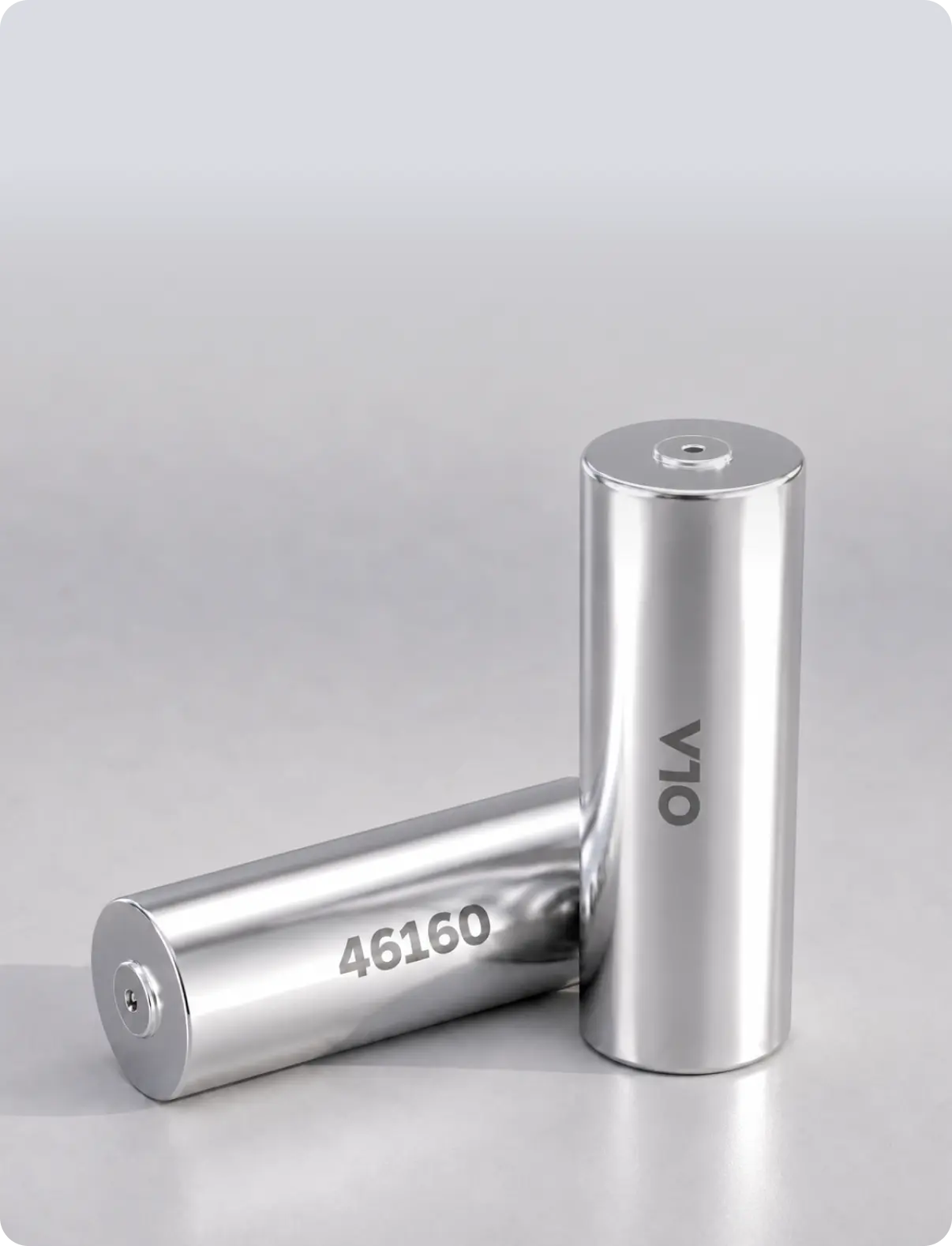
It’s worth being precise about “indigenous” here. Ola’s claim covers development and manufacture of the cell itself — chemistry formulation, cell design and production — at its own Indian facilities. It doesn’t necessarily mean every raw material or upstream component, such as lithium or iron-phosphate precursor sourcing, is domestically produced; no available source makes that broader claim. What’s verifiable is that Ola has moved cell development and manufacturing in-house rather than relying on an external, often imported, supplier — a meaningfully different position from most Indian EV makers, who still integrate third-party cells into their own packs.
Why the S1 Z Matters Beyond India
India’s electric two-wheeler market is unusual in its combination of scale and price sensitivity, making it a proving ground for cost-down battery engineering. Bringing an indigenously produced LFP cell to a sub-₹80,000 vehicle tests whether local cell manufacturing can compete on cost with the imported cells that dominate this segment worldwide. If it can, it offers a template — localised cell production feeding directly into mass-market pricing — that other markets pursuing battery supply-chain independence may watch closely. None of this establishes that Ola’s cell is superior to competing LFP makers internationally; the comparison that matters is strategic and economic, not a performance benchmark.
Ola S1 Z: The Technology Takeaway
The Ola S1 Z isn’t a technical showcase in the way a flagship model might be. Its significance lies in where the technology landed, not in any single spec. Putting an in-house LFP cell into the cheapest scooter in the lineup, rather than reserving it for premium models, signals that Ola intends its battery investment to shape its most price-sensitive, highest-volume segment first. Whether that translates into sustained cost advantage and durability will depend on data that hasn’t yet accumulated — real-world fleet performance over years, not a launch-day spec sheet.
Stay connected via Google 'Electric Vehicle' News
Follow BijliWaliGaadi | India's Trusted EV Insights Portal
source on Google