Porsche T-Hybrid Powertrain: How Electrification Made the 911 Faster, Not Just Cleaner
Stay connected via Google 'Electric Vehicle' News
Follow BijliWaliGaadi | India's Trusted EV Insights Portal
source on Google
Turbocharged engines can produce enormous power, but managing throttle response, boost delay and energy losses has always been the trade-off. Spin a turbine large enough to make big numbers, and the driver waits a beat for it to catch up with their right foot. Make it small enough to respond instantly, and it runs out of breath at the top of the rev range. It’s a compromise that has shaped how turbocharged performance cars, the 911 included, have historically needed to be tuned.
Porsche’s answer is the T-Hybrid powertrain, a performance-hybrid architecture that first appeared in the 911 Carrera GTS in 2024 and has since been reworked for the flagship 911 Turbo S. Rather than treating electrification as a fuel-saving add-on, Porsche built it directly into the turbocharging system itself.
What Is the Porsche T-Hybrid Powertrain?
The Porsche T-Hybrid is a lightweight performance-hybrid system built around an electrically assisted exhaust-gas turbocharger, a strengthened eight-speed PDK transmission with an integrated electric motor, and a compact 400-volt high-voltage battery. Unlike hybrids designed for electric-only range or fuel economy, T-Hybrid exists to sharpen throttle response, accelerate boost build-up and recover energy under braking and off-throttle driving, with efficiency gains arriving as a secondary benefit rather than the primary goal.
A Performance Hybrid, Not a Conventional One
It’s worth separating T-Hybrid from the hybrid systems most drivers already know. There is no plug and no oversized battery pack eating into cabin or luggage space. Porsche has been explicit that this technology is not a plug-in hybrid; it charges itself through recuperation, refuelling with petrol like any other 911. The absence of a dedicated electric-only driving mode isn’t a technical shortfall — it simply reflects that T-Hybrid was designed around performance delivery rather than EV-style range.
That distinction matters because it shapes every engineering decision that follows. A fuel-economy hybrid is optimised to maximise the time spent running on electricity alone. A performance hybrid is optimised to deliver electrical energy in short, forceful bursts, precisely when the combustion engine needs it most: off the line, mid-corner, or the instant a driver squeezes back onto the throttle.
How the Electric Turbocharger Eliminates Traditional Turbo Lag
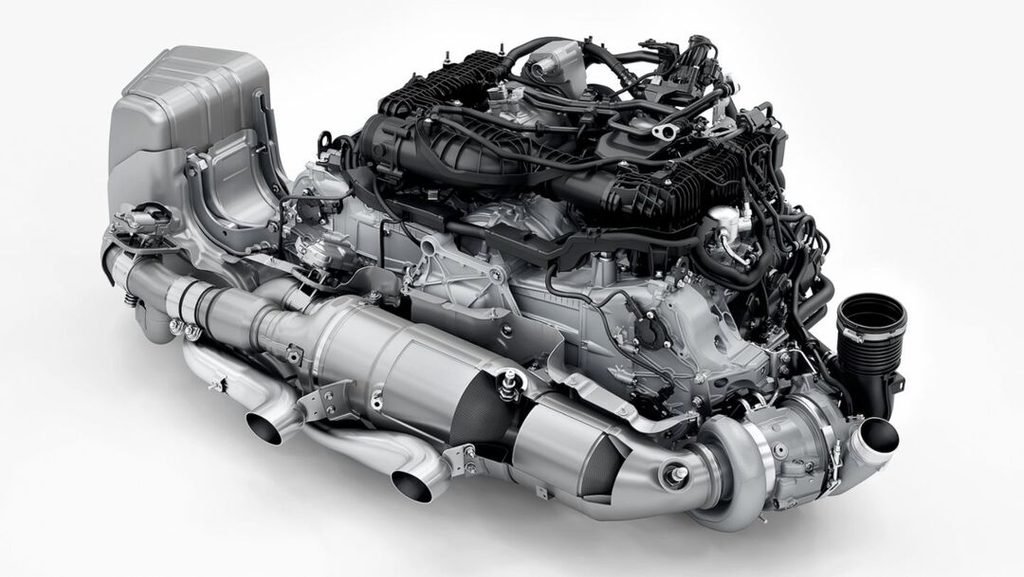
At the centre of T-Hybrid sits the eTurbo, an electrically assisted exhaust-gas turbocharger with an electric motor mounted between the compressor and turbine wheels. The 911 Carrera GTS uses a single, larger eTurbo unit; the 911 Turbo S instead uses two smaller eTurbos, one per bank, tuned specifically for the flagship car’s higher output and all-wheel-drive character.
The electric motor can spin the turbocharger up to speed independently of exhaust-gas energy, dramatically reducing the delay traditionally associated with waiting for exhaust flow to build. Porsche describes the effect as delivering boost pressure regardless of engine speed or load — the practical result is that torque arrives in a much more linear, immediate fashion than a conventionally turbocharged engine can manage, without the driver having to wait for the turbine to “spool up.”
This same motor also does double duty as a generator. Depending on the driving situation — trailing throttle, braking, or steady cruising — it extracts energy from the exhaust-gas flow and converts it into electricity, some of which flows to the transmission-mounted motor and some into the battery. This electric motor/generator function, combined with the eTurbo’s electronically controlled architecture, changes how the turbocharger is managed compared with a conventional unit — boost and energy recovery are governed electrically rather than relying solely on the mechanical wastegate arrangement typical of non-hybrid turbo systems.
The Electric Motor Inside the PDK Transmission
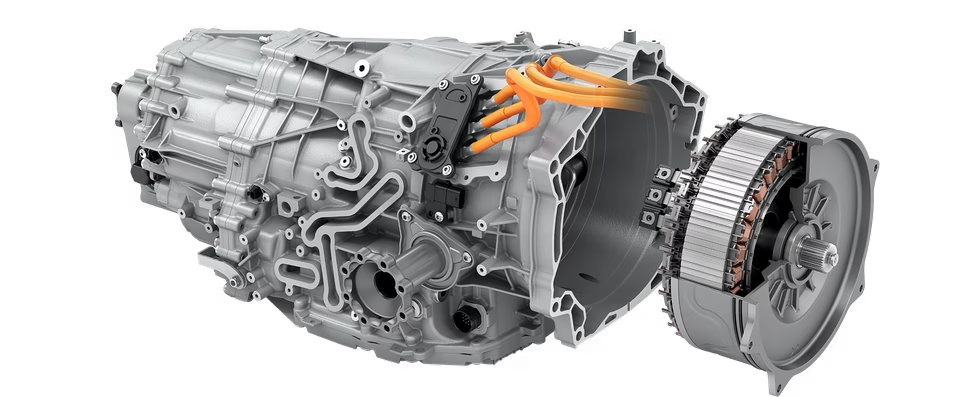
The second pillar of the system is a permanent magnet synchronous electric motor built directly into the eight-speed PDK gearbox housing. It isn’t a bolt-on unit; it also functions as the car’s starter motor and alternator, which is part of how Porsche keeps the added hardware so light.
In the 911 Carrera GTS, this motor contributes up to 40 kW and around 150 Nm of additional torque, filling in exactly where a combustion engine is naturally weakest: from idle and through the lower rev range, before boost has fully built. The Turbo S uses a more powerful version of the same concept, rated at 60 kW and 188 Nm, reflecting the flagship car’s higher overall output and all-wheel-drive traction demands. The result, in both cars, is a powertrain that feels like it’s making torque everywhere, rather than gathering it in a rush once the turbo spools.
Why Porsche Uses a Compact 400V Battery Instead of a Large Hybrid Pack
Porsche’s high-voltage battery for T-Hybrid has a gross capacity of 1.9 kWh — deliberately modest by hybrid-vehicle standards, and roughly the size of a shoebox. It weighs around 27 kg and sits under the front bonnet, both for optimal weight distribution and so it doesn’t intrude on luggage space.
This is a battery engineered for power density, not capacity. Its job isn’t to sustain electric-only driving; it’s to absorb recuperated energy quickly and discharge it back to the electric motors just as fast, repeatedly and on demand, whenever the driving situation calls for it. In a performance hybrid, how fast energy moves in and out of a battery matters more than how much of it the battery can hold. A larger pack would add weight and packaging complexity without meaningfully improving the driving experience T-Hybrid is built to deliver.
How the Complete System Works Together
It’s tempting to picture T-Hybrid as a closed, self-sustaining energy loop, but the real system draws on several distinct recuperation pathways rather than a single circuit. Energy can be recovered under braking and coasting, the eTurbo’s motor/generator can extract energy directly from exhaust-gas flow, and the combustion engine itself can be run at a slightly higher load point specifically to generate additional electrical energy through the system. All of this is stored in the 400V battery, which then supplies both the eTurbo’s motor and the PDK-integrated motor as the driving situation demands.
The electric motors in each 911 T-Hybrid model — one in the eTurbo (or two, in the twin-turbo Turbo S) plus one in the PDK — draw from that same battery, and the system manages the flow between them automatically and continuously, even recuperating at high speed when exhaust flow is greatest. The combustion core itself is a newly developed 3.6-litre flat-six, engineered from the outset to work with electrical assistance rather than having a hybrid system retrofitted onto an existing engine architecture.

Why Porsche Calls It T-Hybrid
Porsche hasn’t spelled out an official definition of the letter, but the “T” points clearly to what actually differentiates this system from other hybrids: turbocharging isn’t a separate subsystem bolted alongside electrification, it’s the primary site of that electrification. Where many hybrids place their electric motor between engine and wheels, Porsche placed a motor inside the turbocharger itself. T-Hybrid reads, in effect, as a hybridised boost strategy first, with the PDK motor and battery built around supporting it.
Real-World Performance Gains
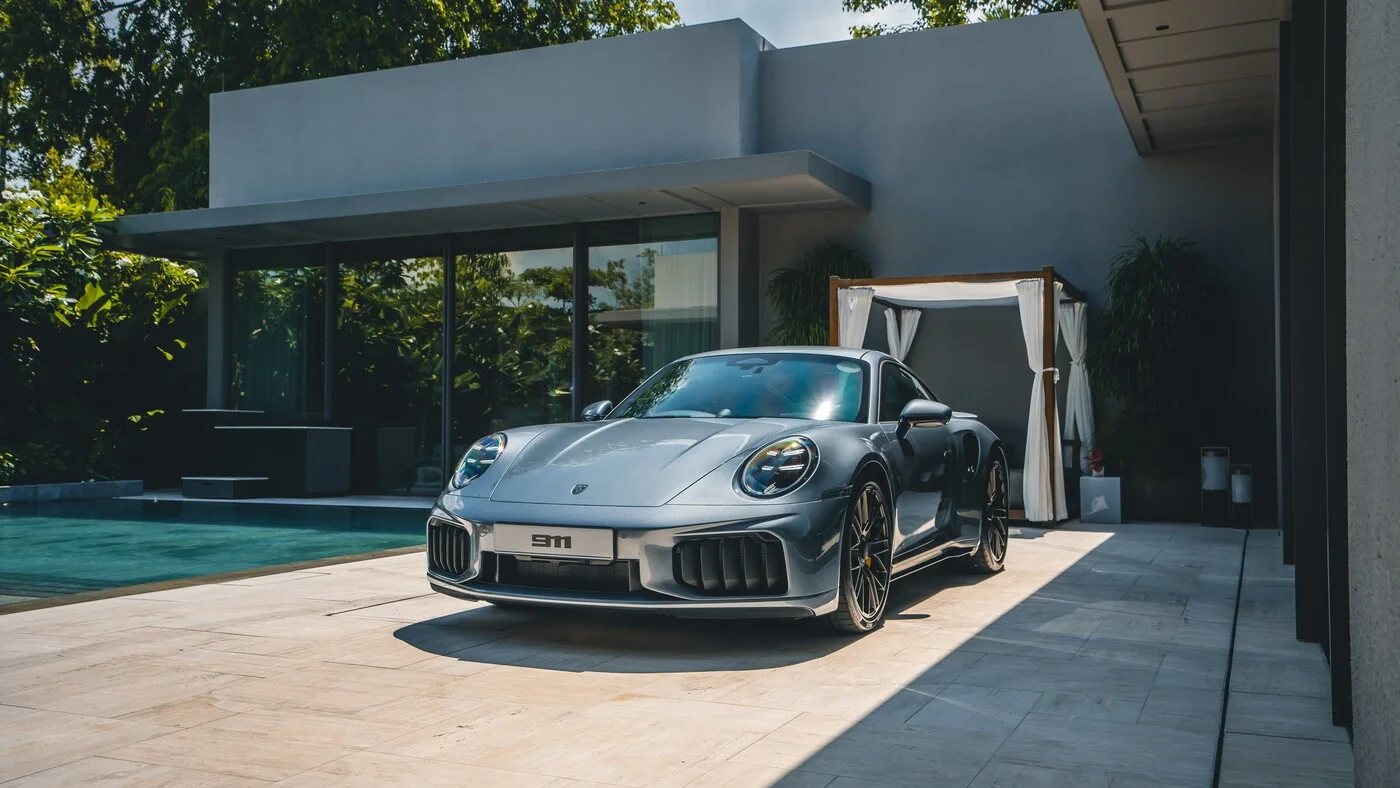
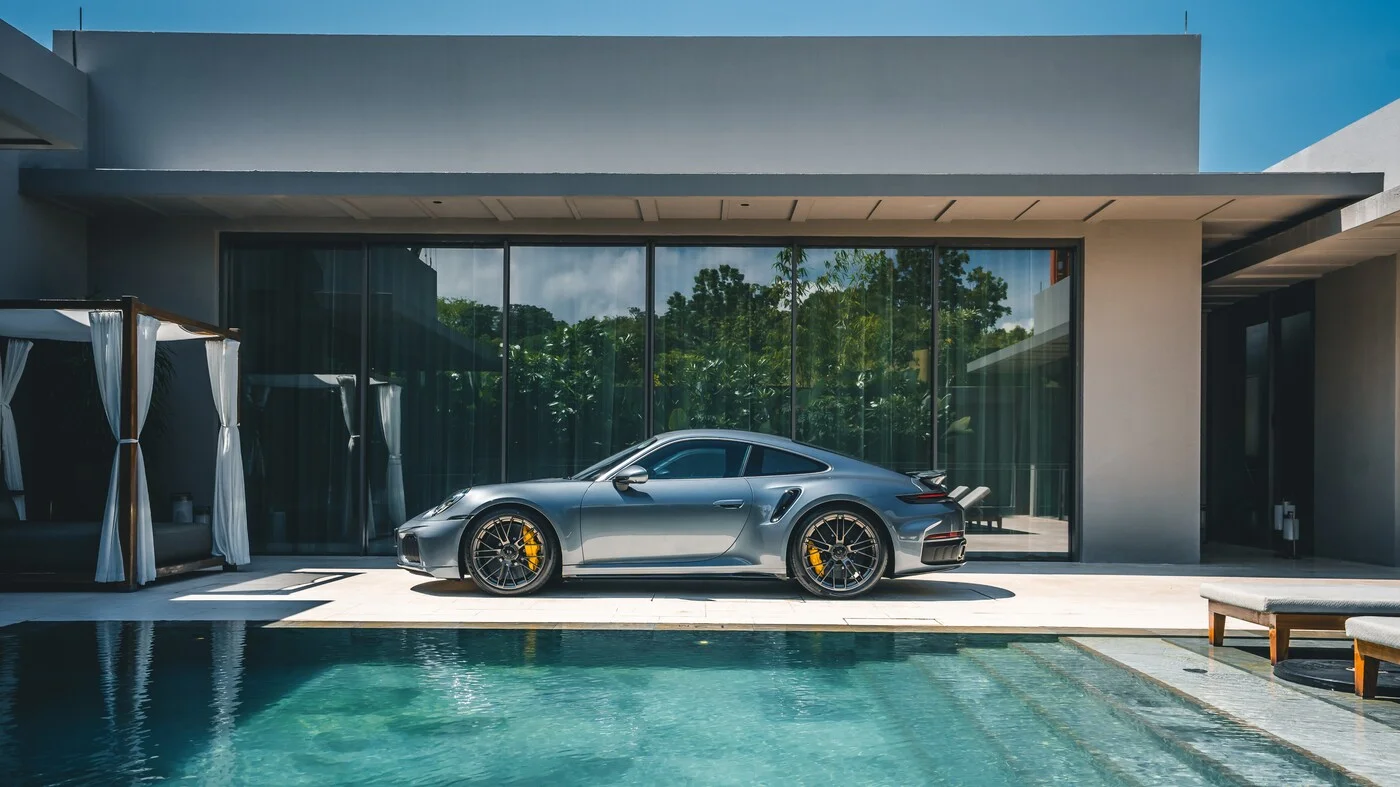
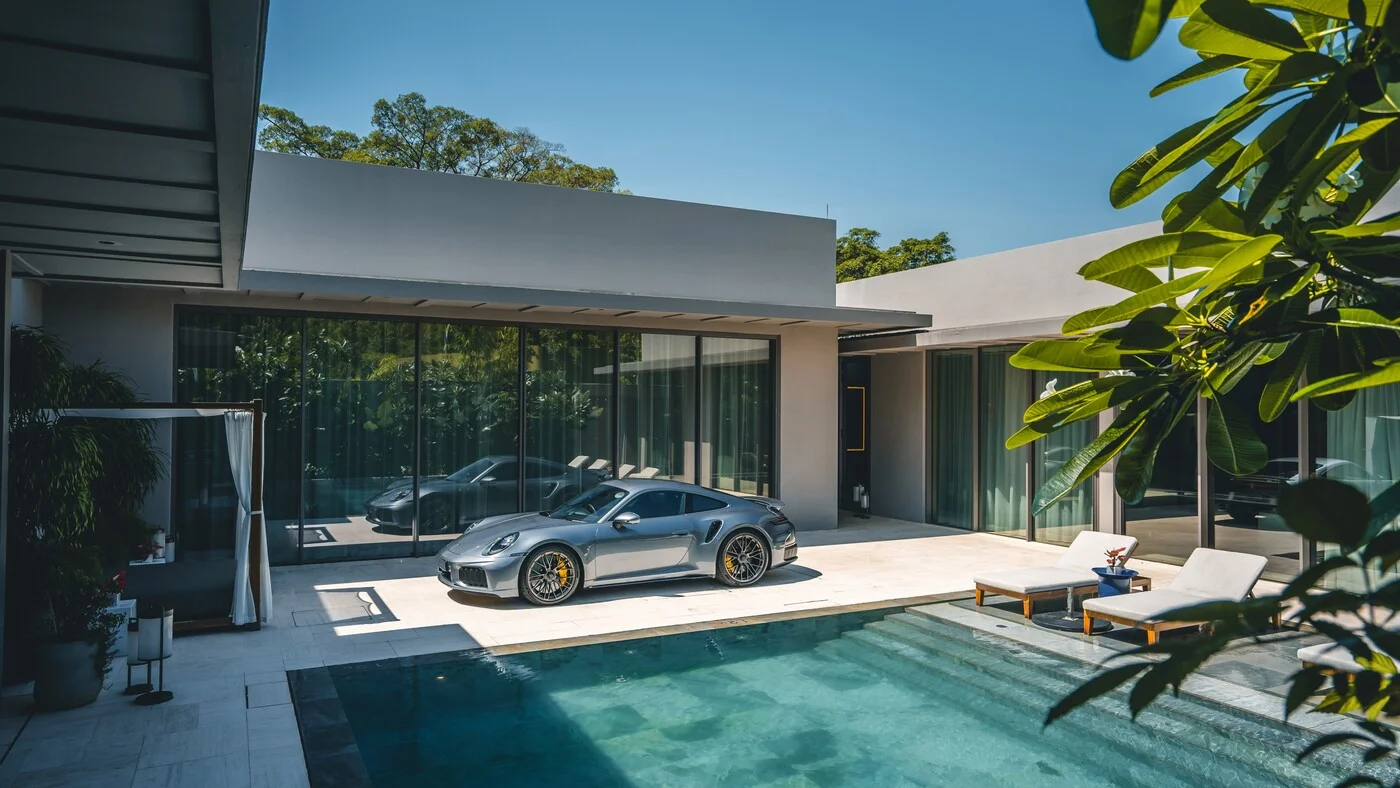
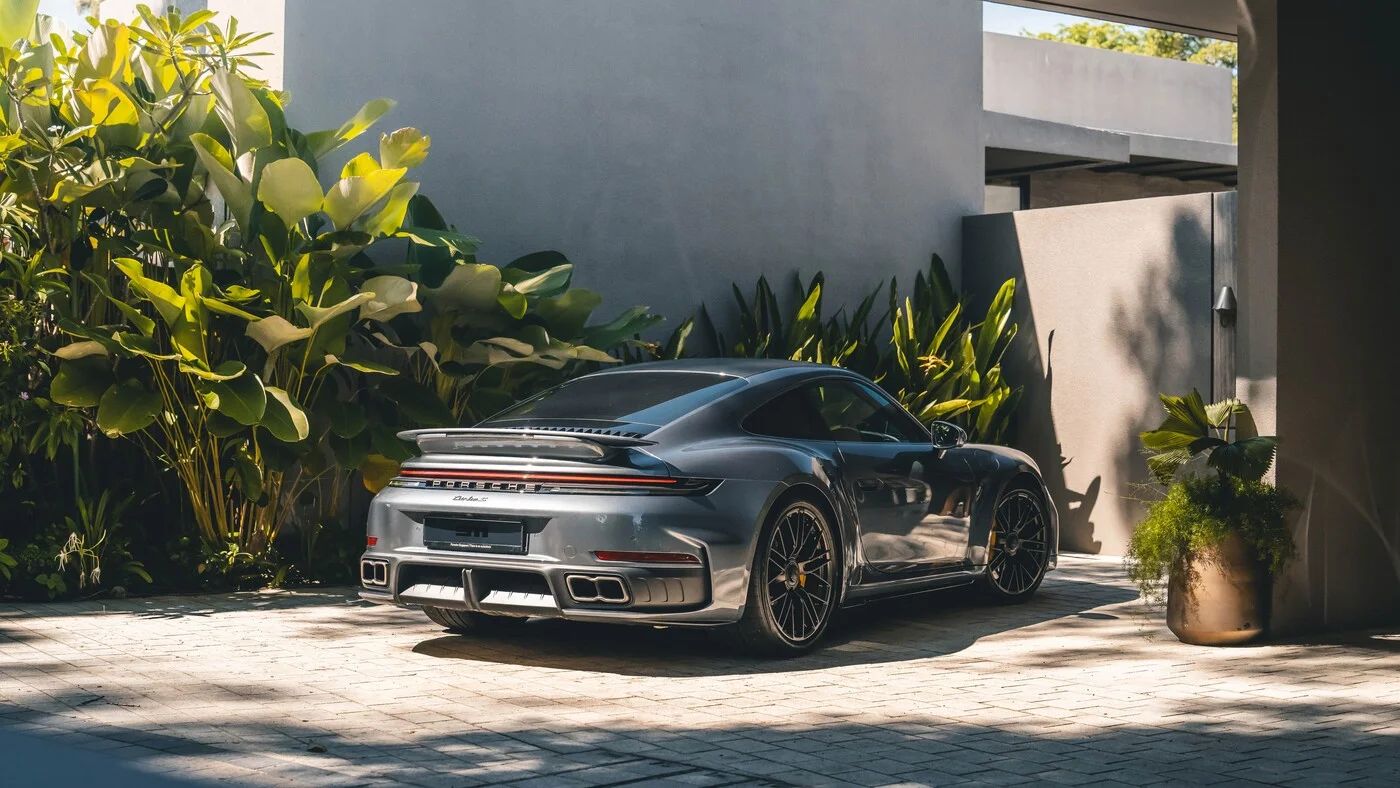
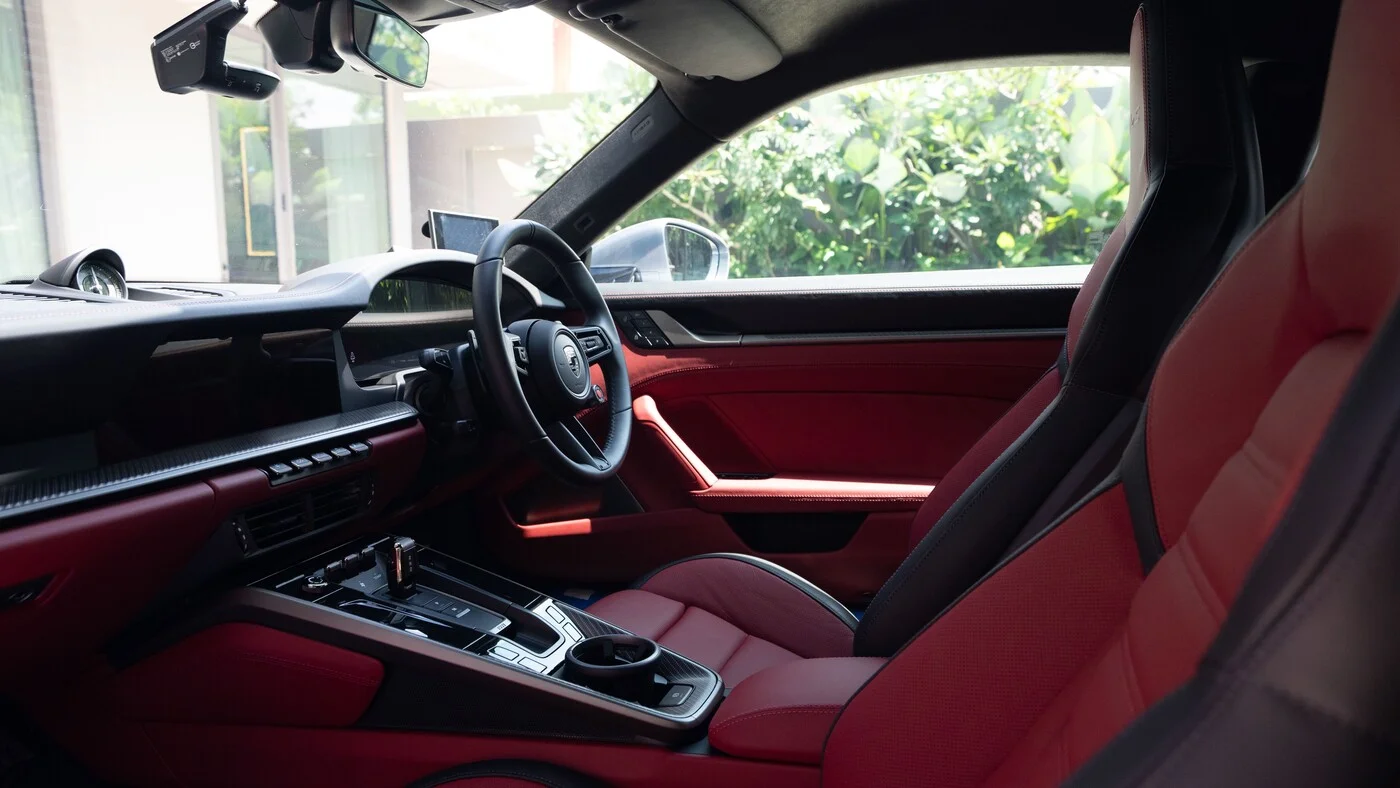
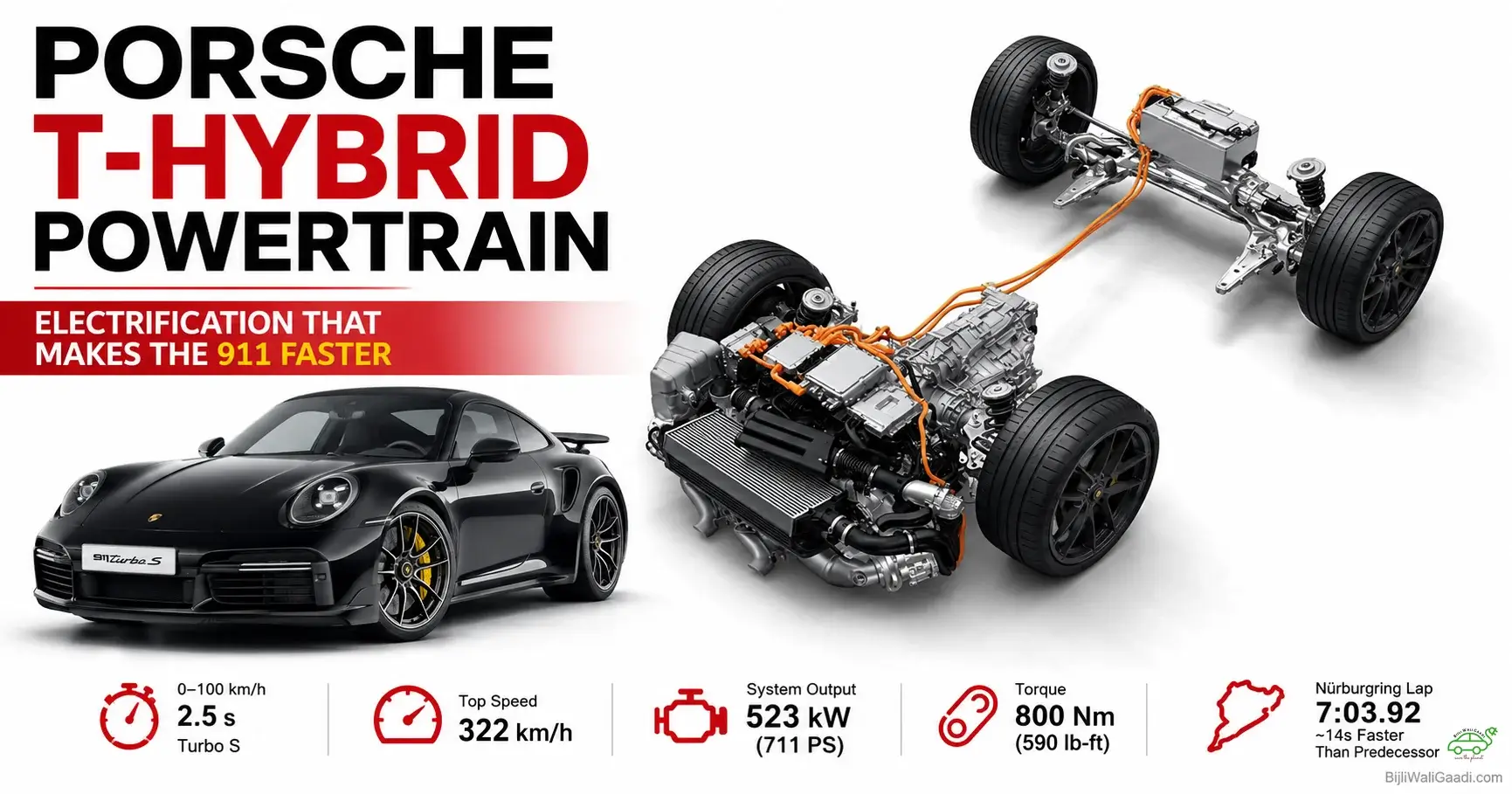
In the 911 Carrera GTS, T-Hybrid lifts combined system output to 398 kW (541 PS) and 610 Nm, a gain of 45 kW over its non-hybrid predecessor, enabling a 0–100 km/h time of 3.0 seconds with the Sport Chrono Package and a top speed of up to 312 km/h.
The 911 Turbo S takes the architecture further with its twin-eTurbo layout, producing a system output of 523 kW (711 PS) and 800 Nm (590 lb-ft) of maximum torque, good for 0–100 km/h in 2.5 seconds, 0–200 km/h in 8.4 seconds, and a top speed of 322 km/h. Porsche says a lightly camouflaged 911 Turbo S completed the Nürburgring Nordschleife in an officially documented 7:03.92, around 14 seconds faster than its predecessor. The shared thread across both cars isn’t just the headline numbers — it’s that torque now arrives with far less delay relative to driver input, and stays consistent for longer, because the electric turbo isn’t waiting on exhaust gas to do its job.
Weight: The Most Important Compromise
Adding two electric motors, power electronics and a battery to a 911 should, by conventional hybrid logic, mean a meaningful weight penalty — precisely the enemy of a rear-engined sports car built around agility and a specific weight balance. Porsche’s own figures suggest the trade-off has been kept unusually small: the T-Hybrid 911 Carrera GTS is only 50 kg heavier than its predecessor, and the far more powerful, all-wheel-drive 911 Turbo S carries an 85 kg increase despite gaining a second eTurbo, a strengthened PDK, and the electro-hydraulic chassis control the system’s electrical architecture makes possible.
That the Turbo S is faster around a lap despite the added mass is the more telling data point than the weight figure alone. It suggests the additional hardware isn’t simply tolerated — it’s actively paying for its presence through the responsiveness and traction gains it enables. The new Turbo S also combines its T-Hybrid electrical architecture with an electrohydraulically controlled roll-stabilisation system, ehPDCC, which contributes further to its cornering composure and agility.
T-Hybrid vs Conventional Hybrid Systems
A conventional hybrid is typically designed to prioritise fuel economy, lower emissions and a degree of electric-only driving, often using a larger battery to sustain that capability. A plug-in hybrid extends this further with external charging and meaningfully longer EV range, usually at a real cost in weight and packaging. T-Hybrid pursues neither goal directly. Its battery is deliberately small, there is no charging port, and there is no electric-only driving mode. Instead, every component is sized around one priority: making the combustion engine respond and deliver power more effectively, with the resulting efficiency gains treated as a welcome secondary outcome rather than the design brief.
What T-Hybrid Means for the Future of the 911
T-Hybrid reads less like a step toward electric replacement and more like a demonstration that electrification can be used to preserve, and even sharpen, the character of a combustion-driven sports car rather than dilute it. Its motorsport lineage — Porsche has drawn a direct line to the hybrid systems developed for its 919 Le Mans programme — suggests this is less an experiment and more the maturation of a philosophy the brand has been developing for over a decade.
Whether this specific architecture becomes the long-term template for future 911 variants, or one waypoint among several as Porsche balances performance, regulation and eventual deeper electrification, isn’t something the current record settles either way. What is clear from the GTS and Turbo S applications so far is that a small battery and a pair of well-placed electric motors can do more for a turbocharged engine’s character than a much larger, heavier hybrid system ever could.
Frequently Asked Questions
Stay connected via Google 'Electric Vehicle' News
Follow BijliWaliGaadi | India's Trusted EV Insights Portal
source on Google