BYD Yangwang U7 Battery Retains 98.7% Capacity After 30,000 km and 350+ Flash Charges
Stay connected via Google 'Electric Vehicle' News
Follow BijliWaliGaadi | India's Trusted EV Insights Portal
source on Google
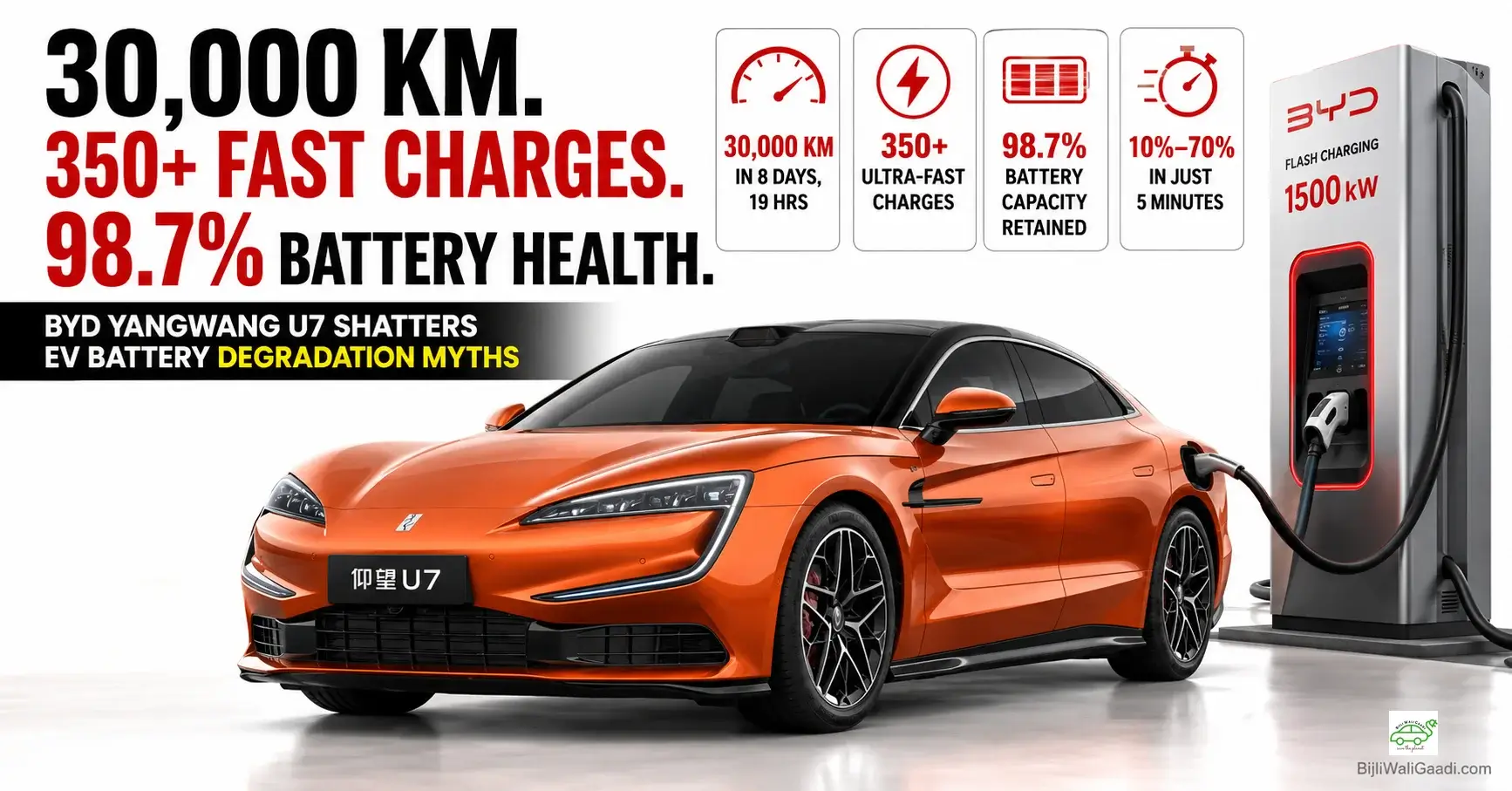
A car that gets fast-charged more than 350 times in nine days should come out the other side with a tired, weakened battery. That’s the conventional wisdom, anyway. BYD says its Yangwang U7 finished the ordeal with 98.7% of its original capacity intact — a loss of about 1.3 percentage points, over 30,000 km of driving and hundreds of ultra-fast charging cycles. It’s a result that runs against everything drivers have been told to fear about repeated rapid charging.
So is this proof that megawatt charging is finally safe for batteries, or a carefully staged number from a company with every incentive to look good? The details are more interesting than either answer.
The 30,000-km Torture Test
According to Yangwang, BYD’s ultra-luxury sub-brand, the test used a standard production U7 pulled at random from a retail store — not a factory-tuned car. It covered 30,000 km in 8 days, 19 hours and 58 minutes on a test track in Nanning, southern China, where ambient temperatures reportedly ran above 36°C with humidity around 80%, and cabin air conditioning was held at 24°C throughout.
The numbers get more vivid when calculated out: roughly 3,400 km per day, and an overall average of about 141 km/h across the full elapsed test duration, including charging stops — not a driving-only figure. Yangwang/BYD separately reported a sustained cruising speed of 240 km/h while the car was actually moving. These are calculations based on the reported figures, not numbers BYD itself published.
The car underwent more than 350 Flash Charging cycles — on average, one every roughly 36 minutes, or about every 86 km. This wasn’t a slow trickle of top-ups; it was sustained, aggressive fast charging. Yangwang says its broader test program covered 758 vehicles accumulating 10.49 million km.
The Surprising Battery Result
For context, battery degradation rates vary widely with chemistry, temperature, charging behavior and mileage — there’s no single “normal” number for capacity loss. What makes the U7 result notable is that it followed hundreds of forced rapid-charge events rather than the slower charging most owners rely on day to day.
It’s also worth being precise about what “350+ Flash Charging cycles” means. BYD’s figure describes charging sessions — plug-in events — not necessarily 350 complete, equivalent full battery cycles. Many stops were likely partial top-ups, so cumulative energy throughput, the metric that actually drives degradation, was probably lower than a 350-full-cycle count implies. That doesn’t make the result less significant, but it’s a different metric.
It’s worth being precise about what this doesn’t mean. It’s a single test, on a single vehicle, reported by the manufacturer — not independently audited, and not a claim about years of real-world ownership. Yangwang’s general manager, Hu Xiaoqing, said the company welcomes independent verification, but as of publication, no third party has replicated the test. Treat 98.7% as a data point about short-term durability under extreme charging load, not a guarantee about the battery’s fate a decade from now.
Why Megawatt Charging Doesn’t Automatically Wreck a Battery
Fast charging is hard on batteries in well-understood ways. Pushing large currents into a cell generates heat, which accelerates side reactions that eat away at usable capacity. At high charge rates, lithium ions can struggle to intercalate into the anode fast enough, raising the risk of lithium plating — a process that permanently strips capacity and, in extreme cases, threatens safety. Current density, cell-level voltage limits and thermal gradients across a pack all compound the problem.
None of that physics disappears just because a car is well-engineered. But it can be managed. BYD’s Blade Battery 2.0 uses lithium iron phosphate (LFP) chemistry, generally more thermally stable and less prone to runaway degradation than nickel-rich chemistries under stress — one reason BYD has leaned on LFP for its fastest-charging models. But chemistry is only one piece; whether a battery survives 350 rapid charges intact has just as much to do with pack architecture, cooling design and battery-management software.
Inside BYD’s Flash Charging System
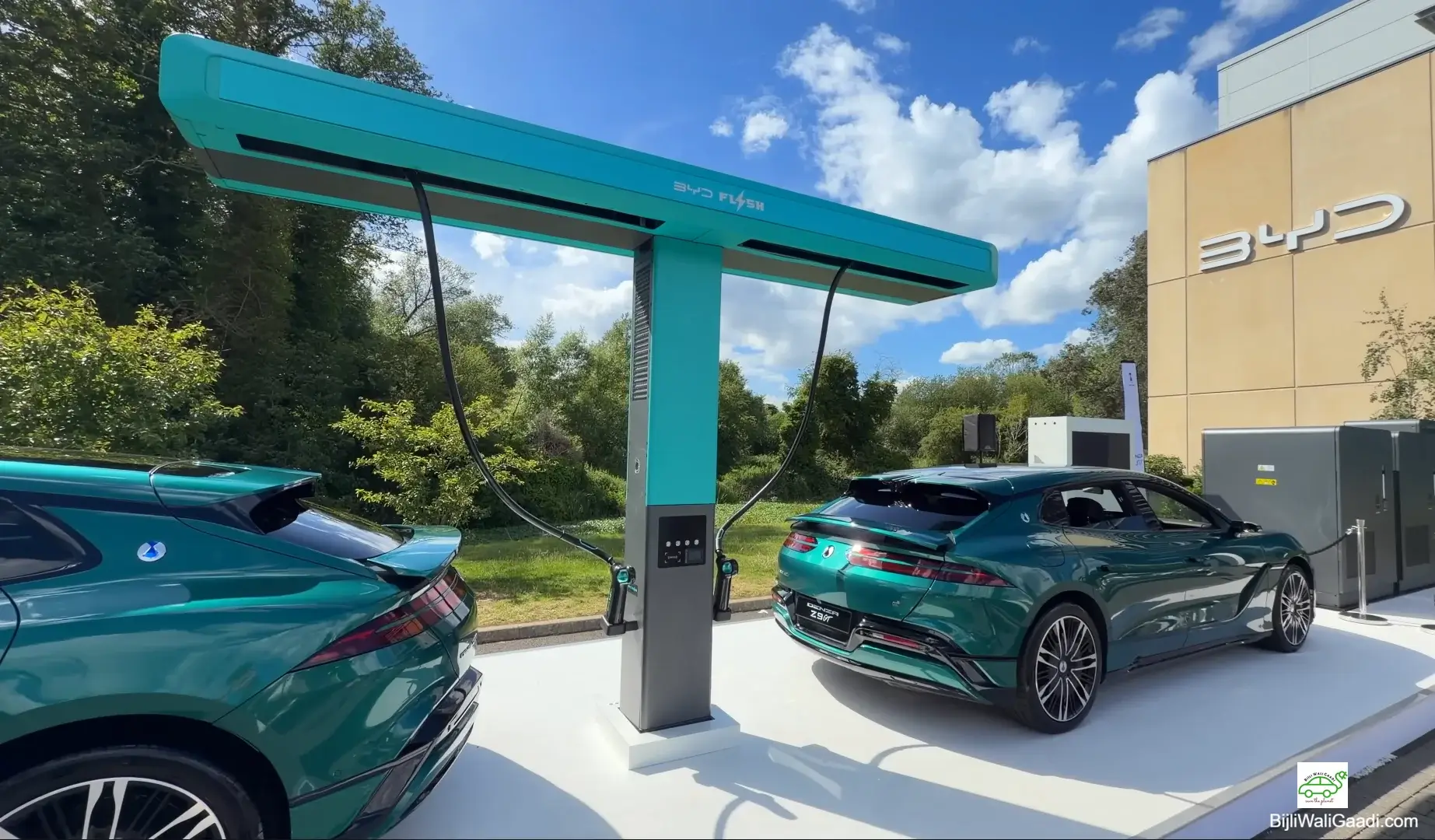
BYD’s Flash Charging network, launched nationally in March 2026, pairs 1,500 kW-capable charging hardware with compatible vehicles built on a 1,000V-class electrical platform — the higher voltage class describes the car’s own architecture as much as the charger. Higher system voltage matters because power equals voltage times current — for a given power level, raising voltage lets engineers reduce current, cutting resistive heating in cables, connectors and the pack itself.
It’s important not to overstate what “1,500 kW” means in practice. That’s the charger’s maximum output, not what the U7 pulled for every session. InsideEVs, citing BYD/Yangwang’s account of the test, reported the car could draw up to roughly 640 kW at points — still extraordinary, but well below the charger’s ceiling. Charging power in any EV tapers with state of charge, cell temperature and BMS limits; the headline number describes the top of a curve, not a flat line. BYD claims the system takes a compatible car from 10% to 70% in five minutes, and 10% to 97% in nine — durations closer to a fuel stop than a coffee break.
China Is Building the Megawatt Charging Network
None of this matters without somewhere to plug in. BYD reached its 10,000th Flash Charging station in China on August 28, 2026, roughly six months after the network’s March launch, spread across some 325 cities, and is targeting 20,000 by year end. It has partnered with Sinopec, China’s state oil giant, to install chargers at existing fuel-station sites — at one Shanghai location, reporting indicates Sinopec removed its underground fuel tanks entirely and converted the site into a dedicated charging hub, rather than simply adding chargers alongside the pumps.
One detail explains how BYD is scaling this without waiting years for grid upgrades: battery-buffered charging. Rather than drawing 1,500 kW directly from the grid, some stations reportedly pull a steadier load — around 100 kW — into an on-site buffer battery, which then discharges at high power to the car. That decouples charger speed from grid capacity, letting BYD put megawatt-class hardware where a direct megawatt grid connection wouldn’t otherwise be feasible.
What This Means for the Global EV Market
The Yangwang U7 is a $95,000-plus flagship, not a mainstream car, and its test conditions were extreme rather than typical. But the shift matters well beyond one model. For years, the EV conversation centered on range — how far can this car go on one charge? BYD’s push, and China’s broader charging buildout, points toward a different question: how quickly can a battery give back the energy it just spent, repeatedly, without quietly shortening its own life?
That question matters for automakers watching 800V and emerging 1,000V platforms, for fleets needing vehicles that charge in minutes rather than hours, and for battery developers deciding where to invest next. It’s also relevant to regulators: Europe’s incoming Euro 7 rules will require new EVs to retain at least 80% of original battery capacity after five years or 100,000 km, whichever comes first — a bar this nine-day test doesn’t directly address, but one the industry will increasingly be judged against.
The Real Takeaway
The 98.7% figure is memorable, but it’s not really the point. The more important story is what it represents: a shift in what engineers are trying to solve. It’s no longer enough to make an EV go far — it now has to accept enormous jolts of energy, repeatedly, without letting speed become a tax on longevity.
Nobody should assume every EV battery can survive what BYD put this one through, or that a nine-day test says anything definitive about a fifteen-year ownership cycle. But if megawatt charging keeps proving itself, the meaning of “refuelling” an electric car may be about to change — from a pit stop you plan around, to one you barely notice.
Stay connected via Google 'Electric Vehicle' News
Follow BijliWaliGaadi | India's Trusted EV Insights Portal
source on Google