Skoda JSW Joint Venture: What the MoU Means for India
Stay connected via Google 'Electric Vehicle' News
Follow BijliWaliGaadi | India's Trusted EV Insights Portal
source on Google
Skoda-JSW JV: What Is Known So Far
| Parameter | Current status |
| MoU | Non-binding |
| Proposed partnership | Strategic joint venture |
| Signatories | Škoda Auto a.s. + JSW Green Mobility Limited |
| Control model | Two-party joint control proposed |
| Vehicle scope | Passenger vehicles |
| Powertrains | ICE, EV, PHEV and hybrid |
| Localisation | Deeper localisation under discussion |
| Manufacturing | India manufacturing under discussion |
| Exports | India and overseas markets |
| 51:49 ownership | Reported structure under discussion; not confirmed |
| Final investment | Not disclosed |
| Definitive agreement | Reported target: end-2026; not final |
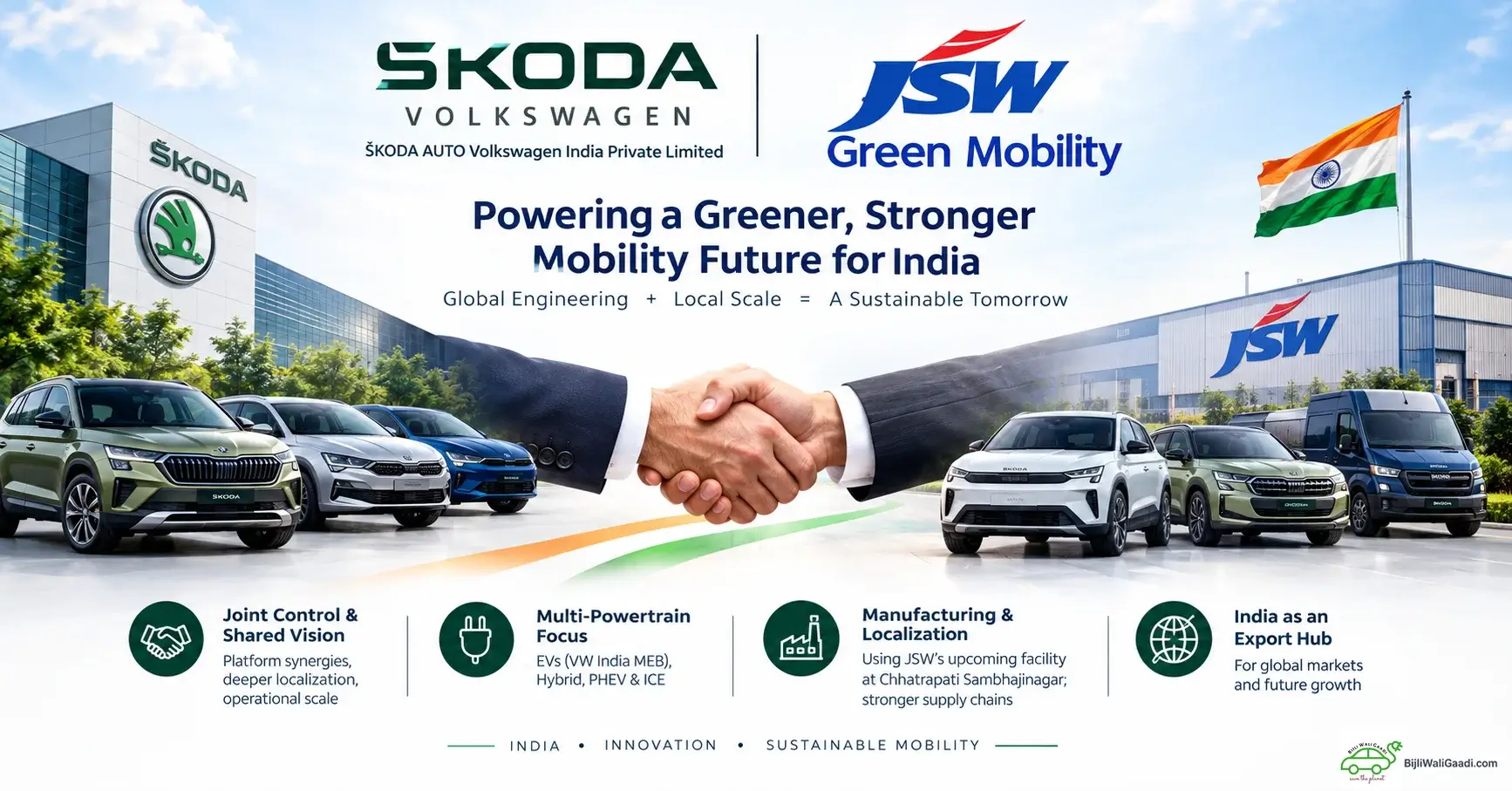
Škoda Auto a.s. and JSW Green Mobility Limited have signed a non-binding Memorandum of Understanding (MoU) to explore a strategic joint venture in India. The proposed Skoda JSW joint venture would explore developing, manufacturing and selling passenger vehicles for India and export markets, spanning internal combustion engine (ICE), electric, plug-in hybrid and hybrid powertrains.
A Škoda Auto Volkswagen India spokesperson described the proposed structure as a two-party partnership built on joint control, with clearly defined roles and mechanisms for swift decision-making. This is not a final agreement. No shareholding split, investment figure or product plan has been officially confirmed, and the companies have said any binding arrangement remains subject to further negotiations, due diligence and regulatory clearances.
What the Skoda-JSW Joint Venture MoU Actually Covers
The MoU commits Škoda Auto and JSW Green Mobility to jointly explore, not to execute, a strategic partnership. A JSW Group spokesperson said the agreement “is exploratory and non-binding” and that “the two companies are in early discussions, and there is no definitive agreement yet.”
The proposed scope, as described by both sides, includes vehicle development, manufacturing, sales and deeper localisation of passenger vehicles for the Indian market and select overseas markets. The proposed partnership also includes strengthening manufacturing and R&D capabilities in India.
Which Vehicles and Powertrains Could the JV Develop?
The proposed venture is not framed as an EV-only initiative. Official statements describe a multi-powertrain scope covering ICE, hybrid, plug-in hybrid and electric vehicles. This distinguishes the Skoda JSW JV from a narrower electric-mobility tie-up and suggests both companies want flexibility across India’s still-diverse powertrain mix.
No specific model, nameplate or platform has been officially named as part of the MoU.
How the JV Could Increase Localisation in India
Localisation is central to the stated rationale. The Škoda Auto Volkswagen India spokesperson said the arrangement is “intended to support competitive product offerings, increased scale, and improved profitability in the Indian market” through deep localisation and platform synergies.
JSW Green Mobility has separately been expanding its manufacturing and EV investments in Maharashtra, including a greenfield facility in the Chhatrapati Sambhajinagar (Auric) region. Earlier automotive trade reporting has discussed these assets in the context of the broader Skoda-JSW talks, but neither company’s MoU-related statements have officially assigned production to a specific JSW plant. Plant allocation, if any, would be a matter for future negotiation.
What the Skoda-JSW Deal Could Mean for Volkswagen EVs
Because Škoda Auto has been responsible for managing Volkswagen Group’s India passenger-car operations, the proposed partnership has implications beyond the Škoda brand. A confirmed Volkswagen JSW joint venture would potentially support Volkswagen Group’s broader India electrification and localisation strategy, not just Škoda’s own product line.
Earlier reporting by Autocar Professional identified the India Main Platform (IMP) as a potential platform for future EV programmes under a JSW partnership. However, IMP is not named in the 9 September MoU announcement and remains a reported element of Volkswagen Group’s wider EV strategy rather than a confirmed component of this specific joint venture.
Could India Become an Export Base for the JV?
Both companies have said the proposed venture could serve India and overseas markets, with exports described as part of the discussion rather than a confirmed commitment. If realised, this could let the venture draw higher volumes from shared manufacturing capacity, though no export markets, volumes or timelines have been disclosed.
What Is Confirmed and What Is Still Under Negotiation?
Confirmed:
- Škoda Auto a.s. and JSW Green Mobility Limited signed a non-binding MoU
- The arrangement is exploratory, not a completed joint venture
- Proposed structure involves two-party joint control
- Proposed scope spans ICE, EV, PHEV and hybrid passenger vehicles
- Localisation, manufacturing, R&D and exports are stated discussion themes
Reported / under discussion — not confirmed:
- A 51:49 shareholding structure, with JSW holding the majority stake. Earlier Autocar Professional reporting said this split was among the options under discussion, but the 9 September MoU statements did not disclose a final ownership split.
- IMP-linked EV programmes as part of this specific JV
- Final investment amount
- Specific plant allocation, including any role for JSW’s Chhatrapati Sambhajinagar facility
- Final product portfolio and platform assignments
- A definitive agreement timeline: industry reports, including Economic Times, have said the MoU moves the parties into exclusive negotiations, with a definitive agreement targeted by the end of 2026. This timeline remains subject to due diligence, approvals and regulatory clearances, and is not a confirmed date.
Why the Skoda-JSW Partnership Matters for India’s Auto Industry
Four themes stand out if the exploratory talks progress toward a binding deal:
Localisation: Greater local sourcing, through JSW’s industrial and manufacturing base, could improve cost competitiveness for Škoda and Volkswagen products in India.
Scale: Combining Škoda’s engineering and product capabilities with JSW’s manufacturing ecosystem could support higher production volumes than either side might achieve independently.
Powertrain flexibility: A scope covering ICE, hybrid, PHEV and EV — rather than an EV-only strategy — reflects India’s mixed-powertrain passenger vehicle market.
Export potential: If finalised, an India-based venture could potentially position the country as a manufacturing base for select international markets, supporting Volkswagen Group’s broader cost and scale objectives.
None of these outcomes are guaranteed at the MoU stage.
What Happens Next for the Proposed JV?
The MoU authorises further discussion, not implementation. Both companies have said a binding agreement would require completing due diligence, finalising valuation and ownership terms, securing internal approvals, and obtaining regulatory clearances. Industry reports, including Economic Times, have pointed to a target of reaching a definitive agreement by the end of 2026, but this remains a reported target rather than an official commitment and is subject to negotiations, due diligence, approvals and regulatory clearances.
Until a binding agreement is signed, the Skoda JSW joint venture remains a proposed, exploratory arrangement.
Stay connected via Google 'Electric Vehicle' News
Follow BijliWaliGaadi | India's Trusted EV Insights Portal
source on Google