Geely’s 2.25 MW Megawatt Charger: 70% in 4.5 Minutes, But What Does Your EV Actually Get?
Stay connected via Google 'Electric Vehicle' News
Follow BijliWaliGaadi | India's Trusted EV Insights Portal
source on Google
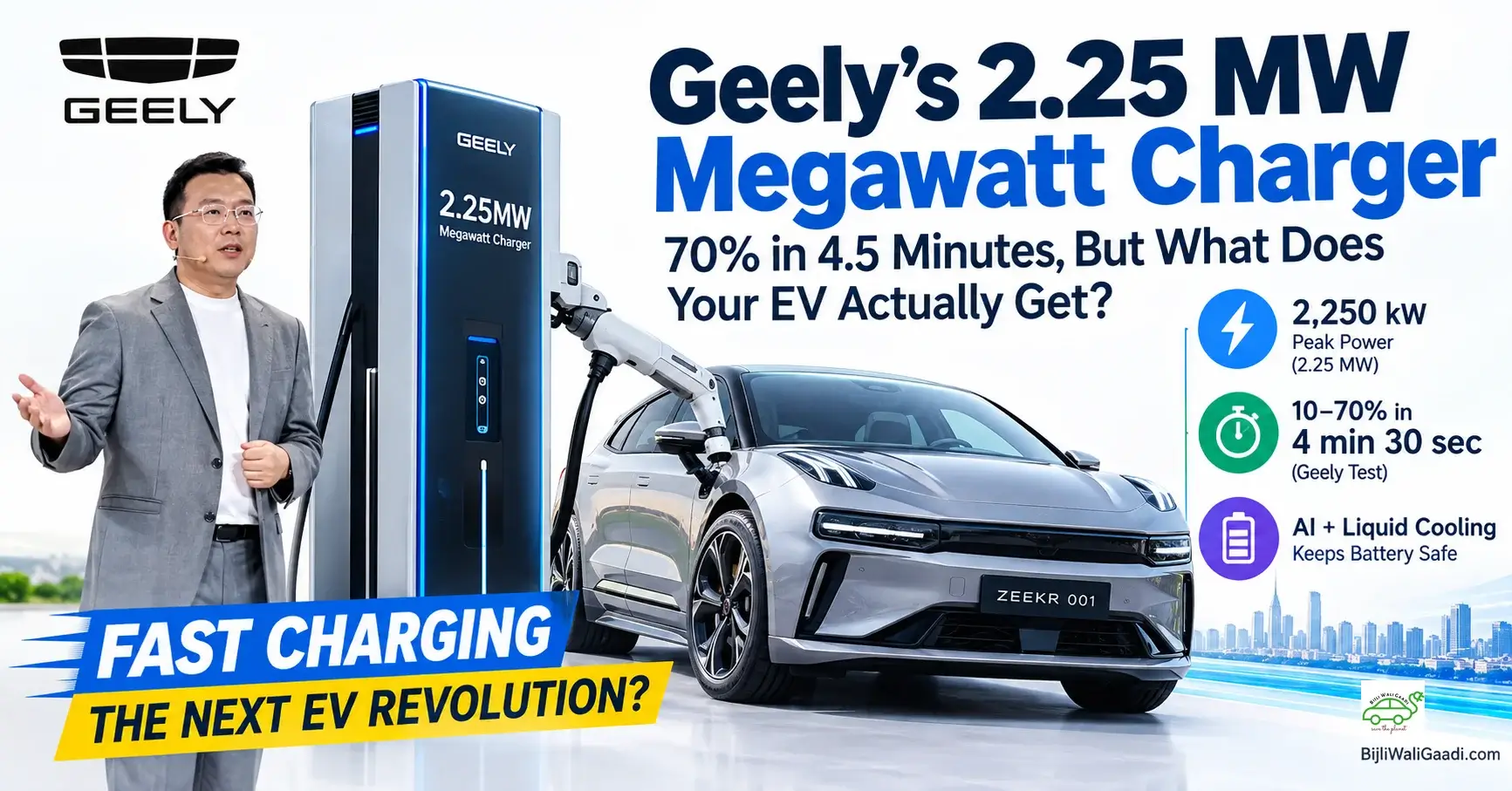
Quick answer: The Geely megawatt charger, officially Geely Smart Charging, is a fifth-generation station with a 2,250 kW (2.25 MW) single-gun peak that Geely calls an industry record. In Geely’s room-temperature tests, it took the Lynk & Co 10 and Zeekr 001 from 10% to 70% in 4 minutes 30 seconds and from 10% to 97% in 8 minutes 40 seconds, with AI managing battery heat, according to Geely.
Geely unveiled Smart Charging at a launch event in Ningbo, China. Below is what the numbers say, how the hardware works, and where the claims deserve a careful read.
Geely Smart Charging at a Glance
| Specification | Detail |
| Official name | Geely Smart Charging (also written “Geely Smart Charge”) |
| Peak power | 2,250 kW (2.25 MW) single-gun peak, according to Geely |
| Measured vehicle peak | About 1,093 kW (CATARC, Lynk & Co 10) |
| Geely-reported test times | 10–70% in 4 min 30 sec; 10–97% in 8 min 40 sec |
| Batteries | Shendun Golden (12C) and Next-Gen Ultra Short Blade (6C) |
| Rollout target | 100,000+ charging points by end-2027 |
What Is the Geely Megawatt Charger?
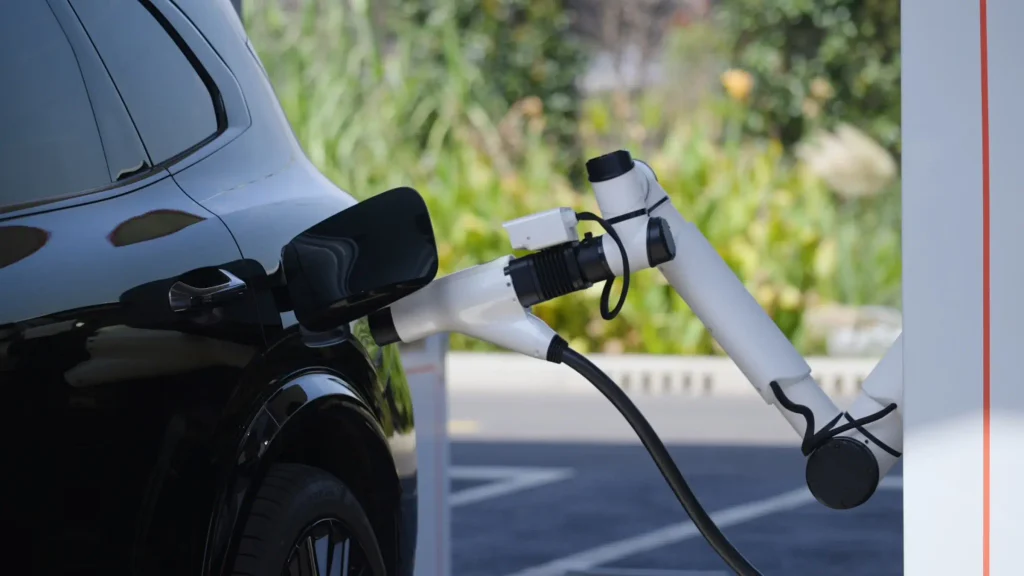
Think of it as a system, not a plug. Geely pairs a 2.25 MW station (with an AI fast-charging function) with its Xingrui PowerMind AI model, high-rate batteries, five-point liquid cooling and a robotic charging arm. Geely describes the result as its fastest production-ready charging performance to date.
How Fast Does Geely Smart Charging Charge an EV? Geely’s Test Results
Geely reports 10–70% in 4 min 30 sec and 10–97% in 8 min 40 sec at room temperature. These are Geely’s published test results, not an independently reproduced consumer test.
| Vehicle | Battery | Window | Time | Conditions |
| Lynk & Co 10 / Zeekr 001 | 12C Shendun Golden (395 mm) | 10–70% | 4 min 30 sec | Room temperature, Geely test |
| Lynk & Co 10 / Zeekr 001 | 12C Shendun Golden (395 mm) | 10–97% | 8 min 40 sec | Room temperature, Geely test |
| Galaxy E5 | 6C Ultra Short Blade (370 mm) | 10–70% | About 8 min 25 sec | Geely’s published figure |
CATARC test data: CATARC (China Automotive Technology and Research Center) tested a Lynk & Co 10 with the technology.
| CATARC metric | Result |
| Peak charging power | About 1,093 kW |
| Time below 55°C (10–97% charge) | 57% of the total charging time |
| Maximum battery temperature | 64°C |
That 64°C maximum stayed below Geely’s stated 65°C peak-temperature limit.
Is Geely’s September Charging Result Faster Than Its April 2026 Test?
The numbers are very close, but the tests are not perfectly comparable. In April 2026, Lynk & Co released test data for a Lynk & Co 10 with a 900V battery, run on Zeekr V4 megawatt chargers, that beat BYD’s flash-charging times.
| Metric | April 2026 test | September 2026 launch |
| 10–70% | 4 min 22 sec | 4 min 30 sec |
| 10–80% | 5 min 32 sec | Not published |
| 10–97% | 8 min 42 sec | 8 min 40 sec |
| Peak power during test | 1,100 kW | ~1,093 kW measured (CATARC); station rated 2,250 kW |
Back in April, power stayed above 500 kW past 80%, but no rollout timeline came with it. September adds the AI layer, the higher-rated station and a rollout plan.
The September figures are broadly in line with April’s demonstration rather than a dramatic improvement, and the different setups mean they should not be compared strictly. That fits what happens at these power levels: heat and cell limits, not the charger’s rating, increasingly set the pace, so extra peak power buys less and less time.
Is Geely’s 2.25 MW Charger a World Record? What Geely Actually Claims
It is a record-class peak claim, with caveats. Geely describes 2,250 kW as an industry record for single-gun peak power. That is roughly 50% above BYD’s 1.5 MW Flash Charging 2.0.
Read it with few caveats:
- Peak is not average. 2,250 kW is the station’s rated peak; CATARC measured about 1,093 kW at the vehicle, less than half. Do not read 2.25 MW as what an EV actually receives.
- Power is not the whole story. Some rival systems, including CATL’s third-generation Shenxing battery, are reported to post quicker times, and returns shrink at megawatt levels. Peak power alone does not decide charging speed.
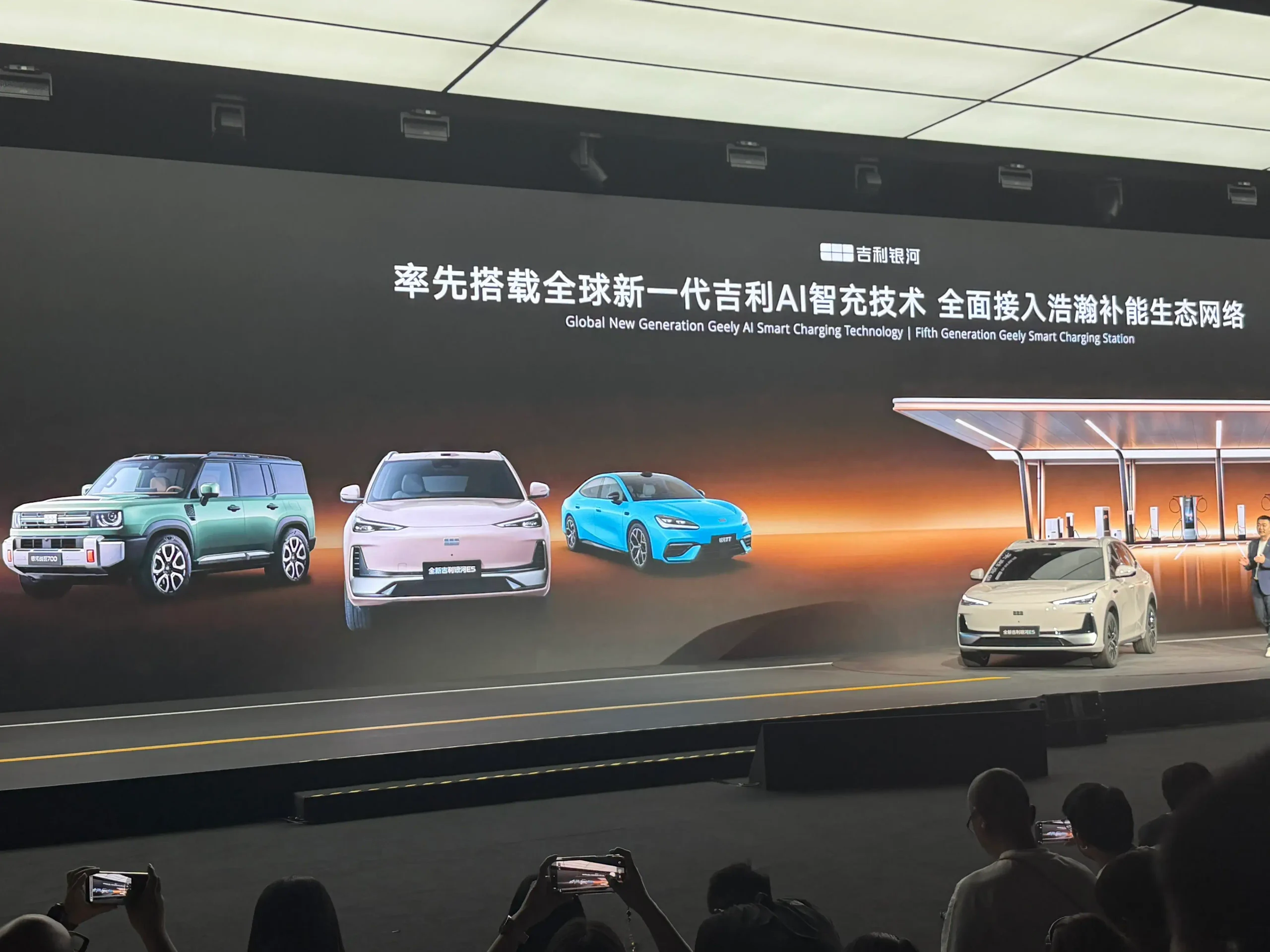
2.2 MW | ~4-minute charges | Haohan network ready
How Does Geely’s AI Keep the Battery Safe at 2.25 MW?
At megawatt power, heat control matters as much as delivery. Geely tackles it in layers.
| Layer | What it does |
| Xingrui PowerMind | Coordinates vehicle, battery, station, cloud, grid and energy storage in real time |
| Charging profiles | Extreme Charge, Smart Charge and Auto Charge |
| Predictive cooling | Forecasts battery temperature up to 30 seconds ahead and adjusts power before heat builds |
| Per-vehicle strategy | Adjusts peak current, cooling intensity and charging duration for each vehicle and battery |
| Thermal limits | Average below 55°C (131°F); peak below 65°C (149°F) |
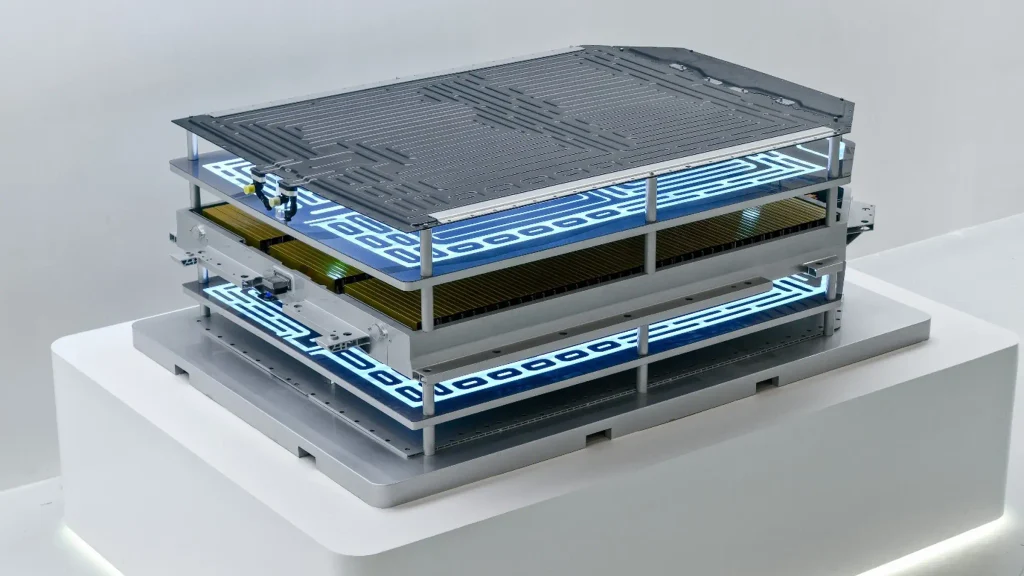
| Five-point liquid cooling | Charging-station energy-storage battery, charging pile, charging cable/gun, charging port and battery pack |
| Pulse restoration | Micro-pulse currents reactivate lithium ions built up on negative electrodes during fast charging |
| Home charging mode | Low-rate strategy that gradually repairs fast-charging degradation |
Battery life claim: Geely says the combined AI charging management and pulse-restoration technology can increase battery cycle life by 20%. Geely has not explained what each of the three profiles does.
Which Batteries Power Geely’s 2.25 MW Smart Charging?
C-rate compares charging current with battery capacity, so a higher number means faster charging.
| Battery | Peak rate | Size | First vehicles | Key feature |
| Shendun Golden | 12C | 395 mm | Lynk & Co 10, Zeekr 001 | Built for ultra-fast charging |
| Next-Gen Ultra Short Blade | 6C | 370 mm | Galaxy E5 | Laser-welded cell tabs and covers cut charging heat by 10% |
Geely says the Ultra Short Blade targets affordable models. In Chinese-market material you may also see the Shendun name rendered as “Aegis Golden Brick”.
What Does Geely’s Robotic Charging Arm Do?
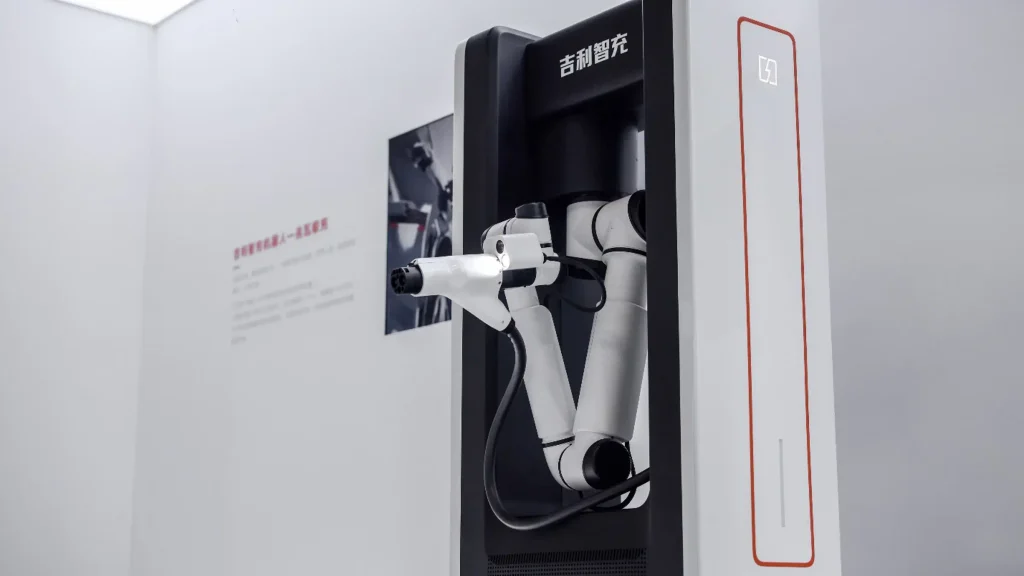
Geely showed an automatic robotic charging arm at the launch. It plugs the connector into the vehicle without the driver handling the cable.
Which Cars Support Geely Smart Charging?
| Vehicle | Status |
| Lynk & Co 10 | Used in Geely’s tests (12C pack) |
| Zeekr 001 | Used in Geely’s tests (12C pack) |
| Galaxy E5 | Updated model shown at launch (6C pack) |
| Geely TT, Zhanjian 700 | Named by Geely’s Kevin Chen, with the E5, as the first cars in China able to use AI Smart Charging |
Geely vs BYD: How Do Their Megawatt Charging Systems Compare?
| Feature | Geely Smart Charging | BYD Flash Charging 2.0 |
| Peak power (stated) | 2.25 MW | 1.5 MW |
| 10–70% | 4 min 30 sec | About 5 minutes |
| 10–97% | 8 min 40 sec | About 9 minutes |
| Infrastructure | 100,000+ points targeted by end-2027; 50,000+ Smart Charging units | 10,000 Flash Charging stations in China as of Aug. 28, 2026; 20,000 targeted by year-end |
| Longer-term network | Coverage of every county in China | Deutsche Bank, citing BYD management, says 90,000 stations by 2028 |
| Europe | Not announced | 3,000 Flash Charging stations planned; nearly €2 billion for five-minute stations |
| AI management | Xingrui PowerMind | Not detailed at Geely’s launch |
| Cold-weather data | Not published | 10–97% in 12 minutes at −30°C (BYD-reported) |
BYD currently has the larger publicly reported Flash Charging network. Geely’s 2027 target and BYD’s current count use different timelines, and companies may count stations, guns or connectors differently, so compare them carefully. In practice, a fast charger only matters if drivers can find one, which is why station count matters as much as charging speed. BYD has a stated target of 20,000 Flash Charging stations in China by the end of 2026.
What Are Geely’s Charger Rollout Plans, Owner Incentives and Battery Warranty?
- Network: over 100,000 charging points by the end of 2027, with more than 50,000 Smart Charging units, covering all Chinese counties.
- Owner credit (Geely’s announced policy): first-time buyers of eligible new models get 1,000 yuan (about $150) a year for two years, a total of 2,000 yuan (about $300), for vehicles bought before January 1, 2028.
- Warranty: battery cover rises from 8 years/150,000 km to 8 years/200,000 km for new and existing eligible models.
Why Does Geely’s Megawatt Charging Push Matter for the EV Industry?
Geely, BYD and CATL have spent about 18 months leapfrogging each other on charging speed. China’s EV price war pushes them to win on technology instead of price cuts.
The pressure is real: China’s domestic passenger-vehicle sales had fallen for 11 consecutive months through August 2026, according to CPCA data.
The battery angle is just as important. Geely’s new packs are part of a drive to reduce reliance on CATL. CATL remains the largest battery supplier in China, while BYD and other Chinese battery makers also hold significant shares of the LFP market. Geely, BYD and CATL have all indicated 2027 timelines for pilot or small-scale solid-state battery production or testing, not mass-market availability.
What Is Still Unknown About Geely’s Charging Claims?
- Independent verification of the 4.5-minute result outside Geely’s own test conditions.
- Cold-weather performance, since tests were at room temperature. BYD has published a −30°C result; Geely has not.
- What each PowerMind profile does.
- Station pricing and availability outside China.
Geely Smart Charging FAQs
–
Stay connected via Google 'Electric Vehicle' News
Follow BijliWaliGaadi | India's Trusted EV Insights Portal
source on Google